Origins of the Martin L. King, Jr. Federal Holiday

flickr photo by Julian Fong

flickr photo by Julian Fong

By Darius Wood

Martin Luther King, Jr.’s birthday is one of the ten federal holidays, and only one of two federal holidays that is for an individual – Washington’s Birthday is the other. “President Ronald Reagan signed the King Holiday Bill into law on Nov. 2, 1983,” but the foundation for the bill was laid in the decade’s prior, spearheaded by King’s wife, Coretta Scott King.  As most know, Martin Luther King, Jr. rose to national acclaim for his nonviolent civil disobedience approach to racial and social justice issues facing the African American community. Shortly after Dr. King’s assignation on April 4, 1968 Congressman John Conyers Jr. introduced the first bill to make King’s Birthday, January 15, a federal holiday.  This attempt failed, but the effort persisted; in 1971 the Southern Christian Leadership Conference presented a petition to Congress containing 3 million signatures.  Unfortunately, this attempt too failed. In 1979, Mrs. King, testified before the Senate and a joint session of Congress in support of the Martin Luther King, Jr. national holiday leading President Carter to urge Congress to pass a bill making Dr. King’s birthday a national holiday.  This bill fell short by 5 votes in the U.S. House of Representatives. However, the momentum continued and in 1980 Stevie Wonder released a song, “Happy Birthday,” celebrating Dr. King’s legacy.  Later in 1982, Mrs. King presented another petition containing 6 million signatures to their representatives.  The next year, in 1983 the House of Representatives finally passed the bill by 338 to 90, making the third Monday in January a national holiday.  The Senate then passed the bill by a vote of 78-22. President Reagan signed Public Law 98-144 establishing the Martin Luther King, Jr. National Holiday, beginning in 1986. Sources:

Interview Season is Upon Us, or Not All Those Who Wander Are Lost

by Murtaza Khwaja

image by flickr user petur-t

image by flickr user petur-t

The Judicial Clerkship Job Fair and the Public Sector Job Fair are both coming up in the next few weeks, and 1Ls are finally able to join the rest of us in applying for upcoming jobs, internships, and/or other positions.

While this will be the 1Ls’ first foray into the legal job market, the rest of us have a little more experience.  However, all of us are faced with the same questions: What do we want to do with our law degree? Where do we want to work? Where do we see ourselves after graduation?

Now, I am sure several of us may have answers to some and maybe all of these questions but for many of us, myself included, internal conflict over a variety of issues remains.

Some of these conflicts come from seemingly having too many interests — from criminal law to international human rights to family law to intellectual property to health law, etc. Any experience I have had in the study or practice of any of these fields has been both exceedingly informative and enjoyable. In the long run however, it seems prudent to become more specialized or at least make my job search more specific instead of feeling as if I am haphazardly applying to too broad a scope of positions.

Other questions exist as well.  Questions like: Is this organization/firm/group the best fit for me individually? How far is too far for a commute? Are there snacks? Okay maybe the last one is just me, but in all seriousness I know that we all must have some uncertainty as we prepare to take the next step in our legal careers.

And that’s okay! I might still be figuring it out, but I know that with self reflection, consultation with both family and friends, and a degree of chance I will end up in the right place for myself.  Or at least that’s my own belief borne out of my faith in things working out the way they are meant to as long as I do my part.

For those facing similar dilemmas, please feel free to share your own experiences and how you are dealing with them/are planning to deal with them. For those unsure, definitely reach out to GSU’s Career Services, professors, and/or your own family and friends. Career Services will give great professional advice but do not discount advice from loved ones. At the end of the day, these are the people that know you best and thus, in all likelihood, will remind you of who you really want to be and what you really want to do. Professors are also great to talk to due to their vast amount of experience in a wide array of fields. All of these resources can help in their own way, and ultimately you will forge your individual path.

In the meantime, best of luck with the new semester, and any upcoming interviews or applications. With hard work, faith, and the right people in our lives, I am sure we will not only find the best fit for us but also create our own place in the world as we set out into the next stage of our lives.

The Law Library, RFID, and You

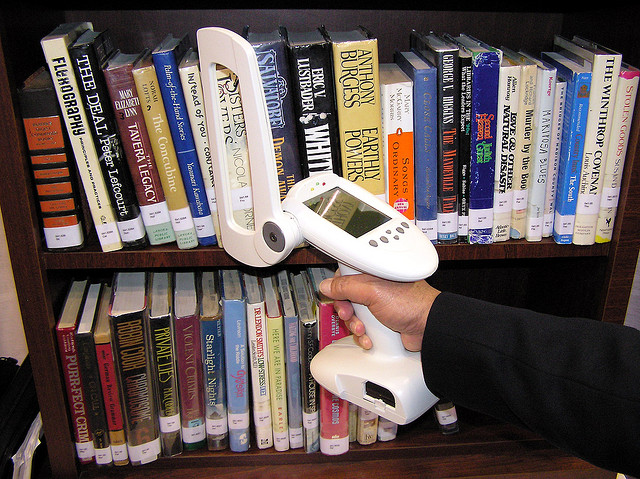
Photo of RFID shelf reader.

Photo by Michael Porter.

Starting tomorrow, January 14th, workers will be going around the library, taking books off of shelves, hopefully not making all that much noise, and in general just doing, well, stuff in the library. What are they doing?

As a part of our move to the new College of Law building, the Law Library is implementing a new system of keeping track of our books using RFID. RFID (which stands for “radio frequency identification”) involves marking each book with a tag that contains a small memory chip. The tag contains information unique to each book that can be read using specialized equipment.

What does this mean for you? Well, many things on the surface won’t change – you’ll still need to check books out at Circulation, and the gates will make noises if you go through them with a book that wasn’t checked out. But an RFID system will help us keep track of what we have more efficiently, particularly if something gets misplaced. For example, if a book isn’t where it’s supposed to be on the shelf (which, yes, does happen, despite our best efforts), we will be able to use a scanner to scan the shelves for the book. We can also check the shelves more efficiently to make sure that everything is where it’s supposed to be. The result is a library where everything is more organized and easier to find. And isn’t that the way a library should be?

We’re aware that this project will result in a bit of noise, but we believe it will be minimal and confined to relatively small areas of the library at any given time. Have questions? Feel free to ask Terrance Manion, the College of Law’s Director of Information Technology.

The Adventures of James Bond and the Public Domain

image by flickr user cronncc

image by flickr user cronncc

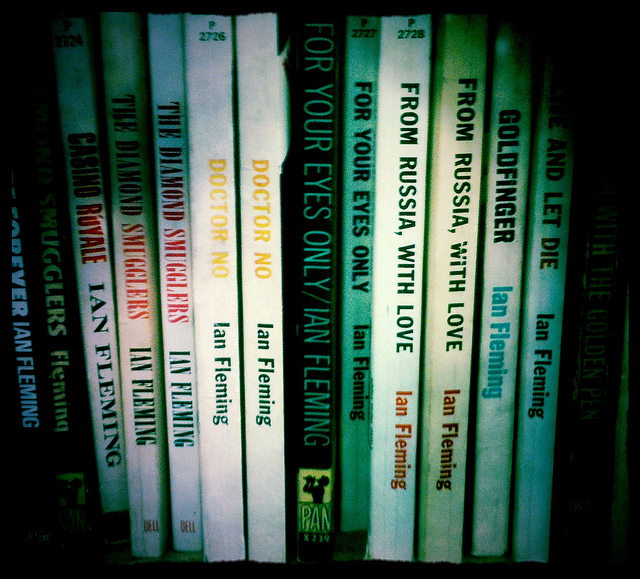
January 1, 2015 was a momentous day — not because it was the start of a new year, but because it saw the works of Ian Fleming, the creator of James Bond, enter the public domain in Canada and a few other countries.

Now, before you start filming your own Bond movie or releasing the books for free in Kindle format for your friends to read in class, remember that the intricacies of copyright law mean that the books are not in the public domain here in the US, and nothing that is unique to the movie versions is in the public domain in any country. i09 has a succinct write up that covers the basics.

If you’d like to learn more about the public domain, the Berne Convention, or international copyright law in general, the GSU libraries have a good selection from which to choose. The University Library also has books about Ian Fleming and a few of the Bond books/movies, including the under-appreciated Quantum of Solace.

“Do you expect me to talk?”

“No, Mr. Bond, I expect you to live on in popular culture for years to come!”

Remembering Nancy Johnson

Law Groundbreaking Lunch 14-0090

Nancy Johnson and Dean Steve Kaminshine at the groundbreaking ceremony for the College of Law’s new building

The College of Law and the profession of law librarianship was hit by a tremendous loss this week. Nancy Johnson, who retired as Associate Dean for Library and Information Services and Professor of Law in 2012, passed away on December 13, 2014. She began working at the GSU Law Library in 1982 and was an integral part of the development of the College and Law Library. Her impact began with some of the first students in the College of Law and continues in the future with the design of the new building.

While her importance is well-known to the College of Law community, she also had a profound influence on the profession of law librarianship. Throughout her career, Nancy inspired and nurtured entire generations of law librarians. She mentored law librarians on research, teaching, scholarship, management, and often personal life issues.

For more information about Nancy and a Celebration of Life on December 21, 2014, please see the College of Law announcement.

We would like to create a space where people can leave memories of Nancy and how she touched their lives and careers. Please contribute your thoughts in the comments field.

Legal Writing Resources

flickr photo by Garry Wilmore

flickr photo by Garry Wilmore

In addition to exams, the end of a law school semester also signals the time when research projects and papers are due. The best legal writers are clear, thorough, and concise. The following are a list of resources that will help you become a more effective legal writer.

Blogs & Articles

Exercises 

GSU Law Library Research Guides 

Executive Orders

medium

flickr photo by Scott Ableman

Interest in executive orders has risen over the past few weeks in light of President Obama’s move to use an executive order to grant around 5 million undocumented immigrants relief from deportation (CNN).

Black’s Law Dictionary defines an executive order as “An order issued by or on behalf of the President, intended to direct or instruct the actions of executive agencies or government officials, or to set policies for the executive branch to follow” (9th Edition). Vivian Chu and Todd Garvey note in their Congressional Research Service Report, Executive Orders: Issuance, Modification, and Revocation, that executive orders are one of various instruments, including presidential memoranda and presidential proclamations, that the President can use to implement policy (CRS Report RS20846, Page 1).

Chu and Garvey explain in their report that “executive orders are generally directed to, and govern actions by, Government officials and agencies” (CRS Report RS20846, Page 1). Furthermore, executive orders generally only have an indirect effect on private individuals (CRS Report RS20846, Page 1).

For more information on the authority of the President to issue executive orders, limitations, and revocation and modification of executive orders, read Chu and Gravey’s CRS Report.

You can locate executive orders for online using the following resources:

  • Whitehouse.gov: The current administration’s executive orders.
  • National Archives: Executive orders from 1937 (Franklin D. Roosevelt) – Present (Barack Obama).


Thanksgiving Week Hours

image by Flickr user alasam

image by Flickr user alasam

The library will have shortened hours during the week of Thanksgiving break. They will be:

  • Monday & Tuesday, Nov. 24 & 25 – 8 a.m. to 9 p.m.
  • Wednesday, Nov. 26 – 8 a.m. to 6 p.m.
  • Thursday – Saturday, Nov. 27 – 29 – Closed
  • Sunday, Nov. 30 – 10 a.m. to 11 p.m. (regular hours resume)

Have a wonderful break!

True Privacy? Touch ID & Biometric Fingerprint Readers

flickr photo by Kārlis Dambrāns

flickr photo by Kārlis Dambrāns

By Darius Wood

Biometric Fingerprint readers like those found on the new iPhone 6 and Samsung Galaxy S5 have become major selling point in terms of protecting privacy, but they may be providing a false sense of security.

It has already been show that these fingerprint readers are imperfect and are capable of being hacked.  See: Galaxy S5 hacked, iPhone 6 hacked

Further, a phone secured with a fingerprint scan may not be protected from the government. The Fifth Amendment protects against compelled self-incrimination, not the disclosure of private information. Virginia Federal Circuit Judge Steven Frucci ruled last month that unlike passcodes, which are protected by the Fifth Amendment, fingerprints are not.

The judge said that providing your fingerprint does not communicate knowledge like disclosing a password, instead, it is similar to a providing a key or DNA, which are both legal.  The judge granted a motion to compel a fingerprint that would allow the government to search the defendant’s phone but denied the motion to compel the defendant’s passcode.

Judge ruling on Motion to Compel 

Pleasure Reading?

by Meghan Starr

image by flickr user pedrosimoes

image by flickr user pedrosimoes

If you’re thinking about what to do over the break, have you considered reading?

No, seriously.  Think about finding and reading a book FOR FUN!

In this month’s ABA Journal, Bryan A. Garner talks about a common problem for lawyers (and law students) – losing the ability to enjoy a good book.  The volume of reading in law school coupled with what is often poor legal writing make it easy to get in the habit of skimming for the main idea or relevant facts. Do you really read the citation strings that come in the middle of a paragraph?

If you feel guilty about picking up the latest Janet Evanovich or James Patterson, rest assured that many law professors think it is important for your professional, as well as personal, development.  Reading books targeted to a general audience can help you develop a more natural writing and storytelling style that can come in handy when trying to persuade a judge or jury.  The classics can help show you the power of language.

If you have already fallen victim to the syndrome and treat Gray Mountain as if it were written by Judge John Grisham, then try these tips:

  • Listen to audio books to force you to hear every word.
  • Try short stories: you may feel less need to rush through.
  • Read aloud: Not only will you absorb the content, but you will also be aware of the rhythms of the language.

I am fortunate enough to have a son that still loves to sit and read with me.  We have been reading Hatchet by Gary Paulsen out loud together over the last month.  We get to sit and snuggle, talk about the plot, and discuss the words Paulsen uses.  My personal tip – find a reading partner.

To read the article in its entirety, you can find it in the November issue.