Abraham Lincoln, Attorney at Law

flickr photo by roxweb

flickr photo by roxweb

Back on this day in 1908, the 16th President of the United States of America was born in Hardin County, Kentucky. Abraham Lincoln is regarded as one of the greatest U.S. Presidents of all time. He is also well known for the Emancipation Proclamation and the Gettysburg Address. But did you know that he was a lawyer in Illinois prior to becoming President?

At 29, he was admitted to the Illinois Bar (Richards 16). At the time of his admittance, he was in his second term in the Illinois legislature (Richard 19). Lincoln would go on to try a variety of cases, many in front of the Supreme Court of Illinois (Richards 19, 22). He also tried many cases in federal trial courts latter in his practice (Frank 7). Lincoln would eventually argue a case before the Supreme Court of the United States (Frank 79). The case was Lewis v. Lewis, 48 U.S. 776 (1849), which was cited in footnotes of a case as recently as 1999, Rogers v. U.S., 180 F.3d 349 (1999). You can  locate the transcript of Lewis v. Lewis using Making of Modern Law: US Supreme Court Records and Briefs, 1832-1978, located on the Law Library’s Database List.

One of Lincoln’s most well known cases was People v. Williams “Duff” Armstrong (1958), also known as the “Almanac Trial” (Steiner 46). A witness in the Almanac Trial testified that he was able to see Armstrong strike the fatal blow “because the moon was high overhead” (Stiener 46). Mark Steiner states that Lincoln “helped secure an acquittal for his client by producing an almanac for the year that showed the moon was near the horizon at that time of night” (Steiner 46).

For further information about the life of Lincoln and his background as a lawyer, consult the following sources:


Clinical Opportunities

10419609_10155143114463125_6181435800920296402_nBy Andrew Vazquez

Starting in the 2015 Fall semester, the in-house clinics will expand from 3 credit hours to 4. This includes the Philip C. Cook Low-Income Taxpayer Clinic, Health Law Partnership (HeLP) Legal Services Clinic, and the Investor Advocacy Clinic.

On Wednesday, February 11, 2015, from 12 PM – 1 PM and 5 PM – 6 PM, the College of Law will be hosting an experiential fair to inform students about the clinics. This event will be held in the second floor lobby and will feature representatives from each of the clinics. This is a good opportunity to ask the professors and students any lingering questions you have about the clinics.

As a former Tax Clinic student I can attest that it is well worth the time to join. Clinics are great because they allow you to put to practice what you have learned in the classroom and put it to actual use. Also, you are able to help real life clients and make a real difference. In the Tax Clinic, for example, I was able to help resolve tax issues that my clients had with the IRS. This included writing legal briefs, negotiating with representatives from the IRS, learning how to interact and interview clients, and file and time management. Even if you realize that you have no interest in tax or health law, the clinics still help you develop the skills that are important to being a lawyer.

When you get into the clinic and have to start doing research, make sure you check out the Law Library’s Research Guide to help you through it!


Upcoming Events

Clinic and Experiential Course Awareness Fair February 11: 12 PM – 1 PM & 5 PM – 6 PM
Tax Clinic Information Session February 12 : 12 PM – 1 PM
HeLP Clinic Information Session February 17: 12 PM – 1 PM
Tax Clinic Open House February 19: 11:45 AM – 1:15 PM
Investor Advocacy Informational Session February 25: 12 PM – 1 PM

New Library Databases

image by Flickr user x-ray_delta_one

image by Flickr user x-ray_delta_one

The law library has recently purchased several new databases that you might be interested in using. Links are included for both on campus access and off campus access for Georgia State Law students and faculty.

  • ABA Law Library Collection Periodicals – This collection is part of our HeinOnline subscription and provides full-text versions of more than 100 ABA magazines. This includes current issues, as well as past ones, of dozens of magazines previously only available to ABA members. On Campus | Off Campus (available to all GSU community members)
  • Art Law & Cultural Property – This is actually two collections, one which covers ownership and export legislation from dozens of countries, and one which covers case law addressing art theft, fraud, and breach of contract, and other related topics. On Campus | Off Campus
  • Leadership Library Online – This powerful tool provides information about employees of law firms, government agencies, media outlets, and more. It’s a great tool for your job hunting. On Campus | Off Campus

These are just a few of our more recent database purchases. Keep an eye on our Legal Databases page for more updates. Have a suggestion for a database we should purchase? Let us know!

Smile!

by Meghan Starr

Image from Wikimedia Commons

Image from Wikimedia Commons

Photographers will be making the rounds next week (February 9th – 15th) in an effort to document how the law school building is being used.  Student volunteers will be taking approximately 100 pictures each hour.

This Photographic Survey is part of a 3-year research project to evaluate the impact of the new building on law students and faculty, as well as the community in general.

We’re still in need of law student volunteers too, especially after 4 p.m. on weekdays and on the weekend. If you are a law student and wish to volunteer, each shift will follow a set route which takes approximately 30 minutes to complete.  You will be provided with a map that reflects each photograph location.  For each shift you take, your name will be entered into a drawing for a (yet to be announced) prize. To volunteer, submit your name on the Google spreadsheet linked to in your email from Dean Sobelson.

For more information about the project, you can also contact Prof. Doug Yarn.

Articles of Confederation


flickr photo by annalynnc

flickr photo by annalynnc

By Nirvi Shah

On January 30, 1781, Maryland was the thirteenth and final state to ratify the Articles of Confederation, which took effect on March 1, 1781.  In comparison to the current U.S. Constitution, the Articles of Confederation designated less control to a central government, leaving most of the power with state governments.  Due to the need for a stronger central government, the U.S. Constitution replaced the Articles of Confederation on March 4, 1789.

Here are a few books in the Law Library where you can learn more about U.S. History and the Articles of Confederation:

Here are some additional links to online sources:

Keeping up with the 2015 Georgia General Assembly

401px-Georgia-state-capitol-domeWe are already six days into the 2015 Session of the Georgia General Assembly. Even if you don’t have time to venture over to the assembly during this session, you can still keep track of legislation and proceedings using a couple few free and commercial resources.

Legislation Tracking

  • Georgia General Assembly Legislation Advanced Search (FREE): The legislation advanced search will allow users to locate legislation from the current session and past sessions of the general assembly. Once you locate a bill or resolution of interest, click on the number, and you will find information on who sponsored the bill, which committees reviewed the legislation, the first reader summary, the status history, and current and previous versions of the bill.
  • Composite Status Sheets (FREE): The sheets provide a consolidated listing of the status of all bills and resolutions introduced during the session.
  • State Bar Legislative Program (FREE): The State Bar of Georgia’s Legislative Program provides a weekly update on the assembly, as well as information on legislative matters of interest to the Bar or affecting the practice of law.
  • WestlawNext Georgia Bill Tracking (Commercial): This database provides summaries and status information concerning current and recently-ended Georgia legislation. A WestlawNext username and password is required to access this database.
  • Lexis Advance GA Bill Tracking Reports (Commercial): This database contains a summary and legislative chronology of all pending Georgia legislation in the current legislative session. A Lexis Advance username and password is required to access this database.

Viewing Floor Proceedings


Magna Carta is 800 years old

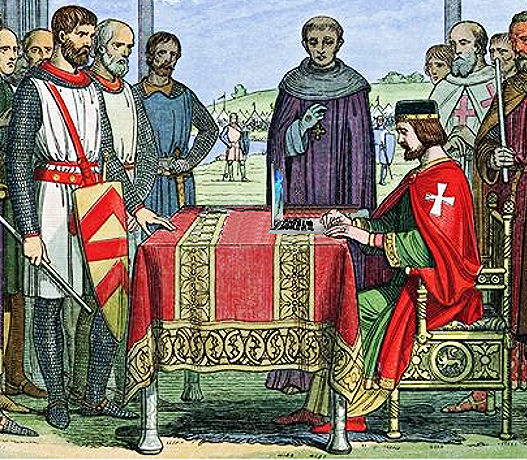
drawing of King John using a laptop to post the Magna Carta to Facebook

King John Posts the Magna Carta to His Facebook Wall, by Mike Licht

The year 2015 marks the 800th Anniversary of the signing of the Magna Carta by King John. The Magna Carta, or the Great Charter of Liberty, is widely viewed as the foundation for individual liberties and the rule of law. The history of the document is storied and murky, including multiple reaffirmations of the principles by monarchs facing an unhappy ruling class and the annulment of the Charter by Pope Innocent III. However, the concept of the liberties outlined in the Magna Carta has persisted through the centuries, particularly in America and Great Britain. America’s Founding Fathers looked to violations of the rule of law by the British king as justification for founding a new country. These ideals of freedom and democracy echo in the Universal Declaration of Human Rights and the European Convention of Human Rights. Even 800 years later, we are still learning about the Magna Carta. Researchers at the British Library preparing for the anniversary recently discovered an account of the sealing of the Magna Carta at Runnymede in an obscure medieval work known as the Melrose Chronicle.

If you would like to learn more about the Magna Carta, Georgia State Law’s Professor Rowberry is organizing a CLE symposium for the Georgia Bar on the meaning of the Magna Carta and its relevance to Georgia. The event will be Monday, March 30, 2015 from 8:15am to 3:00pm at the State Bar of Georgia Conference Center, 104 Marietta St. NW, Atlanta, GA 30303. Symposium attendees will also get to view the American Bar Association’s exhibit on the Magna Carta. More details on the CLE will be available in mid-February. Check the seminar schedule on the ICLE website for more information.

Origins of the Martin L. King, Jr. Federal Holiday

flickr photo by Julian Fong

flickr photo by Julian Fong

By Darius Wood

Martin Luther King, Jr.’s birthday is one of the ten federal holidays, and only one of two federal holidays that is for an individual – Washington’s Birthday is the other. “President Ronald Reagan signed the King Holiday Bill into law on Nov. 2, 1983,” but the foundation for the bill was laid in the decade’s prior, spearheaded by King’s wife, Coretta Scott King.  As most know, Martin Luther King, Jr. rose to national acclaim for his nonviolent civil disobedience approach to racial and social justice issues facing the African American community. Shortly after Dr. King’s assignation on April 4, 1968 Congressman John Conyers Jr. introduced the first bill to make King’s Birthday, January 15, a federal holiday.  This attempt failed, but the effort persisted; in 1971 the Southern Christian Leadership Conference presented a petition to Congress containing 3 million signatures.  Unfortunately, this attempt too failed. In 1979, Mrs. King, testified before the Senate and a joint session of Congress in support of the Martin Luther King, Jr. national holiday leading President Carter to urge Congress to pass a bill making Dr. King’s birthday a national holiday.  This bill fell short by 5 votes in the U.S. House of Representatives. However, the momentum continued and in 1980 Stevie Wonder released a song, “Happy Birthday,” celebrating Dr. King’s legacy.  Later in 1982, Mrs. King presented another petition containing 6 million signatures to their representatives.  The next year, in 1983 the House of Representatives finally passed the bill by 338 to 90, making the third Monday in January a national holiday.  The Senate then passed the bill by a vote of 78-22. President Reagan signed Public Law 98-144 establishing the Martin Luther King, Jr. National Holiday, beginning in 1986. Sources:

Interview Season is Upon Us, or Not All Those Who Wander Are Lost

by Murtaza Khwaja

image by flickr user petur-t

image by flickr user petur-t

The Judicial Clerkship Job Fair and the Public Sector Job Fair are both coming up in the next few weeks, and 1Ls are finally able to join the rest of us in applying for upcoming jobs, internships, and/or other positions.

While this will be the 1Ls’ first foray into the legal job market, the rest of us have a little more experience.  However, all of us are faced with the same questions: What do we want to do with our law degree? Where do we want to work? Where do we see ourselves after graduation?

Now, I am sure several of us may have answers to some and maybe all of these questions but for many of us, myself included, internal conflict over a variety of issues remains.

Some of these conflicts come from seemingly having too many interests — from criminal law to international human rights to family law to intellectual property to health law, etc. Any experience I have had in the study or practice of any of these fields has been both exceedingly informative and enjoyable. In the long run however, it seems prudent to become more specialized or at least make my job search more specific instead of feeling as if I am haphazardly applying to too broad a scope of positions.

Other questions exist as well.  Questions like: Is this organization/firm/group the best fit for me individually? How far is too far for a commute? Are there snacks? Okay maybe the last one is just me, but in all seriousness I know that we all must have some uncertainty as we prepare to take the next step in our legal careers.

And that’s okay! I might still be figuring it out, but I know that with self reflection, consultation with both family and friends, and a degree of chance I will end up in the right place for myself.  Or at least that’s my own belief borne out of my faith in things working out the way they are meant to as long as I do my part.

For those facing similar dilemmas, please feel free to share your own experiences and how you are dealing with them/are planning to deal with them. For those unsure, definitely reach out to GSU’s Career Services, professors, and/or your own family and friends. Career Services will give great professional advice but do not discount advice from loved ones. At the end of the day, these are the people that know you best and thus, in all likelihood, will remind you of who you really want to be and what you really want to do. Professors are also great to talk to due to their vast amount of experience in a wide array of fields. All of these resources can help in their own way, and ultimately you will forge your individual path.

In the meantime, best of luck with the new semester, and any upcoming interviews or applications. With hard work, faith, and the right people in our lives, I am sure we will not only find the best fit for us but also create our own place in the world as we set out into the next stage of our lives.

The Law Library, RFID, and You

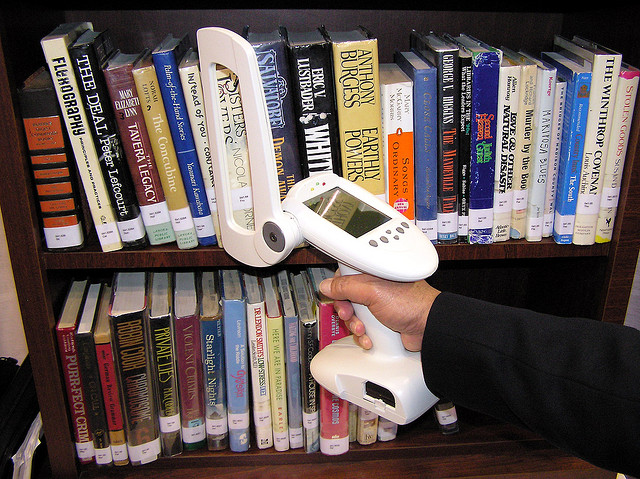
Photo of RFID shelf reader.

Photo by Michael Porter.

Starting tomorrow, January 14th, workers will be going around the library, taking books off of shelves, hopefully not making all that much noise, and in general just doing, well, stuff in the library. What are they doing?

As a part of our move to the new College of Law building, the Law Library is implementing a new system of keeping track of our books using RFID. RFID (which stands for “radio frequency identification”) involves marking each book with a tag that contains a small memory chip. The tag contains information unique to each book that can be read using specialized equipment.

What does this mean for you? Well, many things on the surface won’t change – you’ll still need to check books out at Circulation, and the gates will make noises if you go through them with a book that wasn’t checked out. But an RFID system will help us keep track of what we have more efficiently, particularly if something gets misplaced. For example, if a book isn’t where it’s supposed to be on the shelf (which, yes, does happen, despite our best efforts), we will be able to use a scanner to scan the shelves for the book. We can also check the shelves more efficiently to make sure that everything is where it’s supposed to be. The result is a library where everything is more organized and easier to find. And isn’t that the way a library should be?

We’re aware that this project will result in a bit of noise, but we believe it will be minimal and confined to relatively small areas of the library at any given time. Have questions? Feel free to ask Terrance Manion, the College of Law’s Director of Information Technology.