Escape into Fiction

Lawyers, law students, and law librarians enjoy a good story.  Even better is when that story combines our interest in the law with a bit of escapism.  Here are a couple of ways you can take a break from studying without having to forget about law school entirely.

You may be familiar with some lawyer authors—John Grisham, Brad Meltzer, Lisa Scottoline—who write books for adults—and other lawyers, like Louis Sachar who write for younger readers.  These authors know how to capture an audience’s attention:  Write about issues of justice, power, and the law.

Legal academics entertain themselves and others by considering legal themes in popular culture.  In print, for example, The Law and Harry Potter analyses legal concepts and issues seen in the Harry Potter series.  New York judge Karen Morris wrote Law Made Fun Through Harry Potter’s Adventure:  99 Lessons in Law from the Wizarding World for Fans of All Ages.

And, just this past weekend many celebrated the DVD release of X-Men: First Class.  As described in the Law and the Multiverse blog, the latest X-Men movie addresses international law, as well as civil rights-employment law.  Other blogs also address superheroes and the law.

While you are enjoying law school—whether you’re in your first or your final year—remember that this new way of ‘thinking like a lawyer’ enables you to consider your popular culture consumption in a new way.  You, too, can consume and create fiction—books, movies, blogs, and more—with a focus on truth, justice, and the American way!
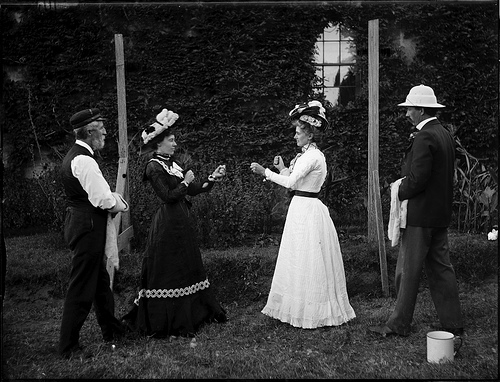
Fist Bump Finally Legal

The days before the fist bump.

Though you still shouldn’t use it in your 1L writing assignment, fist bump is now recognized as a word in the Merriam-Webster’s Collegiate Dictionary for 2011.  Fist bump is one of approximately 150 words added to the new edition.

Dictionaries add new words to reflect changing times, thoughts, and ideas.  You might wonder: the Obamas made the fist bump famous in 2008, why recognize the word now?  Well, the editorial staff who write dictionaries want to be sure that new words are truly part of the vocabulary before adding words—so there is a bit of delay between the introduction of a new word to spoken vocabulary and the formal addition of a new word to the dictionary.

The Concise Oxford English Dictionary also recently issued a 12th edition, commemorating 100 years since the first edition.  Approximately 400 new words are included in the new edition, so parents can defensibly take teens to task for sexting, cougars can hunt men without using their claws, and we can all woot with enthusiasm.

If you’re trying to find the meaning of a new word—that’s not yet in the traditional dictionary sources—don’t forget that you can check slang dictionaries.  One online source for that is urbandictionary.com.  When you want an explanation of jeggings, you can find one in a slang dictionary.

Dictionaries also eliminate words that are no longer common parlance.  Sadly, no longer can we use a growlery—“a place to ‘growl’ in; jocularly applied to a person’s private sitting room,” according to the Oxford English Dictionary online—that may happen instead in a man cave.  You can access the Oxford English Dictionary online through the University Library’s database list.

Facebook Friendships Banned

The Internet was burning last week with stories about Missouri’s new law banning Facebook friendships between students and teachers.  The talk on the web suggests that teachers and students can’t be friends on Facebook.  But is that really what the law says?

The easiest way to answer that question is to go directly to the law.  What’s the best way to do that?  We could try to find the law by turning to the Missouri statutes database on Lexis or Westlaw, but that won’t work.  Why not?  The statute is too new.  The easiest way to begin tracking a new law, one that is the talk of the town, is to begin with Google.  The search <<Missouri facebook teachers friends>> brings up over 34 million results, including reputable news sites.

News stories, such as the National Public Radio story, include background information about the law.  The story includes the number for the bill (SB 54), the name of the bill’s sponsor (Missouri State Representative Chris Kelly), and the approximate date of the bill (“signed into law last month [July].”

The NPR researchers and writers make it easy for us to look at the exact language of the law—they link directly to the Missouri Senate website containing the language of the bill.  Fantastic!  A free legal research tool for those who are interested in Missouri law.

Reviewing the bill summary provided by the Missouri site, we can see that the bill was divided into sections, each section numbered to indicate where the law will be found in the state code, once codified.  The section of interest for teachers, students, and bloggers is Missouri state statute section 162.069.  The exact language of the law: “Teachers cannot establish, maintain, or use a work-related website unless it is available to school administrators and the child’s legal custodian, physical custodian or legal guardian.  Teachers also cannot have a nonwork-related website that allows exclusive access with a current or former student.”

Although Facebook is not mentioned, the law appears to prohibit teachers from maintaining social network sites that allow for private communication with a student.

Whether the law would withstand constitutional challenges is another question!

We’re hiring!

The law library is hiring GRAs for summer and fall 2011.  For both summer and fall, we’re seeking Reference GRAs who will work at the Reference desk, answering research questions for library users.  Reference GRAs report to Deborah Schander, the Reference/Student Services Librarian.  For summer, we’re seeking Research GRAs who will assist with faculty research requests.  Research GRAs report to Pam Brannon, the Faculty Services Librarian.  If you are interested in either type of work, we encourage you to apply.  You can apply for one or both types of position, though applicants for the summer positions must be taking summer classes.

Summer GRAs receive one-half reduction in tuition as well as a $500 stipend.  Fall GRAs receive one-half reduction in tuition as well as a $1,000 stipend. To apply, please submit a completed application, resume, and your anticipated summer/fall class schedule to Deborah Schander by Friday, April 8, 2011.

Chat with a Librarian

The College of Law Library debuted its new chat reference service with the debut of the new College of Law website.  We’re hoping that our library users–students, faculty, staff, public–will use the chat service. 

You can access the service by visiting the library home page–use the Ask Ref! box to begin the conversation.  Our chat reference service is available during regular reference hours.  We’re logged in, ready to help, Monday through Thursday from 9-9, Friday from 9-5, and weekends from 10-6. 

We look forward to chatting with you soon!

Use FDsys.gov for federal gov docs

If you’ve been using www.gpoaccess.gov to access federal government documents, prepare yourselves for a long-awaited arrival:  the Federal Digital System, found at www.fdsys.gov!   The Government Printing Office has announced that, at the end of 2010, FDsys will be the GPO’s electronic system of record for government publications.

From now through the end of 2010, the sites will operate concurrently, but in 2011 you’ll have to use FDsys to retrieve the United States Code, Code of Federal Regulations, presidential documents, the Federal Register, the United States Government Manual, and many other useful government resources.  The COL Library encourages you to take the time to explore the FDsys site and how it functions.  There are helpful tutorials available, demonstrating how you can search or browse using the site.  Because the site is currently in public beta, the GPO is seeking public feedback.  Now is the time to share your thoughts about the new site!

An exciting feature of FDsys is the number of authenticated government documents.  The GPO takes a number of steps to assure that many of the electronic government documents are unaltered from their original publication.  The authenticated  documents available on FDsys have visible digital signatures.  A verified, authentic document will contain a Seal of Authenticity.  The seal is a graphic of an eagle and the words “Authenticated U.S. Government Information.”  Visit www.fdsys.gov and click on a recent piece of popular legislation–like the Dodd-Frank Wall Street Reform and Consumer Protection Act–to see the digital signature.

Resources for Law Student Life

The COL Library recently published a new research guide called “Life as a Law Student.”  The guide focuses on providing law students with resources about life in law school.

Whether you’re a 1L—new to law school—or a 3L looking forward to graduation, this guide includes resources that may be of interest to you.  There are links to books in the library that offer exam preparation advice.  You’ll find links to movies about life as a lawyer, perfect for relaxation after a hard day of classes and studying.  If you have a hard time turning off your technology, the selection of links available for both the iPhone and Android platforms is broad.  The links include both law-related and leisure sources.  Of course, the research guide also includes links to other online resources, including blogs that will keep you up to date on both legal gossip and legal news or provide you with information about life in Atlanta.