Thanksgiving Proclamations

Photo by Flickr user Mr. T in DC.

On Tuesday President Obama issued a proclamation naming November 22, 2012 a day of thanksgiving. The Thanksgiving proclamation was a practice begun by President Washington; however, there were no proclamations from 1815 to 1861.

President Lincoln restarted the tradition of the Thanksgiving Day proclamation in 1863, and a new proclamation has been issued every year since. Like other presidential documents, the proclamations are published in the Federal Register. You can also view all of the proclamations that have been issued thanks to the Pilgrim Hall Museum.

Happy U.N. Day!

Image by Flickr user Ashitakka.

On October 24, 1945, the Charter of the United Nations entered into force, and October 24th has been recognized since 1948 as U.N. Day.  The United Nations celebrates U.N. Day with various activities, including a concert that is broadcast for free on the web. (This year’s featured performer is Stevie Wonder.)

The United Nations is a vast organization which works in numerous areas, including in human rights, children’s rights, international security, international trade, and environmental issues. The U.N. is also diligent about posting its documents online in the U.N. Official Documents System; the ODS contains documents from 1993 to the present, and documents from before 1993 are added daily.

The United Nations is also the home of the largest repository of international treaties in the world. The U.N. Charter requires that member states deposit their treaties with the U.N. Secretariat; the Secretariat, in turn, must publish the treaties it receives. These treaties have been published in the United Nations Treaty Series, which is freely available online in the United Nations Treaty Collection. This collection contains not only the text of treaties deposited with the Secretariat, but also includes such important information as the dates of accession/succession/ratification for each member state and any reservations or declarations made by a signatory country.

The U.N. also has its own folk tales, the most enduring of which may be the story of Nikita Khrushchev banging his shoe on a desk during a U.N. General Assembly meeting in 1960. Which, like many good folk tales, may or may not have actually happened.

Kick Back, Watch TV (We’re Here to Help)

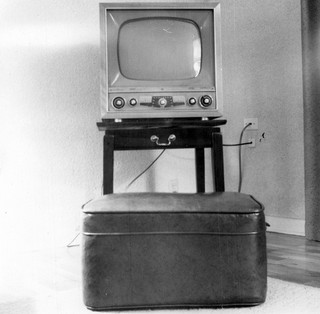
Image by flickr user gbaku.

It’s fall TV season, and there’s a crop of new shows vying for your attention. There’s even another new show about a lawyer, Made in Jersey, on CBS. But what if the new shows all leave you feeling kind of flat? What do you do then?

Well, we’re here to help you out with that. In addition to the shows you’d expect us to have (Law & Order, Matlock, and Perry Mason, mainly), we also have full-season sets of shows you may not have expected from us – or even heard of. Try one of these out:

  • Drop Dead Diva – A model dies and winds up in the body of a plus-size attorney. And it turns out she’s pretty good – and funny.
  • Harvey Birdman, Attorney at Law – Fred Flintstone on trial for racketeering? Boo Boo Bear accused of being the UnaBooBoo? Harvey Birdman is who cartoon characters turn to when they need legal representation.
  • Arrest & Trial – Before there was Law & Order, there was Arrest & Trial. Same concept, but with a couple of twists: it takes place in L.A., and the “Order” part of the show focuses on the defense attorneys.
  • House – Yes, that House. In case you’re missing now that it’s off the air, we have it.
  • The Guardian – Before he was The Mentalist, Simon Baker was  The Guardian, a corporate attorney who works part time as a child advocate. A rare show that features children and family law issues.
  • Eli Stone – Jonny Lee Miller (now on Elementary as Sherlock Holmes) is Eli Stone, an attorney who has visions – or hallucinations, depending on who you ask.

All of these, and more, are available in our Leisure Collection!

Banned Persons

Image of Robben Island by mr_mayer.

September 12 was the 35th anniversary of the death of Steve Biko, an anti-apartheid activist and leader in the South African black consciousness movement, who died in police custody on September 12, 1977. (If you’re a fan of Peter Gabriel, you may know of him through the song “Biko“; if you’re a Denzel Washington fan, you may about Steve Biko from the movie about his life, Cry Freedom.) Biko’s death was a watershed moment in the struggle against apartheid in South Africa.

Biko was also one of over 1,600 people who were “banned” in South Africa. A banning order severely restricted the person’s movements and associations with others. Banning orders could restrict someone to a specific district or city, and sometimes placed the person banned under house arrest. Helen Joseph, a prominent white member of the anti-apartheid movement, was restricted to her home for years. She was not allowed to receive visitors on the weekends or at night, and was also restricted to speaking with one person at a time. Banning orders often prevented people from visiting family and attending events like weddings and funerals.

More information on banning orders is available in books in the Law Library such as Apartheid: A Documentary Study of Modern South Africa and online resources such as South African Apartheid Legislation, available through HeinOnline. A list of many of the persons banned, along with details about the banning orders, is also available from South African History Online.

Welcome (back)!

Whether you’re coming back as a 2L or 3L, or just starting law school as a 1L, welcome! We hope you had a great summer, and that you’re refreshed and ready for a new school year.

Like always, we’re here to help make your law school experience an easier one, whether it’s by giving you the option to reserve a study room online, providing resources like AudioCaseFiles and CALI, or making it easy to find a book to read or a movie to watch. We’ve also put together maps to let you know of some great places to eat or get coffee near the law school.

So, welcome (back)! We’re happy to see you, and we hope you have a great year!

Trademark Games

Registered trademark symbol

Today marks the beginning of the 2012 Summer Olympics in London, but for lawyers, the Olympics have been going on for a while. “Branding laws” in the UK were passed a few years ago to ensure that only the official sponsors of the London Olympics can use phrases such as “London 2012” or Olympics-related designs. There has been criticism of the way these laws have been applied; a butcher was forced to remove a sign featuring the Olympic rings made out of sausages, and even the Duchess of Cambridge’s family’s party planning business had to make changes to its website.

Protecting trademarks (and other intellectual property) is a regular part of being a well-known brand. If a word or symbol becomes too synonymous with the product, trademark protection may be lost. That’s what happened to “aspirin,” “escalator,” and “Murphy bed.” So lawyers often send out “cease and desist” letters to people who are believed to be using a trademark without authorization.

While there has been criticism of the approach taken to protect the Olympics trademark, another approach has recently made news. Patrick Wensink recently received a cease-and-desist letter from the attorneys for Jack Daniel’s, which has been hailed as “the most polite, encouraging, and empathetic cease-and-desist letter ever to be sent in the history of lawyers and humanity.”  Mr. Wensink’s book, Broken Piano for President, features a cover that looks remarkably like the Jack Daniel’s logo. Jack Daniel’s attorney, Christy Susman, sent Mr. Wensink a letter that very politely explained that while they are “certainly flattered by [Wensink’s] affection for the brand” and “appreciate the pop culture appeal of Jack Daniel’s,” they have to protect their trademark and request that the cover design be changed. Jack Daniel’s even offered to pay part of the costs of changing the design quickly.

The U.S. Patent and Trademark Office has a searchable database of both “live” and “dead” trademarks, TESS. You can use that system to search for the Jack Daniel’s mark (the serial number is 85456921) or any trademark from an organization like the United States Olympic Committee.

Short and Plain (and Trackable)

It’s a busy time to be Lance Armstrong’s attorneys. The U.S. Anti-Doping Agency, a non-governmental organization given authority by Congress to enforce anti-doping measures in amateur sports, decided to file formal drug charges against the retired racing cyclist. Sanctions from the USADA would likely include a lifetime ban from sports and stripping Armstrong of his seven Tour de France titles.  Given a choice of accepting sanctions or submitting to arbitration by Saturday, Armstrong decided to file suit, which he did on Monday, filing an 80-page complaint in federal district court in Texas challenging the authority of the USADA.

Later that day, though, the complaint was dismissed by the judge in the case, Judge Sam Sparks. Why? A failure to comply with Rule 8 of the Federal Rules of Civil Procedure, which requires “a short and plain statement of the claim.” As Judge Sparks noted, “[t]his Court is not inclined to indulge Armstrong’s desire for publicity, self-aggrandizement, or vilification of Defendants, by sifting through eighty mostly unnecessary pages in search of the few kernels of factual material relevant to his claims.” Armstrong’s attorneys reworked the complaint and shaved off 55 pages, refiling a new 25-page complaint on Tuesday. On Wednesday the USADA granted a 30-day extension of time for Armstrong to contest the drug charges, prompting his attorneys to drop their request for a temporary restraining order while Judge Sparks considers their request for an injunction.

While we’re sure you can continue to follow the case in the media, did you know that you can also follow the filings in the case? You can using Bloomberg Law. You can request to track the docket (number 1:12-cv-00606) and be informed as often as you’d like of any new filings in this case or any other case in a court covered by Bloomberg. As this case is in federal court, you can also view any of the filings in the case, such as the numerous exhibits submitted by Armstrong’s attorneys, which include emails, news reports, and even law review articles.

How many calories are in that pizza?

Picture by Scott Bauer, USDA

The major pizza companies are up in arms. Why? Because the FDA will soon require them to post calorie counts for their pizzas, which they say is impractical for a number of reasons. For example, the regulations would require the restaurants to list the calories in an entire pizza, rather than the calories per slice.

The proposed rules, which were distributed via the Federal Register in April 2011, would apply not only to pizza chains, but also to other restaurant chains with more than 20 locations. There was an open comment period that ended on July 5, 2011; comments that were submitted during that period can be viewed online at regulations.gov. Although the FDA anticipated issuing the final rules by the end of 2011, there have been delays and now they anticipate issuing the rules in November of this year.

There is evidence that consumers agree with the FDA’s stance. A recent study by the Center for Science in the Public Interest found that consumers overwhelmingly favored labeling in restaurants, and even favored labeling of items exempted from the new FDA rules, such as alcohol.

Fastcase: Legal Research, Now on Your Android Device

It’s no surprise (but still often a shock) that upon graduation you lose the LexisNexis and Westlaw access that you’ve become accustomed to over the past three or four years. Six months after graduation you lose access to Bloomberg Law. Yet you still have to do legal research in order to practice law. How do you do that?

One option is to pay for access to LexisNexis, Westlaw, or Bloomberg Law, and many people do. However, there is another option. One of the perks that you get with membership in the Georgia Bar (along with free parking in the State Bar parking deck) is free access to Fastcase, a legal research service with access to both state and federal cases, statutes, regulations. Fastcase also offers Authority Check, which can help with locating citations to cases.

Fastcase released its iPhone and iPad apps in 2010, and this week launched the first legal research app for Android. What’s more, these apps are free for anyone to use. You have to register, but registration is free and not limited to subscribers or members of the state bar. The early reviews are in, and they’re pretty positive. If you have an Android device (or iPhone or iPad), go and check it out – it’s free, and it’s a great way to start becoming familiar with a resource that you’ll get upon graduation (and passing the bar, of course)!

Keep It Simple, Lawyer

MacBook writing (Håkan Dahlström) / CC BY 2.0

Today, May 21st, was the first day of the fifth international Clarity Conference. The conference brings together people from around the world who are involved in the plain-language movement, who will discuss efforts to promote the use of plain, simple language in a variety of legal contexts. Advocates of plain language say that it saves time and increases compliance with laws and regulations. Using plain language in jury instructions, for example, can improve juror comprehension.

The plain-language movement has made some headway in recent years. The Plain Writing Act of 2010 requires that federal agencies use language “that the public can understand and use.” The Plain Regulations Act of 2012, introduced earlier this year, would close a loophole in the Plain Writing Act and require that agencies write regulations in plain, clear language. The ClearMark Awards reward companies and agencies who adopt plain language in their documents and websites.

Want to know more about how to write plainly and avoid “legalese”? Check these resources out: