New Law Librarian of Congress

David Moa was recently named the new Law Librarian of Congress.  Moa will be the 23rd Law Librarian of Congress, taking over from Roberta Shaffer.  His appointment to the position is effective as of January 4, 2012.

Prior to being appointed to this post, Moa served as the Deputy Law Librarian of Congress since June 2010.   Before his time at the Law Library, Moa held positions at Georgetown University and the international law firm Covington and Burling.

The Law Library of Congress was established by the U.S. Congress in 1832 in order to provide legislators with convenient access to reliable legal materials.  The Law Library’s current collection of over 2.65 million volumes of primary and secondary sources makes it the world’s largest law library.  Most law students are probably familiar with THOMAS, an online resource produced by the Law Library of Congress that allows users to research and track legislation in Congress.

If you would like to find out more information about David Moa and the Law Library of Congress, check out the following sources:


And We’re Back

By Flickr user ToniVC

The winter break is over, and the law library is open for business once again. We have limited hours this week:

  • Jan. 3-6: 8 a.m. to 6 p.m. (with Reference until 5 p.m.)
  • Jan. 7&8: 10 a.m. to 6 p.m. (Reference closed).

We resume our regular hours on Jan. 9 when classes begin.

Exams Are Over, Now What?

Are you a little bummed out that exams are over and you don’t know what to do with all your free time? Since most of you have been sheltered away from the real world for the last 4 months, I will catch you up on some of the best activities to keep yourself busy over the winter break.

  1. Sleep:  It’s never a bad idea to catch up on a little lost sleep and try to build on sleeping habits that you can carry with you into the Spring semester.  You don’t have to make a 9am class anytime soon, so abandon the alarm for the next 2 weeks and get try to get 7-8 hours a night.
  2. Gym: The gym can be your friend.  Sweat your worries away and rejuvenate yourself in time for a productive second semester.
  3. Shop:  Don’t forget to pick up those last minute gift items for family and friends.  Fortunately, most people will not hold you to high expectations during law school….hence why most of my family and friends received “law school swag” during my 3 years of law school.
  4. Read:  Read?  Yes read.  Winter break is the best time to catch up on pleasure reading.  You aren’t bogged down with summer classes or work for an internship.  Plus, it’s always good to remind yourself that reading can be fun.   If you need a few ideas on what to read, check out the New York Times Best Sellers.
  5. Television:  You will have plenty of time to catch up on all of those shows you DVR’d over the last few weeks and discover your new favorite shows.   If you need a suggestion on new TV Shows, I would highly suggest “Person of Interest” and “Revenge.”  It is also college bowl season, so spend a little time kicking it on the couch and watching your favorite college team play in the “PizzaCarRandomWebsite.com Bowl.”
  6. Movies:  Yes, they are slightly expensive, but who can resist larger than satisfying Diet Cokes and free refill movie popcorn!  My picks for this winter break are “Mission: Impossible – Ghost Protocol,”  “Sherlock Holmes: A Game of Shadows,” and “Tinker Tailor Soldier Spy.”

If  you get tired of all these fun activities, just remember that the Law Library will be back open on January 3rd from 8am – 6pm.  Have a great winter break.

Quiet in the Library for Exams

The librarians  would like to share a few strategies we have identified that will help everybody focus and prepare for exams.

First, the librarians are going to make extra efforts to keep the library quiet.  This includes keeping our own noise levels down.

Typical Study Room, Typing Room #220, taken in 1926. Source: New York Public Library Visual Materials / Lantern Slides / Research Library / Typing

If you prefer quiet when studying, we have some guidelines and suggestions.

1) Use the back of the library (up the stairs or the ramp) as an extra quiet area.

2) If you would like a librarian to come and shush other library patrons in the designated quiet area, please ask at the reference desk or use the library’s chat reference service to better maintain your anonymity.

3) Borrow one of the new “Do Not Disturb” signs from the circulation desk–you can put it on the shelf in your study carrell as an indication that you’re trying to focus on your schoolwork.

4) If we can’t keep the ambient noise out of your head, please pick up some earplugs–sponsored by West–from the Reference Desk.

Of course, if you would like to use the library to study with a group of people, and you are looking for a place for your study group to be successful, please use our study rooms.  They are available for checkout for law students only, and you can reserve them online.  Study rooms are great if you want to outline together, talk through hypos, use a wipe board, or project your notes on the wall using the overhead projector.

We have three additional study rooms available for reservation during the exam period thanks to the Career Services Office.

Good luck with your exams!

Happy Thanksgiving!


Image by (V)oluntary (∀)mputation

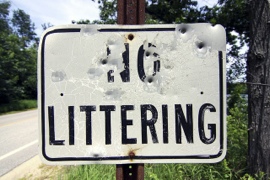
Happy Thanksgiving from the College of Law Library! Although everyone hears about the first Thanksgiving, did you know that Congress didn’t officially establish the last Thursday in November as Thanksgiving Day until 1941? And not long after that another famous Thanksgiving event occurred – Arlo Guthrie’s arrest for littering, immortalized in song as “Alice’s Restaurant.”

Yes, it’s true. Alice exists. The restaurant and church existed (the church is now the site of the Guthrie Center, actually). And, on November 28, 1965, Officer Obie (a.k.a. William J. Obanhein) did actually arrest Arlo Guthrie for littering. You can even go up to Stockbridge, Massachusetts in May and see all of the sites on the annual “Garbage Trail Walk.”

Since the release of song detailing the events surrounding the arrest – and the subsequent film – listening to “Alice’s Restaurant” has become a Thanksgiving tradition for many Americans. Turn on the radio on Thanksgiving around noon, and you’re likely to hear it on at least one station.

And, just like the dump in the song, the library’s closed, of course – we reopen on Sunday, November 27th. In the meantime, we hope you’re all having an enjoyable few days off!


Relax With the Law: Ace Attorney Video Games

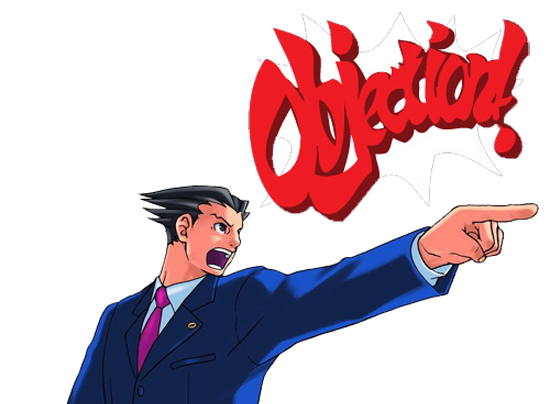
The Blackacre Times has already introduced you to a law firm which created a video game to give applicants an idea of what the practice of law is really like. But maybe you aren’t interested in reality. You just want to relax, point and click, and shout “Objection!” a lot. Allow me to introduce you to the Phoenix Wright: Ace Attorney series. As Phoenix “Nick” Wright, you are a rookie attorney, just entering the legal profession. Each game sees you interact with the police, wacky suspects, a clueless judge and ruthless prosecutors as you investigate and try several cases.

The series has proved incredibly popular over the past decade. The original game has spawned two direct sequels, two spin-offs, a team-up with the popular Professor Layton game series, a couple of manga books, and an upcoming live action movie adaptation. To say nothing of Nick’s recent addition to the Marvel v. Capcom line up (in one move, he literally throws the book at opponents).  Not bad for one attorney.

As a budding attorney yourself, it won’t take you long to realize that the game play bears little resemblance to the US trial system. In some part, this is because you are after all playing a video game, but  mostly it’s because the games originated in Japan. Although some references and settings have been localized for an English-speaking audience, the games still primarily reflect Japan’s legal system, which is a mix of the European civil law system, with some American elements thrown in recently. If you need a justification for playing a video game during law school, just say it’s helping you “study comparative law”.

The Phoenix Wright games are available for the Nintendo DS, Wii and, most recently, through the Apple store for your iOS devices.

Occupy Wall Street’s Library?

by Katie Ginnane

As many of you have probably already heard, the Occupy Wall Street camp in Zuccotti Park has been evicted.  A raid  conducted this morning resulted in 200 arrests of park occupants.

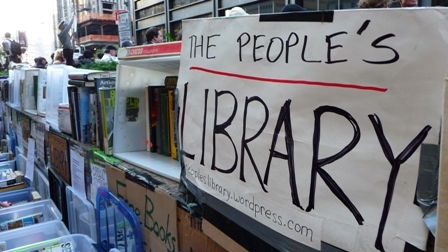
What most of you probably don’t know is that the Occupy Wall Street protestors had amassed a collection of more than 5,500 books in their volunteer-run Occupy Wall Street library.  The volunteers have even set up their own blog for the library along with a catalog of the current collection.  The collection of books ranges from Spider-Man Comics to Jane Eyre.

The collection functioned using names in order to check out books.  The ground practices listed instructions on everything from how to process incoming books to opening and closing the library.

Unfortunately, when the raid occurred on the Occupy Wall Street protestors, the library was removed along with other personal property.  Flyers were handed out at the raid with instructions to retrieve any abandoned property at the Department of Sanitation; however, it is unclear where the books ended up.

Say it ain’t so, Joe!

By Mark Edwards

Despite a storied and illustrious 46-year career at Penn State University, college football coach Joe Paterno will be forced to retire in the midst of a child-abuse scandal involving a former assistant coach.  After being notified by a graduate assistant, the coach failed to sufficiently report to the proper authorities an alleged instance of child-abuse by his former assistant coach, Jerry Sandusky.  Mr. Sandusky has been charged with 21 felony counts of sexually abusing eight boys over a 15 year period.

Is Coach Paterno in anyway culpable?  Does his pristine reputation and legacy deserve to be trampled on despite his countess good deeds and notable charitable contributions he made to many academic endeavors?  Could one egregious transgress nullify 46 years of contributions to society?

The answers to these questions will vary from person to person, and only time will tell on how the court of public opinion would ultimately judge Coach Paterno.

What is notable and worth taking from this situation, is the all too frequent and sobering reminder of how fragile success can be.  One can move mountains and part waters to achieve great feats and dominate personal goals, but one lapse in judgment can compromise all the personal sacrifice and goodwill accumulated over the years.

In Coach Paterno’s case, once he was notified of the alleged transgression and decided not to report it to the proper authorities, the bad deed was done.   Every day he failed to properly disclose his knowledge of the alleged assault, the ramifications for his failure increased.  Days turn to months, and month to years.  So much time eventually passes that even a reasonable man in the Coach’s position would not opt to disclose his knowledge.  In essence, the bad deed can be narrowed down to one bad decision.  That decision not to tell the proper authorities at the first opportunity eventually festered into other reasoned bad decisions.  All gone so fast…

So we must learn from Coach Paterno’s mistake, and be vigilant protectors of our careers.

Vengeful Librarians

Could your local reference librarian actually be a CIA agent?  Probably not, but a recent Associated Press story has got people thinking about the role of librarians in open source intelligence gathering.

Known as “vengeful librarians,” a group of analysts at the CIA’s Open Source Center analyze Facebook and Twitter posts, newspapers, television news, local radio and chat rooms to collect valuable intelligence about America’s friends and enemies.

Although all of the information they gather can be found in the open, they possess the special skills needed to gather that information and use it in conjunction with clandestine intelligence.  Many times the information they collect can give intelligence analysts a better idea of the local mood of a region.

An example of open source information that has provided analysts with valuable intelligence is social media postings during the Osama bin Laden raid.  Open source analysts were able to gather hundreds of local postings, which officials then used to gauge the public perception after the killing.  Another example is analysts gathering social media postings prior to the Arab Spring.   While you might think anyone can do this, that is far from the truth.

Tweets and other posts cannot always be pinpointed to a certain geographic location, so analysts have to use language and dialect to figure out their location of origin.  The center’s director, Doug Naquin, noted that the best analysts possess a master’s degree in library science (M.L.S) and speak several languages.  This enables them to locate, translate, and organize the information for intelligence analysts.

So next time you think about posting on a social media site, consider who might be watching in.  All of your the Legal Bibliography professors here at Georgia State have an M.L.S. degree, so maybe they previously worked as analysts for the Open Source Center. Of course I would tell you if I had worked there prior to coming to Georgia State, but then I would have to …

More Information

Happy Birthday to the MPAA’s Rating System

by Katie Ginnane

What is the MPAA you may ask? Well, the Motion Picture Association of America establishes the rating standards we so frequently use while attending movies, among other things. The modern rating system was enacted in order to counter extreme limitations placed on freedom of expression inherent in federal and state laws prior to 1968. With the advent of the modern rating system, rather than preventing movies from even making it to theaters, the founders of the rating system simply wanted to inform decisions of movie-goers, particularly parents.

Although the original ratings were somewhat different, the current ratings are comprised of G, PG, PG-13, R and NC-17, with G being the least controversial and NC-17 being the most.  According to the MPAA’s website, the rating of NC-17 should not be seen as a negative; however, according to an article published by CNN, the actual effects of an NC-17 rating make the rating inherently negative.

According to the article, growing pressure on the MPAA for a change in the system began with Stanley Kubrick’s Eye’s Wide Shut.  The film, originally given an NC-17 rating, had scenes cut in order to assure an R rating.  If the film studio had adhered to the original film and settled with its original NC-17 rating, advertisements of the film would not have been allowed on network television and many newspapers and certain theaters even would have refused to play it.

For more information on the film industry and censorship, check out these great resources and articles: