Masters of the (Info) Universe

It’s still National Library Week, and so we’re still geeking out over exactly how great libraries are. From public libraries (which are, as Keith Richards, an almost-librarian, said “the great equalizer[s]”) , to the library at the National Baseball Hall of Fame and the Folger Shakespeare Library. And law libraries, of course. Many law libraries are open to the public and provide information that is, in the words of Thomas Jefferson, “the currency of democracy.” Law libraries also provide an important service to members of the bar and courts; Justice Sandra Day O’Connor once noted that the law library “provides the stability and continuity for the rule of law.”

So it was no surprise to us when CNN ran a story recently declaring librarians “masters of the info universe.” Neil Gaiman, a longtime advocate for libraries, said much the same thing last year.

By the way, while we’re on the subject of libraries, have you checked out our trivia contest yet? If you’re one of the students with the most correct answers about your own College of Law Library, your name will be entered into a drawing for a $50 Target gift card. Don’t wait too long, though – you only have until Sunday, April 17th, at 11:59 p.m. While you’re at it, do us a favor and fill out our short student survey. This is your chance to let us know how we’re doing and what we can do to improve our services to you. The survey will be available until Friday, April 29th at 5:00 p.m.
Sports Law=Pretty Neat

Just in case you haven’t heard, there’s a lot going on in the world of sports right now. The NFL’s players are locked out, Barry Bonds is facing trial for perjury, there’s some sort of basketball tournament happening, and the usual scandals surrounding college athletes and recruiting violations are going on. Did you know that all of this has to do with law? Specifically, it all has to do in one way or another with sports law.

Sports law covers a lot of areas of law that interact with sports – contracts, ADR, antitrust, IP, torts, and employment law being just a few. The Legal Information Institute, a site that we love, has a pretty good overview with links to some of the major statutes and most recent cases. In the Law Library,we have some great books on the subject, like Sports Justice, Female Gladiators, and Courting the Yankees, which features a chapter by our very own Professor Jack Williams.

If you’re more interested in what’s going on now, check out a few of the many blogs devoted to sports and the law, like Findlaw’s Tarnished Twenty or the aptly named Sports Law Blog. If you’re interested in college sports, keep an eye on the College Sports Law Blog and the NCAA Bylaw Blog. If you’re more interested gender issues in sports, there’s the Title IX Blog. Finally, for those who are really invested in their fantasy baseball/basketball/football leagues, there’s always the Sports Judge Blog. In addition to discussing legal issues affecting fantasy gaming, SportsJudge also handles dispute resolution for fantasy sports leagues, complete with options.

Now, we’re not saying that watching ESPN can substitute for, say, studying for classes, but the next time you’re watching SportsCenter, just remember – there’s a lot more law there than you’d think.

L&O v. Reality

Let’s face it: you’re in law school, which means that it’s almost certain that you’ve seen Law and Order. You may have even heard your pet howl at the sound of the theme song. And you’re aware by now that, while great TV, L&O may not accurately represent every aspect of the legal system. But you lack cold, hard data to back that up.

Well, now you have some. Back in May, the website Overthinking It asked its readers to complete a short survey every time they watched an episode of Law & Order. In February, it was announced that they had information on every episode from the first ten seasons. If you compare that with information from the Bureau of Justice Statistics, like Felony Sentences in State Courts, you can see some of the differences. In real life, 94% of felony cases end in a guilty plea; on Law & Order, only 36.7% end in a plea bargain.

The data compiled by Overthinking It is limited to the outcome of the trial and doesn’t include, for example, the percentage of trials before a jury (in real life, only 4% of felony cases are tried before a jury), or information on sentencing. If you want to compile that information for yourself, or check any of Overthinking It’s data, check out our Leisure Collection – we have nine seasons of Law & Order on DVD (i.e., all of the seasons currently released on DVD).

Study Aids Available!

Studying for finals? Can’t figure out U.C.C. 2-207? The Law Library is here to help! To help you succeed on your exams we have:

Substantial previews of some study aids, such as the Examples & Explanations series, are available through Google Books. The library’s new catalog, GIL-Find@GSU, provides links to the available previews.  (Hat tip to USF’s Zief Law Library & John Marshall Law School’s Biro Law Library!)

Court-Watching Made Easy

We’re a little over 1 month into the Supreme Court’s 2010 term, and there have already been some interesting arguments touching on, among other things, the sale of video games to minors and the Westboro Baptist Church. You can follow the developments at the Court on the news, but there are also some great websites that track what’s going on, from grant of certiorari to decision.

SCOTUSblog, one of the best sources for Court news, keeps track of the most interesting recent petitions for certiorari and recently granted petitions. To prepare for oral argument, you can check the Legal Information Institute’s oral argument previews, and SCOTUSblog’s collection of briefs and other case documents. And, of course, after the argument you can check out the audio on the Supreme Court’s website and at the Oyez Project; starting with the 2010 term, transcripts and audio will be posted on Friday of every argument week. When the opinion is finally handed down, you can follow the happenings live at SCOTUSblog, get the syllabus sent automatically to your email account from the LII, see a visual representation of the votes from Oyez, and download the full slip opinion from the Supreme Court.

If that’s not enough, you can play some Oyez Baseball and find out where your favorite former Justice is buried. Or you could use all of this information to dominate your own FantasySCOTUS league!

Be an Informed Voter

Ballotpedia is one of the more fascinating sites that you’ve probably never heard of. It’s a freely editable wiki, like Wikipedia, but much, much more specialized. With a couple of clicks, you can find out what measures are currently on the ballot across the country, details on all of the state legislative elections, and all sorts of information on what’s going on with the Georgia elections.

Ballotpedia also has a lot of historical information. Want to see what measures were on the Georgia ballot in 2004? Or 2000? You can find them there. In many cases you can even find a link to the full text of the measure or the official election results. And, of course, Ballotpedia will be updating the site tomorrow with all of the latest results.

Angelo Herndon: Race, Communism, Free Speech, and Atlanta

The College of Law’s Henry J. Miller Distinguished Lecture Series continues on October 21st, when Harvard’s Mark Tushnet will talk about a case that originated in Atlanta in a lecture entitled “The Hughes Court’s Treatment of Radical Dissent: The Angelo Herndon Case.”

Angelo Herndon, an African-American, member of the Communist Party, and labor organizer, was arrested in Atlanta in1932 for attempting to “incite insurrection” and convicted the following year. His case, which went to the Supreme Court in 1935 and 1937, features a stunning cast of characters, including future 5th Circuit judge Elbert Parr Tuttle, renowned historian C. Vann Woodward, poets Don West and Langston Hughes, and Charles Hamilton Houston, special counsel for the NAACP. The final verdict in Herndon v. Lowry was a narrow 5-4 reversal of Herndon’s conviction.

Of course, the Law Library has much more information on this fascinating case. The Law Library has put together a display of books and videos related to the case and its major issues, and you can find the complete record of the case in U. S. Supreme Court Records & Briefs, a database available through the College of Law Library.

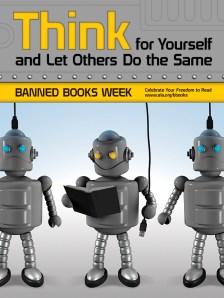
It’s Banned Books Week!

ALA Banned Books Week Poster 2010

This past Saturday, September 25th, marked the beginning of Banned Books Week. Established in 1982, Banned Books Week highlights attempts to  remove books from library and store shelves.

Being a law library, we’re interested in Banned Books Week as librarians, and also because there happens to be a lot of case law resulting from efforts to ban books. Removing books from school libraries was the primary focus of Board of Education, Island Trees Union Free School District No. 26 v. Pico, 457 U.S. 853 (1982). There are also cases about the suppression of specific books,  including James Joyce’s Ulysses, Henry Miller’s Tropic of Cancer and Tropic of Capricorn, and William S. Burroughs’ Naked Lunch.

The Law Library has a number of books on the First Amendment and book banning, including:

120 Banned Books: Censorship Histories of World Literature, by Nicholas J. Karolides, Margaret Bald, & Dawn B. Sova

Freedom for the Thought That We Hate: A Biography of the First Amendment, by Anthony Lewis

Girls Lean Back Everywhere: The Law of Obscenity and the Assault on Genius, by Edward De Grazia

Ulysses in Court: The Litigation Surrounding the First Publication of James Joyce’s Novel in the United States, by Irving Younger & James W. McElhaney