Baby Blue

The Bluebook. The mere mention can incite strong emotions in the law community. Some of love (perhaps Stokholm syndrome from long law review hours?) and some of hate.

Why is a system designed in an age of manual typesetting still dictating the law community’s citation formatting?

This question has been asked for decades and prompted the creation of alternatives. Richard Posner even wrote a law review article entitled Goodbye to the Bluebook in 1986. Throughout years of complaints and criticisms the Bluebook has remained the gold standard.

the_bluebook_18th_ed_cover

Baby Blue is a project started by NYU to create [yet] another Bluebook alternative. However, Baby Blue is not really an alternative.  Instead it is more of a “re-expression” of the rules–the stated goal being to breakup “the cartel” controlling the publishing and updating of the Bluebook.  Idealistically, legal citation rules should be simple and freely available to all.

The Harvard Law Review initially took exception to Baby Blue and sparked many discussions about the the Bluebook’s copyrightability. The historical origin of the Bluebook was even researched and called into question.

Does Baby Blue infringe on the Bluebook’s intellectual property?  Who can assert a copyright claim?  These interesting questions may never be resolved; as of the creation of this post Baby Blue is freely available online.

 

March 1 is Super Tuesday!

by Veselin Simonov

Image by flickr user Erik Thauvin

Image by flickr user Erik Thauvin

It’s primary election season and Georgia voters will soon get to pick their preferred presidential nominees! For both parties, Georgia votes on Tuesday, March 1 along with Alabama, Arkansas, Colorado, Massachusetts, Minnesota, Oklahoma, Tennessee, Texas, Vermont and Virginia. The Republican-only contests on March 1 are the Alaska, North Dakota, and Wyoming caucuses. The Democrats hold the American Samoa caucus on March 1 as well. This group of primaries is called Super Tuesday, and it’s the day on which candidates have a chance to win more delegates than on any other single day of the primary calendar.

As the name implies, Super Tuesday happens on a Tuesday in either February or March of a presidential election year. It started out in 1988 as a way for some states to pool their electoral power in the primaries in order to secure a more prominent national role. It’s also an effort to offset the retail politics targeted towards early states that resulted in frontloaded primary contests. Super Tuesday is one of the first significant electoral tests of a campaign’s national appeal and its ability to conduct broad-reaching, wholesale politics.

Super Tuesday does not come without issues, however. First, it’s expensive to campaign all over the country on a packed schedule. This can force candidates with smaller war chests to drop out. Second, the time crunch results in less expansive, shallower campaign efforts in the immediate lead-up to Super Tuesday. Finally, the mass primary also has the potential to overshadow primaries that come after it by, in effect, picking the nominees early.

This year, Super Tuesday consists mostly of southern state primaries (leading some to dub it the “SEC primary”) in a bid to increase the region’s political influence. So, if you’re looking to have your voice heard, go out and vote for your preferred nominee. As a reminder, Georgia has open primaries. You pick which primary you want to vote in at your polling place by taking an oath to affiliate with the party you are voting for. If you don’t know where your polling place is, you can always check at the GA Secretary of State’s My Voter Page.

Sources:

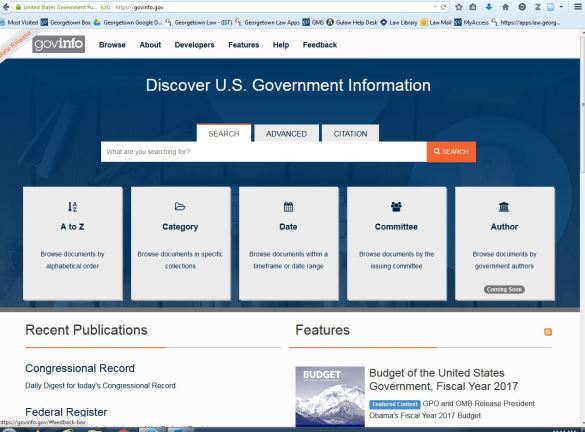
Meet govinfo: Federal Law Research Gets a Makeover

govinfo

By: Chloe Martin

This month, the U.S. Government Publishing Office introduced the world to govinfo, a beta website that will eventually replace the Federal Digital System (FDsys) as the go-to resource for federal primary law from all three branches of government. Read our Q&A to learn more.

How does govinfo differ from FDsys?

The content available for access will not change, but govinfo offers some new and improved features:

  • New ways to browse content (alphabetically and by category);
  • Responsive design for better display on mobile devices;
  • More choices for sharing pages and content on social media;
  • Enhanced search filters; and
  • The brand new “related documents” feature which will display other documents within govinfo that relate to or reference a particular document.

Who can access govinfo?

Everyone. Govinfo, like FDsys, is available to the public.

What major resources are available to search and browse on govinfo?

  • The Federal Register
  • The Code of Federal Regulations
  • The Federal Budget
  • The U.S. Code
  • Congressional Bills
  • Statutes at Large
  • The Congressional Record
  • Congressional Calendars, Hearings, and Reports
  • U.S. Court Opinions, including SCOTUS decisions

How can I access govinfo?

Visit https://www.govinfo.gov/

The GPO is requesting public feedback on its new site; visit this survey to tell the GPO what you think!

ALERT! ALERT!

Students often ask about ways they can improve their research.  They say they want to be more efficient.  They say they want to be more effective.  They want to use technology proficiently, to support their work.  They know that employers are interested in hiring candidates who will do legal research as needed, keeping costs to a minimum.

The Applied Legal Experience, Research, & Technology (ALERT) Program is a non-credit program developed by the Law Library that provides students with additional opportunities outside of the College of Law curriculum to develop their legal research and technology skills.  Students, through a survey, identified the topics that are included this semester. Please RSVP if you would like to attend any of the sessions!

Upcoming next week is the sixth topic this year–Formatting a Word Document.  Roxanne Greeson, who works with the College of Law and the GSU Center for Instructional Innovation, will be presenting on the topic of Formatting a Word Document.  The presentation will help you to use the tools available in Microsoft Word to assure that your documents are formatted consistently and efficiently.  The program will happen twice:  5 PM on February 24 and 2:50 PM on February 25.

The next topic for the year is Legislative History.  Terrance Manion, Librarian and Director of Information Technology, will take you through the process of doing legislative history research.  We have some great tools in the library for gathering a federal legislative history, such as the ProQuest Legislative Insight database.  We also have print materials, such as Nancy Johnson’s Sources of Compiled Legislative Histories that are helpful.  The Legislative History program is scheduled for noon on March 2 and 5 PM on March 3.

The final topic will be Research Parties and Expert Witnesses.  Meg Butler, Associate Director for Public Services, will share tools and tips for using law library resources to identify and evaluate expert witnesses and parties.  The program is scheduled for noon on March 21 and 5 PM on March 24.

We hope to see you at the programs!

Runoff Election in House District 58 on Tuesday, Feb. 16!

by Veselin Simonov

If you live in the neighborhoods of East Atlanta, Cabbagetown, Reynoldstown, Edgewood, Gresham Park, Grant Park, Kirkwood, Ormewood Park or Boulevard Heights – listen up! You may be eligible to vote in the Georgia House of Representatives runoff election in District 58 that’s happening TODAY! The district covers residents from just south of Piedmont Park to around Turner Field to over by Fort McPherson. If you aren’t sure whether you live within the district lines or where your polling location is, you can check the Secretary of State’s My Voter Page.

District 58 was previously represented by Simone Bell (D-Atlanta), who resigned late last year to become Lambda Legal’s Southern regional director. As reported by The Atlanta Journal-Constitution, former Representative Bell held the distinction of being the nation’s first African-American lawmaker, serving in a State House, who is out as a lesbian.

2015-11-01_ParkCannon-141-Edit-1024x683

Park Cannon

The special election was held on January 19, 2016 between three candidates: Kwame Thompson, Park Cannon, and Ralph Long, III. The runoff held today is between Park Cannon and Ralph Long, III. Park Cannon won the special election with 47.43% of the vote and Ralph Long, III came in second with 33.65%. Only 835 people voted in the special election.

ralph_long_iii_shot_by_micheal_bond

Ralph Long, III

So if you live in District 58 and have a few minutes to spare today, we encourage you to stop by your polling location and fulfill your civic duty! And, of course, if you would like to research the candidates or check your voter registration status, please feel free to use the technology and resources available in the law library.


Regulatory research gets easier

ProQuest Regulatory Insight home screen

ProQuest Regulatory Insight home screen

The law library recently added the new ProQuest Regulatory Insight database to its collection of research tools available for you.  You may be familiar with ProQuest Legislative Insight, which provides legislative histories for federal laws that have been enacted.  Regulatory Insight contains federal administrative law histories organized by public law.

Our law students can access ProQuest products through our law library database list.  You may be asked to select the appropriate account when you login; if that happens, please select the account that includes the College of Law (“Coll of Law Lib”) in its description.

You can search Regulatory Insight by number, including Federal Register or Code of Federal Regulations citation, as well as the Public Law Number, Statutes at Large Citation, U.S. Code Citation, the Regulation Identifier Number (RIN), and the Agency Docket Number.

There is an advanced search function that allows word searching of the Federal Register (1988 to present) and the Code of Federal Regulations (1997 to 2015), as well.

If you need help accessing or using this new product, please contact a reference librarian!

Spring is coming early!

Punxsutawney Phil did not see his shadow this morning–so spring is on its way!  In case you are wondering, neither did the Canadian groundhog Shubenacadie Sam, Staten Island Chuck, or Georgia’s General Beau Lee.

Sixth floor balcony on a foggy Groundhog's Day morning.

Sixth floor Law Library terrace on a foggy Groundhog’s Day morning.

For our borrowers, that means that fine amnesty will not be extended past today.  If you have any overdue library materials, please return them before 11:00 PM today, to take advantage of the amnesty period.  Everyone shares the law library resources.  We thank you for your consideration for your colleagues!


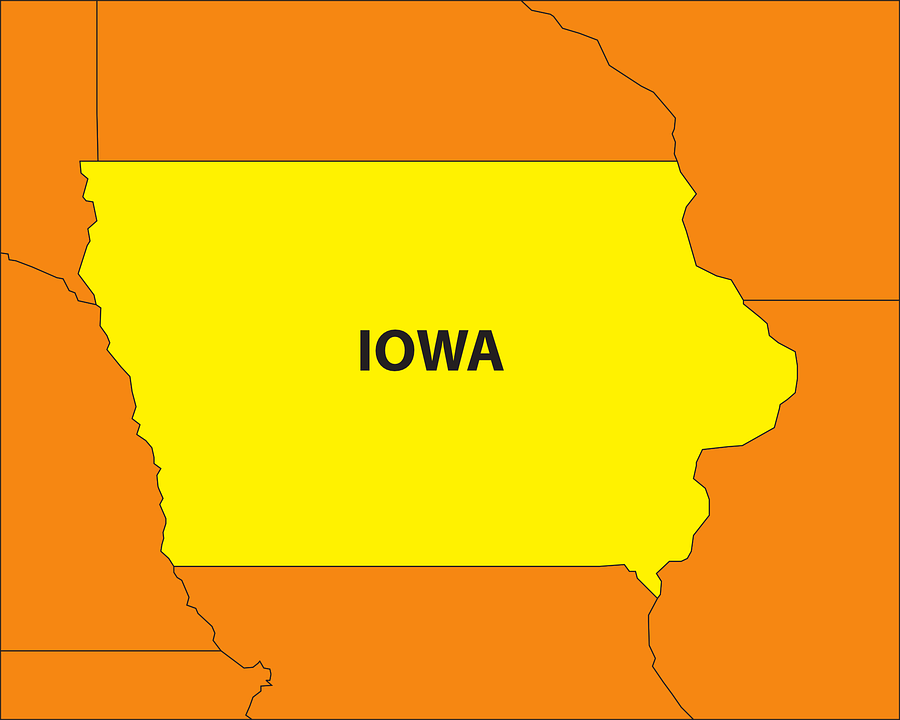
The Iowa Caucuses

iowa-43756_960_720

The Iowa Caucuses are a mystery to many people.  We understand that they occur and that the outcome can have a great impact on the eventual outcomes of the Convention’s candidate decisions, but how do they work exactly and how do they affect the outcome?

The Iowa Caucuses work differently than primary voting.  Voters from each precinct gather at a polling station but do not initially cast a vote.  The caucuses start with representatives speaking about their respective candidates, giving speeches to try to influence the other voters.  After the speeches are complete, voting begins.  In the republican caucus, votes are cast by secret ballot.

In the democratic caucus, voting is done by groups of people moving together into representative groups.  If a candidate is seen as unviable, meaning they receive less than 15% of the vote, the people from that candidate group will then move to one of the other candidate’s groups.

Through this process, winners are announced at the end of the day of caucusing.  Iowa only represents 1% of the votes at the national conventions, a very tiny amount, and yet it receives a huge amount of hype leading up to the caucuses.  This is because these are the first primary conventions in the country and the momentum which can be achieved by candidates selected is significant.  When a candidate has won the first state, it makes it easier to continue to convince other states that you should win there too.  If a candidate instead makes a poor showing in Iowa, they may choose to bow out and allow the election to continue without them on the ballot.

When watching the caucus results, it is important to remember that these elections are not actually to choose a candidate, but instead delegates who currently represent that candidate.  This is very important, as representatives for a specific candidate can change their minds about their candidate between now and the time they vote in higher level conventions.  Nothing is set in stone based on the results of this, or any other, primary.

Caucusing identifies 1,681 precinct delegates who will go to the 99 county-level conventions.  The process will be repeated at these conventions and delegates will be selected to go to congressional district-level conventions where the process will repeat again.  Lastly, the last group of representatives will go to a state-level convention where delegates for the national convention are selected.  This final selection of delegates to the national convention will occur sometime late in May.

Watching for Punxsutwaney Phil

Group photo including man holding Punxsutawney Phil

Punxsutawney Phil on Groundhog’s Day in Gobbler’s Knob, photo by Anthony Quintano, licensed under CC BY 2.0

This semester you may notice that you again accrue fines if you keep library items past their return time.  The librarians want to assure that everybody has access to our resources, and charging for items that are overdue will help assure that items, including study aids and reserve materials, are available when people come to borrow them.  A systems upgrade turned off the fines and we just got the issue resolved.

Since you may have forgotten about fines while they were turned off, we ask that for now, you please be sure to turn in any overdue items.  We are providing an amnesty through Groundhog’s Day.  You may see fines on your account (if you return an item late), but we will waive them for any items returned by February 2.

But wait, there’s more!  If Punxsutawney Phil sees his shadow on Groundhog’s Day, we will extend the amnesty period by 6 more days to end on February 8.  If the prediction is six more weeks of winter, we will give you all six more days of amnesty for returning your overdue items.  For items returned after the end of the amnesty period, fines will accrue as our Circulation Policy indicates.

If you have questions about the policy, you may speak with Meg Butler, Associate Director for Public Services, or Kris Niedringhaus, Associate Dean for Library and Information Services.