Miller Lectures of the Past

With the 68th installment of the Henry J. Miller Distinguished Lecture Series right around the corner, it’s a great time to revisit some highlights from previous Miller lectures. Recently, the law library has been digitizing programs from the earliest Miller lectures, so these materials are more accessible than ever. This is an ongoing project, so watch this space for additional updates as the archive grows.

Although we have been unable to find a program for Murray L. Schwartz’s inaugural Miller Lecture, we have digitized the program for the second lecture, and it’s a doozy, featuring Justice Antonin Scalia, who had at the time just wrapped up his first year on the Supreme Court.

The Miller series has had the good fortune to feature a few Supreme Court justices. We’ve digitized the program for Justice Sandra Day O’Connor’s 12th Miller Lecture in 1992. In addition to that, the law library’s own Alison Guffey memorably wrote on this very blog about Justice Ruth Bader Ginsburg’s 32nd Miller Lecture, which was delivered in 2003. You can also find a transcription of Justice John Paul Stevens’s 53rd Miller Lecture, from 2014, in the GSU Law Review’s archives.

We’ve also had some other notable jurists from other courts speak, including Judge A. Leon Higgenbotham of the Third Circuit for the 4th Miller Lecture in 1988 and Judge Patricia McGowan Wald of the D.C. Circuit for the 7th Miller Lecture in 1990.

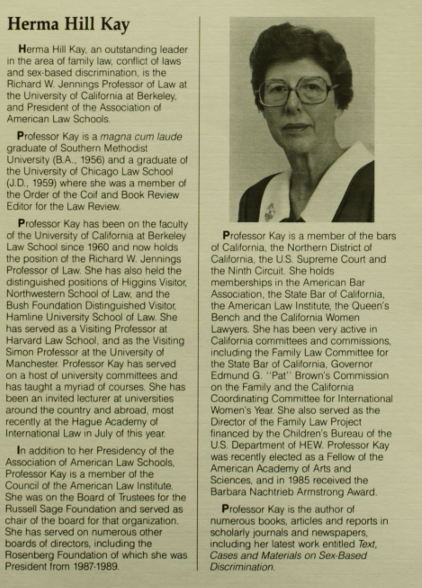
Perhaps unsurprisingly, the Miller Lecture series has also featured many scholars. In the early days, the series did an especially good job of providing feminist legal scholars with a forum. These include Herma Hill Kay, a co-author (along with the aforementioned Justice Ginsburg) of the first casebook on sex-based discrimination, who gave the 6th Miller Lecture in 1989, and Nadine Strossen, the first woman to lead the ACLU, who gave the 15th Miller Lecture in 1994.

Exploring the law library’s Miller archives is a great way to learn more about the history of GSU Law, while also getting to know some of the nation’s most influential scholars and jurists. We will continue this proud tradition at the next Miller Lecture, when Election Law scholar Rick L. Hasen discusses “A Real Right to Vote.” Don’t miss it!
The Day RBG Came to Campus

by Alison Guffey, 3L

On this day 20 years ago, Justice Ruth Bader Ginsburg visited the Georgia State University College of Law to deliver the 32nd Henry J. Miller lecture. The topic of her lecture was “Little Known Pages from the Supreme Court’s History,” and her focus was on re-telling the accounts of two women: Burnita Shelton Matthews, the first woman to be appointed as a Federal District Court judge, and Malvina Harlan, wife of Supreme Court Justice John Harlan and author of a memoir titled, “Some Memories of a Long Life, 1854-1911.”

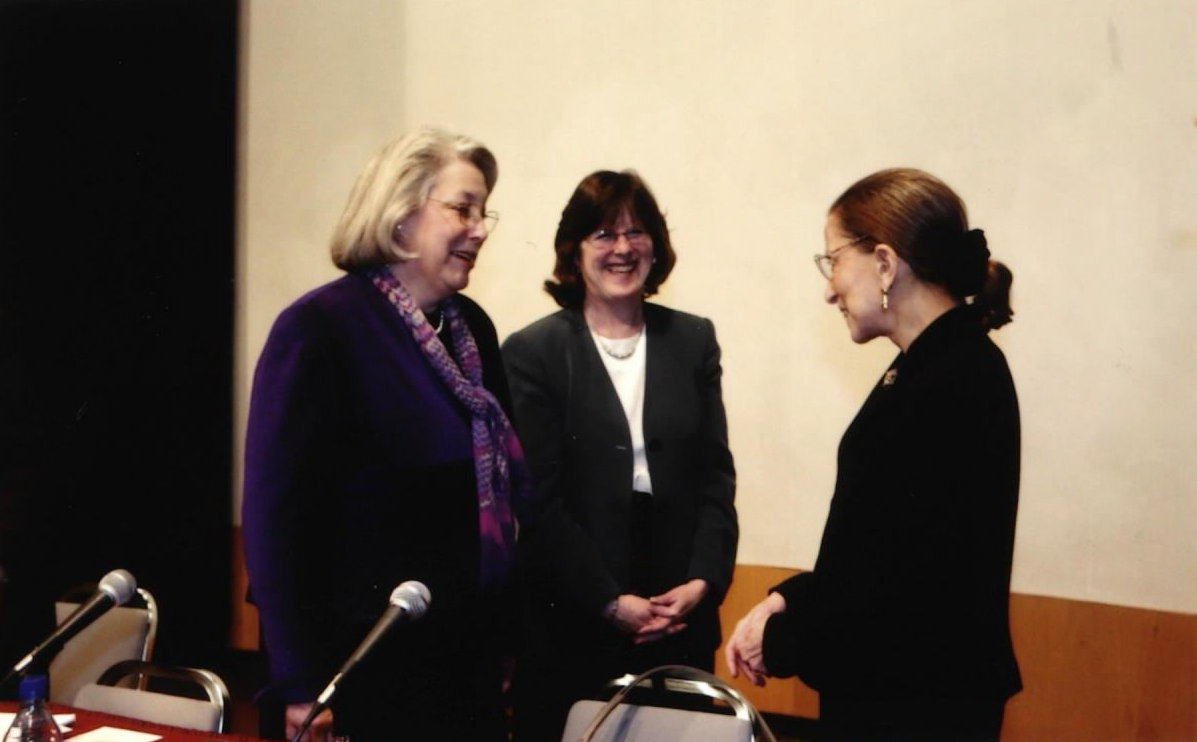
Justice Ginsberg, Professor Mary Radford, and Dean Knowles converse after the Miller Lecture.

One particular story highlighted by Justice Ginsburg from Malvina’s memoir featured Malvina inspiring her husband to finish his dissent in the Civil Rights cases by swapping his inkstand for one with a different history: the very inkstand that was used by Justice Taney in composing the Dred Scott opinion. Justice Harlan knew of this inkstand’s history, and by writing with the same inkwell that decades earlier had “tighten[ed] the shackles of slavery,” Justice Harlan finished his dissent and powerfully asserted the need to “protect the recently emancipated slaves in the enjoyment of equal civil rights.”[1]

Ginsburg told this story of poetic justice, of an inkstand in need of absolution, and she wondered of the pen in need of absolution in her own career. She determined the next time her thoughts on an opinion refuse to flow easily, she may visit the pen “that Judge Justice Bradley used to write his now-infamous concurring opinion in Myra Bradwell’s case, Bradwell v. Illinois, an 1873 decision upholding a state’s right to exclude women from the practice of law.”

Without ever directly addressing why Justice Bradley’s pen would be in need of absolution, Justice Ginsburg spoke of a photograph that is taken periodically of the Supreme Court Justice’s spouses. The audience knowingly chuckled while Justice Ginsburg explained that, with her and Justice O’Connor on the Supreme Court, “the subject of these photographs have changed beyond anything Justice Bradley or even Justice Harlan would have contemplated.”

Justice Ginsburg’s lecture was poised, clear, and moving as she masterfully led the audience through monumental moments in the Supreme Court’s history that came from the lives of Burnita Shelton Matthews and Malvina Harlan. Georgia State Law’s own Professor Mary Radford was in attendance for Justice Ginsburg’s lecture, and had the opportunity to speak with her one-on-one. Of this experience, Radford reflects on Justice Ginsburg’s “dignity and grace,” her “shy smile, almost embarrassed by the amount of attention that was flowing her way,” and recalls that Justice Ginsburg “greeted each individual, from student to faculty member to judge to local dignitary, with a quiet smile and a light handshake . . . wearing black lace gloves.” Professor Radford sums up the day: “An uninformed observer would probably have been astounded to learn that this unassuming, soft-spoken, petite woman was in fact one of the most powerful, insightful, and influential legal thinkers of our time.”


It is undeniable the impact Ruth Bader Ginsburg left on the nation and the world. On February 13, 2003, she visited our campus in celebration of GSU Law’s 20th anniversary. This year, as GSU Law celebrates its 40th anniversary, we take time to recount her lecture and remember her legacy. To watch Justice Ginsburg’s lecture, learn about other notable visitors, and read about the history of the Georgia State University College of Law, check out GSU Law’s 40th Anniversary Exhibit here.


[1]  Harlan, M.S. and Przybyszewski, L. (2003) in Some Memories of a Long Life, 1854-1911. New York: Modern Library, pp. 113–114.