With the 68th installment of the Henry J. Miller Distinguished Lecture Series right around the corner, it’s a great time to revisit some highlights from previous Miller lectures. Recently, the law library has been digitizing programs from the earliest Miller lectures, so these materials are more accessible than ever. This is an ongoing project, so watch this space for additional updates as the archive grows.
Although we have been unable to find a program for Murray L. Schwartz’s inaugural Miller Lecture, we have digitized the program for the second lecture, and it’s a doozy, featuring Justice Antonin Scalia, who had at the time just wrapped up his first year on the Supreme Court.
The Miller series has had the good fortune to feature a few Supreme Court justices. We’ve digitized the program for Justice Sandra Day O’Connor’s 12th Miller Lecture in 1992. In addition to that, the law library’s own Alison Guffey memorably wrote on this very blog about Justice Ruth Bader Ginsburg’s 32nd Miller Lecture, which was delivered in 2003. You can also find a transcription of Justice John Paul Stevens’s 53rd Miller Lecture, from 2014, in the GSU Law Review’s archives.
We’ve also had some other notable jurists from other courts speak, including Judge A. Leon Higgenbotham of the Third Circuit for the 4th Miller Lecture in 1988 and Judge Patricia McGowan Wald of the D.C. Circuit for the 7th Miller Lecture in 1990.

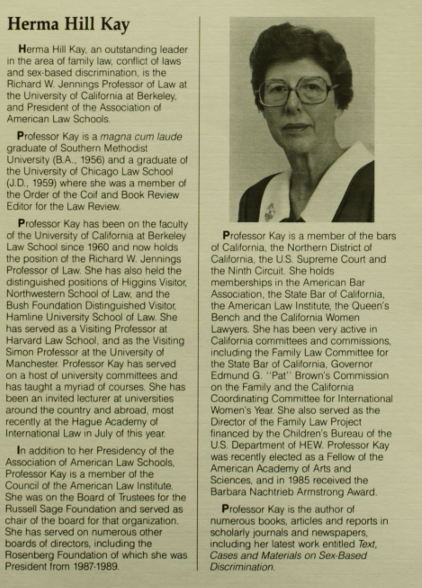
Perhaps unsurprisingly, the Miller Lecture series has also featured many scholars. In the early days, the series did an especially good job of providing feminist legal scholars with a forum. These include Herma Hill Kay, a co-author (along with the aforementioned Justice Ginsburg) of the first casebook on sex-based discrimination, who gave the 6th Miller Lecture in 1989, and Nadine Strossen, the first woman to lead the ACLU, who gave the 15th Miller Lecture in 1994.
Exploring the law library’s Miller archives is a great way to learn more about the history of GSU Law, while also getting to know some of the nation’s most influential scholars and jurists. We will continue this proud tradition at the next Miller Lecture, when Election Law scholar Rick L. Hasen discusses “A Real Right to Vote.” Don’t miss it!


 The Blackacre Times
You must be logged in to post a comment.