Presidential Libraries

By Lindsay Anglin

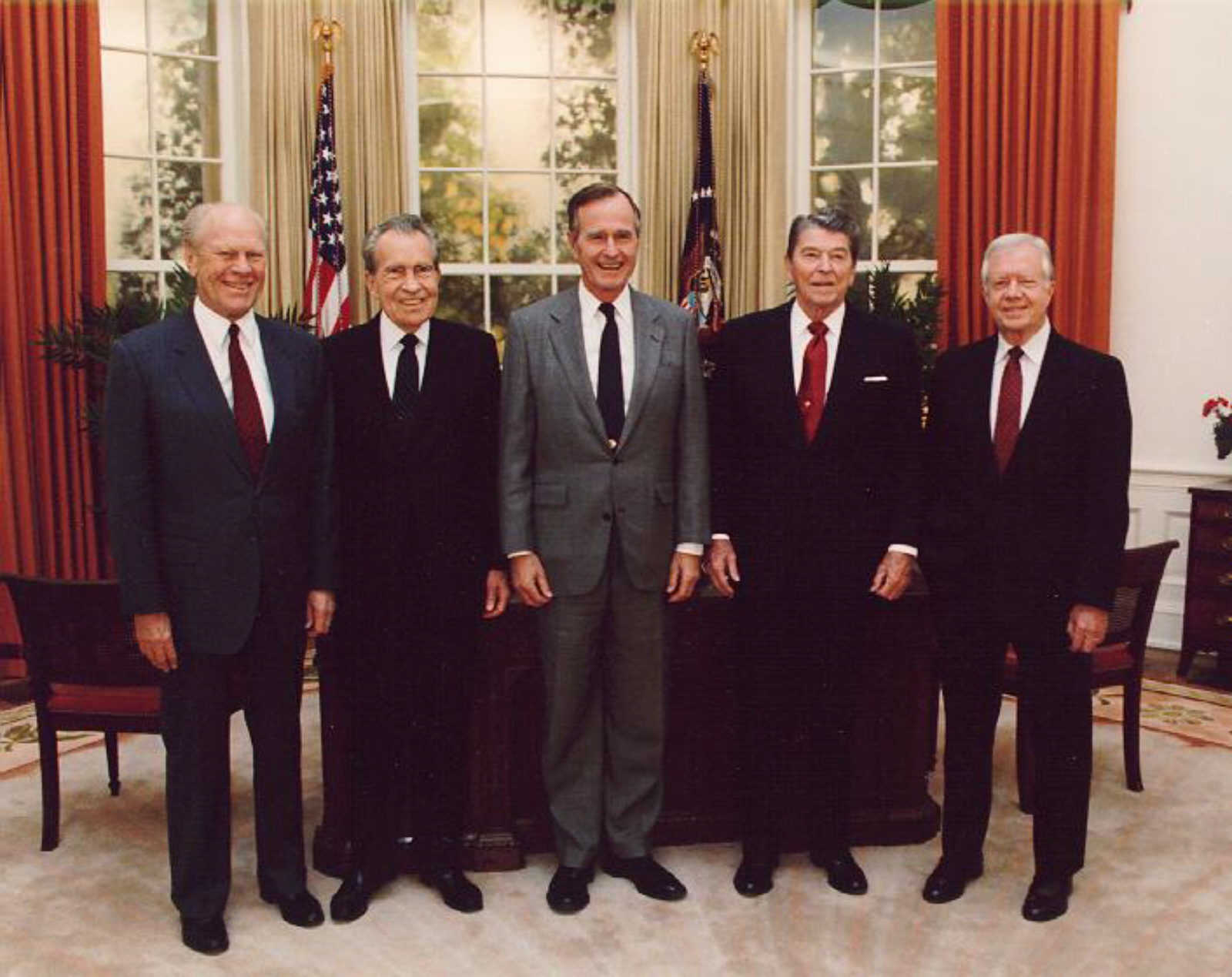
Would you like to see Franklin D. Roosevelt’s New York State Bar Association Application? Or read John F. Kennedy’s national security files from the Cuban Missile Crisis? Or see menus from White House dinners during Bill Clinton’s presidency? Or read about the three-and-a-half tons of Jelly Bellies that were shipped to the White House for Ronald Reagan’s 1981 Inaugural festivities? Or read the condolence mail President George W. Bush received following the September 11, 2001 terrorist attacks? Then explore the Presidential Libraries!

The Office of Presidential Libraries coordinates a nationwide network of thirteen Presidential Libraries, each housing the papers, records, and other historic materials of U.S. Presidents. These libraries are great sources for researchers studying our presidents and our nation’s history. Since President Herbert Hoover, these libraries have been archiving presidential documents, media, and electronic materials to preserve the evidence of the Presidency for future generations.

Presidential libraries are both archives and museums, bringing together documents and artifacts of the President and his administration and displaying them in exhibits to millions of visitors each year. The libraries preserve not only official presidential records and documents, but also personal papers of Presidential family members, associates, and friends and audio and visual collections. If you cannot visit the libraries in person, each Presidential library has an electronic database to make researching more accessible.

Visit the Presidential libraries online:

Banned Books Week 2012

By Mark Edwards

Have you ever wanted to do something just because someone told you that it was not allowed?  Well now it is your time to read a book that is currently on the banned book list.  (See below).     Banned Books Week celebrates its 30th anniversary this year.

The purpose of the event is to celebrate the freedom of information and expression of ideas.  Banned Books Week brings together the entire book community – librarians, booksellers, publishers, journalists, teachers, and readers of all types – in shared support of the freedom to seek and to express ideas, even those some consider unorthodox or unpopular.

The movement was started 30 years ago by the American Libraries Association (hereinafter “ALA”) in response to a closely divided Supreme Court in which it was held that the First Amendment limits the power of local school boards to remove library books from junior high schools and high schools. (457 U.S. 853).  The ALA provides a timeline of the movement – Click here.

The Top Ten Most Frequently Challenged Books of 2011 include the following titles; each title is followed by the reasons given for challenging the book: 

1)      ttyl; ttfn; l8r, g8r (series), by Lauren Myracle
Offensive language; religious viewpoint; sexually explicit; unsuited to age group

2)      The Color of Earth (series), by Kim Dong Hwa
Nudity; sex education; sexually explicit; unsuited to age group

3)      The Hunger Games trilogy, by Suzanne Collins
Anti-ethnic; anti-family; insensitivity; offensive language; occult/satanic; violence

4)      My Mom’s Having A Baby! A Kid’s Month-by-Month Guide to Pregnancy, by Dori Hillestad Butler
Nudity; sex education; sexually explicit; unsuited to age group

5)      The Absolutely True Diary of a Part-Time Indian, by Sherman Alexie
Offensive language; racism; religious viewpoint; sexually explicit; unsuited to age group

6)      Alice (series), by Phyllis Reynolds Naylor
Nudity; offensive language; religious viewpoint

7)      Brave New World, by Aldous Huxley
Insensitivity; nudity; racism; religious viewpoint; sexually explicit

8)      What My Mother Doesn’t Know, by Sonya Sones
Nudity; offensive language; sexually explicit

9)      Gossip Girl (series), by Cecily Von Ziegesar
Drugs; offensive language; sexually explicit

10)  To Kill a Mockingbird, by Harper Lee
Offensive language; racism

Baseball and PEDs

By Kristin Poland

Several years after Congress began investigating the use of performance-enhancing drugs (PEDs) in baseball and the Mitchell Report’s withering condemnation of the culture of Major League Baseball that allowed for their widespread use, some players continue to risk their careers in order to attempt to gain an advantage over their fellow players.  Recent PED scandals have implicated some of the biggest names in the game, including last year’s National League MVP, Ryan Braun, and former Atlanta Brave and 2012 All-Star MVP Melky Cabrera, and former Cy Young Award winner Bartolo Colon.  Braun contested the test results and eventually succeeded in overturning his suspension prior to the beginning of the season based on a chain of custody issue surrounding the urine sample.  Cabrera, on the other hand, quickly admitted to taking a substance that he should not have, and accepted a fifty-game suspension from the league.  Likewise, Colon accepted his suspension and issued an apology statement through the Players’ Association.

The current Major League Baseball Joint Drug Prevention and Treatment Program, agreed to by the league and the MLB Players’ Association, governs testing for prohibited substances among players and also outlines punishments for positive tests.  These guidelines were first adopted in 2006, in response to Congress’ investigation.  A first positive test results in an automatic fifty-game suspension, while a second earns a player a suspension for one hundred games.  A player who has a third positive test will be banned from Major League Baseball for life.

If you are interested in learning more about PEDs and Major League Baseball, the Law Library has a number of resources for you.  A copy of the Mitchell Report can be found through the GPO, or a quick search in GIL Express.  Additionally, a large number of law review and other scholarly articles have been written on the topic, and, among other databases, are available through HeinOnline.

A Funny Thing Happened on the Way to the Bar

By Stephen Adams, 2012 Library GRA

Students taking the bar exam.The law library is rather quiet today, because today is the first day of the two-day process that is the bar exam. All the folks that have been toiling away in the library with their BarBri and Kaplan materials are now taking what is quite possibly the biggest test of their lives. Three (or four, or five, if they’re part-time students) years of hard work boils down to two days of lengthy multiple choice questions and essay questions. To say that nerves are a bit frayed would be an understatement.

So let’s just make fun of the situation with cute jokes and take a bit of a mental vacation in honor of all those folks toiling away in a big, scary room.

–          Today, Tort Bunnies is continuing its last hurrah before the author ends the strip: a five-day story arc devoted to both the bar exam and world annihilation. Because let’s be honest: the bar exam is rather close to the end the world, isn’t it?

–          When in Law School has wished its readers good luck, but you’ll also want to check out their other bar exam-related posts to recreate the proper feelings attributable to the exam.

–          Above the Law’s contribution this year has been a little less than usual, but is still a gem: a student from Hastings rapping (not RAPping…Rule Against Perpetuities FTW) herself through some property concepts.

Good luck to all of those that are sweating bullets today and tomorrow!

Keep Your Lips Sealed…and Keep Your Client’s Secrets

By Lindsay Anglin

Confidential image

Image by Flickr user naiadsspring

As many of you are now deeply entrenched in case files, briefs, and client intake at your summer internships, it is important to take a moment to remember your ethical responsibilities regarding client information. Last week the 5th Circuit approved $30,000 in sanctions against a firm for accidentally distributing an opposing party’s confidential client information after someone from the firm mistakenly copied the information onto compact discs that were given to other attorneys. (Source: ABA Journal). While confidentiality breaches like this can easily occur when sending electronic files or cc’ing the wrong person on an email, the greatest risk lies in a casual conversation with friends, family, or fellow students.

None of you want to be the employee who cost the firm thousands in sanctions for an inadvertent breach in client confidentiality. So check out these tips on how to maintain confidentiality this summer:

  • Do not talk about the firm’s clients outside of the firm. Period.
  • It may be tempting, especially if you have a funny story to tell, but don’t tell specific case stories or facts to friends and family. Even if you keep it vague, with a little internet research on your firm, agency, or judge, someone can find out what case you are working on and figure out who your client is.
  • Refrain from posting updates about your summer internship on social media sites. Though you (hopefully) withhold client names, postings with date and time stamps can easily be traced back to your dealings with certain clients, attorneys, or judges.
  • Along those same lines, do not blog about your summer experience. Giving you more space to air your thoughts certainly does not help your chances of breaching confidentiality.
  • Try not to trash talk your firm, the attorneys you work for, or other interns. While this does not violate a rule of legal ethics, you never know who might be behind you in the elevator or sitting at the next table.
  • Do not copy, download or distribute written work product without approval from your firm. If you are applying for a job later and want to use a brief you wrote at your firm as your writing sample, ask for permission from the firm. They own this work product, not you. And using it could breach client confidentiality.

Source: Above the Law, an expert recruiter and former firm hiring partner.

Most of your offices likely provided training on legal ethics, but for those of you who were still recovering from your post-finals celebrations that first week on the job and have forgotten some of the rules, the library has resources to help you out:

Good luck this summer and remember to keep your lips sealed when it comes to your clients.

The Two Most Important Things to a Law Student – coffee and the brain – in that order

By Joe Brock

Image of coffee mug

Image by Flickr user mhaithaca

While many students drink coffee simply to keep their head off the desk, coffee does have some beneficial effects other than an energy boost. First, coffee helps one be a better proof reader. According to a study in the Journal of Experimental Psychology it only takes about 200 milligrams of caffeine a day to make you a better proof reader. 200 milligrams is roughly 12 oz. of coffee. But, if some is good more is better, right? I wish I had known this before I turned in my Appellate Brief for RWA, needless to say, it wasn’t mistake free. 


Aside from the benefits to proofreading skills, coffee may also deter Alzheimers. Although researchers concluded that coffee may reduce the risk of Alzheimers, they cannot pinpoint what component of coffee provides this affect. According to the study, decaf won’t cut it, but caffeine is apparently not to blame either. However, this is probably irrelevant for people at GSU law because no one would drink decaf – ever. 

So next time you find yourself reading tax or con law, remember a cup of joe is good for more than just alertness. 

Fun with State Ballot Laws

By Stephen Adams

by Flickr user dreamagicjp

We all envision state employment and service as a humdrum kind of life, complete with triplicate forms and staid office buildings. It’s the 1984 of the legal realm, where the status quo prevails, and we all wear metaphorical matching suits while learning about our doubleplusgood state statutes.

But not in Hawaii.

Leave it to a state with a festive, colorful shirt to break the monotony of state election laws. This week, after a two month back-and-forth with Arizona Secretary of State Ken Bennett, Hawaii has again verified President Obama’s long-form birth certificate, this time after providing us all with a lesson how to deal with those who make our day oh-so-interesting.

Ken Bennett, presumably under pressure from an apparently-whopping 1,200 constituents in Arizona, started a state ballot ordeal by requesting that Hawaii verify President Obama’s birth certificate yet again, even after Hawaii had done so multiple times. These requests were so numerous to the state that a special statute was passed to allow the state to disregard certain requests.

Talking Points Memo obtained, through a FOIA request, emails sent from Bennett and Jill Nagamine, Deputy Attorney General for the state of Hawaii; and they can be read here. The emails show us two main tactics in dealing with testy folks: 1) stalling, and 2) using the law to make them work for it.

Could Hawaii have just verified the birth certificate and made Bennett (and those 1,200 birthers) happy? Probably, but what’s the fun in that?

The Debate for Instant Replay Continues!

by Katie Ginnane

For all you soccer fans out there, I am sure you have witnessed your fair share of upsets, which in my opinion, makes the game even more exciting. However, the dark side of soccer’s unpredictability stems from inherently incorrect calls from referees. We have all seen it. The ball crosses the goal line, yet the referee calls for a goal kick rather than seeing a goal. A corner kick is awarded when the ball should have been thrown-in. A hand ball turns into a goal.

The 2010 World Cup coverage was peppered with these instances of horrible calls. A shot by England’s Lampard’s crossed the goal line against Germany; however, because the referee did not see it, it was not a goal. A goal by Argentina’s Tevez came while he was clearly offsides, as shone by instant replay. Finally, the heartbreaking loss for Ireland against France when Thierry Henry trapped the ball with his hand to score, ending Ireland’s prospects of continuing into the World Cup. All of these bad calls and mistakes in the 2010 World Cup fueled a continuing debate of whether the game should finally allow for instant replay technology.

The debate continues again, this time stemming from a Tottenham loss against Chelsea in the FA cup.  According to players on both sides, a goal called by the referee simply did not cross the goal line and was not a goal.  Spurred by these horrible calls and fan’s outrage, the Federation Internationale de Football Association or FIFA has decided to look into changing some of the rules to allow for instant replays.  Although, it is not as easy as one may think.

FIFA, an international body, contains a Congress , several executive bodies, standing committees, judicial bodies and governance bodies.  The Congress’s decision-making powers includes:  deciding whether to admit, suspend or expel a member, deciding the location of FIFA headquarters (in Zurich since 1932), awarding the title of honorary president, honorary vice-president or honorary member, amending the Statutes, the Regulations Governing the Application of the Statutes and the Standing Orders of the Congress, removing a FIFA Executive Committee member from office, approving the balance sheet and income statement, approving the Activity Report, and finally electing the president every four years.  The judicial branch of FIFA has three sections, appeals committee, ethics committee and disciplinary committees.  The board who decides the universal rules of the game is the International Football Association Board.  Because of “Home Nation’s”, which include England, Northern Ireland, Scotland and Wales, influence, generally a rule will not be changed without British support.  On the heals of England’s loss in the 2010 World Cup, British opinion has shifted towards allowing instant replays in the games.  Only time will tell if replays are ever allowed.

Because a referee’s decision is final, looking back at all the mistakes in all these matches does not mean that a game will be replayed, as Ireland requested during the 2010 World Cup.  This request for instant replays also requires consideration of how much it would fundamentally change the game.  Perhaps what makes the game so enjoyable and unique is multifaceted factors which influence the game, including the referees.

E-Book Conspiracy

Photo courtesy of samratm on Flickr

By Meghan Starr

The U.S. Department of Justice filed an antitrust lawsuit yesterday against Apple and several e-book publishers for alleged price fixing.

Apple is accused of coordinating a move to an agency model of pricing.  In the agency model, the publisher sets the book price with the vendor retaining a set percentage (here 30%).  The Justice Department claims the higher prices have cost consumers millions of dollars and raised the price of some books as much as $3.  They want e-book publishers and vendors to return to the traditional wholesale model where publishers can offer discounts or promotions, but it is the retailer (i.e. Amazon, Apple) who sets the final book price.

Three publishers, Hachette, HarperCollins and Simon & Shuster, have settled the suit.  Macmillan and Penguin Group, along with Apple, plan to fight the charges and deny they colluded to fix prices.  They claim that the agency pricing has been beneficial to consumers by allowing Apple to compete with Amazon.

Prior to this pricing strategy, Amazon was believed to have about 90% of the e-book market.  Amazon was known to offer its books at a steep discount, possibly even selling them at a loss.   Amazon’s Kindle has a market share now closer to 60% (with the Nook at 25% and the iBookstore at 10-15%). (Huffington Post Article)

Also at issue is the “most-favored nation” clause in Apple’s contracts which requires that book sellers provide them with the lowest prices they offer competitors.  The Justice Department voiced concerns that consumers could be hurt if several companies sign contracts that refer to competitor’s prices.

The e-book market grew by 117% in 2011 according to Publishers Weekly.  It is nearly a $970 million market. (Bloomberg Article)

The North Atlantic Treaty Organization

by Katie Ginnane

Today in 1949, the North Atlantic Treaty was signed by twelve states establishing the North Atlantic Treaty Organization. These member states, including Belgium, Canada, Denmark, France, Britain, Iceland, Italy, Luxemborg, the Netherlands, Norway, Portugal and the United States, signed the treaty creating a “political and military alliance whose primary goals are the collective defense of its members and the maintenance of democratic peace in the North Atlantic area.”  NATO currently consists of 28 independent member countries.

The current leader of NATO is Secretary General Anders Fogh Rasmussen.  Rasmussen took over in July of 2009.  The secretary general is responsible “for coordinating the alliance’s work, leading NATO’s staff and chairing the North Atlantic Council.”  This council is the top political governing body and “oversees the political and military process relating to security issues affecting the whole alliance.”

NATO’s website provides a great set of research guides on a variety of topics.  These guides can be used to start research on anything from “Women, Peace and Security” to “Arms Control, Disarmament and Non-Proliferation.”  NATO also has a multimedia library, unfortunately it is located in Brussels.  Finally, if you are interested in learning more about NATO’s history and objectives, here are some resources recommended by the organization.  The first, “NATO:  The First Five Years” is considered the first NATO handbook and is digitized here.  Another recommended book is “A History of NATO:  The First Fifty Years.”  Finally, “The Long Entanglement:  NATO’s First Fifty Years” addresses NATO’s relationship with the United States.