The Research Works Act

by Katie Ginnane

The Research Works Act, proposed December 2011, is new legislation introduced by Representatives Darrel Issa of California and co-sponsored by Carolyn B. Maloney of New York.  The crux of the legislation is to end the current requirement that research paid for by taxpayers be publicly available for free.  The government body most potentially affected by the legislation would be the National Institute of Health because of its policy of allowing public access; however, any other agency hoping to share the results of research gained through public funds would also be inhibited from doing so in the future.  The bill is currently being considered by the House Oversight and Government Reform Committee, of which Mr. Issa is the chair.

The bill’s support stems mainly from the Association of American Publishers.  These publishers argue that by publishing research results in their articles they had value and credibility to the research.  By allowing public access to the research results, they may be denied just compensation for publishing because of their peer review process.  The process assesses the research for validity and significance, and according to proponents of the bill, adds value enough to warrant charging for articles outlining the results.

The main opponents of the bill are the Scholarly Publishing and Academic Resources Coalition, the Alliance for Taxpayer Access and the American Library Association.  The American Association of Law Librarians opposes the bill as well.  The opponents of the bill protest that the research results are already public property because the research was paid with taxpayer funds.  In essence, according to opponents of the bill, individuals who would purchase the articles would essentially have paid for the research twice.  These organizations stress the importance of access to publicly funded research and would like to continue its availability to those individuals whose funds made the research available in the first place.
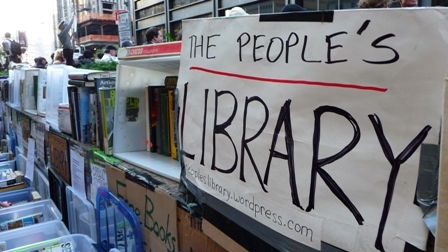
Occupy Wall Street’s Library?

by Katie Ginnane

As many of you have probably already heard, the Occupy Wall Street camp in Zuccotti Park has been evicted.  A raid  conducted this morning resulted in 200 arrests of park occupants.

What most of you probably don’t know is that the Occupy Wall Street protestors had amassed a collection of more than 5,500 books in their volunteer-run Occupy Wall Street library.  The volunteers have even set up their own blog for the library along with a catalog of the current collection.  The collection of books ranges from Spider-Man Comics to Jane Eyre.

The collection functioned using names in order to check out books.  The ground practices listed instructions on everything from how to process incoming books to opening and closing the library.

Unfortunately, when the raid occurred on the Occupy Wall Street protestors, the library was removed along with other personal property.  Flyers were handed out at the raid with instructions to retrieve any abandoned property at the Department of Sanitation; however, it is unclear where the books ended up.

Say it ain’t so, Joe!

By Mark Edwards

Despite a storied and illustrious 46-year career at Penn State University, college football coach Joe Paterno will be forced to retire in the midst of a child-abuse scandal involving a former assistant coach.  After being notified by a graduate assistant, the coach failed to sufficiently report to the proper authorities an alleged instance of child-abuse by his former assistant coach, Jerry Sandusky.  Mr. Sandusky has been charged with 21 felony counts of sexually abusing eight boys over a 15 year period.

Is Coach Paterno in anyway culpable?  Does his pristine reputation and legacy deserve to be trampled on despite his countess good deeds and notable charitable contributions he made to many academic endeavors?  Could one egregious transgress nullify 46 years of contributions to society?

The answers to these questions will vary from person to person, and only time will tell on how the court of public opinion would ultimately judge Coach Paterno.

What is notable and worth taking from this situation, is the all too frequent and sobering reminder of how fragile success can be.  One can move mountains and part waters to achieve great feats and dominate personal goals, but one lapse in judgment can compromise all the personal sacrifice and goodwill accumulated over the years.

In Coach Paterno’s case, once he was notified of the alleged transgression and decided not to report it to the proper authorities, the bad deed was done.   Every day he failed to properly disclose his knowledge of the alleged assault, the ramifications for his failure increased.  Days turn to months, and month to years.  So much time eventually passes that even a reasonable man in the Coach’s position would not opt to disclose his knowledge.  In essence, the bad deed can be narrowed down to one bad decision.  That decision not to tell the proper authorities at the first opportunity eventually festered into other reasoned bad decisions.  All gone so fast…

So we must learn from Coach Paterno’s mistake, and be vigilant protectors of our careers.

Happy Birthday to the MPAA’s Rating System

by Katie Ginnane

What is the MPAA you may ask? Well, the Motion Picture Association of America establishes the rating standards we so frequently use while attending movies, among other things. The modern rating system was enacted in order to counter extreme limitations placed on freedom of expression inherent in federal and state laws prior to 1968. With the advent of the modern rating system, rather than preventing movies from even making it to theaters, the founders of the rating system simply wanted to inform decisions of movie-goers, particularly parents.

Although the original ratings were somewhat different, the current ratings are comprised of G, PG, PG-13, R and NC-17, with G being the least controversial and NC-17 being the most.  According to the MPAA’s website, the rating of NC-17 should not be seen as a negative; however, according to an article published by CNN, the actual effects of an NC-17 rating make the rating inherently negative.

According to the article, growing pressure on the MPAA for a change in the system began with Stanley Kubrick’s Eye’s Wide Shut.  The film, originally given an NC-17 rating, had scenes cut in order to assure an R rating.  If the film studio had adhered to the original film and settled with its original NC-17 rating, advertisements of the film would not have been allowed on network television and many newspapers and certain theaters even would have refused to play it.

For more information on the film industry and censorship, check out these great resources and articles:

The Law Library: Quiet Once Again!

by Katie Ginnane

Noticed an increase in the background noise and chatter interfering with your long hours of study in the law library?  Well, we have got some great solutions for you to stop the insanity.

  • First, the law library has designated quiet areas with signs in the upper level on the left side of the library.  These are the spots to go if you really need complete silence to concentrate.  Anyone who chooses to study there should also be respectful of those around you and observe the quiet area.
  • Second, the reference desk has a bowl of earplugs available for students.  We will continue to stock the bowl through out the semester, so please feel free to grab a set.
  • Finally, the circulation desk has four signs available for three-hour windows that students can use.  The signs have two sides.  One side says “Go Away, I’m Studying” and the other side says “Do Not Disturb”.  These can be used by students who do not want their full concentration interrupted by others around the library.
Happy Studying!

Amanda Knox Released

by Katie Ginnane

For those of you keeping up with the well-known trial of Amanda Knox, it all came to a head yesterday. Amanda Knox’s guilty verdict was overturned by an Italian appeals court.

For those of you not keeping up with the Knox case, here is cursory look at the case and its underlying facts and legal issues.

The murder of Meredith Kercher occurred on November 1, 2007. That evening, Amanda Knox, Kercher’s roommate, was with Raffaele Sollecito, another individual convicted in Kercher’s murder trial. Kercher’s body was found by police officers (Post and Communications Police), Knox, Sollecito and Know’s other flatmates.

After Kercher’s body was found, Sollecito and Knox were both interviewed separately by the Italian government.  This resulted in a “confession” from Knox; however, it is unclear how the confession came about.  Knox claimed she was denied food and water and interrogated in Italian.  The Italian government denies such claims.  These allegations would later lead to libel charges against Knox.

Later in the investigation, the Italian Supreme Court would rule that Knox’s human rights were violated because she did not get a lawyer and was not informed of her legal rights; therefore, her signed statement could not be used in the criminal trial.

Police officers found their third suspect through DNA taken from a bloody fingerprint. Rudy Guede was convicted of Kercher’s murder along with Knox and Sollecito; however, Guede’s conviction was not recently overturned. His sentence was reduced because he apologized to the Kercher family.

Some of the evidence used against Knox and its problems are below:

Kercher’s bra clasp and a knife, which surfaced six weeks after the murder, were found with Knox’s, Sollecito’s and possibly Kercher’s DNA on them.  The two sides wanted DNA testing re-done because of possible contamination, but the appeals court refused.

Bloody footprints of both Knox and Sollecito were found at the scene of the murder; however, they were not found in Kercher’s bedroom.  Another expert challenged whether the footprints were really Knox’s and stated that the footprints were those of Guede’s.

Knox’s behavior after arrest also did not help her case.  According to police, Knox was turning cartwheels at the police station and at one point, sat on Sollecito’s lap during questioning.  The two were also seen embracing and kissing after questioning.

Guede testified against both Knox and Sollecito.

Once the written explanation of the appeals court verdict is published, we will have a better understanding of they came to their decision and why.

For more information, you can see the BBC’s news webpage on this issue, or try searching the news archive Westlaw or Lexis for various media sources’ coverage of the trial.

Famous Librarians!

by Katie Ginnane

In honor of Banned Books Week, the Georgia State Law Library brings you a list of famous librarians, some of whom might surprise you. Before, and sometimes after, these masters of microfiche became famous for their various pursuits, they spent their nine to five in the quiet of a library.  Among this list are a founding father and and former first lady, so librarianship truly leads to great opportunities!

Laura Bush– This former first lady attained her Masters of Library Science from University of Texas at Austin in 1973.  She was employed both in a Houston public library and at Dawson Elementary School.  She has been quoted as saying, “I worked as a teacher and librarian and I learned how important reading is in school and in life.”

Ben Franklin– Not just an inventor, this founding father conceived of the idea of a subscription library, which would pool funds from members to buy books available to all.  He implemented his idea with the Library Company of Philadelphia, which continues today with 500,000 rare books, 160,000 manuscripts and 75,000 graphic items.  Ben Franklin also hired the first American librarian, Louis Timothee.

Mao Zedong–  Prior to his reign over China, this dictator worked as an assistant librarian at Peking University, where he was also a part-time student.  After, Mao became headmaster of school in Changsha.

Lewis Carroll– Before he crafted Through the Looking Glass and inspired Jefferson Airplane, this famous poet and writer worked as a sub-librarian at Christ Church, a college in Oxford.  He would later teach there.  Mr. Carroll, whose real name was Charles Lutwidge Dodson, was also a mathematician.  Lewis Carol’s famous book Alice’s Adventures in Wonderland was banned by one of our other famous librarians, Mao Zedong.

Madeleine L’Engel– Prior to publishing A Wrinkle in Time, this author volunteered at the Cathedral of St. John the Divine as a librarian, where she was later the writer in residence.  Later, she would go on to publish dozens of both fiction and non-fiction books.  “A Wrinkle in Time” is also on several banned books lists.

J. Edgar Hoover– This former head of the F.B.I. worked in the Library of Congress while attending law school at George Washington University.  At the Library of Congress Mr. Hoover worked as a messenger, cataloguer and a clerk during his tenure at the library.  In 1919, he left the library to become a special assistant to the Attorney General.

Philip Larkin– This famous poet also made a career out his librarianship.  Larkin worked as the librarian for many institutions in England, from from the public library in Wellington, Shropshire to the University of Hull library.  Larkin is credited with making the University of Hull library the first library with an automated online circulation system in Europe.

NY Times References GSU Law Review Article

by Katie Ginnane

In a story published September 19, 2011, the New York Times mentioned an article published in the Georgia State University Law Review. The story, concerning the recent Supreme Court Decision, Citizen’s United v. Federal Election Commission, discusses the requirement of disclosure outlined in Citizen’s United. It discusses some of the policy implications behind requiring disclosure of campaign contributions by elected officials. By requiring disclosure, voters may be able to make more informed decisions when casting their ballot. The more well known holding in Citizen’s allows unlimited campaign spending by corporations and unions.

The Georgia State Law Review article, written by Professor Torres-Spelliscy of Stetson University College of Law outlines the campaign periods from 2007-2010 and “the dramatic 180-degree turn that the law has taken” after the Supreme Court’s decision.
If you are interested in scholarly works published by Georgia State or other law professors, SSRN is a great site for access to working scholarly papers. You can access SSRN through the law library homepage, under legal indexes and databases.

Why did I go to law school again? A look at resources on alternative legal careers

by Katie Ginnane

As many of us law students contemplate the end of law school and the beginning of our legal career, we all have moments of doubt.  Whether you are a first year student just getting started or a third year student ready to get out, we have all asked ourselves the same question.

Why am I in law school?

Because firm life is the main trajectory of recent law school grads, we law students all assume it is the right career for us without researching our alternatives.  Looking at all your options throughout law school may help you realize how much you want to work at a firm, or it may start you down a path you never thought about prior to beginning law school. With the legal market the way it is, it may be worthwhile to research careers outside of firm work. Either way, here are some great resources about “life after law school” careers that may be worthwhile for those moments of uncertainty.

Here are some useful books available in the law library:

Non-legal Careers for Lawyers

  • Non-legal Careers for Lawyers is published by the American Bar Association.  It includes three sections.  The first section offers general advice on pursuing a non-legal career.  The second section is divided into several chapters addressing specific subject-area and the non-traditional opportunities within each.  Finally, it contains a list of additional resources for more comprehensive and personal research.

Should You Really Be a Lawyer? 

  • Should You Really Be a Lawyer is also divided into three subsections, two of which involve deciding to attend law and staying in law school.  The last section, Should You Really Practice Law?, addresses the decision of whether or not you should practice, including a self-assessment.  This book is useful for determining what you want to do, not necessarily at finding the right career alternative for yourself.

The Lawyer’s Career Change Handbook: More than 300 things you can do with your law degree 

  • The Lawyer’s Career Change Handbook offers insights into changing legal careers; however, it also provides a great list of opportunities within different fields of the law and resources to find out more about them.  This book provides helpful hints on honing in on marketable skills.  It is more focused on broad strategies for finding jobs than on individual career paths.

The Lawyer’s Guide to Finding Success in Any Job Market 

  • The Lawyer’s Guide to Finding Success in Any Job Market has one chapter specifically devoted to alternative law school careers.  In this book, the careers are divided into 8 subsections with information on who does it, what it is, what it pays and breaking into the industry.  It also lists pros and cons of alternative career choices, with some pros being few geographic restrictions, possibly increased job security and better life-work balance and some cons being reduced earning potential, loss of prestige and possible difficulty of returning to mainstream practice.

Outside of the library, Westlaw and Lexis have several articles outlining some alternative careers in their news sections.

Finally, the career services office is a great source for questions and advice about what to plan for if looking at alternative opportunities after law school and later in your career.