Laptops in Classroom: Useful Tool or Attention Drain?

By John Evans

Most law students love their laptops. Editable, searchable notes which take less space and are much lighter than traditional books and pens. Laptops can also enable access to online textbooks and research platforms—all in the middle of class.  These new age textbooks can substitute lower costs, incorporate all sorts of media, and integrate advanced note taking options.

On the flip side, there is the distraction of social media, online games, articles and newspapers. Are the academic benefits worth the attention drain and temptations?

Some classes greatly benefit from the incorporation of laptops. For example, I found that the ability to update my work in real time while discussing issues in class was of immeasurable help in Foundations and Advocacy. However in more traditional classes, laptops only serve as a note taking devices.

noia

By Dread83


Even professors seem divided on the issue. Some professors have issued outright bans.  Others have embraced technology by abandoning the analog casebook.

Recent academic studies do point to some answers. One study from the University of Michigan, showed that when laptop use is incorporated into classroom, as opposed to just being used to take notes, students report greater classroom engagement.  Another study showed that when laptops were only used for note taking, students who used laptops in class had a statistically significantly lower grade when controlling for academic aptitude. The study also found that 25% of students played games in class and 43% used the laptop to surf the web.

evernote_on_ipad_and_macbook

By John Keane


Does this question come down to self-control? Is the onus on us, as students, to uses are laptops more responsibly. Should professors put their foot down and ban laptops?  Is it just another factor helping the cream to rise to the top? Does the ability to concentrate through available distractions demonstrate a useful job skill, thus reflected in a student’s GPA?

What strategies do you use to ensure you only use your laptop for classroom activities?

Has Bankruptcy Become a Weapon for Team Owners to Circumvent League Control?

A 5 Part Series by Blake Williams


united_states_bankruptcy_court_seal

With a total of 11 professional sports franchises filing bankruptcy and considering the unique ways that franchises attempt to use it to their advantage, bankruptcy has truly become a peculiar feat within sports culture.  While the rate of filings among professional sports franchises is not very high, three MLB franchises and two NHL franchises have filed for chapter 11 protection within the last seven years.  While these franchises’ respective circumstances have been unique, most of their financial troubles were caused by the majority owner defaulting on loans, disputes between the league and the franchise, or subpar performance on the field leading to poor support from the local community (the Cubs being the notable exception).  Overall, team bankruptcies must be judged as successes because 9 of the 11 franchises successfully reorganized and remain active in the same city they were in when they filed.

It’s particularly peculiar, that of the 11 franchises that filed bankruptcy over the last 45 years, six of them have been from the National Hockey League.[1]  Patricia Moses of Portfolio 101 explained that, “It turns out that NHL teams have a higher likelihood of failure because the teams have less cash flow and the owners usually have a lower net worth than owners of other sports franchises”.[2]  The NHL has 30 teams, which means that 20 percent of the league has filed for bankruptcy protection at least once. The Pittsburgh Penguins are the only team that has filed twice. Also, the Cleveland Barons were the last major league sports franchise to cease operations due to its bankruptcy filing and subsequent merger with the Minnesota North Stars (now the Dallas Stars).

The MLB seems to have caught the latest bankruptcy bug.  The MLB has had five franchises file for bankruptcy, with three of the filings having occurred since 2009. This means that one out of six franchises have filed.  The most interesting fact is that as of recent, it’s not the small-market teams that are filing, but rather the big-market teams.[3]  No NFL or NBA teams have ever filed for bankruptcy protection.[4]


Stay Tuned for Part II: Reasons Teams File for Bankruptcy


[1] Patricia Moses, 4 Reasons Pro Sports Team File for Bankruptcy, Investopedia (Mar. 9, 2011),  http://www.investopedia.com/financial-edge/0311/4-reasons-pro-sports-teams-file-for-bankruptcy.aspx.

[2] Patricia Moses, 4 Reasons Pro Sports Team File for Bankruptcy, Investopedia (Mar. 9, 2011),  http://www.investopedia.com/financial-edge/0311/4-reasons-pro-sports-teams-file-for-bankruptcy.aspx.

[3] Matt Egan, The Latest Weapon in the Pro Sports Playbook: Bankruptcy, Media Advertising: FOXBusiness (July 01, 2011), http://www.foxbusiness.com/features/2011/06/30/pro-teams-throw-chapter-11-into-playbooks.html.

[4] Joseph Checkler, Sports Teams’ Secret to Success After Bankruptcy: File Again!, The Wall Street Journal (June 27, 2011), http://blogs.wsj.com/bankruptcy/2011/06/27/sports-teams-secret-to-success-after-bankruptcy-file-again/.

I’m On Campus and I Want Food!

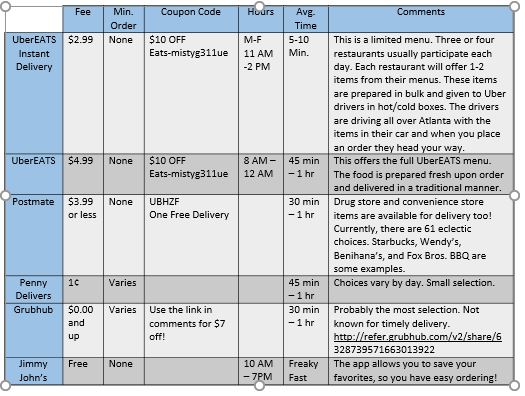
Now that you are a month into the semester, you might be looking for some new dining options. You’re studying hard, spending long hours on campus, the student organization kick-offs that provide free food are dwindling, and you may be tired of the cuisine available within walking distance or in the law school. You could walk to your car, fight traffic, and drive in search of food more suitable to your palette, but with the study hours required for law school, ain’t nobody got time for that!

fasting_4-fasting-a-glass-of-water-on-an-empty-plate

by Jean Fortunet

There is a solution for bored taste buds. Downtown Atlanta is a foodie’s heaven. Although all of the tasty meals may not be in walking distance, the COL’s urban location offers a variety of delivery options. In fact, there are so many options that the delivery services compete with each other by offering discounts (sometimes FREE) delivery on initial orders, and many offer referral fees. Plan your meals as carefully as you craft a legal memo in Lawyering Foundations, and you may eat cheap for a few weeks!

capture


Event Management System: A New Way to Host Events

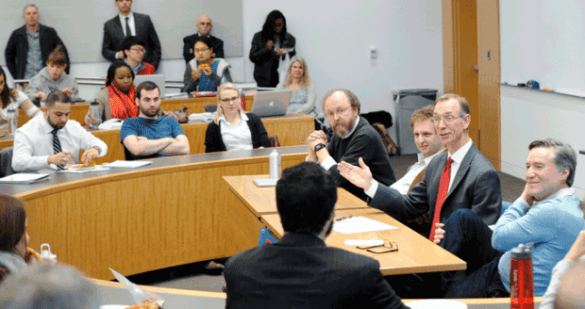
One of the College of Law’s numerous informative events put together by student organizations last year. This panel was organized by the American Constitution Society and discussed the passing of Justice Scalia.

by Veselin Simonov

If you are not a part of a student organization or club – then what are you waiting for?! The College of Law has over 25 different student organizations and one of them will surely catch your eye! From constitutional law to labor and employment – we have it all and you can check them out here.

If you are already part of a student organization, chances are your board will want to set up an event. To do that, you would need to reserve a room. Room reservations were previously done via email, however the College of Law recently began handling room reservations through the Online Event Management System (EMS). EMS is a simple, hassle-free way to reserve lecture halls and event space for speaker and panel-style events. This system is not for reserving library study rooms – you will still have to do that at the fifth floor desk or online.

To access EMS, go to the Events tab on InsideLaw. If you choose Internal Calendar, it will show you everything occurring in the College of Law on a particular day, including all the classes. If you choose Public Calendar, it will show you more typical “events,” like programs put on by CSO or by student organizations. To access EMS, select “Add an Event”. If you have not used the system before, you will have to submit an access request. You will typically receive permission to access the system within 24-36 hours of your request.

Once you have been granted access, you can request a room by going to “Reservations”. This will take you to a scheduling page where you need to enter some basic details about your event like date, time, expected attendance, etc. Once you complete your search, simply select a room from those shown as available and complete the booking (which formally requests permission to use the room). If you encounter any problems with the system, please contact College of Law staff by emailing lawevents@gsu.org.

Tips for Tackling Your First Semester of Law School

By Colleen Hampton

The first semester of the 2016-17 school year is underway and the building is buzzing with a special kind of caffeine-induced energy.  It’s the energy that comes with a fresh crop of 1L’s. Welcome to this wild, overwhelming world of legal education. 1L hell, as some call it, can be tricky but it doesn’t have to be the end of life as you know it.

Life in law school is all about balance and GSU COL has helpful resources to assist you in finding the ideal balance. Here are some helpful tips from those who survived 1L hell:

  1. Do your reading. Being prepared is a pretty big deal in law school (okay, it’s the biggest deal).  I wish I had a sassy quip to make light of this one but, no. It’s simply unprofessional to show up to class without having done the reading.  Read your cases.
  2. Start outlining earlier. You don’t have to know how the black letter law fits together in order to outline. Use your syllabus or table of contents in your book to begin. Both should have a useful framework in which you can insert your notes. This will help tremendously when November rolls around and exams are looming over you.
  3. Attend the Academic Success lectures. This law school stuff is new to you and that’s okay. The Academic Success Program includes a series of lectures covering subjects from ‘study groups’ to ‘exam strategies’ and everything in between. You can find the schedule for the Academic Success lectures on inside law.
  4. Take care of yourself. This is an absolute must. You are working hard to develop the discipline necessary to hack it in law school but don’t forget to recharge your batteries (yes, even if it means you take a break from reading). The Mindfulness in Law Society offers advantage of the Mindfulness Wednesdays beginning in September as well as Yoga classes on Wednesday morning (beginning September 20th from 7:20-8:20) and Tuesday afternoon (beginning September 21st from 4:30-5:30).  Contact the President of the Mindfulness in Law Society, for more information.
  5. Find a study group. Studying with others is important for a lot of students. Finding the right group may take time and that’s okay. When you found your study group start meeting sooner than you think necessary. Use your time to run over questions you have from the reading or discuss hypos from one of the study aids in the library. Working together early (before the exam crunch) will help you find the group that works best for you and give you a solid foundation when the panic of exams sets in.

Ultimately, there is no ‘right’ way to law school. Everybody learns differently and has different needs. If you are neck deep in your first semester of law school it can feel pretty overwhelming but do not despair. Try your hand at some of these suggestions, we hope they are helpful. Know that law school is survivable. You can do this.

Survived 1L hell? What worked for you? Share you tips and tricks with the incoming class.


We Also Have Fun and Games!

Grab some friends and have some fun!

by Veselin Simonov

Have you had a long study session recently? Have you been stressed out about classes? Do you feel like you would rather eat your casebook than read another long, complicated case? If you answered “yes” to any of those questions, you may have fallen victim to a particularly nasty case of study fatigue.

But fret not, intrepid soon-to-be legal scholars! If you’re looking for a fun remedy that’s close at hand, then look no further than the fifth floor library desk! Believe it or not, we’ve got stuff that’s even more entertaining than study aids and flash cards (though those certainly come in handy for exam prep!). We also have a selection of wonderful board and card games and we welcome you to grab some friends and try them out!

Feel like a nice, relaxing game of chess? We’ve got you covered! Chess not your cup of tea? You can use the board with the checkers set that’s also included! Or maybe you and a few friends would like to play some bridge. No problem – just check out a deck of Bicycle playing cards. We’ve got other card games too. Apples to Apples will entertain a crowd of 4 to 10 players. Or you could give something like Uno or Phase 10 a shot. Think you can beat all your friends at Dominoes? Just rent out the library set and show them what you’re made of! Would you rather dust off your vocabulary skills? Then grab our Scrabble set and check out a dictionary while you’re at it. And if cribbage is more your game, then you are in the right place!

There are plenty of ways to beat stress in law school. Board and card games are an especially effective method. They are fun, social activities that will build bonds with your classmates and help you relax after a brutal day of critical thinking and learning new legal concepts. We hope you consider putting this valuable library resource to good use!

The 2016 Presidential Race: A Chance for History

By John Evans

If you are anything like me, right now two sets of stories dominate your social media feeds; stories of the Olympics and stories about the presidential elections. With the Olympics already receiving a blog post, I figured I will focus on the presidential election.  What is a possible implication of the Electoral College?


1908The 12th amendment to the Constitution of the United States changed the Electoral College and in part established that in the event no candidate receives a majority of electoral votes, the House of Representative shall choose the president from the top three candidates. However, each state only gets one vote.

As of 8/15 the fivethiryeight.com forecasts Clinton receiving 322 votes and Trump receiving 216. 270 electoral votes are needed for a majority. If Trump is able to rally and win back Florida and North Carolina that would change the totals to Clinton 278 and Trump 260.

But what happens when a third party candidate breaks up the two party political monopoly?  The only candidate currently running who seems to have any chance would be Gary Johnson of the Libertarian Party.  To stage this upset, Johnson would only need to take away 9 electoral votes from Clinton. Johnson’s home state, New Mexico, holds 6 votes and the “Free State Project”–New Hampshire–holds 4 more.  If Johnson wins these two states the final tally would be Clinton 268, Trump 260 and Johnson 10.  The election would then move to the House.

Many people, at this point, would say that the idea of a third party candidate winning even one state is impossible and not worthy of any analysis. However Gary Johnson may be the first third party Candidate even allowed to debate in modern history. Presidential debates are planned and sponsored by The Commission on Presidential Debates (CPD).  The FEC requires the CPD to choose the participants in the debates based on “pre-existing, objective” criteria.

The CPD’s criteria: “[c]onstitutionally eligible … appear on a sufficient number of state ballots to have a mathematical chance of winning a majority vote in the Electoral College, and have a level of support of at least 15 percent of the national electorate as determined by five selected national public opinion polling organizations.”

Historically, many third party choices have met the first two criteria and are held out by the third.  Johnson has recently received his own bump in the polls.

Johnson media attention has also been significant, including large articles in Politico and Time Magazine. This additional media attention could lead to a last big push to the 15% mark and get Johnson on the big stage. Johnson could then use the momentum from getting into the debate to win some electoral votes.

With the likelihood the republicans retaining the house, and the unpopularity of Trump among house republicans, who knows the outcome.


WANTED: Class of 2016 Student Commencement Speaker

A speaker from the 2015 GSU Law Commencement

A speaker from the 2015 GSU Law Commencement

Calling all graduating 3Ls! Do you enjoy public speaking? Have you dreamed of giving the commencement address to your fellow classmates? Do you have something awe-inspiring to share? THIS IS YOUR CHANCE.

SBA is seeking applications from 3Ls who will be graduating this May to represent our class as the student commencement speaker. If you’re interested (and you should be), email your resume and a short description of what you would talk about if you were chosen to speak (a few paragraphs) to Dean Timmons (kctimmons@gsu.edu).

The deadline for submission is Wednesday, April 6. That’s tomorrow! So, take this afternoon and tonight to gather your thoughts and sum up your law school experience at GSU. What have the past three years meant to you? What do your classmates mean to you? What have you learned about yourself or the law along the way? Who would you like to thank for making this possible? We want to hear what you have to say!

Here’s Reese Witherspoon’s Legally Blonde speech for some inspiration:

Summer Classes!

by Veselin Simonov

As summer veers ever closer, students – especially 1Ls – face the decision of whether to take classes during the summer. It’s a complicated issue and it’s ultimately up to how each individual student’s schedule shakes out. That said, here are some basic tips that might help you make up your mind.

  • To be a full time student in the summer and qualify for financial aid, you need at least six credit hours. That’s two three-credit courses.
  • If you’re doing a full time summer internship, it may prove tricky to reconcile that with your class schedule.
  • Luckily, the College of Law offers a variety of day and evening courses. There’s also a selection of online courses. This should offer you some flexibility when you’re figuring out your schedule.
  • If you’re participating in the externship program, those credits count towards the minimum you need to qualify for financial aid. That means that you can take an externship and only one class and still meet the six hour minimum.
  • You still have required courses as a 2L. Two of those are Constitutional Law I and Professional Responsibility. Both are offered over the summer. If you knock one of them out in the summer, that can leave you with more options to take electives in the fall and spring of your second year.
  • The College of Law has added some interesting new electives this summer. For example, there’s the mediation clinic and the brand new animal law course.
  • Be prepared for a somewhat more intense class experience. Because of the short time frame, courses are more condensed which means longer classes and potentially a denser workload.

If you’re still not sure whether you should take summer classes, try contacting your adviser or the faculty members teaching the courses you’ve got your eye on. They should be able to help you craft a schedule that makes sense.

Volunteer Opportunities for Spring Break

396623135_e52d134e35_o

Image courtesy of Jacob Moyer via Flickr Creative Commons

By: Murtaza Khwaja

Staying in town over Spring Break? Need a way to catch up on your pro bono hours?

Want to help out in your local community?

Well, here are just a few of the many volunteer opportunities available via Hands on Atlanta during this year’s spring break. Check the Hands on Atlanta Volunteer Calendar for the full schedule: (http://www.handsonatlanta.org/HOC__Volunteer_Opportunity_Calendar_Page)

Sunday 13th March:

  • 1:00pm: Urban Farming at Truly Living Well East Point

Monday 14th March: – Friday 18th March

  • 9:00am : Trees Atlanta Weekday Plant Guardians (Monday, Tuesday, Wednesday, Thursday)
  • 9:00am: Books for Africa (everyday)
  • 10:00am: West End Community Urban Garden (may be cancelled)
  • 1:00pm: Trees Atlanta Weekday Plant Guardians
  • 1:00pm: Books for Africa
  • 3:00pm: Girls Inc. of Greater Atlanta Program Volunteer
  • 4:00pm: Elementary Homework Help

Saturday 19th March:

  • 7:00am: Green Market – Piedmont Park Conservancy
  • 8:00am: Discovery Program at Thomasville Heights Elementary School
  • 8:00am: Discovery Program at Perkerson Elementary School
  • 8:30 am: Teen Service Saturdays: Trees Atlanta
  • 8:30am: Food Pantry at Clarkston United Methodist Church
  • 9:00am: Books For Africa


The Muslim Law Students Association is also planning to take a visit down to Clarkston to meet with the refugee population Saturday March 13th, so if you are interested in immigration law or in working with refugees be sure to reach out to Haroun Mcclellan (MLSA President) @ amcclellan1@student.gsu.edu to reserve a slot.

And don’t forget to stay on the lookout for any PILA events including their Criminal Law panel (March 15th) and their annual Law week talk.

Also, if you’re interested in further volunteer opportunities throughout the year make sure to check out these two organizations and the different projects they have going on.

Glitter of Hope Foundation (The Glitter of Hope Foundation is a not-for-profit organization devoted to addressing the basic needs of orphan* children rescued from refugee camps in Africa and Asia and brought into the US as refugees. ) http://www.glitterofhope.org/

Helping Organizations and People Everywhere (H.O.P.E. teams up with non-profit organizations and charities worldwide to support many initiatives including: financial empowerment, ambassadorship and networking, strengthening local communities, physical & mental health, youth leadership, and non-profit consulting.) http://hopefsm.weebly.com/