30 Years of Banned Books Week

Banned Books Week by ALA

Banned Books Week by ALA

September 22-28, 2013 is the 30th anniversary of Banned Books Week. Banned Books Week celebrates the freedom to read by highlighting attempts to suppress books.  In recognition of this anniversary, the American Libraries Association has put together a timeline of books either banned or challenged during the 30 years that Banned Books Week has been celebrated. Among the books on the timeline is that classic of legal literature, To Kill a Mockingbird, which has been repeatedly challenged for language and racial themes.

From the legal side of things, the decision to remove a book from a school library is generally made by the local school board and can be appealed in court. If you want to find cases dealing with the banning of books, we suggest you check out cases assigned the topic and key number Constitutional Law 1983. You may also want to check out Girls Lean Back Everywherea classic book on the law of censorship.

A Key Day for Indigenous Peoples

On September 13, 2007, an event over two decades in the making happened: the United Nations General Assembly adopted the Declaration on the Rights of Indigenous Peoples. 143 countries voted in favor of the Declaration; although the United States voted against it, the U.S. has since voiced its support for the Declaration.

The Declaration addresses issues such as the right to self-determination, preservation of cultural heritage and ethnic identity, and the forcible removal of indigenous peoples from their lands or territory. Work to ensure the implementation of the Declaration continues, particularly by the United Nations’ Permanent Forum on Indigenous Issues, which meets for its thirteenth session in May 2014.

Keeping up with the Justices

Photo by Flickr user  Phil Roeder.

Photo by Flickr user Phil Roeder.

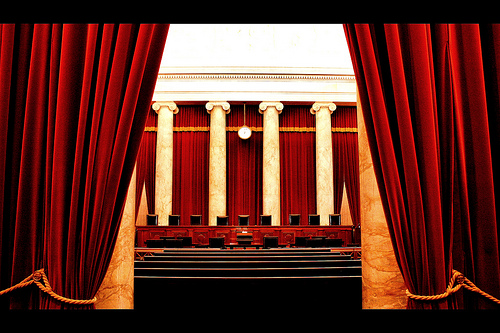
It’s mid-June, which means that things are starting to heat up in the Supreme Court. As you probably know, the Supreme Court has a history of releasing their most controversial/high-profile opinions at the end of the term, which is generally in late June. The Court has already moved to announcing opinions twice a week, on Mondays and Thursdays, and in the past week has handed down a few of this term’s blockbuster opinions, most notably Association for Molecular Pathology v. Myriad Genetics on Thursday and Arizona v. Inter Tribal Council of Arizona today.

There are still 14 decisions outstanding, including decisions in high-profile cases such as:

As with many aspects of the Supreme Court, the source to go to when you want to find out what’s going on is SCOTUSblog, which live blogs the opinion announcements every Monday and Thursday. If you don’t want to read the full opinion in each case, you can always check to see if the haiku version has been posted.

Toward Better Googling

frustration

Photo by Syben Stüvel.

There’s this idea floating around that, as librarians, we’re supposed to tell you not to “just Google it.” But the reality is that, well, that works sometimes. The problem that many people have with finding information on Google, though, is that they don’t know all of the different tricks you can use to make your Google search more efficient.

Next time you’re searching Google and not finding what you want, try these out:

  • Use quotation marks. Just like in Lexis and Westlaw, quotation marks in Google can be used to find phrases.
  • Seriously, use quotation marks, even for single words. One way that Google helps you is by automatically including results with words related to the term you searched. However, if you only want to find the word you searched and no other related words, you need to put that word in quotation marks. To see this in action, just look at the difference between this search and this search.
  • If you want even more related words, use a tilde. The tilde (~) before a word will bring back search results with a broader list of synonyms. (Also, you now know that that symbol is called a tilde.)
  • Limit your search to a specific site or domain. Want to just search government websites? Include this in your search: “site:.gov” Want to just search the College of Law’s website? Include “site:law.gsu.edu”
  • Limit your search to a specific filetype. You may have noticed that reports are usually put online as PDF files. You can limit your search to just PDFs by including “filetype:pdf” in your search. This works with any file extension – try it out to find Word documents, Powerpoints, etc.
  • Change the order of the words. The order of the words matters in Google’s search algorithm. To see the difference, just try searching for “state georgia” and “georgia state.”
  • Use wildcards. The asterisk (*) is a wildcard operator for words in Google. You can’t use a wildcard for a single character, but you can use it for a word. So do you have a phrase where you think one or more words might change? Use a wildcard to replace them. It works great with misheard song lyrics.

Google has a page that you can consult with more tips and tricks. You can also take a couple of online courses on better searching.

Read (Something Other Than Casebooks)!

Photo by Flickr user aafromaa.

Photo by Flickr user aafromaa.

We know – finals are about to get underway, and you don’t have time right now to read anything other than casebooks and outlines. That’s OK. Because in a few weeks, finals will be over, and the summer will begin. Which means that you’ll have time to read for fun, because that’s a thing that people do, we’ve heard. We consulted with the College of Law faculty, and received from them the following suggestions for some lighter reading. (If you want more suggestions, see our previous lists.) You know, for when exams are done (because exams will be done).

Pam Brannon

It’s almost impossible to overstate the influence The Hitchhiker’s Guide to the Galaxy, by Douglas Adams, has had on me. I first read it when I was still in elementary school, and I can’t count how many times I have read it since then. I’m reading it again right now, actually. I’ve been trying to think of a way to describe it, and the best way I can think of is to say it’s impossibly funny. And impossibly influential. If you have any geek leanings at all and haven’t read Hitchhiker’s Guide, a lot of references will be explained once you read it. The importance of towels and the number 42. The Radiohead song “Paranoid Android.” Also, it has a character named Slartibartfast. That’s amazing.

Mark Budnitz

The Burgess Boys, Elizabeth Strout. This is a story about two brothers living in New York, one a corporate lawyer, the other a legal aid attorney doing criminal appellate work. They both go home to Maine to help their nephew who has been accused of committing a hate crime.

Russell Covey

Gone Girl, Gillian Flynn. Flynn’s latest book, Gone Girl, is definitely her best yet. The book tells the story of Nick, whose beautiful wife Amy disappears amid signs of foul play. With a bow to the famous Japanese film Rashomon, the book tells the story of Amy’s disappearance from both Nick and Amy’s viewpoints, giving rise to substantial questions regarding the reliability of the narrators. I would have ended the book differently, but that’s just me. It kept me on edge all the way through. Great beach reading.

William Edmundson

A Perfect Spy is one of John le Carré’s best. Another book, Single and Single, involves lawyers, and resembles A Perfect Spy in its plot line, though it is not quite as well turned. The resemblance is no coincidence, because David Cornwell (le Carré when he’s at home) had a father on which the father character (or father-figure) in both novels was modeled. What makes Single and Single singular is not only that its protagonist is a lawyer, but is a lawyer with both a senior partner and clients from Hell.

Anne Emanuel

The Gift of Rain, by Tan Twan Eng. Technically a historical novel set in Malaysia during WWII, it is extraordinarily gracefully written and, as the author says, “very strong on human themes… Relationships, aging, love…”

The Tiger: A True Story of Vengeance and Survival, by John Vaillant. Gripping. A beautifully written compelling tale. Not a book I would have sought out, but once it was put in my hands, not a book I could put down.

Lynn Hogue

I just finished reading Richard Ben Cramer’s book What It Takes: The Way to the White House about the 1988 presidential race. It was published in 1993, so many folks may already have read it. The author, Cramer, died recently, and I picked up on it from his NYT obituary. I found it fascinating. Several folks who ran then, e.g., Joe Biden, are still around. Anyway, I would highly recommend it. Cramer has a breezy style and a great eye for detail. The book is apparently popular with political junkies, but you don’t have to be one to enjoy the book.

Deborah Schander

Whenever I get stressed about something, or just want to relax with a book I know I’m going to enjoy, I pull out A Year in Provence by Peter Mayle for another read. Published in 1990, A Year in Provence became a literary sensation and can in large part be credited (blamed?) for the “author moves to another country and writes pithy comments about the experience” genre. But don’t worry about the hype. It deserves all its praise. Mayle is a wry, witty author who can find humor and pathos in the most random of events. Immerse yourself in a world of French plumbers who never seem to be on hand to do the work, neighbors who are trying to sell their ramshackle abodes for a fortune, and the descriptions of Provençal food. Oh, the food. Delicious.

Nirej Sekhon

Beautiful Ruins, Jess Walter. A gifted crime-fiction writer branches out with tremendous effect!

Roy Sobelson

The Orphan Master’s Son, Adam Johnson.

Ellen Taylor

My Beloved World, Sonia Sotomayor. Sotomayor’s new memoir is a great read, and very inspirational.

Anne Tucker

The Round House, Louise Erdrich. From the NY Times Review: “A Native American woman is raped somewhere in the vicinity of a sacred round house, and seeking justice becomes almost as devastating as the crime. The round house itself stands on reservation land, where tribal courts are in charge, but the suspect is white, and tribal courts can’t prosecute non-Native people. In a morass of laws, the judge handling the case is uncertain whether the accused man can be charged at all, the 13-year-old boy whose mother was raped pursues his own quest for justice. In the process, this young boy will experience a heady jolt of adolescent freedom and a brutal introduction to both the sorrows of grown-up life and the weight of his people’s past.”

The Orchardist, Amanda Coplin. From the NY Times Review:  “‘His face was as pitted as the moon,’ Coplin writes of her late-19th-century protagonist, a well-meaning orchardist named Talmadge whose familial yearnings are eclipsed by early misfortune: the mysterious disappearance of his teenage sister. At the cusp of middle age, Talmadge forms surrogate kinships with Della, a young girl also haunted by the loss of a sister, and Caroline, the herbalist who attended his mother before her death.” This book struck me as about the dividing line between solitude and loneliness. It was a gripping story that I raced to finish, and afterwards found myself thinking about the characters and missing them.

The Boy Kings of Texas, Domingo Martinez. This is a nonfiction memoir that reads like it must be fiction because how could anyone’s childhood/adolescence/early adulthood be so fraught with disaster and still have the main character survive to write about it later? This book is funny in its tragedy as the author talks about living between two worlds in the border town of Brownsville, Texas and the emotional upheaval of his family-life. In my circle this book has been read by as many male as female readers and all have been captivated by the humor, the rage, and the story of what feels like growing up in another world.

Work for the Law Library!

This could be you!

This could be you!

The Law Library is hiring Reference and Research GRAs for Summer and Fall 2013. Reference GRAs work at the reference desk and report to Deborah Schander; more information on the position is available in the job description. Research GRAs perform research and document delivery for law faculty and report to Pam Brannon; more information on the position is available in the job description.

Summer GRAs receive a 1/2 tuition waiver and a $500 stipend; Fall GRAs receive a 1/2 tuition waiver and $1000 stipend.

If you are interested in either position, please apply! To apply for the Reference position, please submit a cover letter, your resume, and a completed availability statement to Deborah Schander at dschander@gsu.edu. To apply for a Research position, please submit a cover letter and your resume to Pam Brannon at pbrannon@gsu.edu. Please submit your information as one file with your last name as the filename. To be considered, applications must be received by 5 p.m. on April 10, 2013.

The Race (to the Patent Office) is On!

Today, March 16, 2013, marks a major change in U.S. patent law. Until today, the United States has operated under a unique first-to-invent system.Today, thanks to the America Invents Act, the U.S. changes to the system used by the rest of the world, a first-to-file system. What does this mean?

Under a first-to-invent system, if two people file patent applications on the same invention, the patent office awards the patent to the person who is able to prove that they invented (conceived and reduced to practice) the invention first, regardless of who filed their patent application first. In a first-to-file system, however, priority is given to the applicant who filed first, creating what is popularly called a “race to the patent office.” There are ways that the first inventor can retain priority, however, even if they file second. The USPTO is ready for the change, having released its final rule and examination guidelines implementing the new system.

The first-to-file system has been criticized, particularly by those who argue that the system is unconstitutional. The constitutionality of the America Invents Act has also been challenged in court, in MadStad Engineering, Inc. v. United States Patent & Trademark Office.

Without a court ruling blocking the implementation of the Act, however, the system is set to change today. Get your running shoes on!

Happy Birthday, Antitrust Law!

The President’s Dream of a Successful Hunt, by Clifford Kennedy Berryman, 1907.

In the beginning of this year, the Federal Trade Commission concluded a 20-month-long investigation into whether Google violated federal antitrust laws, an action which has met with mixed reactions. When most people think of antitrust law, they think of trust-busting Presidents Theodore Roosevelt and William Howard Taft, the Sherman and Clayton Acts, or more recent events such as the Microsoft case. They don’t really think of Alabama.

Which is unfortunate, because Alabama has a number of ties to antitrust law. Alabama holds the distinction of being the first state to pass an antitrust law in the United States, on February 23rd, 1883, seven years prior to the passage of the first federal antitrust law, the Sherman Antitrust Act of 1890. The Alabama law prohibited railroads from forming agreements to divide the market and fix prices in the freight industry in Alabama.

Henry De Lamar Clayton, Jr., the sponsor and namesake of the Clayton Act of 1914, was a representative from Alabama. The Clayton Act added significant features to federal antitrust law, including restrictions on price discrimination and interlocking directorates.

Want more information on antitrust laws? The Law and University Libraries have some materials that may be of interest, such as:

Top Blawgs

Image by Flickr user futureshape.

Image by Flickr user futureshape.

Recently the ABA Journal named its 2012 “Blawg 100,” the 100 best legal blogs (or “blawgs”) out there. The list includes some of our old favorites, like Law and the Multiverse (seriously, love that blog), but some others that deserve mention:

Abnormal Use: Abnormal Use focuses on products liability litigation, including litigation about football turf and the Star Wars prequels.

The Careerist: The Careerist provides tips and advice on getting and managing a job in the law, including some helpful chats with partners at top firms about what they’re looking for when they hire.

Circuit Splits: Every student who makes law review hears it – “Circuit splits make great note topics.” The Circuit Splits blog provides an easy way to get the latest information on areas of the law where the circuits disagree.

Hollywood, Esq.: There are a lot of lawsuits in Hollywood. A lot. This blog from the Hollywood Reporter covers them all, whether they relate to movies, TV shows, music, you name it.

The Jury Room: Keene Trial Consulting provides practical advice and information on how to make the best impression on a jury, often using examples from their own cases.

LawProse: Want to know how to write more effectively? Follow this blog from Bryan Garner, the guru of legal writing. Garner provides a usage tip of the day and answers questions about usage and style.

Lowering the Bar: You can get a sense of what this blog covers from the post categories. Assorted Stupidity. Lawsuits (Ridiculous). The Inexplicable. Make sure to check out the Case Law Hall of Fame.

Screw You Guys, I’m Going Home: Covers information on any aspect of labor and employment law, including on just what can and can’t get you fired and myths about employment laws. It also may win the contest for best  blog name.

Supreme Court Haiku Reporter: Can’t read through the whole opinion? You can get a sense of it in three lines. (Note that reading haiku instead of the cases will not be enough to get you through being called on in class. Or your exams.)

ZombieLaw: Whenever zombies show up in legal documents, this blog is there, complete with pictures of senators, judges, etc. as zombies.