Organ Donor Registries Grow Thanks to Facebook

Green ribbon for organ donation awareness. Image by Wikimedia user MessrWoland.

Yesterday Facebook announced that it had teamed up with Donate Life America for a new initiative: promoting organ donation. Using a new feature in Facebook’s Timeline, Facebook users can sign up to be an organ donor and share their registration status on their Timeline. Since the announcement more than 100,000 users have used the feature, with over 18,000 as of Wednesday morning clicking through to sign up to be an organ donor.

Organ donation is regulated in a number of ways, including through a uniform law – specifically, the Uniform Anatomical Gift Act. There are three versions of the Act that are in use by various states; the U.S. Department of Health and Human Services maintains a chart of the differences in state legislation. The Uniform Anatomical Gift Act, among other things, includes provisions allowing people to sign up to become an organ donor when they receive their driver’s license. However, the success of this strategy is mixed, with registration rates differing greatly between states.

So maybe Facebook’s strategy will help with the transplant waiting list. Facebook has also set up a help page with instructions on how to sign up as an organ donor and share your status.

The Random Legislator

Image

Image by Wikipedia user Marysas

The focus of this election cycle has started to shift; Mitt Romney, the presumptive Republican presidential nominee, has already begun his search for a running mate. In addition to the presidential election, contests for seats in state legislatures and Congress are starting to gear up. As this election year wears on, some people will begin to ask whether this is the best way to choose our legislators.

According to a group of Italian physicists, maybe not. The scientists, from the University of Catania, created a mathematical model of a parliament with two parties. They then proceeded to show how the efficiency of the parliament is improved when some of the legislators are selected at random, rather than elected. These random legislators they dub the “accidental politicians.”

If this sounds new, it really isn’t. Picking legislators at random has a long history, going back to ancient Greece and sortition. Maybe this will bring back the kleroterion?

The Rule Against Perpetuities Goes to the Oscars

One of the biggest moments of Sunday night’s Oscars broadcast was Jim Rash’s impromptu “loving tribute” to Angelina Jolie’s leg-baring pose. Rash was on stage with Nat Faxon and Alexander Payne accepting the Oscar for Best Adapted Screenplay for The Descendants, which was adapted from a novel by Kaui Hart Hemmings.

The story in The Descendants is propelled by the need to sell property that has been in the family for generations due to the operation of that bane of first-year law students, the Rule Against Perpetuities. The filmmakers consulted with University of Hawai’i professor Randall Roth to get the details of trust law right (which cannot be said of the other movie to use the RAP as a plot device, Body Heat). And it appears that they’ve also gotten the details of day-to-day life as an attorney in Hawai’i correct, as well. An article in Forbes notes that the movie provides a number of lessons in estate planning.

Who said you couldn’t learn something by going to the movies?


The Georgia Legislature: Goings On Up the Hill

Photo by Wikipedia user connor.carey.

The Georgia General Assembly began its 40-day session on the second Monday in January, as specified by the Georgia Constitution. Today representatives from Georgia State University (including the College of Law) made a special trip to the Capitol to highlight our recent activities to legislators. In turn, we figured we’d show you how to follow what the legislators themselves are doing.

While the legislature is in session, both the House and the Senate provide live broadcasts from the floor. You can also view archived footage from House floor and committee meetings. Additionally, both the Atlanta Journal-Constitution and the Daily Report track what’s going on from day-to-day.

But what if you want to know about a piece of legislation that was discussed last session, or back in 2002? There’s help for you, too. All of the resources in the last paragraph are used by the members of the Georgia State University Law Review to help create the Peach Sheets. Law Review members follow the session as its going on, identify important pieces of legislation, and compile the information that they will use to write articles describing the legislative history of those laws. In addition to the Peach Sheets, the Mercer Law Review produces the Annual Survey of Georgia Law. Each article in the Annual Survey summarizes significant cases and legislation from the past year on a specific legal topic.

And, finally, you can always just go and visit – after all, the Capitol is just up the hill!

Happy Thanksgiving!


Image by (V)oluntary (∀)mputation

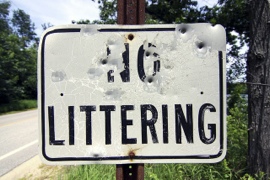
Happy Thanksgiving from the College of Law Library! Although everyone hears about the first Thanksgiving, did you know that Congress didn’t officially establish the last Thursday in November as Thanksgiving Day until 1941? And not long after that another famous Thanksgiving event occurred – Arlo Guthrie’s arrest for littering, immortalized in song as “Alice’s Restaurant.”

Yes, it’s true. Alice exists. The restaurant and church existed (the church is now the site of the Guthrie Center, actually). And, on November 28, 1965, Officer Obie (a.k.a. William J. Obanhein) did actually arrest Arlo Guthrie for littering. You can even go up to Stockbridge, Massachusetts in May and see all of the sites on the annual “Garbage Trail Walk.”

Since the release of song detailing the events surrounding the arrest – and the subsequent film – listening to “Alice’s Restaurant” has become a Thanksgiving tradition for many Americans. Turn on the radio on Thanksgiving around noon, and you’re likely to hear it on at least one station.

And, just like the dump in the song, the library’s closed, of course – we reopen on Sunday, November 27th. In the meantime, we hope you’re all having an enjoyable few days off!


Introducing: Bloomberg Law

This is an exciting week for the Law Library, because we’re in the process of rolling out access to a new resource for the College of Law: Bloomberg Law. Bloomberg Law’s a relatively new resource in the world of legal information, although Bloomberg itself has been around for a while.

(If you recognize the name, it may be because (a) you’ve worked in the financial industry, (b) you have access to the cable channel, or (c) the founder is the mayor of a pretty big city.)

In addition to cases and statutes, Bloomberg Law provides expanded access to company information, news resources, and court dockets. And let’s face it – we’re all about providing access to more information!

To help with the roll-out, we’re hosting two representatives from Bloomberg who are leading sessions introducing this new resource. To make the process even easier, they’re even providing food!

There will be three sessions on Tuesday, October 25th:

  • 1:00 to 2:30 p.m., in Room 170
  • 2:45 to 4:00 p.m., in Room 100
  • 5:00 to 6:00 p.m., in Room 100
So stop by, learn about a new way to find information, and grab something to eat!

Jefferson and the Library of Congress

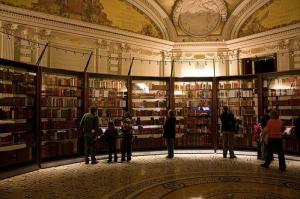
Picture by Flickr user mkoukoullis

Today, the Library of Congress is the largest library in the world, with over 147 million volumes, but it actually had a little bit of trouble getting off the ground. The Library of Congress was established in 1800, and by 1814 had around 3,000 volumes. Those books, though, went up in smoke when the British burned Washington, D.C. during the War of 1812, leaving Congress without a library – that is, until Thomas Jefferson stepped in.

By 1814, Thomas Jefferson was a little strapped for cash and, coincidentally, also had the largest collection of books in the country. Sensing an opportunity to remedy two issues (his financial situation and the condition of the Library’s collection), Jefferson wrote to Congress offering to sell his personal library to replace the destroyed Library of Congress. After a bit of debate (which, by the way, you can see for yourself in the U.S. Congressional Documents Library and on the Library of Congress’ site), Congress agreed and bought 6,487 volumes from Jefferson for $23, 950, more than doubling the previous size of the Library. Unfortunately, though, there was another fire in 1851 that destroyed two-thirds of Jefferson’s collection; what remains, though, forms the core of the Library of Congress’s current collection.

In 2008, the Library of Congress recreated Jefferson’s library – both physically in the library and online. The interactive portion of the online exhibition also recreates Jefferson’s original organization of the books, starting with the broad categories “Memory,” “Reason,” and “Imagination.”

Kunstler, Darrow and… Shatner?

By now you all know, of course, that the Law Library has a pretty great DVD collection, and you also know where it is. (Oh, you don’t? Well, go down to the Federal Reporter and hang a left.) And we’ve done some work over the summer to make it better, including adding some interesting depictions of real life (and some not-so-real-life, of course) lawyers.

For instance, we already owned the Criterion Collection’s DVD release of Young Mr. Lincoln, starring Henry Fonda as a young travelling lawyer named Abraham Lincoln; we’ve also recently added the DVD of Henry Fonda’s acclaimed one-man show about Clarence Darrow, in which he recounts the trials of  John Scopes and Leopold and Loeb.

Disturbing the Universe on POVWe’ve also added a documentary on a much more recent and controversial attorney, William Kunstler, who died on September 4th, 1995, while preparing to represent another in a long line of controversial defendants.

Don’t need all of that reality? Well, we have you covered, too. Check out The Defender, starring a very young William Shatner as an attorney defending Steve McQueen, or the more recent (and hilarious) Harvey Birdman: Attorney at Law. Who knows? You might just get an idea for your outfit for next year’s Dragon*Con!

Civ Pro Case Study: Deities

If you’re a follower of the career of Malcolm McDowell, then you probably know about his upcoming movie, Suing the Devil.

You might find this premise a little familiar for a couple of reasons. For those of you who haven’t taken Civil Procedure, you may be familiar with either the short story or film version of The Devil and Daniel Webster. For those of you who have taken Civ Pro, then you’re probably reminded of another case brought against Satan, United States ex rel Mayo v. Satan & His Staff, 54 F.R.D. 282 (W.D. Pa. 1971). The opinion in that case is a civil procedure classic, in which the district judge denies the plaintiff’s prayer to proceed in forma pauperis due, in part, to a lack of personal jurisdiction and proper service of process.

In that case though, as opposed to the movie, no one showed up as counsel for the defendants. This can be contrasted with another, more recent case, Chambers v. God, No. 1075 (Neb. D. Ct., Douglas Cty., Oct. 14, 2008). In this case, Nebraska State Senator Ernie Chambers sued God in state district court, seeking a permanent injunction preventing God from continuing to “cause harmful activities.” The final order to dismiss is was posted online by Slate, but what are more interesting are the documents mentioned in the order: three answers filed on behalf of God and a special appearance, all filed in September 2007. Luckily for us, the Civil Procedure & Federal Courts Blog posted the original petition, all three answers, and the special appearance, which are a wonderful read for just about anyone, although only lawyers and law students may really appreciate the invocation of the doctrine of unclean hands.

Studying and Fun: Not Mutually Exclusive

We’ve entered the final stretch of exams, which means that you’re likely feeling at least a little bit fatigued. And while it’s important to stay the course and remain focused, an important part of studying, particularly for law school exams, is knowing when you need to take a break. You could always help yourself to one of the DVDs from our Leisure collection, but there are a few other ways you can take a break and still do some studying.

One way is to watch YouTube videos starring beloved childhood toys, such as Legos. For example, those of you still studying for Torts may find the Lego reenactment of Palsgraf to be helpful. If you’re studying for Evidence, though, we’ve heard that there may be some flaws in the Lego explanation of hearsay exceptions. (Hint: If there is a contradiction, it’s best to side with Prof. Milich on evidence law. He did help rewrite the Georgia evidence code, after all.)

Another option is to use the TV shows and movies you watch as hypotheticals. For example, you may want to use your break to watch Thor; afterward, you can visit Law and the Multiverse for an analysis of the legal issues in the movie, such as the interpretation of force majeure clauses and the important problem of supervillain insurance (or, more specifically, the lack thereof). If you’re catching up on the last few episodes of The Office, then check out That’s What She Said, where attorneys at Ford & Harrison total up the potential litigation value of each episode.

If you need a break from reading, try playing a game. Maybe one of the games designed by Justice Sandra Day O’Connor; Do I Have a Right? lets you manage a civil rights firm, while Argument Wars lets you argue cases such as Gideon v. Wainwright, Snyder v. Phelps, and Brown v. Board of Education.

Finally, if all you really want is to find some peace and seek out the inner stillness of the law, try some Supreme Court haiku. Breathe deeply, sit quietly, and meditate on the Constitution – in seventeen syllable increments.