ALI Members at Georgia State Law

Do you know what the American Law Institute (ALI) is and better yet do you know whom on the Georgia State Law faculty are members?

First things first: as you remember from your first year legal bibliography class, the ALI is made up of 4000 lawyers, judges, and law professors of the highest qualifications.  Through a deliberative process (sometimes taking two decades), they draft and then publish restatements of law and principles of law.  Final versions of these resources can be found in hardcopy in the Law Library general collection (e.g. the Restatement of Law, Torts can be found among tort resources, KF1246-KF1327 and Restatement of Law, Contracts can be found among contract resources, KF801-KF839).  The final restatements can also be found on Westlaw. Their Restatement of Law, Torts database contains the complete text of the 1st, 2nd, and 3rd Restatements of Torts as well as some proposed and tentative drafts, while their Restatement of Law, Torts Archive database provides considerably more historical tentative drafts, proposed drafts, and draft-related documents from the ALI Reporter.

Georgia State Law is well represented in the institute.  The following faculty are members of the American Law Institute:

The Real 8,000,000th

Patent DrawingEarlier this week the US Patent and Trademark Office (USPTO) granted  patent number 8,000,000 to Second Sight Medical Products Inc. for a device that helps people with degenerative vision problems to see better.  It’s certainly a far cry from patent number one granted after the Patent Act of 1837 for enhancements to locomotives wheels.

Now I don’t want to crash anyone’s party, namely the USPTO’s party at the Smithsonian American Art Museum on Sept. 8, 2011 recognizing granting patent number 8,000,000, but patent number 8,000,000 is not actually the 8,000,000th patent granted. It is worth noting that patent number one is not the first US patent issued.  Rather there were around 9,900 patents issued prior to patent number one. These patents were originally unnumbered; however, the USPTO has since gone back and numbered the surviving early patents, prefacing the number with an “X”. Today these patents are commonly known as the X-Patents. That being said I am unaware of these patents having any special mutant abilities, save an immunity to fire. Unfortunately less than 2,000 of the early patents survived the patent office fire of 1836.

So the US actually issued its 8,000,000th patent about 9,900 patents ago and with an eye to being  more precise and giving credit where credit is due, I propose here that we instead recognize Mitsubishi Heavy Industries, Ltd.’s patent for a Battery control device for hybrid forklift truck —US PAT 7,990,100– as the closest thing we will ever come to a 8,000,000th US patent.

So please join in the USPTO celebration on September 8th but also have a drink in the name of Mitsubishi Heavy Industries, Ltd 8,000,000th US patent and X-Patents.

Dean Johnson Inducted Into Law Librarian Hall of Fame

With throngs of Georgia State University Law Librarian, both past and present, cheering in appreciation, Nancy Johnson was inducted into the American Association of Law Libraries (AALL) Hall of Fame at the 2011 AALL Annual Meeting and Conference.  The Georgia State University Associate Dean for Library and Information Services and Professor of Law is part of the 2011 class of hall of fame inductees and joins other  pioneers and leaders of the profession.

Librarian Johnson in the Rare Book Collection

Johnson built the Georgia State Law Library collection from the ground up.

The following announcement is from the June issue of AALL Spectrum:

Nancy P. Johnson, associate dean for library and information services and professor of law, Georgia State University, has been active nationally in AALL and especially the Academic Law Libraries Special Interest Section (ALL-SIS). On the local level, she has been active with the Atlanta Law Libraries Association (ALLA) and the Southeastern Chapter of the American Association of Law Libraries (SEALL), serving as president of ALLA in 1990-91 and of SEALL in 2003-04. She was chair of the ALL-SIS in 1992-93 and served as Special Interest Section Council chair in 1993-94. She was a member of the AALL Executive Board in 1996-99 and chaired the AALL Economic Study Advisory Committee on Law Book Pricing, for which she received a Presidential Certificate of Appreciation in 2001. In 2009 she was honored by the ALL-SIS with the Frederick Charles Hicks Award for Outstanding Contributions to Academic Law Librarian ship, and in 2010 she received the SIS’s award for best article of the year for “What First-Year Students Should Learn in a Legal Research Class,” published in Legal Reference Services Quarterly.

Johnson’s strengths can be seen in her writing, her teaching responsibilities, and her support as a mentor. She has guided many former staff members to new positions as directors and associate directors in law libraries. She has spoken at and has served as a moderator at AALL Annual Meetings as well as SEALL and CALI programs. She was one of the early founders of CALI’s Legal Research Community Authoring Project, which reached a milestone in 2010 with 100 legal research lessons. Georgia Legal Research, co-authored with Elizabeth Adelman and Nancy Adams, is the definitive publication on the subject. Sources of Compiled Legislative Histories has been published with regular updates since 1979 and is now available on Hein Online. Johnson has been a co-author of Legal Research Exercises, most recently with Susan Phillips, since 1986.

Congratulations Nancy. It is well deserved.

CALI Lessons on the iPad

How many tiBlack Angry Birdmes have you caught yourself catapulting angry birds across your iPad thinking, “if only CALI lessons were not in flash and available for the iPad, I could be having just as much fun while learning secondary considerations used in assessing the nonobviousness requirement in patent law.”

Well that time is almost here.

Starting in the fall CALI lessons will be available to students with mobile devices such as iPads and iPhones. The new viewer dubbed CALI 5 uses HTML and Jquery to bring their library of lessons to mobile devices. For more information visit the CALI website announcement.

Faculty can preview the iPad-iPhone compatible viewer over the summer. To learn more about the new viewer faculty can register for an upcoming webcast: New lesson viewer webcast on July 12.  Also faculty can view a CALI conference session on the CALI 5 viewer.

Going Back to CALI

Today is the first day of the CALI conference for Law School Computing.  The conference is being hosted at Eckstein Hall, the new home to Marquette University’s Law School  (which was designed by the same architects the College of Law worked with during the pre-design phase of our new building).  I imagine as I type this law school technologists, librarians, faculty and administrators from around the U.S. are discussing law school technology on the shores of Lake Michigan while drinking beer,  and eating sausages.

CALI Conference Logo

CALI (the Center for Computer-assisted Legal Instruction) is best known by law students for their library of interactive, computer-based lessons. The CALI library of lessons is a collection of over 851 lessons covering 33 legal education subject areas. They are interactive tutorials written by law faculty to supplement traditional law school instruction. The format of the exercises varies according to the authors’ objectives.  The Georgia State Law librarians have authored several legal research lessons including:

  • Georgia Legal Research–Primary Source Material
  • Georgia Legal Research – Secondary Source Materials
  • Copyright and Trademark Legal Research
  • Mastering Looseleaf Publications
  • Forms of Federal Statutory Publication
  • Researching Federal Legislative History

Information on how to access CALI these and other lessons can be found here

Students may also know CALI for the awards they give out at the end of each semester.  The CALI Excellence for the Future Award is given to the highest scoring student in each law school class at many law schools including Georgia State Law. Past award winners can be found here.

In addition to the more visible lessons and awards, CALI is engaged in a number of interesting and forward-looking initiatives to better facilitate the teaching of law.   eLandell is  a new model for law school casebooks, namely electronic casebooks that better lend themselves to ebook and iPad users.  Classcaster is a blogging and podcasting solution to help faculty supplement their lectures. Free Law Reporter publishes nearly all appellate and supreme court opinions.   We recommend that you explore all of CALI’s resources.

What you may not know is how involved Georgia State College of Law has been in CALI.  As mentioned above Librarians have contributed significantly to the library of lessons.  Technologist and librarians presented at CALI every year for as long as I can remember.  This year Librarian Pam Brannon is presenting case management technology to better support faculty research.  Prof. Patrick Wiseman currently serves on the CALI Board of Directors.  Finally not one, but two Georgia State Law faculty members received the CALI Excellence in Service Award:  Dean Nancy Johnson and Prof. Patrick Wiseman.

If you are interested in viewing this year’s sessions you can do so online or if you are interested in exploring what all CALI has to offer you can get the Georgia State Law activation code here.

Library Construction

Very few events are a more accurate indicator of the arrival of summer than library construction projects.  This year is no different. No sooner was Joseph Zukusky hooded as the last Juris Doctor candidate at this year’s commencement and hooding ceremony than the Law Library started knocking down walls with an eye to finishing before our new crop of law students arrive in August.  This year’s library construction includes three projects:

  • new study rooms
  • additional soft/relaxed-style seating area
  • upgrading the Instructional Lab.

Study Rooms (184A-C)Study room construction

Room 184 in the University Center wing of the Law Library (more commonly known as ‘up the steps’) is being renovated to accommodate three new study rooms.  This space had previously served as an unneeded copy room and more recently a seldom-visited student lounge. The new study rooms will be outfitted with networked tables similar to our other study rooms.  After the project is completed in late July the law library will offer eighteen study rooms that can be reserved by study groups via the Law Library Study Room Reservations System.

Soft Seating Area (across from the Georgia collection)

The bizarre brick silos that pepper Urban Life create unique and cozy spaces.  The Law Library is outfitting one of these spaces with soft/relaxed seating and improved lighting.  Hopefully this will make the space more inviting. This space is located immediately beside the Georgia collection.

Instructional Lab (113B)Computer lab renovation

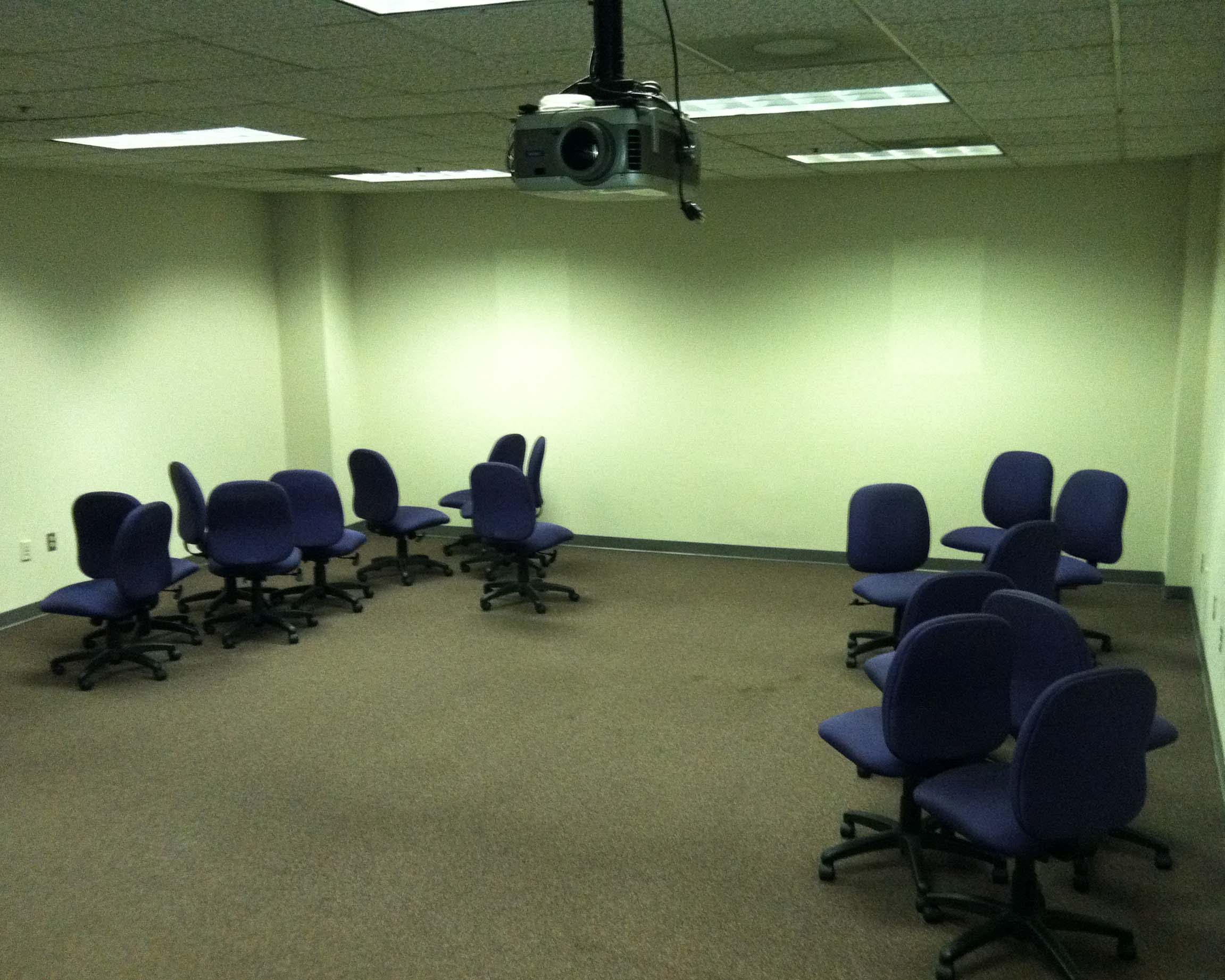
The instructional lab (more commonly known as the back half of the computer lab) is being renovated and upgraded.  The instructional lab had supported 24 worn and weathered workstations with out-of-date CRT monitors.  The new instructional Lab will support 16 new workstations with considerably more desk work space allowing students to spread out and take notes when the space is used as a classroom.  The Instructional Lab will also offer an instructor’s workstation and mounted LCD projector that will project a larger image than before.  This project will also be completed in late July.  Until that time the back lab is unavailable to students; however, the front lab consisting of the help desk, 12 workstations, and printers (PantherPrint, Westlaw and Lexis) will remain open over the summer.