On Why Glannon’s Civil Procedure E&E Is The Best Law School Supplement of All-Time

by Hanish Patel

glannoncivpro

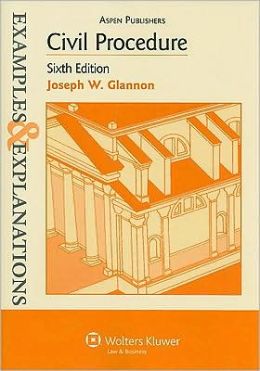
Of course, it is no hard feat to write about the dread of reading law supplements and the associated anxiety of exams. I am confident history cannot produce a single instance of a student delighted in reading a textbook.  No, the real challenge arises in reading them as literary works on their own, separated from its underlying material and academic purpose. While the law and material that fill a supplement is the same for all books, no two supplements are ever alike. Why is it that some favor “Gilbert’s” over “Emanuel’s” or vice versa? The answer lies in the same reason why anyone prefers a work literature over another – the author’s use of his craft. In this respect, Joseph Glannon’s seminal Civil Procedure: Examples & Explanations may be regarded as the best law school supplement of all-time.

Divided into six parts, the E&E takes on the herculean task of explaining to first-year law students the strangeness that is civil procedure, with its dizzying array of concepts and rules like impleader, res judicata, and ancillary jurisdiction. In his opening “Preface to Students,” Glannon acknowledges civil procedure as the “most unfamiliar and intimating” of the law school courses, but prods students to be patient as they wander through the labyrinth. It is here the epic journey begins.

In this heroic quest, Glannon makes use of the classic E&E formula – explanation, example, followed by explanation – but with the flair of a virtuoso. First, he begins with an insightful and concise explanation of the law, summarizing vast abstract concepts to a mere two pages while showing respect to the complexities and nuances involved. Next, like Socrates, he presents a thorny hypothetical that simply forces the student to critically analyze not only the problem, but the world around them. He finishes with an explanation that borders on poetic, leaving students asking for more. For visual learners, he provides countless diagrams and flowcharts to clear up the resulting fog of complex litigation. Glannon makes this three-step dance look effortless as he guides the nervous and stumbling student through the contours of their mind.

As an added special treat for the determined reader, buried throughout the text are little gems of wit and anecdote. The chapter on the Erie Doctrine, entitled “Eerie Erie” opens with a fictional comedic tale of a young Glannon learning about the doctrine during his first year, with an appearance by the Archangel Gabriel advising the dozing Glannon to pay attention in class. One can only imagine a smirk on the face of Glannon as he was feverishly typing.

In his book, Glannon tells the reader he aims to make the whole process “rewarding” and “perhaps even enjoyable.” Undoubtedly, he not only achieves his goal, but far surpasses it, providing a generation of students like myself a beacon of hope in learning civil procedure in the days leading up to the exam. I dream of the possibility of a movie adaptation.

A Nicer Place to Sit: A Parable

by Julia Hightower

sit

Last semester, Austin Williams and Deborah Schander found an uncatalogued book in the stacks. While the author is unknown, authorities agree it is likely the last journal of a former law student. Sadly, within its pages was an entry many of us can relate to.

“Hour 2 in my search for a Clean Restroom:

My bags have become too heavy to carry. I’ve abandoned them in an empty locker. I pray they will remain safe until my return. Rations are low. Moral is poor. If a nicer place to sit is not found soon, I fear the worst.”

This journal’s haunting last entry got the reference librarians thinking, “How can we improve the libraries amenities for the poor lost souls, I mean law students, who spend so much time here?” They reviewed last year’s library survey, but not enough people filled it out to give them a cohesive idea of what the student population wanted. (Seriously, go fill out the survey. They listen!) So they took the next logical step. They convened the panel of your peers known as the “Law Library Advisory Committee” and asked for ideas. In response your library, your home away from home, went through a MAJOR upgrade:

  • First, they succeeded in replacing the old water fountain with a Hot and Cold Filtered Water Fountain. Go! Rejoice! Make Tea!
  • The Library purchased board and card games for your entertainment. Said games, available at circulation, may be checked out for 3 days. Take them home over the weekend and host a board game night.
  • Thinking about skipping class because your laptop is dead? We have laptop chargers for checkout.
  • Is your smartphone dying? Ask circulation if they have a smartphone charger which fits it!
  • And last, but certainly not least, the restrooms now have toilet seat covers.

Let this parable be a lesson to you. Change can come!

The Democratic People’s Republic of Korea

DMZ_kalleboo

Flicker photo by kalleboo

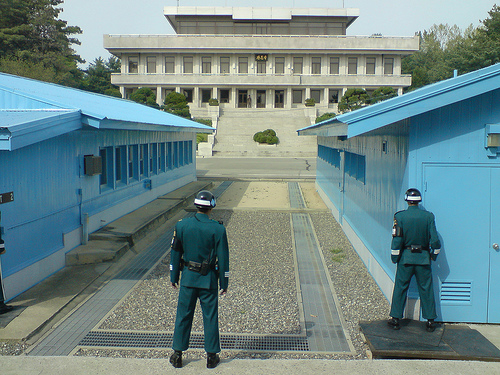
The Democratic People’s Republic of Korea (DPRK), popularly known as North Korea, has generated a significant amount of press recently in regards to its rhetoric towards the Republic of Korea, also known as South Korea, and the United States of America.  While tensions have increased recently, relations between the three over the past 60 years have always been less than cordial.  The strained relations between the three stem from their involvement in the Korean War.

The Korean War (June 1950 – July 1953) was seen as the first military action of the Cold War.  Supported by the Soviets and China, the North Korean Army crossed over the 38th parallel and invaded South Korea, which was supported by the United States.  Eventually the 38th parallel was restored with the signing of the armistice agreement between North and South Korea.  While this stopped the fighting, it was not a peace agreement.  North and South Korea are still technically at war with each other today.

In the past several months, tensions have risen significantly due to North Korea’s long range rocket launch in December 2012 and underground nuclear bomb test in February 2013.  In March, after the U.N. Security Council agreed to sanctions, North Korea abandoned the 1953 armistice and cut its military hotline with South Korea.  In April, North Korea moved several medium-range missiles to its east coast and pulled all of its workers out of the Kaesong Industrial Complex.  It’s unclear what all of this will eventually mean.  North Korea does have a history of charged rhetoric in order to gain concessions.  One can only wait and see how this will all play out.

The following sources will provide more information on current developments with North Korea and information on the Korean War.

April Celebrations


Day PictureBy Kristin Poland

Spring break is over, and you might be thinking that there aren’t any holidays to look forward to until Memorial Day, right?  Wrong!  April is full of fun and interesting celebrations, so choose your favorite and make it memorable.

Dyngus Day was celebrated on April 1st this year.  Traditional activities include soaking ladies with water and swatting them with pussy willow branches.  If that type of thing doesn’t appeal to you, you could just kick back with a plate of pierogies and listen to some polka music instead.

April 7th is No Housework Day, so be sure to get your laundry done on Saturday if you happen to be running low on clean undies.

The inventor of Scrabble was born on April 13, 1899, and so, every April 13th, we observe National Scrabble Day.  I recommend commemorating the day by learning all of the words that begin with “q” but do not require “u.”

Tuesday, April 16th is National Library Workers Day.  I can’t find a reference anywhere, but I’m pretty sure that this momentous holiday is observed by bestowing gifts of baked goods on your friendly GSU Law librarians.

Closing out the month is Hairstyle Appreciation Day, on April 30th.  Websites recommend that, among other things, you style your hair in a special way, or in a way that you have not tried before.  For those of you born after 1989, and therefore never sported a mullet for school pictures (with the laser background, of course), now is the perfect time to try it out.

Happy April!

Free Online Education

Flicker photo by Extra Ketchup

Flicker photo by Extra Ketchup

By Mark Edwards

A new nontraditional method of education has emerged through free online education websites.  While education costs are steadily rising, these websites serve as a method to overcome the financial barrier that prevents many people from receiving an effective education.  The lessons are presented in a variety of formats such as: online videos, audio recordings, blackboard illustrations, and many more.  Here is a list of some of these websites:

Khan’s Academy (https://www.khanacademy.org/) – uses Yahoo Doodle images on a blackboard in combination with a voiceover to teach over 4,000 micro lessons.  Subjects include: mathematics, history, healthcare, medicine, finance, physics, chemistry, biology, astronomy, economics, cosmology, and organic chemistry, American civics, art history, macroeconomics, microeconomics, and computer science.

Open Yale Courses (http://oyc.yale.edu/) – is a project of Yale University to share full video and course materials from its undergraduate courses.  All lectures were recorded in the Yale College classroom and are available in video, audio, and text transcript formats.

U.C. Berkeley (http://webcast.berkeley.edu/) – is a database of video of undergraduate lectures recorded by professors of U.C. Berkeley.

MIT OpenCourseWare (http://ocw.mit.edu/index.htm) – is an initiative of the Massachusetts Institute of Technology (MIT) to put all of the educational materials from its undergraduate- and graduate-level courses online, partly free and openly available to anyone, anywhere. MIT OpenCourseWare (OCW) is a large-scale, web-based publication of MIT course materials.

Wikiversity (http://en.wikiversity.org/wiki/Wikiversity:Main_Page) – is a collaborative learning community in which the internet community creates and edits the lessons.

Coursera – (https://www.coursera.org/) – offers courses from various universities around the county.  Courses include engineering, humanities, medicine, biology, social sciences, mathematics, business, computer science, and other areas.

Work for the Law Library!

This could be you!

This could be you!

The Law Library is hiring Reference and Research GRAs for Summer and Fall 2013. Reference GRAs work at the reference desk and report to Deborah Schander; more information on the position is available in the job description. Research GRAs perform research and document delivery for law faculty and report to Pam Brannon; more information on the position is available in the job description.

Summer GRAs receive a 1/2 tuition waiver and a $500 stipend; Fall GRAs receive a 1/2 tuition waiver and $1000 stipend.

If you are interested in either position, please apply! To apply for the Reference position, please submit a cover letter, your resume, and a completed availability statement to Deborah Schander at dschander@gsu.edu. To apply for a Research position, please submit a cover letter and your resume to Pam Brannon at pbrannon@gsu.edu. Please submit your information as one file with your last name as the filename. To be considered, applications must be received by 5 p.m. on April 10, 2013.

Indictment Against Groundhog

by Joshua Kahn

groundhog

Image Used By Permission Under Creative Commons License

Ohio prosecutor Michael Gmoser has filed an indictment against groundhog-prognosticator Punxsutawney Phil, accusing the varmint of purposely misrepresenting an early spring. The charges are extremely serious and carry a potential death penalty.

The prosecution’s case is likely to rest on the groundhog’s purported “incapab[ility] of error” which, the prosecution will say, shows his clearly erroneous prediction was an intentional misrepresentation.

We here at Georgia State believe it is critical that the voiceless be given their day in court, and are therefore asking students to help us draft an amicus curiae brief in the case on behalf of Georgia groundhog—and holder of an honorary doctorate from GSU—General Beauregard Lee.

General “Beau” Lee seeks to argue his Yankee colleague simply is not very accurate, that Punxsutawney Phil’s most recent wrong prediction was just another in a long series of mistakes, and, therefore, he should be spared a grisly demise at the hands of overzealous prosecutors.

Beau is also willing to offer expert testimony that his predictions are more accurate than “cousin” Phil’s.

Any interested students should contact the library staff.

h/t Ohio State Law Library

The Race (to the Patent Office) is On!

Today, March 16, 2013, marks a major change in U.S. patent law. Until today, the United States has operated under a unique first-to-invent system.Today, thanks to the America Invents Act, the U.S. changes to the system used by the rest of the world, a first-to-file system. What does this mean?

Under a first-to-invent system, if two people file patent applications on the same invention, the patent office awards the patent to the person who is able to prove that they invented (conceived and reduced to practice) the invention first, regardless of who filed their patent application first. In a first-to-file system, however, priority is given to the applicant who filed first, creating what is popularly called a “race to the patent office.” There are ways that the first inventor can retain priority, however, even if they file second. The USPTO is ready for the change, having released its final rule and examination guidelines implementing the new system.

The first-to-file system has been criticized, particularly by those who argue that the system is unconstitutional. The constitutionality of the America Invents Act has also been challenged in court, in MadStad Engineering, Inc. v. United States Patent & Trademark Office.

Without a court ruling blocking the implementation of the Act, however, the system is set to change today. Get your running shoes on!

100 Milestone Documents

Stock Photo of the Consitution of the United States and Feather QuillTake a walk through United States history using the National Archives and Records Administration’s “100 Milestone Documents.”  The website, www.ourdocuments.gov, provides PDF access to documents from 1776 – 1965.

In addition to the Declaration of Independence and the Constitution of the United States, there are several documents that have both historical and legal significance.  Below is a list of a few documents contained in the 100 Milestone Documents that may be of interest to law students:

  • Bill of Rights (1791)
  • Marbury v. Madison (1803)
  • Emancipation Proclamation (1863)
  • Executive Order 9981: Desegregation of the Armed Forces (1948)
  • Armistice Agreement for the Restoration of the South Korean State (1953)
  • Executive Order 10730: Desegregation of Central High School (1957)
  • Voting Rights Act (1965)

Happy (?) Be Nasty Day!

by Joshua Kahn

Crosa

Image by Crosa

March 8th is national Be Nasty Day (do not ask us how this got started) and a wonderful occasion to review a few defamation lawsuits.

We all know that somewhere deep in the bowels of case reporters lurk some outrageous cases, and here are a few for your procrastinatory enjoyment:

Newman v. Delahunty, 681 A.2d 671 (1994)
Apparently, it’s not impossible to defame a political candidate.

Hustler Magazine, Inc. v. Falwell, 485 U.S. 46 (1988)
The name pretty much says it all.

Burnett v. National Enquirer, Inc, 144 Cal.App. 3d 991 (1983)
Did “a boisterous Carol Burnett had a loud argument with another diner, Henry Kissinger. . . traipse around the place offering everyone a bite of her dessert. . . [then] accidentally knocked a glass of wine over one diner and start giggling instead of apologizing?”

If you want to learn more about defamation law, we have a number of good books on the topic in the library stacks.