Laptop Anchors Installed

In response to students’ requests the law library is in the process of installing laptop anchors on about half of its 113 student study carrels located throughout the law library’s lower and upper levels.

These laptop anchors –essentially a hook fastened to the study carrels with an industrial adhesive and screws– allow students to secure their laptops with a laptop cable. Most laptops offer a K-slot or other anti-theft system that allows a user to attach a security cable to the laptop and in turn secure it to an anchor. Check with your manufacturer for recommendations of security cables that are compatible with your laptop.

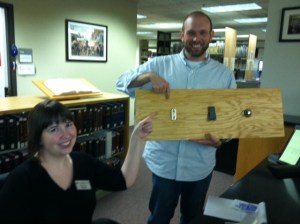
Librarians Williams and Brannon point out the selected laptop anchor

We found that there is no shortage of laptop anchor designs and options available. Consequently the law library looked to the students for direction in selecting the ones that would be ultimately installed.  Over spring exams (as part of the library’s coffee study break initiative which transforms the library conference room into a makeshift café offering free coffee to students studying for exams in the library) three laptop anchors were presented. Students were asked to vote on which anchor they would like to see installed in the law library. 92 votes were cast and the overwhelming preference with 57 votes was anchor option A (seen here with Librarians Austin Williams and Pam Brannon).

These laptop anchors will be installed over the summer and available by the start of the fall semester (if not sooner).

The law library does provide public services during regular university business hours (8:30 am to 5 pm, Monday to Friday). Members of the public are welcome in the law library at these times. The law library is committed to providing a safe and studious environment for members of the College of Law community as well as the general public. Students are reminded to take personal responsibility for protecting their property. While laptop anchors and security cables do create a deterrent to theft, it is strongly recommended that students never leave their laptops or other computing devices unattended—even if you are just getting a drink of water or running to the bathroom.

Fun with State Ballot Laws

By Stephen Adams

by Flickr user dreamagicjp

We all envision state employment and service as a humdrum kind of life, complete with triplicate forms and staid office buildings. It’s the 1984 of the legal realm, where the status quo prevails, and we all wear metaphorical matching suits while learning about our doubleplusgood state statutes.

But not in Hawaii.

Leave it to a state with a festive, colorful shirt to break the monotony of state election laws. This week, after a two month back-and-forth with Arizona Secretary of State Ken Bennett, Hawaii has again verified President Obama’s long-form birth certificate, this time after providing us all with a lesson how to deal with those who make our day oh-so-interesting.

Ken Bennett, presumably under pressure from an apparently-whopping 1,200 constituents in Arizona, started a state ballot ordeal by requesting that Hawaii verify President Obama’s birth certificate yet again, even after Hawaii had done so multiple times. These requests were so numerous to the state that a special statute was passed to allow the state to disregard certain requests.

Talking Points Memo obtained, through a FOIA request, emails sent from Bennett and Jill Nagamine, Deputy Attorney General for the state of Hawaii; and they can be read here. The emails show us two main tactics in dealing with testy folks: 1) stalling, and 2) using the law to make them work for it.

Could Hawaii have just verified the birth certificate and made Bennett (and those 1,200 birthers) happy? Probably, but what’s the fun in that?

Keep It Simple, Lawyer

MacBook writing (Håkan Dahlström) / CC BY 2.0

Today, May 21st, was the first day of the fifth international Clarity Conference. The conference brings together people from around the world who are involved in the plain-language movement, who will discuss efforts to promote the use of plain, simple language in a variety of legal contexts. Advocates of plain language say that it saves time and increases compliance with laws and regulations. Using plain language in jury instructions, for example, can improve juror comprehension.

The plain-language movement has made some headway in recent years. The Plain Writing Act of 2010 requires that federal agencies use language “that the public can understand and use.” The Plain Regulations Act of 2012, introduced earlier this year, would close a loophole in the Plain Writing Act and require that agencies write regulations in plain, clear language. The ClearMark Awards reward companies and agencies who adopt plain language in their documents and websites.

Want to know more about how to write plainly and avoid “legalese”? Check these resources out:

CRS Reports

Have you ever wondered how a congressman with little or no background in science or military matters can speak so intelligently on these topics during interviews or debates in Congress?  Part of it may be that they have a good speech writer or congressional staff.  Another reason may be that they have read a CRS Report on that topic.

CRS Reports are produced by the Congressional Research Service (CRS), a department within the Library of Congress.  The CRS writes reports that provide policy and legal analysis for members of Congress.  Usually they tackle complex topics and attempt to examine the issue from all sides.

The CRS was originally called the Legislative Reference Service when it was created through legislation in 1914.  Further legislation in 1970 changed its name to Congressional Research Service and expanded its obligations to Congress.  Now each of the reports produced by the CRS are a direct result of congressional directives and guidance.

CRS Reports are perfect for anyone researching a topic of congressional importance because they provide a concise overview of the topic with references to primary authority.  The great thing for law students is that CRS Reports are public information.  The caveat with that though is there is no centralized website where the public can access these reports.  Luckily for you though,  I have included a few places below where you can access CRS Reports and find information about the Congressional Research Service:

So the next time you are trying to impress your friends, dominate trivia night, or start your research paper, give CRS Reports a try.

Alumni Access to the Library

Image by Flickr user thomashawk

Congratulations to all our graduating law students!

Did you know that you can still access the law library long after graduation? It’s true! As a law alum, you can continue to use the library facilities and collection throughout your career. Just a few of the perks of being alumni include:

  • on-site access to electronic databases, including LexisNexis Academic (federal and state cases, statutes and more)
  • access to the library whenever we are open, including exams
  • ability to borrow up to 5 books for 4 weeks at a time (with an alumni card, see below)
  • online renewal options and account review access
  • a wealth of Georgia practitioners’ resources, such as civil and criminal forms, topical treatises and handbooks
  • research assistance from the librarians
  • a Bloomberg Terminal
  • printers, copy machines and a scanner (email and flashdrive enabled)
  • so much more!
Now, there are a few restrictions too. For example, you won’t be able to access our electronic resources from off-site. We also aren’t able to borrow books from other libraries (via ILL or GIL Express) for you. And finally, you must have an alumni card to borrow books. To obtain an alumni card, contact Alumni Affairs (Alumni Hall, 30 Courtland Street, Suite 133  — or — 404/413-2190) to arrange for your card. A $50 donation is required.

We hope that you continue to see the law library as a resource throughout your career!

European Elections

If you were trapped under a mountain of law outlines all weekend, you probably missed out on a couple of historic events in French and Russian politics.

In a run-off election on Sunday, May 6th, François Hollande defeated incumbent Nicolas Sarkozy for President of the French Republic. Sarkozy’s defeat is significant, considering he was the first French president since 1981 not to win a second term in office. In addition, Hollande is the first Socialist to win the French presidency since the 1980s. Followers of European politics will certainly be paying attention to how Hollande interacts with the rest of the European community, especially German Chancellor Angela Merkel. (Source: Francois Hollande to set France on new course after win, BBC.com)

In Russia, Vladimir Putin was inaugurated as President of Russia on Monday, May 7th. This will be Putin’s third term in office as President. He previously held the office from 2000 – 2008 and was barred from a third term by the Russian Constitution. During his time between presidencies, he acted as Prime Minister from 2008-2012 under President Dmitry Medvedev, a position he also held briefly from 1999 – 2000 under President Boris Yeltsin. Since leaving the presidency, the term lengths where amended from 4 year to 6 years. Because there are no limits on the number of terms, just the number of successive terms, Putin will be eligible to run again in 6 years. If Putin completes his current term of 6 years, he will have been the longest serving Russian leader since Joseph Stalin. (Source: Vladimir Putin inaugurated as Russian president, BBC.com)

Organ Donor Registries Grow Thanks to Facebook

Green ribbon for organ donation awareness. Image by Wikimedia user MessrWoland.

Yesterday Facebook announced that it had teamed up with Donate Life America for a new initiative: promoting organ donation. Using a new feature in Facebook’s Timeline, Facebook users can sign up to be an organ donor and share their registration status on their Timeline. Since the announcement more than 100,000 users have used the feature, with over 18,000 as of Wednesday morning clicking through to sign up to be an organ donor.

Organ donation is regulated in a number of ways, including through a uniform law – specifically, the Uniform Anatomical Gift Act. There are three versions of the Act that are in use by various states; the U.S. Department of Health and Human Services maintains a chart of the differences in state legislation. The Uniform Anatomical Gift Act, among other things, includes provisions allowing people to sign up to become an organ donor when they receive their driver’s license. However, the success of this strategy is mixed, with registration rates differing greatly between states.

So maybe Facebook’s strategy will help with the transplant waiting list. Facebook has also set up a help page with instructions on how to sign up as an organ donor and share your status.

Summer Reading Suggestions From Your Professors

by Flickr user chaparral

Exams have begun, and maybe you can even see the end of them. Just in time for summer, here are some reading suggestions from your professors.

Russell Covey

I recently discovered a new favorite author — David Liss. Liss writes historical fiction. Many of his plotlines revolve around stock market manipulation and financial treachery. I highly recommend the Coffee Trader (about the attempt of a Jewish merchant in 15th century Amsterdam to corner the new European market in coffee), The Whiskey Rebels (an engrossing story set in post-revolutionary Philadelphia, New York, and Pittsburgh, involving all of the monumental figures of the day engaged in an epic battle over the financial fate of Hamilton’s Bank of the U.S. and of the new republic, exposing their very human motivations – greed, lust, honor, etc. – that brings them to life as real people), and, on a different note, The Ethical Assassin (trust me, very different, but equally engaging). And a bonus reason to read Liss – he’s a GSU graduate.

William Edmundson

I’ve enjoyed William Prescott’s History of the Conquest of Peru. Prescott was a 19th century Boston lawyer who happened also to be blind. The conquest is a story of treachery and brutality that disgusted even some of those who took a leading part in it. Prescott is never indignant but never misses an opportunity to point out how our interests shape our perceptions of our deeds. As Prescott was aware, most of the sources he had to rely on were suspect, and there is a wealth of archival material that has come to light since he wrote. So, there are more accurate histories but I would be surprised if there are many better stories.

Anne Emanuel

Population 485 by Michael Perry. A sleeper I would have overlooked but for the keen eye and good advice of the owner of a small independent bookstore. I can’t do better than the description on Amazon: “Welcome to New Auburn, Wisconsin, where the local vigilante is a farmer’s wife armed with a pistol and a Bible, the most senior member of the volunteer fire department is a cross-eyed butcher with one kidney and two ex-wives (both of whom work at the only gas station in town), and the back roads are haunted by the ghosts of children and farmers. Against a backdrop of fires and tangled wrecks, bar fights and smelt feeds, Population: 485 is a comic and sometimes heartbreaking true tale leavened with quieter meditations on an overlooked America.”

Jessica Gabel

Devil in the White City by Erik Larson. I usually don’t like non-fiction, but the action is riveting for a turn of a century book that meshes the architecture of the Chicago World’s Fair with the hunting grounds of a serial killer.

A Visit from the Goon Squad by Jennifer Egan – the ins and outs of the music industry told by way of a trek through time.

Bernadette Hartfield

I recommend The Warmth of Other Suns by Isabel Wilkerson.  It is a fascinating historical account of African American families who moved, or in some cases escaped, from the south to northern locales in the great migration.  It is very powerful and engaging, and it won many awards.  There are aspects of criminal, juvenile, family and race law throughout.  It’s available in paperback now, although it was only available in hardback when President Obama took it on his vacation last summer.

Wendy Hensel

The Art of Racing in the Rain by Garth Stein.  It’s the story of a widower and his daughter as told by the family dog.  It is a sweet and insightful book that is a great, quick read.

Cutting for Stone by Abraham Verghese.  It’s a complex story of a family of surgeons in Africa.  It is beautifully written and richly evocative.  It will stay with you long after the last page.

Nancy Johnson

The Litigators by John Grisham. If you want a fast page-turner, this book is for you. John Grisham books are usually not funny, but this time he wrote a funny story with interesting and sympathetic characters, Finley, Figg, and Zinc. The fate of the cholesterol drug lawsuit was inevitable, but there were some interesting twists along the way. There is lots of legal action, including the mistreatment of illegal immigrants, product liability law, and the hypocrisy of the drug companies. It is a very entertaining book.

Julian Juergensmeyer

Although it is law related – I still recommend The Lawyer Myth: A Defense of the American Legal Profession by Rennard Strickland and Frank T. Read. I just think it gives a perspective that we tend to miss when we are involved with the “law” – in whatever capacity – on a daily basis.

Basil Mattingly

Atlas Shrugged, Ayn Rand. A cure for ignorance, blood loss, and bedwetting. http://www.usatoday.com/money/companies/management/2002-09-23-ayn-rand_x.htm

Lonesome Dove, Larry McMurtry. A glimpse of our country before the bankers and lawyers got ahold of it. Great compilation of all of life’s essential priorities. http://rogerwallace.com/lonesomedove.html

Deborah Schander

I’ve just finished up The Agency trilogy by Y.S. Lee. It’s a young adult series about a teenage thief in Victorian England who is saved from the gallows and offered the chance to be trained in an all-female spy school. Just as Agatha Christie’s Miss Marple was the perfect sleuth because no one ever paid attention to the quiet old lady, under the same theory Mary Quinn is trained to work undercover in overlooked roles (lady’s companion, builder, maid). The stories go quickly, have plenty of action and just the right amount of romance. The books also delve into the uneasy juxtaposition of the native English population with the Chinese immigrants in east London during this time. The series includes A Spy in the House, The Body at the Tower and The Traitor in the Tunnel.

Roy Sobelson

Defending Jacob by William Landay. It’s the story of a family torn apart by their son’s arrest for murder of a school friend. This one is likely to appeal to lawyers and non-lawyers alike, as it has a gut-wrenching human element to it, as well as the necessary legal wrangling and drama we’d normally associate with a book by Scott Turow or John Grisham.

Leslie Wolf

For pure escapism, I highly recommend the Spellman series by Lisa Lutz.  The tales of this dysfunctional family of private investigators who live and work in San Francisco are told through the eyes of the immature, but outrageously funny, middle-daughter, Isabel Spellman.  Start with the first, the Spellman Files.  I found them like potato chips — you can’t read just one.  If you read them on your e-reader, so click on the footnotes.  While some are just informative, so add to the hilarity.

On a more serious note, Still Alice, by Lisa Genova, is a compelling description of a highly successful academic experience with early on-set Alzheimer’s. While fictional, the story rings true — indeed the author’s work has been embraced by the Alzheimer’s Association.

The Debate for Instant Replay Continues!

by Katie Ginnane

For all you soccer fans out there, I am sure you have witnessed your fair share of upsets, which in my opinion, makes the game even more exciting. However, the dark side of soccer’s unpredictability stems from inherently incorrect calls from referees. We have all seen it. The ball crosses the goal line, yet the referee calls for a goal kick rather than seeing a goal. A corner kick is awarded when the ball should have been thrown-in. A hand ball turns into a goal.

The 2010 World Cup coverage was peppered with these instances of horrible calls. A shot by England’s Lampard’s crossed the goal line against Germany; however, because the referee did not see it, it was not a goal. A goal by Argentina’s Tevez came while he was clearly offsides, as shone by instant replay. Finally, the heartbreaking loss for Ireland against France when Thierry Henry trapped the ball with his hand to score, ending Ireland’s prospects of continuing into the World Cup. All of these bad calls and mistakes in the 2010 World Cup fueled a continuing debate of whether the game should finally allow for instant replay technology.

The debate continues again, this time stemming from a Tottenham loss against Chelsea in the FA cup.  According to players on both sides, a goal called by the referee simply did not cross the goal line and was not a goal.  Spurred by these horrible calls and fan’s outrage, the Federation Internationale de Football Association or FIFA has decided to look into changing some of the rules to allow for instant replays.  Although, it is not as easy as one may think.

FIFA, an international body, contains a Congress , several executive bodies, standing committees, judicial bodies and governance bodies.  The Congress’s decision-making powers includes:  deciding whether to admit, suspend or expel a member, deciding the location of FIFA headquarters (in Zurich since 1932), awarding the title of honorary president, honorary vice-president or honorary member, amending the Statutes, the Regulations Governing the Application of the Statutes and the Standing Orders of the Congress, removing a FIFA Executive Committee member from office, approving the balance sheet and income statement, approving the Activity Report, and finally electing the president every four years.  The judicial branch of FIFA has three sections, appeals committee, ethics committee and disciplinary committees.  The board who decides the universal rules of the game is the International Football Association Board.  Because of “Home Nation’s”, which include England, Northern Ireland, Scotland and Wales, influence, generally a rule will not be changed without British support.  On the heals of England’s loss in the 2010 World Cup, British opinion has shifted towards allowing instant replays in the games.  Only time will tell if replays are ever allowed.

Because a referee’s decision is final, looking back at all the mistakes in all these matches does not mean that a game will be replayed, as Ireland requested during the 2010 World Cup.  This request for instant replays also requires consideration of how much it would fundamentally change the game.  Perhaps what makes the game so enjoyable and unique is multifaceted factors which influence the game, including the referees.

The Random Legislator

Image

Image by Wikipedia user Marysas

The focus of this election cycle has started to shift; Mitt Romney, the presumptive Republican presidential nominee, has already begun his search for a running mate. In addition to the presidential election, contests for seats in state legislatures and Congress are starting to gear up. As this election year wears on, some people will begin to ask whether this is the best way to choose our legislators.

According to a group of Italian physicists, maybe not. The scientists, from the University of Catania, created a mathematical model of a parliament with two parties. They then proceeded to show how the efficiency of the parliament is improved when some of the legislators are selected at random, rather than elected. These random legislators they dub the “accidental politicians.”

If this sounds new, it really isn’t. Picking legislators at random has a long history, going back to ancient Greece and sortition. Maybe this will bring back the kleroterion?