Occupy Wall Street’s Library?

by Katie Ginnane

As many of you have probably already heard, the Occupy Wall Street camp in Zuccotti Park has been evicted.  A raid  conducted this morning resulted in 200 arrests of park occupants.

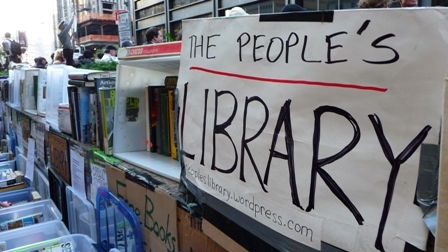
What most of you probably don’t know is that the Occupy Wall Street protestors had amassed a collection of more than 5,500 books in their volunteer-run Occupy Wall Street library.  The volunteers have even set up their own blog for the library along with a catalog of the current collection.  The collection of books ranges from Spider-Man Comics to Jane Eyre.

The collection functioned using names in order to check out books.  The ground practices listed instructions on everything from how to process incoming books to opening and closing the library.

Unfortunately, when the raid occurred on the Occupy Wall Street protestors, the library was removed along with other personal property.  Flyers were handed out at the raid with instructions to retrieve any abandoned property at the Department of Sanitation; however, it is unclear where the books ended up.

Say it ain’t so, Joe!

By Mark Edwards

Despite a storied and illustrious 46-year career at Penn State University, college football coach Joe Paterno will be forced to retire in the midst of a child-abuse scandal involving a former assistant coach.  After being notified by a graduate assistant, the coach failed to sufficiently report to the proper authorities an alleged instance of child-abuse by his former assistant coach, Jerry Sandusky.  Mr. Sandusky has been charged with 21 felony counts of sexually abusing eight boys over a 15 year period.

Is Coach Paterno in anyway culpable?  Does his pristine reputation and legacy deserve to be trampled on despite his countess good deeds and notable charitable contributions he made to many academic endeavors?  Could one egregious transgress nullify 46 years of contributions to society?

The answers to these questions will vary from person to person, and only time will tell on how the court of public opinion would ultimately judge Coach Paterno.

What is notable and worth taking from this situation, is the all too frequent and sobering reminder of how fragile success can be.  One can move mountains and part waters to achieve great feats and dominate personal goals, but one lapse in judgment can compromise all the personal sacrifice and goodwill accumulated over the years.

In Coach Paterno’s case, once he was notified of the alleged transgression and decided not to report it to the proper authorities, the bad deed was done.   Every day he failed to properly disclose his knowledge of the alleged assault, the ramifications for his failure increased.  Days turn to months, and month to years.  So much time eventually passes that even a reasonable man in the Coach’s position would not opt to disclose his knowledge.  In essence, the bad deed can be narrowed down to one bad decision.  That decision not to tell the proper authorities at the first opportunity eventually festered into other reasoned bad decisions.  All gone so fast…

So we must learn from Coach Paterno’s mistake, and be vigilant protectors of our careers.

Vengeful Librarians

Could your local reference librarian actually be a CIA agent?  Probably not, but a recent Associated Press story has got people thinking about the role of librarians in open source intelligence gathering.

Known as “vengeful librarians,” a group of analysts at the CIA’s Open Source Center analyze Facebook and Twitter posts, newspapers, television news, local radio and chat rooms to collect valuable intelligence about America’s friends and enemies.

Although all of the information they gather can be found in the open, they possess the special skills needed to gather that information and use it in conjunction with clandestine intelligence.  Many times the information they collect can give intelligence analysts a better idea of the local mood of a region.

An example of open source information that has provided analysts with valuable intelligence is social media postings during the Osama bin Laden raid.  Open source analysts were able to gather hundreds of local postings, which officials then used to gauge the public perception after the killing.  Another example is analysts gathering social media postings prior to the Arab Spring.   While you might think anyone can do this, that is far from the truth.

Tweets and other posts cannot always be pinpointed to a certain geographic location, so analysts have to use language and dialect to figure out their location of origin.  The center’s director, Doug Naquin, noted that the best analysts possess a master’s degree in library science (M.L.S) and speak several languages.  This enables them to locate, translate, and organize the information for intelligence analysts.

So next time you think about posting on a social media site, consider who might be watching in.  All of your the Legal Bibliography professors here at Georgia State have an M.L.S. degree, so maybe they previously worked as analysts for the Open Source Center. Of course I would tell you if I had worked there prior to coming to Georgia State, but then I would have to …

More Information

Happy Birthday to the MPAA’s Rating System

by Katie Ginnane

What is the MPAA you may ask? Well, the Motion Picture Association of America establishes the rating standards we so frequently use while attending movies, among other things. The modern rating system was enacted in order to counter extreme limitations placed on freedom of expression inherent in federal and state laws prior to 1968. With the advent of the modern rating system, rather than preventing movies from even making it to theaters, the founders of the rating system simply wanted to inform decisions of movie-goers, particularly parents.

Although the original ratings were somewhat different, the current ratings are comprised of G, PG, PG-13, R and NC-17, with G being the least controversial and NC-17 being the most.  According to the MPAA’s website, the rating of NC-17 should not be seen as a negative; however, according to an article published by CNN, the actual effects of an NC-17 rating make the rating inherently negative.

According to the article, growing pressure on the MPAA for a change in the system began with Stanley Kubrick’s Eye’s Wide Shut.  The film, originally given an NC-17 rating, had scenes cut in order to assure an R rating.  If the film studio had adhered to the original film and settled with its original NC-17 rating, advertisements of the film would not have been allowed on network television and many newspapers and certain theaters even would have refused to play it.

For more information on the film industry and censorship, check out these great resources and articles:

Emanuel Book Signing

Georgia State University College of Law Professor Anne Emanuel will be holding a book discussion and signing at the Georgia State University College of Law Library on Thursday, October 27th at 4 p.m.

Her book, titled “Elbert Parr Tuttle: Chief Jurist of the Civil Rights Revolution,” is the first and only authorized biography of the late Elbert Parr Tuttle.  Tuttle served as chief judge of the United States Court of Appeals for the Fifth Circuit during the height of the civil rights movement, from 1960 until 1967.

Tuttle is a graduate of Cornell University for both his undergrad and  law degree.  Prior to attending law school he served in the U.S. Army and worked as a reporter.

Click here for more information about the book.

The event will be held on the first floor of the Law Library.  Following the presentation, copies of the book will be available for purchase and signing.  Light refreshments will be served.

Click here for more information on the event.

Introducing: Bloomberg Law

This is an exciting week for the Law Library, because we’re in the process of rolling out access to a new resource for the College of Law: Bloomberg Law. Bloomberg Law’s a relatively new resource in the world of legal information, although Bloomberg itself has been around for a while.

(If you recognize the name, it may be because (a) you’ve worked in the financial industry, (b) you have access to the cable channel, or (c) the founder is the mayor of a pretty big city.)

In addition to cases and statutes, Bloomberg Law provides expanded access to company information, news resources, and court dockets. And let’s face it – we’re all about providing access to more information!

To help with the roll-out, we’re hosting two representatives from Bloomberg who are leading sessions introducing this new resource. To make the process even easier, they’re even providing food!

There will be three sessions on Tuesday, October 25th:

  • 1:00 to 2:30 p.m., in Room 170
  • 2:45 to 4:00 p.m., in Room 100
  • 5:00 to 6:00 p.m., in Room 100
So stop by, learn about a new way to find information, and grab something to eat!

Taylor Swift: Library Patroness

A young library patron checks out the new donations - photo from the Reading Eagle

Singer Taylor Swift recently donated 6,000 books to the public library in Reading, PA (pronounced “redding”). Swift, a native of nearby Wyomissing, PA, also donated to two other struggling libraries. The books are primarily geared toward young readers.

Reading was once a prosperous transportation, shopping and agricultural center. The Reading Railroad (remember that from Monopoly?) was centered there, as well as the first outlet mall in the country, VF Outlet Village. It continues to boast the presence of a symphony and a local baseball team, as well as many other attractions. The city has fallen on hard financial times of late, however. The public library nearly closed in 2009, so local library officials are hoping that this donation will bring in more support as well.

The Reading Public Library was my hometown library growing up (though I mostly used the bookmobile service, which came to my suburb every other Tuesday afternoon). I’ve still got many fond memories of visiting there. Thanks, Taylor Swift!

The Law Library: Quiet Once Again!

by Katie Ginnane

Noticed an increase in the background noise and chatter interfering with your long hours of study in the law library?  Well, we have got some great solutions for you to stop the insanity.

  • First, the law library has designated quiet areas with signs in the upper level on the left side of the library.  These are the spots to go if you really need complete silence to concentrate.  Anyone who chooses to study there should also be respectful of those around you and observe the quiet area.
  • Second, the reference desk has a bowl of earplugs available for students.  We will continue to stock the bowl through out the semester, so please feel free to grab a set.
  • Finally, the circulation desk has four signs available for three-hour windows that students can use.  The signs have two sides.  One side says “Go Away, I’m Studying” and the other side says “Do Not Disturb”.  These can be used by students who do not want their full concentration interrupted by others around the library.
Happy Studying!

Meet Warren Buffett

Warren Buffett has increasingly made headlines over the past few months based on his claim that he pays a lower tax rate than his maid.  Why is this so significant?  It’s because Buffett happens to be listed by Forbes as the 2nd  Richest American, only bested by Microsoft founder Bill Gates.  Forbes lists Buffett’s net worth at an estimated 39 Billion dollars, which is no small pocket change.  So just how did he get there?

Buffett was born in 1930 in Omaha, Nebraska to U.S. Representative Howard Buffett.   He attended Wharton Business School for two years before he transferred to the University of Nebraska-Lincoln and graduated at 19 with a B.S. in Business Administration.  After undergrad he attended the Columbia Business School.  Between 1951 and 1969 he held such positions as an investment salesmen, securities analyst, and general partner.  In 1970 he became Chairmen, CEO of Berkshire Hathaway, Inc., and from there, the rest is history.  Buffett became a millionaire in 1962 and reached billionaire status in 1990.

In addition to his vast wealth, Buffett is also known for his philanthropy.  Buffett has vowed to give most of his money away to charity after his death.

For those interested in finding out more about Warren Buffett, check out the following websites and books:

iPads and Apps

You may have heard the news that Steve Jobs, Apple’s co-founder, has died.  Described as a visionary, he is credited with overseeing the creation of the iPod, iPhone and iPad.

Not surprisingly, the iPad (and iPhone, to some degree) holds a great deal of fascination for lawyers.  The American Law Institute and the American Bar Association have sponsored with the ABA Law Practice Management section several continuing education classes about lawyers and their iPads.   The classes addressed basic set up and use of an iPad for lawyers as well as how to use an iPad in a law practice.  One regularly offered class particularly addresses iPhone and iPad apps that are useful for lawyers.

Of course, the law library is also in on the game, and Austin Williams, one of our student services reference librarians, created a LibGuide that addresses in part apps that law students may find useful.  Check out the Life of a Law Student guide’s selection of apps.

If you want to read more about the iPad and the law, check out some blogs on the topic.  For example, you may want to read the Off Site LawTech Center, which has introductory info for those new to the iPad, as well as suggestions for law-related apps, such as one for tracking juries.  Blogs that might also be of interest include TabletLegal,TechnoEsqiPad Notebook, and iPhoneJD.