Helpful Study Aids for Spring Courses

As finals approach, study aids are again in high demand. It’s easy to see why. Although study aids make a poor replacement for casebooks and other required materials, they can be a tremendously helpful tool for exam-prep purposes. They provide concise and highly organized reviews of topics covered in the typical law school course on the subject. The best ones also give students some valuable practice for their analytical skills. But with so many study aids out there, featuring differing formats and uses and often featuring very stark differences in quality, how can you know you’re choosing the best one?

Let’s try to answer this question while looking at a few of the best study aids for this semester’s 1L offerings. We’ll talk about what makes them worthy and how you might use them. This will also give us a nice opportunity to discuss the strengths and weaknesses of the various study aid formats and series you’ll encounter.

Examples & Explanations for Property (online/physical)

The E&E series provides an accessible course overview while also foregrounding the important skill of legal analysis. It does this by structuring the entire discussion around the titular examples, a format that proves to be especially well-suited for explaining future estates and other similarly knotty concepts from Property Law. Indeed, this title’s analysis of these hypotheticals evokes the common law methods of legal analysis at the heart of this core doctrinal course. This helps to make the supplement truly feel like an extension of the classroom discussion.

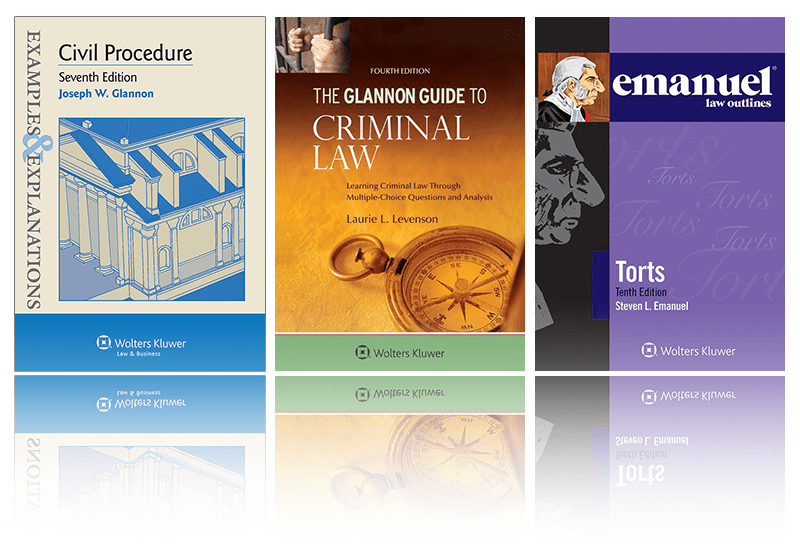
The Glannon Guide to Civil Procedure (online/physical)

The author’s CivPro E&E (online/physical) is an absolute classic, but don’t sleep on this one either. Glannon Guides have a similar focus on analysis and application, but here it’s in the form of multiple-choice questions. After each one, Professor Glannon patiently explains the right (and wrong) answers in conversational prose that helps demystify this oft-convoluted area of law. The overall format works especially well for the more FRCP-driven aspects of Civil Procedure.

Principles of Contract Law (Concise Hornbook Series) (online/physical)

If you’re chiefly after a bird’s eye view of the course, there are many study aids designed with just that in mind. However, in my experience, NutshellsShort & Happy Guides, and the like don’t provide enough detail or nuance to be truly useful. They can help you learn basic concepts and doctrines quickly, but that’s about it.

The Concise Hornbook Series provides a nice (if less concise) alternative. Like other titles in the series, Principles of Contract Law provides an overview of the major course topics. However, it keeps many of the doctrinal subtleties intact. Believe me, those subtleties will come in quite handy when asked to apply those doctrines to a novel fact pattern on an exam.  

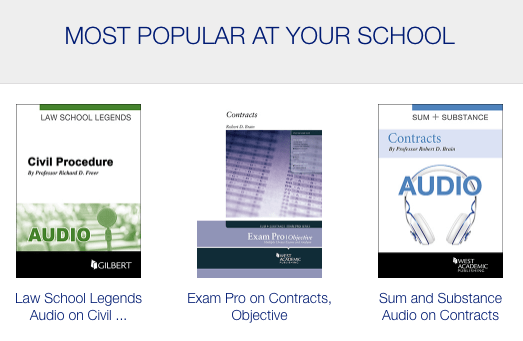
Sum & Substance: Criminal Law (online)

Audio study aids like the Sum & Substance series are a convenient resource for busy law students. It’s easy to multitask with these, to simply put them on in the background during a commute or while housekeeping, and efficiently absorb a tidy little overview of one of your law school courses.

Here, Professor Dressler endeavors to be your “tour guide” for Criminal Law, splitting the lectures into a series of audio tracks that are mostly quite short and easy to digest. His overall presentation is a bit dry but always very clear. This study aid is also a solid choice because it makes a great companion for Dressler’s well-regarded hornbook, Understanding Criminal Law (physical).

Summing It Up

My overall advice is to choose study aids that emphasize analysis and application, such as the E&E series and the Glannon Guides. This ensures that you’re practicing the skills that you will be tested on in your exams. Even if you end up opting for a hornbook-style overview, consider supplementing it with some CALI lessons since the included quizzes provide a nice opportunity to test your grasp on the material. There are high-quality lessons covering many of the topics taught in CivProContractsCriminal Law, and Property.

Thanks to your tech fee funds, Study Aids are more accessible than ever, with most of the major series available for use online through the Wolters Kluwer and West Academic platforms. These resources try to recreate the format and the feel of their print counterparts, making them a breeze to use.

What are your favorite study aids? What do you look for when you’re trying to choose one to prep for an exam? Let us know in the comments!

The Basics of Basic Tax Research

Liberty + Tax
“Liberty + Tax” by MTSOfan is licensed with CC BY-NC-SA 2.0. To view a copy of this license, visit https://creativecommons.org/licenses/by-nc-sa/2.0/

For C.P.A.’s, accountants, and tax procrastinators of all kinds, April 15 is the anti-holiday of anti-holidays.  While the official tax “due date” was recently moved to May 17, April 15 will probably always exist as one of the more dreaded days for Americans.  In the spirit of tax day, we here at the Georgia State College of Law Library thought it would be fun, relatively speaking, to give the most basic of basic primers on tax law.  Unless you are well versed in tax law, even the lingo can be a little confusing.  So, without further ado, let us begin the non-tax person’s primer on tax law research. 

Where is it?

The tax code is officially codified in Title 26 of the United States Code, or 26 U.S.C. § 1 et. seq.  It spans from 26 U.S.C.  §§ 1-9834.  While it’s not the longest, and doesn’t contain the most words, 9834 sections is quite lengthy for a title containing only one topic.  For comparison, Title 42 – Public Health and Welfare is the longest but includes a number of sub-topics like housing, child welfare, energy, etc[1]

Citation is one point of constant confusion.  While you may cite the codification in the U.S. Code, you can also cite the Internal Revenue Code itself.  For example, 26 U.S.C. § 1 and I.R.C. § 1 cite to the same text, with the latter being favored by practitioners for brevity.

The tax code also creates and enables many Federal Regulations, Agencies (the I.R.S.), and administrative documents.  Title 26 of the Code of Federal Regulations contains most tax regulations.  Moreover, the Internal Revenue Service writes a number of advisory documents.  These non-binding writings try to offer some interpretation of the tax statutes, regulations, and administrative decisions.  While non-binding, they do offer some predictions as to what the I.R.S. might do or how they might interpret certain situations. Most are available on Westlaw, Lexis, or the I.R.S. Website. The I.R.S. website describes them this way:

“For anyone not familiar with the inner workings of tax administration, the array of I.R.S. guidance may seem, well, a little puzzling at first glance. To take a little of the mystery away, here’s a brief look at … the most common forms of guidance.

In its role in administering the tax laws enacted by the Congress, the I.R.S. must take the specifics of these laws and translate them into detailed regulations, rules and procedures. The Office of Chief Counsel fills this crucial role by producing several different kinds of documents and publications that provide guidance to taxpayers, firms and charitable groups.”

Some of the most common guidance documents are: [2]

Revenue RulingAn official interpretation by the I.R.S. of the Internal Revenue Code, related statutes, tax treaties and regulations. It is the conclusion of the I.R.S. on how the law is applied to a specific set of facts.
Revenue Procedure  An official statement of a procedure that affects the rights or duties of taxpayers or other members of the public under the Internal Revenue Code, related statutes, tax treaties and regulations and that should be a matter of public knowledge.  While a revenue ruling generally states an I.R.S. position, a revenue procedure provides return filing or other instructions concerning an I.R.S. position
Private Letter RulingA written statement issued to a taxpayer that interprets and applies tax laws to the taxpayer’s specific set of facts. A PLR is issued to establish with certainty the federal tax consequences of a particular transaction before the transaction is consummated or before the taxpayer’s return is filed.
Technical Advice MemorandumGuidance furnished by the Office of Chief Counsel upon the request of an I.R.S. director or an area director, appeals, in response to technical or procedural questions that develop during a proceeding.  Technical Advice Memoranda are issued only on closed transactions and provide the interpretation of proper application of tax laws, tax treaties, regulations, revenue rulings or other precedents. The advice rendered represents a final determination of the position of the I.R.S., but only with respect to the specific issue in the specific case in which the advice is issued. Technical Advice Memoranda are generally made public after all information has been removed that could identify the taxpayer whose circumstances triggered a specific memorandum.
NoticeA public pronouncement that may contain guidance that involves substantive interpretations of the Internal Revenue Code or other provisions of the law. For example, notices can be used to relate what regulations will say in situations where the regulations may not be published in the immediate future.
AnnouncementAn announcement is a public pronouncement that has only immediate or short-term value. For example, announcements can be used to summarize the law or regulations without making any substantive interpretation; to state what regulations will say when they are certain to be published in the immediate future; or to notify taxpayers of the existence of an approaching deadline.

Quick Federal Tax Research Tips

While navigating the seemingly endless statutes, regulations, cases, and guidance documents may seem impossible, there are sources available here at Georgia State that can help make quick sense of your tax law research question.  In particular, they allow you to do three main tasks: Research by I.R.C. citation, research by tax topic, and quickly pull I.R.S. guidance documents. 

Research by I.R.C. Citation

                This method works exactly like it sounds – If you have an I.R.C. citation, you can find associated secondary material, editorial content, and plain language explanations about the topics contained in this citation.  Historically, several sources have been organized around the I.R.C., but maybe the easiest for GSU students is United States Tax Reporter by R.I.A. in Westlaw.  If you have a citation, say I.R.C. § 1, all you have to do is open the corresponding dropdown menu, find the section, and the reporter will provide you with the text of the section, historical context, legislative history material, and editorial analysis. 

Research by Tax Topic

                If you don’t already know the I.R.C. code section dealing with your issue, you can also research by topic using the Lexis Tax Advisor.  You can search the entire publication, but the most powerful tool is the index. Not only can you find the topic you’re looking for, it will also give you some ideas for other sub-topics.  For instance, if you’re looking for information on accounting standards and look up “accounting,” you’ll see that one of the sub-topics is S Corporations.  A novice researcher may not have known that S corporations have their own unique tax accounting topics, but by using the index, they can discover these types of things. 

Retrieving Advisory Documents

Finally, the Westlaw Tax Find and Keycite page will allow you to retrieve the guidance documents listed above.  Just visit the page, select “rulings and releases,” choose the document you’re looking for, and enter the numeric part of the citation. It’s as easy as that. 

Conclusion

While tax is often seen as one of the more challenging law school classes, tax research is surprisingly accessible because of the powerful research tools made available to tax students and practitioners alike.  So long as you have a topic, I.R.C. section, or guidance document citation, you should be able to quickly and efficiently use the tools above to get started on your research.  Also, remember, if you run into difficulties, never hesitate to reach out to the librarians here at the Georgia State College of Law Library. We’re available by our individual emails, the reference email address  lawreference@gsu.edu, or by our reference chat available at http://lawlibrary.gsu.edu .


[1] https://bommaritollc.com/2013/08/19/is-the-tax-code-the-longest-title/

[2] https://www.irs.gov/newsroom/understanding-irs-guidance-a-brief-primer

Personal Librarian: Meg Butler

During the spring and fall semesters of this year, we are highlighting our Personal Librarian program by featuring one of our Law Librarians.

The Personal Librarian program is another way that the GSU Law Library connects to students. In this program, students are paired with a Librarian, and through communications, they stay up to date on library services and ask questions that they may have during their time at the Georgia State University College of Law.

This month we are featuring Meg Butler, our Associate Director for Public Services. She has been at the GSU Law Library for 10 years!

The following is a little Q&A from Meg:

  • What do you do? In the library, I am the Associate Director for Public Services, and that means that I work to make sure that the library is doing what it needs to do to fulfill the needs of our patrons–faculty, students, and citizens.
  • Did you always want to be a librarian? Sometimes.  When I was little, in elementary school, I “worked” in the library.  And middle school.  And high school.  And somehow I didn’t manage to become a professional librarian until later.
  • Favorite movie? This is a very difficult question to answer.  I have enjoyed a bunch of serious movies.  But the movies that I love to watch over and over again are Addams Family Values and The Pirate Movie.  I like them because they make me laugh.
  • Favorite legal resource? The Bluebook.  Who doesn’t love something so easy to complain about?
  • Favorite place in Atlanta? I enjoy working in my front yard. So maybe my front yard? I can chat with neighbors, enjoy the weather, and watch my kids ride bikes or scooters.

You can learn more things about Meg, like her favorite class and lunch spot near the law school, as well as about the personal librarian program at this link.

Recommended Reading from Necessity of Unparalleled Unity CLE

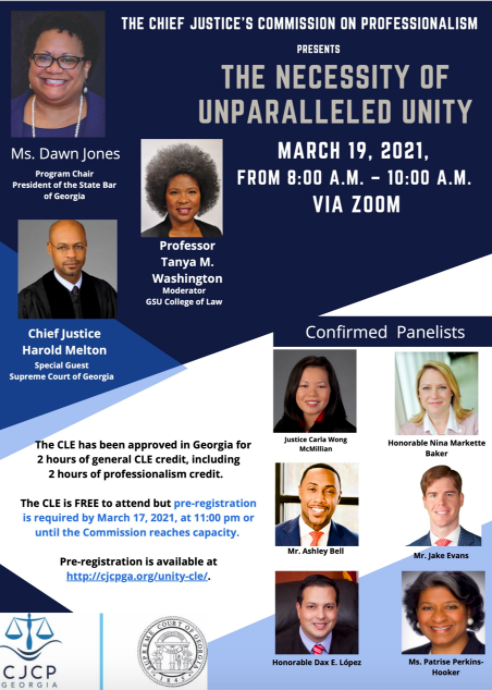
Friday, March 19, the Chief Justice’s Commission on Professionalism presented The Necessity of Unparalleled Unity, a program focusing on the ways that attorneys can serve the public and the common good by using the tools of professionalism and “lead our fellow Americans in bridging our divisions despite our differences” (Program Materials, p. 1).

The panelists represented a variety of perspectives and experiences, including judges and practicing attorneys with significant leadership experience. The panelists shared their thoughts and suggestions for attorneys to build bridges. Several panelists commented upon the need to build connection by developing relationships—talking and listening (not just waiting to talk again) with each other.

If you missed the program—moderated by Professor Tanya Washington—and wish to learn more, you may visit the website and read the speakers’ prepared materials, related articles from the August 2020 Georgia Bar Journal issue addressing the subject, and also review materials related to the Chief Justice’s Commission on Professionalism.

Several speakers recommended books that are available in the law library. Here are their suggestions. Books may be available as ebooks through GSU Libraries, as indicated below. Some are available for delivery to the College of Law to GSU students, faculty, and staff who log in to their library accounts and request the items, as described below.

Several panelists recommended some books to the attendees. These books are available for GSU students, faculty, and staff through the library. Mr. Bell recommended The Color of Money: Black Banks and the Racial Wealth Gap by Mehrsa Baradaran, The New Jim Crow: Mass Incarceration in the Age of Colorblindness by Michelle Alexander (available as an ebook too), and Caste: The Origins of Our Discontents by Isabel Wilkerson (available as an ebook too).

Judge Dax Lopez recommended Our America: A Hispanic History of the United States by Felipe Fernandez-Arnesto. Ms. Patrise Perkins-Hooker recommended the Pulitzer Prize-winning book Slavery by Another Name: The Re-Enslavement of Black Americans from the Civil War to World War by Douglas A. Blackmon (also available as an ebook). There  is also a DVD called Slavery by Another Name, which is based on the book and was an Official Selection of the 2012 Sundance Film Festival.

If you want to read any of these books, you can sign in to your library account (there is a link on the upper right). If you want to request delivery of the print version, you can select delivery to the library of your choice and either pick it up in person from the law library or arrange for curbside Express Pickup from one of the other university libraries.

Racial Justice Resources Guide: Incorporating Race Into The Classroom

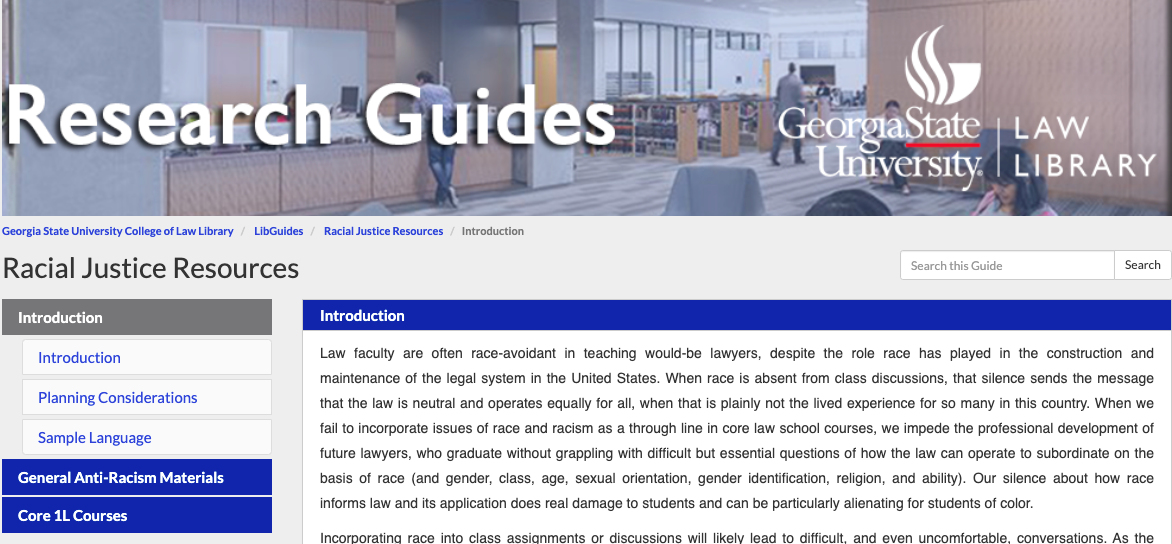
Law schools across the country have responded to the mass protests of the past year with renewed efforts to better integrate issues of race and racism into the law school curriculum.  To this end, the GSU College of Law Library has published Racial Justice Resources, a new research guide dedicated to furthering discussions of race in the law school classroom.

GSU Law’s Center for Access to Justice worked with the law library to create this valuable resource. It is meant to help law faculty incorporate race into their teaching, filling a major gap in legal education. As A2J Assistant Director Darcy Meals explained, “law faculty are often race-avoidant in teaching, despite the role race has played in the construction and maintenance of the legal system in the United States.” By placing materials that highlight this critical role at their fingertips, the guide encourages faculty to engage students in conversations about race across the law school curriculum.

So far, it appears to be succeeding in this endeavor. In a short period of time, Racial Justice Resources has become one of the law library’s most frequently used research guides. Law faculty across the country have also praised the guide. Writing for the Best Practices for Legal Education blog, Penn State Professor of Clinical Law Jill Engle called it “a true gem” and described how the guide introduced her to materials that facilitated the creation of a popular new course.  

The guide collects a wide range of resources that address race and legal pedagogy. They fit into two overarching categories, one focused on specific courses and the other on anti-racism materials with more general applicability. Within each category, the guide offers a curated list of teaching guides, podcasts, legal scholarship, and more.   And whether it’s a scholarly article that develops a pedagogical framework, an assessment tool that gauges implicit bias, or a seminal essay that shaped the zeitgeist, each resource was specifically chosen for its capacity to help law faculty incorporate issues of race and racism into their courses.

While the guide is primarily designed for law teachers, other audiences will also find that it contains much that is of interest. For some researchers, the guide’s practical orientation will complement other resources dedicated to specific schools, theories, and ideas. For law students, in particular, the materials could broaden their understanding of how race has shaped the legal doctrines they are learning, preparing them for their role in these important classroom conversations.

Searching for Georgia Dockets

If you want to know the story of a case, the best place to start is with the case docket. It is a chronological listing of all the events in a case, including filings and proceedings. E-filing makes it even easier for attorneys and others to access and monitor dockets.

The information in dockets is useful to attorneys for a bunch of reasons. Attorneys may review filings to review underlying documents that other attorneys have filed. These may be helpful in drafting their own filings. They may also help attorneys evaluate the arguments to make before judges.

Georgia is a super special place for docket searching. Dockets are maintained by the courts, which means that each court in Georgia—and remember, we have 159 counties each with their own trial courts—has its own docket system.

* Image from: PeachCourt Home Page

PeachCourt, a portal for civil and criminal e-filing documents, allows for searching multiple Georgia counties at once. Even non-attorneys can search in PeachCourt. You do need to create an account in order to search the dockets for the participating courts.

Unfortunately, not all metro-Atlanta counties participate in PeachCourt. To be sure that you’re checking all the places you mean to check, it’s worth verifying whether PeachCourt coverage includes the court you’re interested in searching by checking the map of courts they serve. If you’re interested in Gwinnett County trial court docket information, for example, you would need to separately check the Clerk of Superior, State, Magistrate, & Juvenile Courts County of Gwinnett website and follow the instructions to search.

The Court of Appeals of Georgia and the Supreme Court of Georgia each make some of their own docket information available. The Court of Appeals provides a search tool that can be searched by party name or by docket number. Their system does not include the Emergency Motions docket. Although the docket information retrieves some cases docketed with the Court of Appeals of Georgia as early as 1999, the final decisions are only available from more recent opinions.

The Supreme Court of Georgia also uses a computerized docketing system, and it can be searched by the Supreme Court case number, attorney name, or party name. Interesting, you can see from the docket number of Supreme Court cases an indication of the type of matter being appealed. If you want to see whether an attorney has had recent cases before the Supreme Court of Georgia, it’s really easy to do an attorney name search.

If you have questions about docket searching, please chat with us from the library home page. We are happy to help!

Expanding Expungement in Georgia is Given a Second Chance

By Gilbert Morales, Reference GRA

On January 1, 2021, Georgia’s “Second Chance” law went into effect. The new law improves an individual’s ability to restrict and seal certain criminal convictions from the general public, a process commonly referred to as expungement. According to the Georgia Justice Project, “Georgia finally joins 41 other states that allow an individual an opportunity to expunge certain convictions after a period of time.”[1] The new law is the latest development in a decade-long push to facilitate rehabilitation for former offenders. Advocates contend that public access to all convictions, even minor offenses, poses a substantial barrier to a former offender’s rehabilitation. Allowing access to an individual’s criminal history can limit job opportunities and housing eligibility, increasing the chances for that individual to re-offend. 

Misdemeanors 

Advocates say the new law is a step forward. Unlike Georgia’s previous “record restriction” law that only allowed court petitions for sealing offenses that did not result in a conviction and made a narrow exception for misdemeanor convictions committed by individuals under 21, the new law allows individuals to seal two misdemeanor convictions with limited age restrictions. So long as an individual has not reoffended and 4 years have passed since completing their sentence, they can petition the court to seal their misdemeanor conviction. The law does not cover all misdemeanors. Notably, misdemeanors involving sex crimes are excluded from consideration. Moreover, all family violence battery convictions are excluded unless the individual was under 21 years old at the time of the arrest. 

Felonies and Pardons

The new law also covers felony convictions that were pardoned by the State Board of Pardons & Paroles. So long as the pardon was not for a serious violent felony or sexual offense, an individual can petition the court to seal the record of that conviction. An individual must wait 5 years after they have completed their sentence before petitioning the court and cannot have re-offended during those 5 years.

The Process 

A petitioner seeking to restrict and seal a misdemeanor conviction must petition the court that handled the case. For felony convictions, individuals must first obtain a pardon and then file a petition in the original sentencing court. In sealing documents, the court will consider the harm to the individual versus the public interest in knowing about the conviction. An important caveat to remember is that although a record may be restricted and sealed from the general public, law enforcement and prosecutors retain access to those records. 

Beyond Expungement

An important wrinkle in the new law is the liability protection for employers hiring individuals with criminal backgrounds. Liability protection addresses the fear by some employers that hiring someone with a criminal background who then commits a workplace offense will lead to a claim against the employer for negligent hiring. Whether this fear is well-founded is up for debate and another blog entry, nevertheless, it is a major feature of the new law.

Going Forward

The Second Chance law is a major opportunity for former offenders to build back their lives. By allowing misdemeanor convictions and felony pardons to be petitioned, the law enlarges the pool of individuals that can have their records restricted and sealed. The hope is that the new law enables these individuals to integrate back into society. That being said, there are always places where the law can expand such as applying record restrictions to felony convictions that are not pardoned. As one advocate from the Georgia Justice Project stated, although the Second Chance law is a step forward in the right direction, “it is only the beginning.”[2]

To Learn More

The Georgia Justice Project is hosting free sessions to help people understand their criminal history and what they can do about it on the first Friday of each month in 2021. For more information and contact information for them, go to https://www.gjp.org/first-fridays/. Also, to locate additional legal aid that may be available for pro se and self-represented litigants the legal services in Atlanta & the Metro-Atlanta Area Legal, check out our Legal Services in Atlanta & the Metro-Atlanta Area Legal Library Guide (LibGuide).

NOTE:  This post is an update to 2017’s post on the same subject https://theblackacretimes.com/2017/10/24/criminal-background-checks-georgia-law/.


[1] https://www.gjp.org/wp-content/uploads/2020.9.21-SB-288-One-pager_Final.pdf

[2] https://www.gpb.org/news/2021/01/01/second-chance-law-takes-effect-offers-hope-georgians-criminal-past

Featured GSU Law Librarian: Pam Brannon

During the spring and fall semesters of this year, we are highlighting our Personal Librarian program by featuring one of our “fabulous” (a favorite term of this month’s featured Librarian) Law Librarians.

The Personal Librarian program is another way that the GSU Law Library connects to students. In this program, students are paired with a Librarian and through communications, they are able to stay up to date on library services and ask questions that they may have during their time at the Georgia State University College of Law.

This month we are featuring Pam Brannon, our Coordinator of Faculty Services. She has been at the GSU Law Library for over 13 years! The following is a little Q&A from Pam:

  • What do you do? I’m in charge of the services that the library provides to faculty – such as researching arcane (and non-arcane) topics and working with faculty research assistants – and supervise the library’s research GRAs. I also do a lot of other things, including work at the reference desk, teach research methods, and help decide what we purchase.
  • Did you always want to be a librarian? Not really, although I gravitated toward libraries fairly early (I was in my elementary school’s library club – basically, I shelved books). When I graduated from undergrad, I thought I was going to go back to grad school (probably in English lit) to be a professor. But then I started working at the UGA libraries, and I decided pretty quickly afterward that I wanted to be a librarian.
  • Favorite class in school? In undergrad, either History of Rock Music or Ulysses. In library school, I really enjoyed my Book Publishing class, but that may just have been because we got to talk about comic books with a guy from DC Comics. In law school, probably Sexual Orientation & the Law.
  • Favorite legal resource? I love the Federal Register, and both the Federal Register website and Regulations.gov are wonderful because they really help do what the Federal Register was designed to do – make the process of federal rulemaking more transparent and more accountable to the people.
  • Favorite place in Atlanta? Even though I don’t go there much at all anymore, I still love Little 5 Points.

You can learn more things about Pam, like her favorite movie and sport, as well as about the personal librarian program at this link.

The History of Georgia’s Black Legal Community

Image of Styles Hutchins
Styles L. Hutchins, the first Black attorney admitted to the Georgia Bar. From Wikimedia Commons.

As we celebrate Black History Month, we reflect upon the important history of the Black legal community in Georgia. The first Black attorney admitted to the Georgia Bar, Styles Hutchins, was admitted in 1878. He spent much of his career practicing in Chattanooga, and served as a member of the Tennessee legislature. In the early 1940s future Atlanta Municipal Court Judge Rachel E. Pruden-Herndon became the first Black woman to pass the Georgia bar exam and be admitted to the Georgia Bar.

Several other Black members of the Georgia legal community played key roles in the civil rights movement and desegregation efforts in Georgia. Georgia attorneys including future United States District Judge Horace T. Ward, legendary civil rights attorney Donald Hollowell, and Vernon Jordan, a future leader of the National Urban League and political advisor, launched a series of challenges that ultimately led to the beginning of desegregation at the University of Georgia and Georgia State University. Another prominent Black Atlanta attorney, Howard Moore, Jr., was involved in the landmark case Heart of Atlanta Motel v. United States, in which the Supreme Court of the United States affirmed Congress’s authority to prohibit discrimination in public accommodations by private businesses involved in interstate commerce.

In 1948 ten African-American Atlanta lawyers, including attorney and mentor A.T. Walden, founded the Gate City Bar Association, a professional association dedicated to supporting African-American attorneys in Georgia. The Georgia Association of Black Women Attorneys was founded in 1981 to promote the involvement of Black women attorneys and increase focus on women’s and children’s issues. These associations continue to work to support African-American attorneys in Georgia through education, community involvement, and events. These efforts include the Justice Robert Benham Law Camp, an three-week summer program presented in partnership with the Georgia State University College of Law. The program, named after the first African-American member of the Georgia Supreme Court, introduces minority high school students to the study of law and gives them an opportunity to intern with lawyers in the metro Atlanta area.

The Law Library and other GSU libraries have numerous books and other resources available for those wishing to learn more about the history of Black attorneys in Georgia. These resources include the following books:

Managing Your Time in Law School

[UPDATED REBLOG FROM JAN. 2019]

By Sara Landeryou, Reference GRA

Whether you just survived your first semester, are beginning your last, or are somewhere in between, YOU ARE BUSY.  And no one but other law students or lawyers really gets it.  So how do you make time to do everything you need to do, some of the things you want to do, and the things your family and friends expect of you?  You could stretch yourself so thin that you snap.  You could stop sleeping or eating to gain extra time.  You could let the exercise go.  Or, you can keep reading (if you have the time) and learn some tricks for using your time wisely while in law school.

There is no way to add hours to your day, so we need to learn how to use the time we have more effectively.  The ideas below are geared toward the time that we are in school, but good habits will hopefully spill over into our lives after school and will be helpful as our responsibilities change.

Your future may include working in big law and billing lots of hours for several years, getting married and having children, opening your own firm, you just never know.  Learning how to manage your time effectively now will help with all those things that are coming more quickly than you think!

So what can you do?

Get more and better sleep.  It seems counterintuitive when you are trying to save time, but getting more and better quality sleep will actually save you time in the long run.  When you are well-rested, you have more energy, your mind is clearer (for studying), and your body is healthier, so you don’t risk getting sick when finals roll around.

Exercise.  Yes, it takes time, and maybe you can’t carve out an hour a day, but even a little will help you to feel better.  You can add exercise or at least extra movement during the day.  It will keep your body and brain energized and you will feel better for it at the end of the day.  Take the stairs, do your reading while you’re on the treadmill or the elliptical, do a few relaxing yoga poses five minutes before bed.  Even increasing your movement 15 minutes in bits throughout the day is a win.

Mix your studying and social time.  Really.  Study (virtually) with your friends.  Have a glass of wine or a beer.  Work through hypos in a more relaxed and social scene.  You can’t study drunk, but you’ll actually learn more by talking through hypos with friends than by rereading a case book.  Yes, you’ve got to practice writing, but the most important part of learning is really “getting” it.  That is done by talking it through and practicing applying the law.  Who better to do that with than the people at school that you like the most.

Give family and non-law friends 100% of your attention.  This is tough.  You’ve got so much on your mind, you really don’t have time to hang out, and now you’re being told to give 100% of your attention?  It can be done.  In fact, one of the reasons they are frustrated is that when you are with them, you aren’t “with” them.  So, you can actually get away with less time as long as the time you give is quality time. Do a movie night with friends or video chat with mom/dad during lunch. But don’t think about law school at all.  You need the break and so do they!

If you are working….  This is a little harder but worth a try.  If you are a student that is working and going to law school, try to work in the legal field.  First, your colleagues will understand the struggle better than non-law colleagues and they’ll cut you some slack.  Second, you’ll be learning more about the law while you are at work, and you’ll be learning a lot of the things you don’t learn in law school.  You’ll also be networking to some extent and may work yourself right into a post-law school job which will save you a lot of interviewing time.

Turn off your phone.  Not all the time, but for at least an hour of reading/studying time.  It is so easy, especially when you have a boring class and/or terrible reading, to keep peeking at your phone or listening for that little buzz that lets you set the book down and check out something more interesting.  Just shut it down!  Give yourself an hour and power through all of that reading instead of dragging it out and never finishing it all.

Plan.  Set a plan for yourself.  This doesn’t mean that you have to make an hourly calendar of what you are going to do, but it does mean taking 5 now to look ahead.  If you’ve read your syllabus and you know that you’re going to have a project due at the end of February, right about the same time that your best friend has her annual birthday party that leaves you in bed for three days after, start working on it as soon as possible.  Outline as you go instead of waiting until the end of the semester, set monthly goals for that big paper so that you can turn it in before it is due instead of cranking it out at the end.

Reflect.  At least for a few minutes, each day, week, or month.  Look at what has been working for you, and what hasn’t, and change it.

Have any other ideas for saving time?  Share them with your friends!