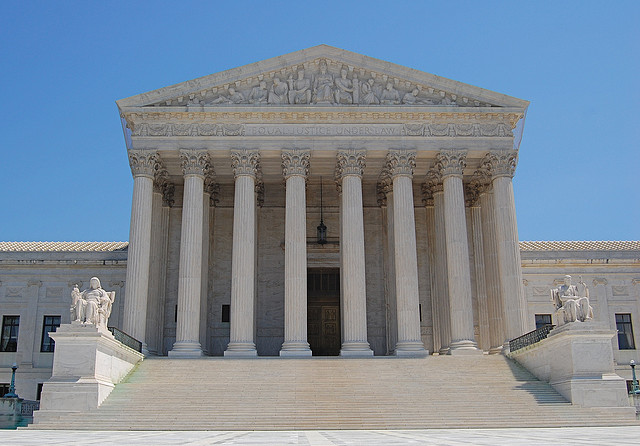
Health Care Oral Arguments

Flicker photo by massmatt

By Kristin Poland

Beginning on Monday, March 26th, the U.S. Supreme Court heard six hours of oral argument spread over three days in the case of  The Department of Health and Human Services v. Florida.  The case involves 26 states who are challenging the constitutionality of the Patient Protection and Affordable Care Act, commonly known as Obamacare.

The Court focused its inquiry on Monday on whether or not it was able to decide on the larger issues in the case in light of the Anti-Injunction Act of 1867.  The act prohibits tax issues from being challenged prior to the tax taking effect, and the issue before the court involved whether the penalty to be imposed for failure to purchase health insurance was a tax.  On Tuesday, the Court heard arguments regarding one of the act’s central provisions-the individual mandate.  The Court questioned attorneys regarding the power of Congress to require individuals to purchase insurance under the commerce clause.  On Wednesday, the Court turned its attention to two further issues: whether the remainder of the act could be allowed to stand if the mandate was struck down, and whether the expansion of the Medicaid program was a proper exercise of congressional power.

The Supreme Court’s decision in this case is expected near the end of June.  Until then, you can brush up on the arguments presented by both sides.  Audio recordings of the arguments are available at the Supreme Court’s website. You can also click here for transcripts of these recordings.

Additionally, C-SPAN has extensive coverage of the issue, including audio recordings.

Is Facebook a Digital Asset?

When an attorney or law student thinks about estate planning, they might think of wills, future interests, and/or trusts.  People invest in estate planning because they have “assets” or they want to make sure their loved ones are taken care of when the inevitable arises (unless you are a Highlander, in which case you can live forever).

When I think of assets, I think of real or personal property, such as your grandmother’s wedding ring, the family home, or land.  Money and investments are also apart of someone’s assets.  But what about their Facebook or Twitter page?  Would you consider your social media accounts as part of your assets?  If so, who takes control of those assets, when can they take control, and how much control can they have?  That is the question that is beginning to pop up in several state legislatures.

A Nebraska Bill (No.738) that is working it way through the legislature right now would treat social media accounts of a deceased person as “digitial assets.”  This means those accounts could be taken over by a friend or relative, who would then have the option to continue or close the account. (Reference: Washington Post)

Currently, Facebook will put profiles in a “special memorialized state” if they have been informed that a user has died.  Part of the reason they do this is to allow the deceased person’s friends to continue to post on their page.  Additionally, Facebook will also remove a page at the request of the deceased’s family members.  One thing Facebook will not do is provide log-in information (a username and password) to anyone, even the next of kin.  Only in cases where the deceased directed them to do so in a will or by a court decree will Facebook provide log-in information. (Reference: Omaha World-Herald)

So far Oklahoma is the only state that has currently passed “digital assets” legislation.  In addition, the Oregon State Bar Association hopes to propose legislation next year.  With legislation passed in one state already,  one state in the process of reviewing legislation, and another in the process of proposing legislation, one has to wonder if this idea will pick up steam in other state legislatures as well.  (Reference: Governing)


Great Stuff on the Law Library Website!

by Katie Ginnane

As some of you may or may not know, the law library webpage has a great collection of a variety of resources for students. Whether you are looking for a free resource for your summer internship or booking a study room, that law library tab on the GSU College of Law’s webpage yields some great resources to navigate your way through law school and after. Here are some of those resources outside of the wealth of databases listed at the top of the page.

Student Writing Competitions– this resource can provide you with a great opportunity to participate in the variety of writing competitions offered to law students throughout the year. Currently, competitions for March, April and June are listed. These include competitions from the Environmental Law Institute, the ABA section on Dispute Resolution and the ABA section on Criminal Justice.

Research Guides– this resource can provide you with a variety of tips and tricks to conducting research within specific fields of the law.  Not only are these guides a great way to get started, but they can also direct you to resources available through the main university library that may not be on the law library’s database list.  These guides also cover subjects such as Life as a Law Student and Bar Exam Resources.

Free Legal Research– another great resource for law students and practicing attorneys alike is the research guide focused on free legal research.  Free legal research becomes particularly useful outside of law school when LexisNexis and Westlaw are not longer provided though the law school.

Old Exams– this resource is particularly useful around exam time.  In case you run out hypos (or don’t like the ones you see).  The hypos on this page range from Administrative Law to Torts, and some even have sample answers.

Audio Case Files– this resource provides MP3 files of edited judicial opinions and a brief fact summary.  This way you can bring important cases with you anywhere you need them.

Finally, if you want more information, the law library hosts Library Abridged Workshops to update students on what is going on at the law library!  You can find the schedule and topics here.

Criminal Background Checks and Georgia Law

by Korinne Lassiter

Did you know that in Georgia if you are arrested it stays on your record even if the case is dismissed or you are acquitted? It’s true.

I didn’t know this sad fact until I began my externship at the Georgia Justice Project, an organization that is working hard to change Georgia’s draconian records law. We have clients come in all the time who are unable to find a job or rent an apartment because of arrests that show up on their record. The Georgia Justice project helps clients go through the convoluted process to correct one’s criminal record. Currently, the only way to get something off your record is to request the original agency having custody or control of the records to purge, modify, or supplement them. That agency then sends your request to the prosecuting attorney who then looks through the record to determine if an individual meets the criteria to clear one’s record. This process is also known as expungement and can take up to a year. If they deny your request then you can appeal to the superior court in that jurisdiction.

Currently, as the law stands, the only arrests or charges that can be cleared off of one’s record are, pursuant to O.C.G.A. § 35-3-7:

1) If a person is arrested and released without the offense being referred to the prosecuting attorney.

2) If a person is arrested and the case is referred to a prosecuting attorney, but the prosecuting attorney decides to dismiss the charges without seeking an indictment or filing an accusation.

3) After the filing of an indictment or an accusation, a record shall not be expunged if the prosecuting attorney shows that the charges were nolle prossed, dead docketed, or otherwise dismissed because:
a. Of a plea agreement resulting in a conviction for an offense arising out of the same underlying transaction or occurrence as the conviction;
b. The government was barred from introducing material evidence against the individual on legal grounds including but not limited to the grant of a motion to suppress or motion in limine;
c. A material witness refused to testify or was unavailable to testify against the individual unless such witness refused to testify based on his or her statutory right to do so;
d. The individual was incarcerated on other criminal charges and the prosecuting attorney elected not to prosecute for reasons of judicial economy;
e. The individual successfully completed a pretrial diversion program, the terms of which did not specifically provide for expungement of the arrest record;
f. The conduct which resulted in the arrest of the individual was part of a pattern of criminal activity which was prosecuted in another court of this state, the United States, another state, or foreign nation; or
g. The individual had diplomatic, consular, or similar immunity or inviolability from arrest or prosecution.

The expungement law and process is critical for attorneys to know. One would think that dismissals would automatically be erased off a client’s record, but this is not the case. Always be sure to expunge your client’s record if they meet the criteria stated above.

Fortunately, there is hope for a change to these laws in Georgia! House Bill 663 would change the law regarding criminal records. The new bill would restrict access to the following types of information (excerpt below taken from the Georgia General Assembly website):

1. If prior to indictment or accusations:
a. The case was never referred for further prosecution to the prosecuting attorney by the arresting law enforcement agency because either such agency closed the case without referring the case to the prosecuting attorney or a period of two years for misdemeanor offenses or four years for felony offenses has elapsed from the date of arrest;
b. The case was referred to the prosecuting attorney but was later dismissed; or
c. The grand jury returned two no bills;

2. After indictment or accusation:
a. All charged were dismissed or nolle prossed or the case was placed on the dead docket with the consent of the state and a period of 12 months has expired from the date of placing such case on the dead docket;
b. The individual was convicted of an offense and was sentenced to punishment other than the death penalty, but such conviction was vacated by the trial court or reversed by an appellate court, the decision of which has been made final, and the prosecuting attorney has not retried the case within 18 months of the final order of the court unless the prosecuting attorney obtains a court order, prior to the expiration of the 18 months, lengthening the time due to ongoing investigation or other appropriate circumstances; or
c. The individual was acquitted of all charges by a judge or jury.

The new bill still has some exceptions to when a record can be cleared, however they are much more reasonable. After the filing of an indictment or accusation, a record shall not be restricted if:

  1. The charges were nolle prossed, dead docketed, or otherwise dismissed because of a plea agreement resulting in a conviction for an offense arising out of the same underlying transaction or occurrence as the conviction;
  2. The charges were tried and some but not all of the charges resulted in an acquittal;
  3. The conduct which resulted in the arrest of the individual was part of a pattern of criminal activity which was prosecuted in another court of this state, the United States, another state, or a foreign nation;
  4. The individual had diplomatic, consular, or similar immunity or inviolability from arrest or prosecution; or
  5. The individual was acquitted of all charges but it is later determined that the acquittal was as a result of jury tampering.

It is important to note that the record will not be restricted to criminal justice agencies, such as law enforcement, district attorneys, or judges.
Unfortunately, most employers will deny employment if ANYTHING shows up on a background check, even if it was dismissed. If this bill passes it will mean that people who were mistakenly arrested or did not commit a crime will be able to find employment more readily. This means less people on state assistance. It seems to be a win, win for Georgia.

For updates on the bill see: http://www.gjp.org/
To see the entire current law: O.C.G.A. § 35-3-7.
To see the proposed bill: http://www1.legis.ga.gov/legis/2011_12/sum/hb663.htm
Soapy Thieves

Flickr photo by Jackson Boyle

There is a new “hot” item in town, and its not stereos, Cadillacs, or copper wiring.  Care to take a guess?

If you guessed “Tide” detergent,then you are correct.  Yes Tide, the same stuff that you washed your clothes with this weekend, has apparently become the next big target for the criminal underworld.

News outlets are reporting a “nationwide spike” in Tide theft, including one incident where an individual over the course of 15 months stole $25,000 worth of Tide from a Wal-mart near Minneapolis (Fox News Story).

About now is when you are probably wondering why Tide is such a popular item for thieves?  Yahoo! reports that thieves are selling Tide on the black market to buy drugs.  But why Tide?  Why not iPads, LCD TVs, or Blu-Ray players.  The same report notes that thieves are targeting Tide because: (1) it is one of the most popular brands and is easily recognizable for consumers, (2) it cannot be tracked because it does not have a serial number, and (3) a $10-$20 bottle can still go for $5 – $10 on the streets (Yahoo! Story).

With the thought of laundry detergent being sold on the black market, one can only begin to wonder what could be next.

The App Store- Compliments of the US government

by Katie Ginnane

Have you ever wished that information about prevention of food born illness, safe food handling and safe preparation of meat, poultry and egg products was right at your fingertips?  No?  Well what about exercises to help manage and reduce stress?  Well, an app that does just that, and many others, is available compliments of the US government. Below are some great, readily available apps available through the United States government’s website:

Law Students

  • Breathe 2 Relax– This app provides information about stress’s effect on the body and exercises to help manage stress through breathing exercises.
  • T2 Mood Tracker– This app helps you track your mood on a daily basis.
  • Tactical Breather– This app helps you gain control over physiological and psychological responses to stress.
  • USA Jobs– this app provides a one-stop-shop to search for jobs within the federal government.

Legal

  • Charge!– This game provides a great way to familiarize yourself with correct acquisition and contracting rules as defined in the Federal Acquisition Regulation.
  • Congress- A Pocket Dictionary– This app helps you find your representative, see how they vote, read up on bills, find out about committee hearings and other information about the day to day activities of congress.
  • Library of Congress- A Virtual Tour– This app does exactly as its name implies, it gives you a virtual tour of the library of congress.
  • SBA– This app helps you find the nearest location of Small Business Administration-affiliated advisers and other resources to help start or grow your small business.
  • The Congressional Record– This app provides the daily congressional record along with records dating back to January 4, 1995.

Fun!

  • Baby Name Playroom– This app allows you to search through popular baby names over the last 130 years.
  • Encyclopedia of Life– This app allows you to catalog the biodiversity of the planet as a part of the Encyclopedia of Life project focused on organizing and making available information about all forms of life on earth.
  • Leafsnap– This app uses photographs of leaves taken from by smartphones to determine the species of a specific tree.
  • Meanderthal– This app uses a picture taken of you or your friends and shows you what the person would look like as an early human.

Personal

  • Alternative Fuel Locator– This app allows you to find the five closest providers of biodiesel, electricity, E85 (ethanol), hydrogen, natural gas and propane for your alternate fuel vehicle.
  • FCC Mobile Broadband– This app allows you to test the quality and speed of your mobile data collection.
  • My Dietary Supplements– This app provides a way to track the vitamins, minerals, herbs and other products you take.
  • My Food-A-Pedia– This app provides nutrition information on over 1,000 foods including the calorie amounts, contribution to the five food groups and the number of extra calories from solid fats, added sugars and alcohol.
  • National Weather Service– This app provides weather, hydrologic and climate forecasts and warnings for the United States and its surrounding territories.

All of these apps and many more are available at usa.gov.

We’re Hiring!

The law library is hiring GRAs for the Summer and Fall 2012 semesters.  Research GRAs report to Pam Brannon, Faculty Services Librarian, and assist with faculty research requests. Reference GRAs work at the Reference Desk, primarily answering research requests for library users, and report to Deborah Schander, the Reference/Student Services Librarian. If you are interested in either type of work, we encourage you to apply. You can apply for one or both types of position. Applicants for the summer positions must be taking summer classes.

Summer GRAs receive one-half reduction in tuition as well as a $500 stipend.  Fall GRAs receive one-half reduction in tuition as well as a $1,000 stipend. To apply, please submit a completed application, resume, and your anticipated Summer/Fall class schedule to Deborah Schander by Friday, March 16, 2012.

The Rule Against Perpetuities Goes to the Oscars

One of the biggest moments of Sunday night’s Oscars broadcast was Jim Rash’s impromptu “loving tribute” to Angelina Jolie’s leg-baring pose. Rash was on stage with Nat Faxon and Alexander Payne accepting the Oscar for Best Adapted Screenplay for The Descendants, which was adapted from a novel by Kaui Hart Hemmings.

The story in The Descendants is propelled by the need to sell property that has been in the family for generations due to the operation of that bane of first-year law students, the Rule Against Perpetuities. The filmmakers consulted with University of Hawai’i professor Randall Roth to get the details of trust law right (which cannot be said of the other movie to use the RAP as a plot device, Body Heat). And it appears that they’ve also gotten the details of day-to-day life as an attorney in Hawai’i correct, as well. An article in Forbes notes that the movie provides a number of lessons in estate planning.

Who said you couldn’t learn something by going to the movies?


“The Simpsons” 500th Episode!

by Katie Ginnane

In case any of you law students missed it, with all that studying you are doing, “The Simpsons” premiered its 500th episode last Sunday. Along with all the regular characters we have come to know and love, the episode also included the voice talents of the infamous Wikileaks founder Julian Assange.

Now in its 23rd season, “The Simpsons” has not been the longest running comedy series without any legal issues, one of which involved a potential lawsuit from Brazilian officials for its depiction of Rio de Janeiro in the episode “Blame It On Lisa.”  The  Executive Producer James Brooks later apologized for the show’s depiction of the city.

However, the show’s most recent legal issue, and potentially continuous battle, came out of its contract re-negotiations for its main cast members in late 2011. This was not the first time cast members vied for larger salaries, or to keep their already high ones. The first big contract negotiation began in the late 1990’s, several years after the show’s advent in 1989. In 2011, however, the main character voices would not be the only ones potentially receiving a pay cut. According to Fox, it would be unable to produce “The Simpsons” under the current business model. The network called for a 45% reduction in the voice actor’s current income at the time of about $400,000 per episode.  Despite the negotiations almost costing “The Simpson’s” 24th and 25th season, a deal was reached for an undisclosed reduction in the voice actors’ pay.

Fortunately, the negotiations have assured a continued run of “The Simpsons” for the next two seasons.  Although its ratings from the current season are down 14% from last year, one cannot discount the many pop-culture contributions the show has provided through out its tenure, including the inclusion of Homer’s famous catchphrase “d’oh!” in the Oxford English Dictionary.

Start the Bidding!!!

We are a day away from the 20th Annual PILA Auction.  PILA, The Public Interest Law Association, is a law student organization that focuses on promoting public interest law.  PILA sponsors an auction every year to raise money to assist students who are working in an area of public interest during their summer internships.

Generally students, faculty, alumni, and other distinguished members of the legal community will attend and bid on items donated by the GSU Law Faculty and Staff.  Items can range from cooking lessons, dinner with a professor, or a weekend getaway.  This year the GSU Law Library has sponsored three auction items.  If you are still  undecided on what to bid on at the event, consider the three items below:

  1. Law Library Study Room:  Imagine it, your group’s very own study room for the rest of the Spring semester.  No waking up early to place a request online.  Forget about running from class to the Law Library to place a last minute reservation.  Now your group can mosey on in at any hour of the day (as long as the library is open) and plop down in your home away from home.  You still have to turn in the keys after each visit, but let’s be honest, they are safer with us.
  2. Lunch with the Law Librarians:   We are not talking PB&J.  Imagine if you will a nice, sophisticated lunch out on the town with your friends and your favorite Law Librarians.  Just think how productive you will be after sinking your teeth into a delicious, cooked to order to meal.  The sky is the limit, but remember we are state employees.  Spoiler Alert: Wraps and Pizza will not be on the menu.
  3. Ping Pong:  Dare to dream.  You and your friends vs. Law Librarians in a game of Ping Pong (or if you prefer, Table Tennis).  Recreate your favorite scenes from Forrest Gump or Balls of Fury.  Headbands are not required, but highly suggested.