Emanuel Book Signing

Georgia State University College of Law Professor Anne Emanuel will be holding a book discussion and signing at the Georgia State University College of Law Library on Thursday, October 27th at 4 p.m.

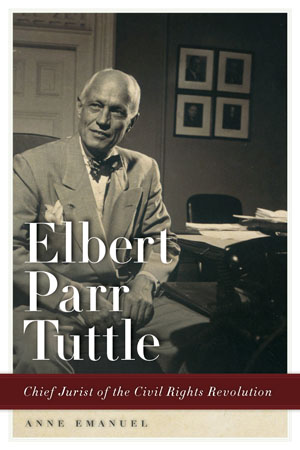
Her book, titled “Elbert Parr Tuttle: Chief Jurist of the Civil Rights Revolution,” is the first and only authorized biography of the late Elbert Parr Tuttle.  Tuttle served as chief judge of the United States Court of Appeals for the Fifth Circuit during the height of the civil rights movement, from 1960 until 1967.

Tuttle is a graduate of Cornell University for both his undergrad and  law degree.  Prior to attending law school he served in the U.S. Army and worked as a reporter.

Click here for more information about the book.

The event will be held on the first floor of the Law Library.  Following the presentation, copies of the book will be available for purchase and signing.  Light refreshments will be served.

Click here for more information on the event.

Introducing: Bloomberg Law

This is an exciting week for the Law Library, because we’re in the process of rolling out access to a new resource for the College of Law: Bloomberg Law. Bloomberg Law’s a relatively new resource in the world of legal information, although Bloomberg itself has been around for a while.

(If you recognize the name, it may be because (a) you’ve worked in the financial industry, (b) you have access to the cable channel, or (c) the founder is the mayor of a pretty big city.)

In addition to cases and statutes, Bloomberg Law provides expanded access to company information, news resources, and court dockets. And let’s face it – we’re all about providing access to more information!

To help with the roll-out, we’re hosting two representatives from Bloomberg who are leading sessions introducing this new resource. To make the process even easier, they’re even providing food!

There will be three sessions on Tuesday, October 25th:

  • 1:00 to 2:30 p.m., in Room 170
  • 2:45 to 4:00 p.m., in Room 100
  • 5:00 to 6:00 p.m., in Room 100
So stop by, learn about a new way to find information, and grab something to eat!

Taylor Swift: Library Patroness

A young library patron checks out the new donations - photo from the Reading Eagle

Singer Taylor Swift recently donated 6,000 books to the public library in Reading, PA (pronounced “redding”). Swift, a native of nearby Wyomissing, PA, also donated to two other struggling libraries. The books are primarily geared toward young readers.

Reading was once a prosperous transportation, shopping and agricultural center. The Reading Railroad (remember that from Monopoly?) was centered there, as well as the first outlet mall in the country, VF Outlet Village. It continues to boast the presence of a symphony and a local baseball team, as well as many other attractions. The city has fallen on hard financial times of late, however. The public library nearly closed in 2009, so local library officials are hoping that this donation will bring in more support as well.

The Reading Public Library was my hometown library growing up (though I mostly used the bookmobile service, which came to my suburb every other Tuesday afternoon). I’ve still got many fond memories of visiting there. Thanks, Taylor Swift!

The Law Library: Quiet Once Again!

by Katie Ginnane

Noticed an increase in the background noise and chatter interfering with your long hours of study in the law library?  Well, we have got some great solutions for you to stop the insanity.

  • First, the law library has designated quiet areas with signs in the upper level on the left side of the library.  These are the spots to go if you really need complete silence to concentrate.  Anyone who chooses to study there should also be respectful of those around you and observe the quiet area.
  • Second, the reference desk has a bowl of earplugs available for students.  We will continue to stock the bowl through out the semester, so please feel free to grab a set.
  • Finally, the circulation desk has four signs available for three-hour windows that students can use.  The signs have two sides.  One side says “Go Away, I’m Studying” and the other side says “Do Not Disturb”.  These can be used by students who do not want their full concentration interrupted by others around the library.
Happy Studying!

Meet Warren Buffett

Warren Buffett has increasingly made headlines over the past few months based on his claim that he pays a lower tax rate than his maid.  Why is this so significant?  It’s because Buffett happens to be listed by Forbes as the 2nd  Richest American, only bested by Microsoft founder Bill Gates.  Forbes lists Buffett’s net worth at an estimated 39 Billion dollars, which is no small pocket change.  So just how did he get there?

Buffett was born in 1930 in Omaha, Nebraska to U.S. Representative Howard Buffett.   He attended Wharton Business School for two years before he transferred to the University of Nebraska-Lincoln and graduated at 19 with a B.S. in Business Administration.  After undergrad he attended the Columbia Business School.  Between 1951 and 1969 he held such positions as an investment salesmen, securities analyst, and general partner.  In 1970 he became Chairmen, CEO of Berkshire Hathaway, Inc., and from there, the rest is history.  Buffett became a millionaire in 1962 and reached billionaire status in 1990.

In addition to his vast wealth, Buffett is also known for his philanthropy.  Buffett has vowed to give most of his money away to charity after his death.

For those interested in finding out more about Warren Buffett, check out the following websites and books:

iPads and Apps

You may have heard the news that Steve Jobs, Apple’s co-founder, has died.  Described as a visionary, he is credited with overseeing the creation of the iPod, iPhone and iPad.

Not surprisingly, the iPad (and iPhone, to some degree) holds a great deal of fascination for lawyers.  The American Law Institute and the American Bar Association have sponsored with the ABA Law Practice Management section several continuing education classes about lawyers and their iPads.   The classes addressed basic set up and use of an iPad for lawyers as well as how to use an iPad in a law practice.  One regularly offered class particularly addresses iPhone and iPad apps that are useful for lawyers.

Of course, the law library is also in on the game, and Austin Williams, one of our student services reference librarians, created a LibGuide that addresses in part apps that law students may find useful.  Check out the Life of a Law Student guide’s selection of apps.

If you want to read more about the iPad and the law, check out some blogs on the topic.  For example, you may want to read the Off Site LawTech Center, which has introductory info for those new to the iPad, as well as suggestions for law-related apps, such as one for tracking juries.  Blogs that might also be of interest include TabletLegal,TechnoEsqiPad Notebook, and iPhoneJD.

Amanda Knox Released

by Katie Ginnane

For those of you keeping up with the well-known trial of Amanda Knox, it all came to a head yesterday. Amanda Knox’s guilty verdict was overturned by an Italian appeals court.

For those of you not keeping up with the Knox case, here is cursory look at the case and its underlying facts and legal issues.

The murder of Meredith Kercher occurred on November 1, 2007. That evening, Amanda Knox, Kercher’s roommate, was with Raffaele Sollecito, another individual convicted in Kercher’s murder trial. Kercher’s body was found by police officers (Post and Communications Police), Knox, Sollecito and Know’s other flatmates.

After Kercher’s body was found, Sollecito and Knox were both interviewed separately by the Italian government.  This resulted in a “confession” from Knox; however, it is unclear how the confession came about.  Knox claimed she was denied food and water and interrogated in Italian.  The Italian government denies such claims.  These allegations would later lead to libel charges against Knox.

Later in the investigation, the Italian Supreme Court would rule that Knox’s human rights were violated because she did not get a lawyer and was not informed of her legal rights; therefore, her signed statement could not be used in the criminal trial.

Police officers found their third suspect through DNA taken from a bloody fingerprint. Rudy Guede was convicted of Kercher’s murder along with Knox and Sollecito; however, Guede’s conviction was not recently overturned. His sentence was reduced because he apologized to the Kercher family.

Some of the evidence used against Knox and its problems are below:

Kercher’s bra clasp and a knife, which surfaced six weeks after the murder, were found with Knox’s, Sollecito’s and possibly Kercher’s DNA on them.  The two sides wanted DNA testing re-done because of possible contamination, but the appeals court refused.

Bloody footprints of both Knox and Sollecito were found at the scene of the murder; however, they were not found in Kercher’s bedroom.  Another expert challenged whether the footprints were really Knox’s and stated that the footprints were those of Guede’s.

Knox’s behavior after arrest also did not help her case.  According to police, Knox was turning cartwheels at the police station and at one point, sat on Sollecito’s lap during questioning.  The two were also seen embracing and kissing after questioning.

Guede testified against both Knox and Sollecito.

Once the written explanation of the appeals court verdict is published, we will have a better understanding of they came to their decision and why.

For more information, you can see the BBC’s news webpage on this issue, or try searching the news archive Westlaw or Lexis for various media sources’ coverage of the trial.

Librarians Go Hollywood

What better way to celebrate the end of Law Library Week than to relax to a movie about the adventures of your average librarian?  Here are a few suggestions to get you started:


BLACK MASK (1996)

Jet Li plays Tsui Chik, a genetically-engineered assassin turned shy librarian after his unit is disbanded.  He becomes a mask-wearing superhero when drug lords start turning up dead.


FOUL PLAY (1978)

Goldie Hawn is a San Francisco librarian who, after being encouraged to try something new, meets a mysterious man who gives her a pack of cigarettes secretly containing a roll of film.  After Hawn is attacked, a detective, Chevy Chase, investigates and together they unravel a mystery and attempt to stop a murder.


THE GUN IN BETTY LOU’S HANDBAG (1992)

Betty Lou Perkins (Penelope Ann Miller) is an introverted librarian largely ignored by everyone including her husband, Alex, a detective.  When she finds the gun to a criminal kingpin’s murder, no one will listen to her, so she confesses to the murder – then she gets attention from the police and the kingpin’s associates.


THE LIBRARIAN

A series of made-for-TV movies featuring Noah Wyle as a brilliant librarian, Flynn Carsen, who holds twenty-two college degrees.  The Metropolitan Public Library where he works houses many rare books as well as historical and magical artifacts in a secret section.


QUEST FOR THE SPEAR (2004):  Someone breaks into the secret section and steals a piece of the Spear of Destiny.  If the thief can unite it with the other two pieces, he will control the destiny of the world and have power over life and death.  Flynn must find the piece of the spear and return it to the library in an Indiana Jones-style adventure.


RETURN TO KING SOLOMON’S MINES (2006):  Flynn receives a map in the mail with the secret location of the mine.  When the scroll is stolen, Flynn must retrieve it before the thief can recover the book hidden in the mine which can give the reader control over space and time.


CURSE OF THE JUDAS CHALICE (2008):  While on vacation, Flynn meets a mysterious woman and they set off in search of the Judas Chalice – a vampire version of the Holy Grail.


THE MUMMY (1999)

Rachel Weisz plays a librarian/Egyptologist, Evelyn Carnahan, in Cairo in the 1920s.  Her brother steals a box with a map from Rick (Brendan Fraser).  When the three team up to follow the map, Evelyn accidentally wakes the mummy of Imhotep.  She and Rick must battle a mummy out for revenge.


MUSIC MAN (1962)

Shirley Jones plays Marian “the librarian” Paroo of the River City, Iowa, Public Library.  Prim and proper, she sets out to prove Professor Harold Hill (Robert Preston) is a fraud, but falls in love with him as she watches him bring the town to life.


THE SHAWSHANK REDEMPTION (1994)

Tim Robbins plays a banker, Andy Dufresne,  convicted of murdering his wife and her lover. While in prison he takes over the library (a former janitor’s closet) and greatly expands the prison library over the next 23 years through an intense writing campaign to government officials.


PLEASANTVILLE (1998)

While not an actual movie about librarians, it is a nice accompaniment to Banned Book Week.  Two modern day teenagers (Toby McGuire and Reese Witherspoon) are transported into a fictional TV show about a 1950s town, Pleasantville, where everything is in black and white, and all the books have blank pages.  As the teenagers tell the plots of the books, the pages of the books fill in.   The library quickly becomes a popular place, and as people start learning new things through books and other experiences, they fill with color.  When town members try to stop the spread of colorization and new ideas, they burn books and forbid access to the library.


If interested, you can find a surprising number of movies about librarians at the following links:

http://emp.byui.edu/raishm/films/introduction.html

http://home.earthlink.net/~movielibrarians/


By Meghan Starr


Surprise! Librarians read too.

In honor of Banned Books Week — and our own Law Library Week — we thought it would be fun to share what we in the library are currently reading. We hope you’ll see something of interest here too.

Rachel Ashe, GRA

I’m currently reading We Wish to Inform You That Tomorrow We Will be Killed With Our Families: Stories from Rwanda by Philip Gourevitch. I’m actually reading it for International Criminal Law, but have wanted to read it for a while.

Pam Brannon, Faculty Services Librarian

I’m reading The Thousand Autumns of Jacob de Zoet by David Mitchell. I’ve read everything else he’s written, loved everything, and this is the latest thing he wrote. And it’s been sitting around my house for months.

Meg Butler, Associate Director for Public Services

I’m reading two books: The Cruel Ever After by Ellen Hart and Fatal Error by J.A.Jance.

Katie Ginnane, GRA/Intern

Although I am currently only reading law school stuff right now, right before school got back I read Animal, Vegetable, Miracle by Barbara Kingslover. The book covers a year of Ms. Kingslover’s family limiting the food they ate to what they could get locally. Ms. Kingslover starts a garden and raises chicken and turkey with her family. This book celebrates the miracle of homegrown food that does not come from a test tube or mass production.

Trina Holloway, Acquisitions/Serials Librarian

I am currently reading Redemption by Jacquelin Thomas. It is my book club selection for the month.

Nancy Johnson, Associate Dean for Library and Information Services and Professor of Law

Try This: Traveling the Globe without Leaving the Table by Danyelle Freeman, 2011 (author is editor of www.restaurantgirl.com). The author covers the most popular world cuisines—how to order and eat them. Her point of departure is the New York City restaurant, where one can find just about any kind of dish as the natives fashioned it, from British to Vietnamese, including information on ingredients, ordering tips, and etiquette. There’s a good bit of research into what’s actually contained in dishes like mincemeat (dried fruit and nuts – no meat), Moros y Cristianos (Cuban beans and rice), and many Asian choices.

Terrance Manion, Director of Information Technology and Librarian

21: The Story of Roberto Clemente, a graphic novel. I’m trying to show my son that the Pittsburgh Pirates were a competitive team and played relevant baseball in September at one time.

Kristin Poland, GRA

I am not currently reading anything but casebooks, but just before the semester started I read Waterland by Graham Swift on the recommendation of my sister, whose opinion I value very highly.

Deborah Schander, Reference/Student Services Librarian

I’m about halfway through Death on the Nile by Agatha Christie. I’ve been working my way through her mysteries because they’re easy reading for the MARTA commute.

Meghan Starr, GRA

I am mostly reading textbooks at the moment, but when I get a chance I’m reading Storm of Swords by George R.R. Martin (the third book of his Song of Fire and Ice saga). My husband strongly recommended the series, then Martin was named one of Time Magazine’s 100 influential people, so I decided to give it a try.

Austin Williams, Reference/Student Services Librarian

Currently I am about 100 pages into Executive Orders by Tom Clancy. I am reading it because the series was on a seven year hiatus until 2010, and I wanted to go through them again to catch up with the newest novels. This is the ninth out of thirteen books set in the Jack Ryan universe.

Emily Williams, Library Technical Assistant

I am currently reading The Other Side of the Bridge by Mary Lawson. I’m reading it because I absolutely loved her first book, Crow Lake.

Betty Wright, Library Reference Specialist

I am currently reading Malcolm X: A Life of Reinvention by Manning Marable. I’m reading this because I am part of a virtual book club created by one of my favorite bloggers. For leisure reading I prefer books with African American women as the main character. Fortunately, this book has been a very interesting read.

Jefferson and the Library of Congress

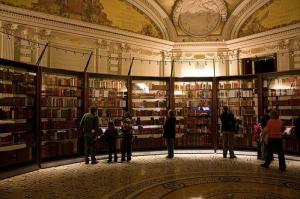
Picture by Flickr user mkoukoullis

Today, the Library of Congress is the largest library in the world, with over 147 million volumes, but it actually had a little bit of trouble getting off the ground. The Library of Congress was established in 1800, and by 1814 had around 3,000 volumes. Those books, though, went up in smoke when the British burned Washington, D.C. during the War of 1812, leaving Congress without a library – that is, until Thomas Jefferson stepped in.

By 1814, Thomas Jefferson was a little strapped for cash and, coincidentally, also had the largest collection of books in the country. Sensing an opportunity to remedy two issues (his financial situation and the condition of the Library’s collection), Jefferson wrote to Congress offering to sell his personal library to replace the destroyed Library of Congress. After a bit of debate (which, by the way, you can see for yourself in the U.S. Congressional Documents Library and on the Library of Congress’ site), Congress agreed and bought 6,487 volumes from Jefferson for $23, 950, more than doubling the previous size of the Library. Unfortunately, though, there was another fire in 1851 that destroyed two-thirds of Jefferson’s collection; what remains, though, forms the core of the Library of Congress’s current collection.

In 2008, the Library of Congress recreated Jefferson’s library – both physically in the library and online. The interactive portion of the online exhibition also recreates Jefferson’s original organization of the books, starting with the broad categories “Memory,” “Reason,” and “Imagination.”