Famous Librarians!

by Katie Ginnane

In honor of Banned Books Week, the Georgia State Law Library brings you a list of famous librarians, some of whom might surprise you. Before, and sometimes after, these masters of microfiche became famous for their various pursuits, they spent their nine to five in the quiet of a library.  Among this list are a founding father and and former first lady, so librarianship truly leads to great opportunities!

Laura Bush– This former first lady attained her Masters of Library Science from University of Texas at Austin in 1973.  She was employed both in a Houston public library and at Dawson Elementary School.  She has been quoted as saying, “I worked as a teacher and librarian and I learned how important reading is in school and in life.”

Ben Franklin– Not just an inventor, this founding father conceived of the idea of a subscription library, which would pool funds from members to buy books available to all.  He implemented his idea with the Library Company of Philadelphia, which continues today with 500,000 rare books, 160,000 manuscripts and 75,000 graphic items.  Ben Franklin also hired the first American librarian, Louis Timothee.

Mao Zedong–  Prior to his reign over China, this dictator worked as an assistant librarian at Peking University, where he was also a part-time student.  After, Mao became headmaster of school in Changsha.

Lewis Carroll– Before he crafted Through the Looking Glass and inspired Jefferson Airplane, this famous poet and writer worked as a sub-librarian at Christ Church, a college in Oxford.  He would later teach there.  Mr. Carroll, whose real name was Charles Lutwidge Dodson, was also a mathematician.  Lewis Carol’s famous book Alice’s Adventures in Wonderland was banned by one of our other famous librarians, Mao Zedong.

Madeleine L’Engel– Prior to publishing A Wrinkle in Time, this author volunteered at the Cathedral of St. John the Divine as a librarian, where she was later the writer in residence.  Later, she would go on to publish dozens of both fiction and non-fiction books.  “A Wrinkle in Time” is also on several banned books lists.

J. Edgar Hoover– This former head of the F.B.I. worked in the Library of Congress while attending law school at George Washington University.  At the Library of Congress Mr. Hoover worked as a messenger, cataloguer and a clerk during his tenure at the library.  In 1919, he left the library to become a special assistant to the Attorney General.

Philip Larkin– This famous poet also made a career out his librarianship.  Larkin worked as the librarian for many institutions in England, from from the public library in Wellington, Shropshire to the University of Hull library.  Larkin is credited with making the University of Hull library the first library with an automated online circulation system in Europe.

Banned Books Week

Saturday, September 24th marked the first day of Banned Books Week 2011.  Banned Books Week  celebrates the freedom to read and the importance of the First Amendment.   This year Banned Books Week is being held from September 24th until October 1st.  During this time libraries all over the country hold events to highlight free and open access to all information.

The American Library Association (ALA) provides a list of 46 books from the Radcliffe Publishing Course Top 100 novels of the 20th Century that have been the target of ban attempts. Here are a few books on the ALA’s  list you may recognize:

  • The Great Gatsby, by F. Scott Fitzgerald
  • The Catcher in the Rye, by JD Salinger
  • The Grapes of Wrath, by John Steinbeck
  • To Kill a Mockingbird, by Harper Lee
  • The Color Purple, by Alice Walker
  • Animal Farm, by George Orwell
  • Gone with the Wind, by Margaret Mitchell
  • The Lord of the Rings, by J.R.R. Tolkien

There are also hundreds of books that have not been banned but have been challenged.  Challenged means that there was an attempt by a person or a group to remove or restrict the materials.  The Office of Intellectual Freedom cites the following as the top three reasons books are challenged:

  1. the material was considered to be “sexually explicit”
  2. the material contained “offensive language”
  3. the materials was “unsuited to any age group”

For those interested in learning more about banned and/or challenged books, you can consult the ALA’s website devoted to Banned Books Week.

The Law Library also has several books devoted to the First Amendment and book banning.  Here are just a few:

Cal Ripken Wants You to Get a Library Card

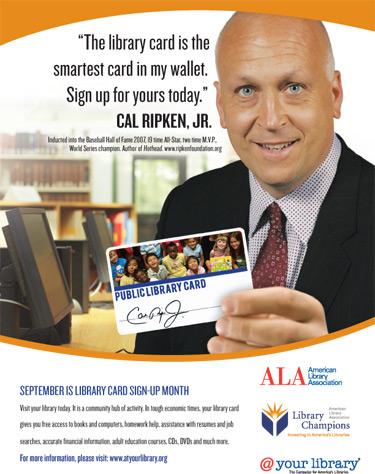
September is Library Card Sign-Up Month in the United States. This year’s spokesman and Honorary Chair is baseball Hall of Famer (and author) Cal Ripken, Jr. Ripken joins the American Library Association in urging kids and adults alike to get a library card.

But what exactly can a library card do for you? It allows you to check out books, of course, but there is often more to it. Many public libraries now offer ebooks, computer and Internet access, databases (newspaper archives and geneology research are especially popular), audiobooks, classes and educational programming, conference rooms, free family movie nights and more. Don’t forget the DVDs either. Depending on your library, those movie rentals may even be free or about the same as a Redbox rental (Take that, Netflix Quixster).

As a GSU student, your PantherID is your library card for both the law library and the university library. You can also get cards for local public libraries as well, including the Atlanta-Fulton Public Library, Dekalb County Public Library and Gwinnett County Public Library systems.


NY Times References GSU Law Review Article

by Katie Ginnane

In a story published September 19, 2011, the New York Times mentioned an article published in the Georgia State University Law Review. The story, concerning the recent Supreme Court Decision, Citizen’s United v. Federal Election Commission, discusses the requirement of disclosure outlined in Citizen’s United. It discusses some of the policy implications behind requiring disclosure of campaign contributions by elected officials. By requiring disclosure, voters may be able to make more informed decisions when casting their ballot. The more well known holding in Citizen’s allows unlimited campaign spending by corporations and unions.

The Georgia State Law Review article, written by Professor Torres-Spelliscy of Stetson University College of Law outlines the campaign periods from 2007-2010 and “the dramatic 180-degree turn that the law has taken” after the Supreme Court’s decision.
If you are interested in scholarly works published by Georgia State or other law professors, SSRN is a great site for access to working scholarly papers. You can access SSRN through the law library homepage, under legal indexes and databases.

ALI Members at Georgia State Law

Do you know what the American Law Institute (ALI) is and better yet do you know whom on the Georgia State Law faculty are members?

First things first: as you remember from your first year legal bibliography class, the ALI is made up of 4000 lawyers, judges, and law professors of the highest qualifications.  Through a deliberative process (sometimes taking two decades), they draft and then publish restatements of law and principles of law.  Final versions of these resources can be found in hardcopy in the Law Library general collection (e.g. the Restatement of Law, Torts can be found among tort resources, KF1246-KF1327 and Restatement of Law, Contracts can be found among contract resources, KF801-KF839).  The final restatements can also be found on Westlaw. Their Restatement of Law, Torts database contains the complete text of the 1st, 2nd, and 3rd Restatements of Torts as well as some proposed and tentative drafts, while their Restatement of Law, Torts Archive database provides considerably more historical tentative drafts, proposed drafts, and draft-related documents from the ALI Reporter.

Georgia State Law is well represented in the institute.  The following faculty are members of the American Law Institute:

NFL Lockout and the Law

On the night of Thursday, September 8th, the 2011-2012 NFL season kicked off when the reigning Super Bowl champion Green Bay Packers hosted the New Orleans Saints at Lambeau Field.  However, it was not too long ago that many of us doubted whether this season would start on time, if at all.  The issues involved in the lockout that threatened to derail our fall Sunday traditions remind us how the law intersects with nearly every aspect of our lives, even our diversions.

For those of you who have not spent the last several months closely following every development of the lockout, the following is a brief summary.

After the close of the 2010-2011 season, the final season included in the previous collective bargaining agreement between the league and the NFL Players Association, things looked rather bleak for football fans.  When the CBA expired in early March, the NFLPA was decertified.  On March 11, the players filed a class action antitrust lawsuit in U.S. District Court in Minnesota.  The players listed as plaintiffs are some of the biggest names in the NFL, and include Tom Brady, Peyton Manning, Drew Brees, Osi Unemyiora, Mike Vrabel, Brian Robison, Von Miller, Logan Mankins, Ben Leber, and Vincent Jackson.  The day after the suit was filed, the league imposed a lockout of the players.

One of the first orders of business for the players was to request an injunction against the lockout.  A hearing regarding the players’ request for an injunction was held in April before District Court Judge Susan Richard Nelson.  Judge Nelson declared the lockout was improper, and the owners immediately appealed to the 8th Circuit Court of Appeals.  The Circuit Court granted the NFL’s motion for a stay of Judge Nelson’s order pending appeal, and later, in a 54-page opinion, reversed Judge Nelson’s ruling.  (See opinion here: http://www.ca8.uscourts.gov/opndir/11/07/111898P.pdf )

In the meantime, settlement negotiations took place between the sides outside of the courtroom.  The 136-day ordeal finally came to an end when the players and owners agreed to terms for a settlement in July.  Upon agreement by all parties, Judge Nelson ordered Brady v. NFL dismissed, stating that the parties had “at all times acted with the utmost integrity and in the best interests of football.”

While the veracity of Judge Nelson’s statement is debatable, we can all agree that the end of the lockout is good for fans everywhere.  Now, our minds are free to ponder other things.  Like, why would Aaron Rodgers shave his magnificent preseason mustache?  Just how bad will the Colts be without Peyton Manning?  Did Tom Brady really agree to be the new face of Uggs?  Can the Falcons rebound after that painful Week 1 loss?

So enjoy this football-season-that-almost-wasn’t, and go Bills!!

By Kristin Poland

Escape into Fiction

Lawyers, law students, and law librarians enjoy a good story.  Even better is when that story combines our interest in the law with a bit of escapism.  Here are a couple of ways you can take a break from studying without having to forget about law school entirely.

You may be familiar with some lawyer authors—John Grisham, Brad Meltzer, Lisa Scottoline—who write books for adults—and other lawyers, like Louis Sachar who write for younger readers.  These authors know how to capture an audience’s attention:  Write about issues of justice, power, and the law.

Legal academics entertain themselves and others by considering legal themes in popular culture.  In print, for example, The Law and Harry Potter analyses legal concepts and issues seen in the Harry Potter series.  New York judge Karen Morris wrote Law Made Fun Through Harry Potter’s Adventure:  99 Lessons in Law from the Wizarding World for Fans of All Ages.

And, just this past weekend many celebrated the DVD release of X-Men: First Class.  As described in the Law and the Multiverse blog, the latest X-Men movie addresses international law, as well as civil rights-employment law.  Other blogs also address superheroes and the law.

While you are enjoying law school—whether you’re in your first or your final year—remember that this new way of ‘thinking like a lawyer’ enables you to consider your popular culture consumption in a new way.  You, too, can consume and create fiction—books, movies, blogs, and more—with a focus on truth, justice, and the American way!

Why did I go to law school again? A look at resources on alternative legal careers

by Katie Ginnane

As many of us law students contemplate the end of law school and the beginning of our legal career, we all have moments of doubt.  Whether you are a first year student just getting started or a third year student ready to get out, we have all asked ourselves the same question.

Why am I in law school?

Because firm life is the main trajectory of recent law school grads, we law students all assume it is the right career for us without researching our alternatives.  Looking at all your options throughout law school may help you realize how much you want to work at a firm, or it may start you down a path you never thought about prior to beginning law school. With the legal market the way it is, it may be worthwhile to research careers outside of firm work. Either way, here are some great resources about “life after law school” careers that may be worthwhile for those moments of uncertainty.

Here are some useful books available in the law library:

Non-legal Careers for Lawyers

  • Non-legal Careers for Lawyers is published by the American Bar Association.  It includes three sections.  The first section offers general advice on pursuing a non-legal career.  The second section is divided into several chapters addressing specific subject-area and the non-traditional opportunities within each.  Finally, it contains a list of additional resources for more comprehensive and personal research.

Should You Really Be a Lawyer? 

  • Should You Really Be a Lawyer is also divided into three subsections, two of which involve deciding to attend law and staying in law school.  The last section, Should You Really Practice Law?, addresses the decision of whether or not you should practice, including a self-assessment.  This book is useful for determining what you want to do, not necessarily at finding the right career alternative for yourself.

The Lawyer’s Career Change Handbook: More than 300 things you can do with your law degree 

  • The Lawyer’s Career Change Handbook offers insights into changing legal careers; however, it also provides a great list of opportunities within different fields of the law and resources to find out more about them.  This book provides helpful hints on honing in on marketable skills.  It is more focused on broad strategies for finding jobs than on individual career paths.

The Lawyer’s Guide to Finding Success in Any Job Market 

  • The Lawyer’s Guide to Finding Success in Any Job Market has one chapter specifically devoted to alternative law school careers.  In this book, the careers are divided into 8 subsections with information on who does it, what it is, what it pays and breaking into the industry.  It also lists pros and cons of alternative career choices, with some pros being few geographic restrictions, possibly increased job security and better life-work balance and some cons being reduced earning potential, loss of prestige and possible difficulty of returning to mainstream practice.

Outside of the library, Westlaw and Lexis have several articles outlining some alternative careers in their news sections.

Finally, the career services office is a great source for questions and advice about what to plan for if looking at alternative opportunities after law school and later in your career.

Kunstler, Darrow and… Shatner?

By now you all know, of course, that the Law Library has a pretty great DVD collection, and you also know where it is. (Oh, you don’t? Well, go down to the Federal Reporter and hang a left.) And we’ve done some work over the summer to make it better, including adding some interesting depictions of real life (and some not-so-real-life, of course) lawyers.

For instance, we already owned the Criterion Collection’s DVD release of Young Mr. Lincoln, starring Henry Fonda as a young travelling lawyer named Abraham Lincoln; we’ve also recently added the DVD of Henry Fonda’s acclaimed one-man show about Clarence Darrow, in which he recounts the trials of  John Scopes and Leopold and Loeb.

Disturbing the Universe on POVWe’ve also added a documentary on a much more recent and controversial attorney, William Kunstler, who died on September 4th, 1995, while preparing to represent another in a long line of controversial defendants.

Don’t need all of that reality? Well, we have you covered, too. Check out The Defender, starring a very young William Shatner as an attorney defending Steve McQueen, or the more recent (and hilarious) Harvey Birdman: Attorney at Law. Who knows? You might just get an idea for your outfit for next year’s Dragon*Con!

Fist Bump Finally Legal

The days before the fist bump.

Though you still shouldn’t use it in your 1L writing assignment, fist bump is now recognized as a word in the Merriam-Webster’s Collegiate Dictionary for 2011.  Fist bump is one of approximately 150 words added to the new edition.

Dictionaries add new words to reflect changing times, thoughts, and ideas.  You might wonder: the Obamas made the fist bump famous in 2008, why recognize the word now?  Well, the editorial staff who write dictionaries want to be sure that new words are truly part of the vocabulary before adding words—so there is a bit of delay between the introduction of a new word to spoken vocabulary and the formal addition of a new word to the dictionary.

The Concise Oxford English Dictionary also recently issued a 12th edition, commemorating 100 years since the first edition.  Approximately 400 new words are included in the new edition, so parents can defensibly take teens to task for sexting, cougars can hunt men without using their claws, and we can all woot with enthusiasm.

If you’re trying to find the meaning of a new word—that’s not yet in the traditional dictionary sources—don’t forget that you can check slang dictionaries.  One online source for that is urbandictionary.com.  When you want an explanation of jeggings, you can find one in a slang dictionary.

Dictionaries also eliminate words that are no longer common parlance.  Sadly, no longer can we use a growlery—“a place to ‘growl’ in; jocularly applied to a person’s private sitting room,” according to the Oxford English Dictionary online—that may happen instead in a man cave.  You can access the Oxford English Dictionary online through the University Library’s database list.