Grab your pencils, your pens, and your thinking caps and join the Law Library in celebrating National Poetry Month!
We have several events we are including as part of the celebration. Today, I am highlighting a couple of ways you can join us. Keep your eyes here for more about our celebration as the month continues!
Poetry Contest
We invite you to craft poems that are law- or law school-related, submitting no more than one poem each day between now and April 15, 2022, at 11:59 PM. We have a talented pool of students, faculty, and staff who will assist us in recognizing the best in category (student, faculty, and staff), as well as a best in show poem.
The Law Library will host poetry slams on April 25 at noon and 5 PM. To encourage participation, we are inviting our poets (if you’re reading your own poem) and performers (if you’re reading a poem by another) to participate in person or submit a video of their performance for screening during the event. Please keep performance length to 3 minutes.
You may submit your video files to me (at mbutler at gsu . edu) using the Georgia State Send a File tool. To be included, please submit your files no later than 9 AM on April 25.
Amanda Gorman is the youngest inaugural poet in U.S. history, and she was the first-ever National Youth Poet Laureate. This picture, taken at the inauguration, is an official photo provided by the Chairman of the Joint Chiefs of Staff. Use of this photo in no way is meant to suggest approval or endorsement by the Chairman, the Joint Staff, or others, of our National Poetry Month Celebration. Image available at: https://www.flickr.com/photos/thejointstaff/.
Brackets, brackets, and more brackets. The GSU College of Law Library is doing its part to add to March’s bracket noise. This year we are hosting a battle of legal resources by putting our favorite ones (including print, online, and Georgia resources) in a seeded, knock-out bracket and allowing the internet (via our Twitter account @GSULawLib) to decide who advances. A PDF printable bracket can be downloaded to fill out and follow along.
Resources have been selected and ranked by a mysterious committee that neither has to define its criteria nor is accountable to anyone for mistakes and down-right bias. The committee is working under the fiction that it is infallible, so they do not want to hear any whining about ranking or who got snubbed. They also seem to have a predisposition for the established, larger programs. See, we are making this almost exactly like another March event.
Legal resources will face off against one another and based on Twitter polls, advance in the tournament. In the improbable event of a tie, our copy of Randomness by Deborah J. Bennett will be tossed in the air. If it lands front-cover up, the first resource wins. If it lands back-cover up, the second resource wins, and if it lands open on a page, we will apply the example of randomness discussed therein.
Round one voting will begin Monday, March 21, 2022. Unfortunately, GSU’s spring break is this week (the week of March 14), so our students are not around. Subsequently, we’ll wait for them to get back and start the week of March 21. That said, everyone out there is welcome and encouraged to join in the Mania-Ness. All voting will take place via the law library’s Twitter account, @gsulawlib. We encourage you to follow the law library on Twitter to not miss any of the “games”.
Each “game” will last one day, and voting will open around 8:30 AM. The tournament schedule is:
Monday, March 21, 2022, First Round (Online 1 Section)
Tuesday, March 22, 2022, First Round (Online 2 Section)
Wednesday, March 23, 2022, First Round (Georgia Section)
Thursday, March 24, 2022, First Round (Print Section)
Monday, March 28, 2022, Second Round (Sweet Sixteen, Online 1 & 2 Sections)
Tuesday, March 29, 2022, Second Round (Sweet Sixteen, Georgia & Print Sections)
Wednesday, March 30, 2022, Third Round (Elite Eight, All Sections)
Thursday, March 31, 2022, Fourth Round ( Final Four, All Sections)
Monday, April 4, 2022, Fifth Round (Finals)
The legal resources that are competing in our March Mania-Ness, their sections, and seeding are as follows:
Congratulations and good luck to all of our legal research competitors. Questions can be directed to Librarian Manion and he will relay them to the mysterious committee.
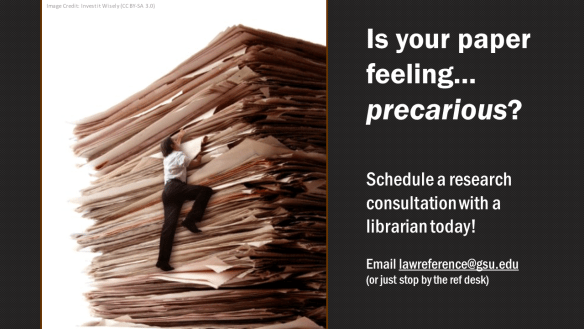
Researching a paper can be intimidating. In my experience, this emphatically applies to many situations where the paper in question is for a law school course. Most law students have only just recently become familiar with the fundamental sources and strategies of legal research, and applying them to a lengthier treatment of a multidimensional (and often interdisciplinary) topic adds another layer of complexity.
Fortunately, your friendly neighborhood librarian is here to help, in the form of a research consultation. We are available to meet with you one-on-one to give you highly individualized advice on researching your paper. This includes help with many different aspects of the paper-writing process, including refining your thesis, checking for preemption, developing a research plan, identifying relevant resources, finding authorities that support your arguments, and more.
Efficient, high-quality research can make a big difference with any paper. Research can be very path-dependent, and the strategies you choose earlier in the process will lead you to different sources, and those sources will inevitably shape your arguments and ideas in the final product. Impeccable research isn’t just something you do to build an impressive footnote count! (Although a consultation will undoubtedly help you with that as well.)
Research consultations are not only extremely helpful, they are also very easy to schedule. To do so, you can hit us up at lawreference@gsu.edu, email your personal librarian, or simply stop by the reference desk. With that high degree of convenience in mind, I’m going to close out this blog post by stridently demanding that you stop whatever you’re doing and schedule a research consultation right now. I mean, don’t you want to write a better paper?
By Ross Crowell, Law Library GRA Sports Law Correspondent
Watching primetime NFL games on television will probably look a bit different during the 2022 season. Fox, CBS, NBC, ESPN, and Amazon are all trying to figure out who they will have announcing their games during this upcoming football season. These multi-million dollar broadcasting contracts are legally complex, implicating different areas such as Contract Law, Employment Law, Media Law. There are also potential Antitrust Law implications, since the NFL and its television broadcasters are regulated by the Sports Broadcasting Act of 1961, which grants a limited exemption to the Sherman Act permitting the various teams to enter into joint broadcasting agreements despite their anticompetitive effects.
The biggest shift relates to increased importance of streaming rights. Amazon has shaken things up being a new player in this business, as they now have the exclusive rights to stream 15 Thursday Night Football games for the 2022 season on Amazon Prime.
The networks’ broadcast booths will be playing musical chairs, as many of the biggest names will be on the move. Some top broadcasters that are potentially leaving networks are Troy Aikman (Fox), Al Michaels (NBC), Louis Riddick (ESPN), and Brian Griese (ESPN). Riddick is being considered for NFL general manager positions and Griese, whose contract expired after the 2021 season, will reportedly become the San Francisco 49ers quarterbacks coach. Aikman, who reportedly will become the new color analyst for Monday Night Football at ESPN, has broadcasted for Fox for 20 years, spending 19 of those with broadcast partner Joe Buck. Aikman’s reported deal will be for five years and close to $18 million annually.
In addition to current broadcasters, some big-name former players are also in consideration for these roles. Recently retired 7-time Super Bowl champion Tom Brady reportedly will be contacted by Amazon and Fox to gauge his interest in broadcasting. Drew Brees, who led the New Orleans Saints to a Super Bowl, was on television last season for NBC and could be poached by one of the competing networks.
However, Brees only has one year of experience on television and Brady has not broadcasted any games, as he retired just over a month ago. As these contracts for broadcasters rival what the top players in the NFL are paid, it is a bit of a risk to hire someone with inexperience. However, the names of Brees and Brady likely will draw in many fans that would want to tune in to their broadcasts. The networks will have to carefully weigh these various considerations when negotiating these complex employment contracts.
In case you haven’t read the news, scholarly research into slavery’s influence on our legal system is highly relevant to many ongoing debates. The law library can help with your research in many ways, but today I’m going to highlight HeinOnline’s Slavery in America and the World: History, Culture, and Law. Whether you are doing legal research that relates to slavery, or interdisciplinary research on other aspects of slavery that touches upon the law, this rich collection gathers a wide range of useful primary and secondary sources that might otherwise be cumbersome to identify and locate.
When it comes to primary legal sources, Slavery in America and the World aims to be comprehensive. It includes:
Every statute passed by every colony and state on slavery;
The way the collection organizes these sources by jurisdiction and then presents them chronologically is obviously a great match for a research project focused on historical developments; however, even if the historical timeline itself is not a major focus of your research, this organization still provides some valuable context. It’s quite useful.
This database also cuts a wide swath when it comes to gathering primary historical sources (i.e., contemporary accounts of slavery). HeinOnline says it includes every pre-1920 English-language legal commentary on slavery, including many obscure articles and journals that are otherwise difficult to find. It supplements those legal commentaries with hundreds of newspapers and pamphlets discussing slavery from a variety of perspectives.
Slavery in America and the World also helps to contextualize this impressive range of primary sources with useful secondary materials. It includes a fairly thorough and relatively up-to-date collection of modern legal scholarship on slavery, as well as an extensive bibliography of books on the topic.
Slavery looms large over American history and American law, and there is no shortage of sources on the topic, which can make research feel overwhelming, even for the experienced researcher. Slavery in America and the World helps to make it more manageable by gathering so many of the most important resources in a single place and organizing them in an intuitive and approachable manner. If you are just getting started, the collection has a clear and easy-to-navigate LibGuide to help point you in the right direction. Of course, as with any of the GSU Law Library’s many resources, librarians are also here to help you use them effectively in your research.
By Ross Crowell, Law Library GRA Sports Law Correspondent
Prior to 2021, college athletes were strictly seen as unpaid athletes. That has changed over the past several months, as now college athletes are able to make money off of their name, image and likeness (“NIL”). While the schools are still not allowed to directly pay their student athletes, the student athletes can now make money from things like advertisements and social media. However, the confusing legal environment surrounding NIL means that colleges and athletes are unsure of what they can and cannot do.
The NCAA abruptly enacting this temporary rule change has created mass confusion among its member schools, as there is currently not much clarity on what is and what is not allowed. Additionally, different states having very different NIL laws has put some schools at a disadvantage. For example, Alabama and Florida, among other states, have stricter NIL laws than other states. Thus, college athletes in those jurisdictions cannot take advantage of the NIL to the same degree as athletes in states that do not have any NIL law at all (such as Kentucky and Virginia).
With players signing lucrative NIL contracts to appear in national advertisements for established brands, stakeholders are seeking clarity and uniformity. From the perspective of colleges, restrictive state NIL laws could be a disadvantage in recruiting, or even prompt top athletes to transfer to schools where they can fully take advantage of NIL. This resulted in the Alabama House voting in favor of repealing its prior law. Other states likely will follow, as the state legislatures will want their universities on a level playing field with schools in other states.
The best solution to this issue may be to enact a new federal law to restore uniformity by preempting the current state NIL laws. Instead of 50 different state laws dictating how their college athletes can profit from their NILs, there would be a single rule that all universities and teams have to play by.
The NCAA seems to feel the same way. When the NCAA announced the legality of NIL on June 30, 2021, Division I Board of Directors chair Denise Trauth said, “with this interim solution in place, we will continue to work with Congress to adopt federal legislation to support student-athletes.” Congress held a hearing on October 1, 2021, where NCAA president Mark Emmert called on Congress to act, claiming that the NCAA has an urgent need for NIL federal framework.
So far, there has not been any federal or NCAA action taken. This will be an interesting issue to follow, as many college sports pundits claim that NIL has turned college athletics into the “wild wild west” without an overarching law.
By Ross Crowell, GSU Law Library Sports Law Correspondent
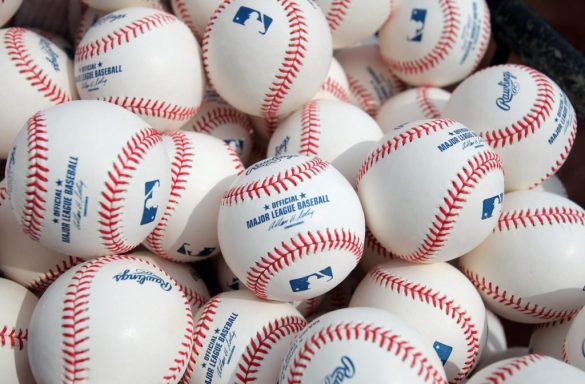
Here in Atlanta, many baseball fans should be looking forward to the upcoming baseball season, as the Braves are fresh off of a World Series victory. The Braves should start off the 2022 season in under two months, as their first game is scheduled at the Miami Marlins on March 31. However, the Braves and the rest of Major League Baseball (“MLB”) likely will not be playing games as scheduled. It appears to be an all-but certainty that the 2022 season will not start on time due to the MLB lockout. And ultimately it might be beneficial to remember that the lockout grew out of something everyone who’s taken 1L Contracts is at least passingly familiar with: protracted negotiations over an extremely complex contract.
We are now over two months into the lockout, which has been caused by the owners and players failing to reach a new collective bargaining agreement (“CBA”). Further, it appears that the two sides have not made much progress in reaching an agreement. The lockout began on December 2, when the Major League Baseball Players Association and the owners could not reach an agreement, resulting in the MLB’s first work stoppage since 1994.
The players and owners are mainly arguing over financial issues, with players upset that they aren’t paid the high salaries they think they deserve. The players also want to change a long-time rule that forces players to wait six years to reach free agency. As players’ first contracts are usually not for substantial money unless they were a high draft pick, this rule forces players to wait a significant amount of time before they can cash in on a big second contract (potentially worth hundreds of millions of dollars in some cases).
Further, the players and owners are struggling to reach an agreement on the pre-arbitration bonus pool. The players recently lowered their proposed pre-arbitration bonus pool from $105 million to $100 million, while the owners are sitting at a proposed $10 million. Thus, there is a significant gap in those negotiations.
Additional issues that the two sides are arguing over are disincentivizing tanking (i.e., stop rewarding teams who intentionally perform poorly), increasing the competitive balance tax threshold, and ending service-time manipulation. The service-time manipulation is an interesting issue that notably occurred with Atlanta’s All Star outfielder Ronald Acuña. With Acuña, the Braves knew that he was ready to be a big contributor during 2018. However, Atlanta waited until three weeks into the season to call Acuña up from the minor leagues, as this would allow the Braves to get an extra year out of Acuña’s contract before hitting free agency. Thus, the players are hoping the new CBA will put an end to this practice.
Moreover, these negotiations involve several attorneys. Notably, MLB Commissioner Rob Manfred was a labor and employment partner at Morgan Lewis & Bockius LLP prior to his career with the MLB. While Manfred was with Morgan Lewis, he negotiated on behalf of the owners during the 1994-1995 MLB lockout, along with negotiating the league’s first drug-testing program in 2022. Dan Halem, who is the league’s Deputy Commissioner, previously served as a partner at Proskauer Rose LLP, working in labor and employment law, along with sports law. Additionally, Bruce Meyer, the MLB Players Association Senior Director of Collective Bargaining and Legal, is a partner at Weil Gotshal & Manges LLP. Meyer also has experience working on behalf of the NHL, NFL, and NBA during arbitrations, lawsuits, and CBA negotiations.
These are just a handful of things that are being heavily disputed between the players and owners. With spring training tentatively beginning on February 16, it appears highly unlikely that things will get started on time, likely resulting in the regular season getting pushed back. If you are planning on going to the Braves’ home opener on April 7 against the Mets, now might be the time to start coming to the realization that the game may not occur.
So, when you’re trying to connect tricky concepts around negotiations, contracts, and labor law to the real world, it might actually be beneficial to think of all of those baseball games that will never be played.
The Georgia State University College of Law Library recently unveiled its new book display, Illustrating the Law. This collection showcases law library print materials that include illustrations. The exhibit is on display for the remainder of the month and is located on the fifth floor of the College of Law Building, just past the reference and circulation service desks on the short shelving that hosts the DVD and leisure collections.
The practice and study of law are incredibly writing-intensive. As such it comes as no surprise that the materials supporting these endeavors generally consist entirely of text, offering very little to break up its dense prose or offer even a cursory nod to the visual learner. Law is written. Our codes, cases, regulations, practice materials, formbooks, treatises, law review articles, legal encyclopedias, and casebooks rarely include an illustration, but there are some exceptions. This exhibit brings together those unique legal resources that opt not to rely entirely on verbose, sesquipedalian prose and instead include an illustration or two. These types of publications range from legal medical dictionaries detailing injuries for tort litigation to technology instructional guides for lawyers peppered with screenshots and flow charts to modern graphic novels tackling legal issues and instruction to somewhat more-refined coffee table books that celebrate a place, time, legal body, or actual library.
Take some time over the next month to explore this temporary collection. Consider how legal publishing uses (and does not use, for that matter) illustrations and graphics to better support the practice and study of law. Evaluate whether these examples add value to their respective areas of law and why so few resources include illustrations.
This exhibit is part of the law library’s revolving series of book displays promoting the breadth and value of its print collection. Not everything is online, after all. Past law library book exhibits include:
As you surely know, Justice Breyer recently announced that he would be stepping down at the end of this term, setting another Supreme Court confirmation process in motion. However, you may not know how to further research Breyer’s legacy and SCOTUS confirmations.
Justice Breyer was well-liked by his colleagues and had a reputation for asking colorful hypotheticals from the bench. SCOTUSBlog has great coverage of his overall legacy, including many reminiscences from former clerks. Before his nomination to the federal bench, Breyer taught admin law, and some of the best scholarship on his SCOTUS tenure focuses on this subject, such as this Justice Stephen Breyer’s Contribution to Administrative Lawsymposium. During his nearly three decades on the Supreme Court, he (of course) wrote important opinions on a wide array of topics, often crafting compromises and creating nuanced balanced tests: the Congressional Research Service (CRS for short—you’ll be seeing a whole lot more of them in this post) recently published a nice overview of his jurisprudence.
To this writer, his most memorable opinion was in dissent, issued in Parents Involved in Community Schools v. Seattle School District No. 1, a case that sharply limited desegregation efforts in public schools. I would encourage anyone who’s ever dismissed Justice Breyer as a bloodless technocrat to listen to him read what Justice Stevens called his “eloquent and unanswerable dissent” from the bench, asking “what happened to stare decisis?”
With Breyer’s imminent retirement, the appointment process for his successor begins. If you’d like to further explore that process, HeinOnline’s History of Supreme Court Nominations collects an impressive array of primary and secondary sources. Those sources include this excellent CRS report on what goes into the President’s selection of a nominee. There are also helpful CRS reports on the rest of the process, including one on the nominee’s consideration by the Senate Judiciary Committee and another discussing the limitations and customs surrounding the questions Senators ask judicial nominees during confirmation hearings.
For a deeper dive, there are some great research guides out there that provide a more in-depth treatment of the many, many resources available on these topics. And, of course, if there are any resources on Justice Breyer’s retirement, or on SCOTUS appointments more generally, that you have found to be especially useful or interesting, be sure to let us know in the comments.
The GSU College of Law Library recently added PowerNotes (Premium) to its Database List. This is perhaps somewhat misleading as PowerNotes is not a research database, per se, but rather a research outlining and management tool. There is a stripped-down free version of PowerNotes; however, the law library acquired institutional access to its premium service (including unlimited projects and other upgrades) for the GSU College of Law community.
PowerNotes uses a browser extension to help with online research, specifically gathering and keeping track of source materials, and organizing and creating a writing outline. Users can install either the Chrome or Firefox browser extension; these are the only browser options at the moment. Once installed, use your campus email address to create an account. Now, you can create a project and begin searching on a preferred research platform or across the web, generally. PowerNotes works with any webpage you browse, including legal subscription services such as Westlaw Edge, Lexis+, and HeinOnline (which provides a LibGuide on how to use PowerNotes on its platform). This is perhaps its most significant feature– centralizing your research regardless of where the source material resides online.
When users find relevant information, they can highlight the text, save it, assign a topic to it and annotate it. The text is saved with a link back to the source. Citation information is automatically collected and put in a preferred citation format, say bluebook. At any time during the research process, users can revisit their projects and reorganize, rename, or expand their topics and quotes.






 The Blackacre Times
You must be logged in to post a comment.