Finding Study Aids for your Professional Responsibility Course

In a previous post we focused on Property Law for the 1Ls, but they are not the only ones who need help!

All of you 2Ls out there likely have your Professional Responsibility final to get past before the summer. The rules of Professional Responsibility are there for a good reason. Unfortunately for us law students though, there’s a little more to them than “don’t touch your client’s money” and “communicate with your client[s].” Thankfully we have the awesome professors at GSU to help us out with these – and the amazing Law Library (and librarians and other staff and students assisting the library) to help us learn them.

Back to the study guide – to get to Professional Responsibility, we click on the “2L Courses” tab in the left menu. This brings down a drop-down menu of selected 2L courses:
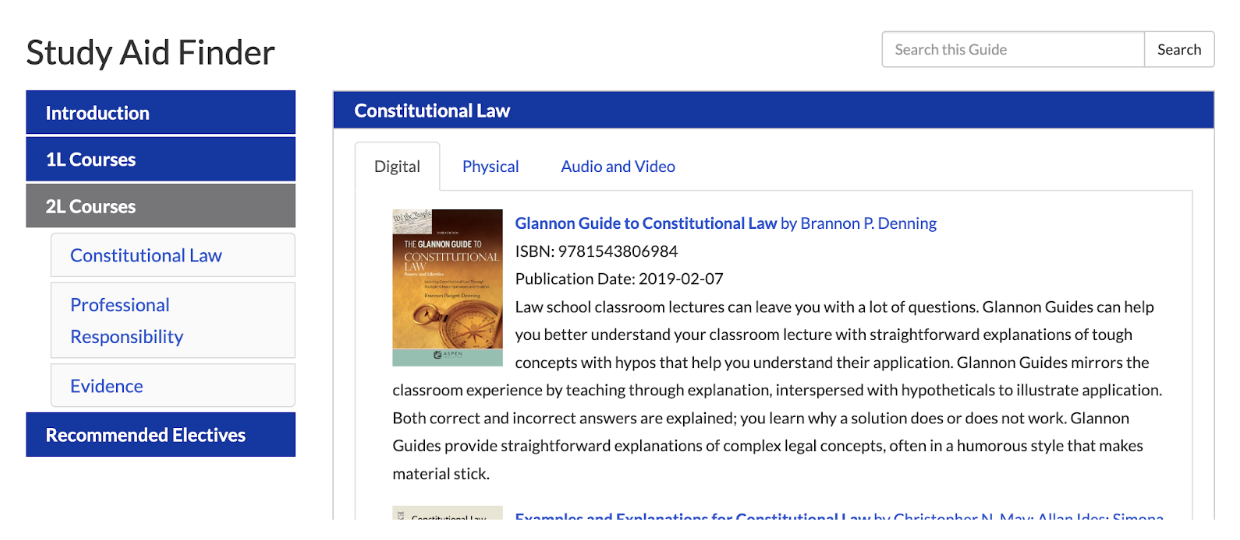
Clicking on “Professional Responsibility” will bring you to a box with digital, physical, and audio/visual resources to aid your study, just like the other courses we’ve reviewed in this blog series:

We previously took a peek at a Glannon guide, so let’s take a look at a different guide this time around.

Clicking on the Examples and Explanations for Professional Responsibility (a.k.a., the “E&E” guide) again brings us to the publishers website and the Aspen Learning Library:
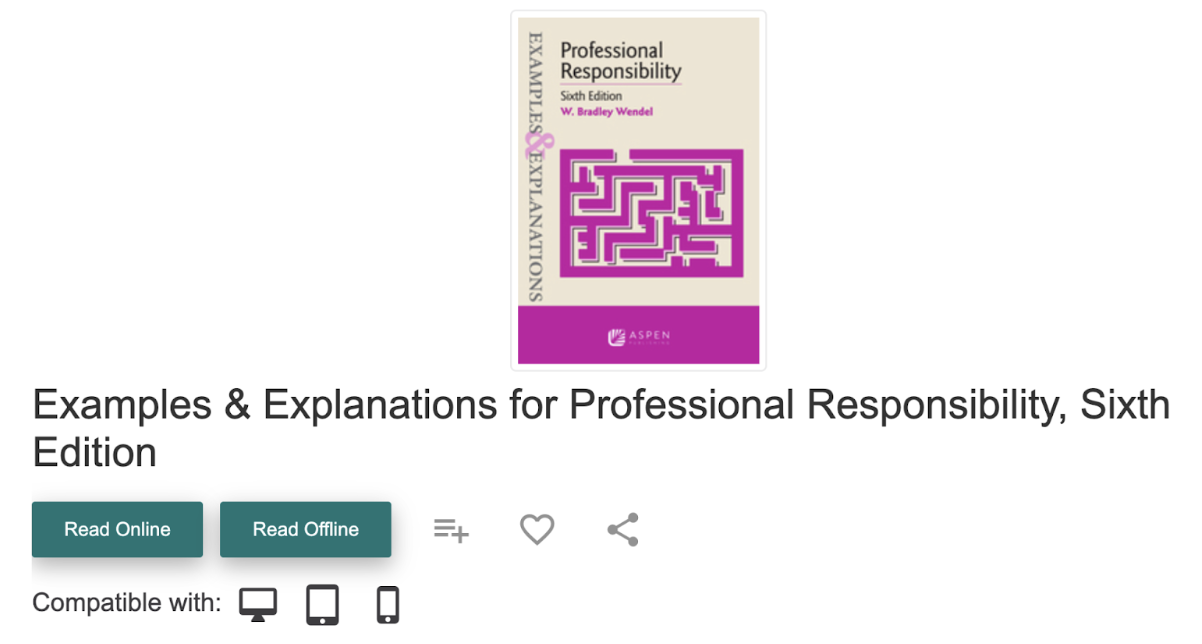
As you can see, it’s compatible with a variety of electronic devices (computer, tablet, phone) and can be accessed online or offline (note: offline reading must be done through the Aspen Learning Library App, available for PC/Mac/Android/iOS).

Utilizing the “Read Online” tab, you are brought to the table of contents, and from there, you can search the ToC, scroll through the ToC, etc. Chapters are broken out into the major topics (possession, gifts, title, etc.). The chapters discuss the topics generally, and provide some examples with explanations (hence “E&E”).

As this is another Aspen Learning Library resource, the interface is similar (if not identical) to that of the Glannon guide discussed previously:

Going to the “Duty of Competence” section, for example, is something that none of GSU students should have to worry about, but, you’re going to get tested on it on the final, the MPRE, and the bar. The top left icons bring one to the Aspen Learning Library and Table of Contents, respectively. The five menu buttons on the top right provide a “text to speech” function, a button for supplemental material, a full screen viewer option, a settings option (allows one to change the font size and font), and a search option. The chapter then ends with some examples. Other resources in the “digital” tab include the Glannon series, the Emmanuel crunchtime series, and others. 

Clicking on the “Physical” tab brings a list of resources that are similar (some are identical) to those in the “digital” tab. These can be accessed physically in the Law Library, or the ISBN is provided and one can Google it and find a vendor-of-choice to obtain the book.

The “Audio and Video” tab has a list of resources that are, well, audio and video! These resources are not as comprehensive or have the depth of examples (a.k.a. “Hypos”) that other resources have, but, for those on the go, these resources provide a great opportunity for learning in traffic, in the gym, nursing a child, etc.

The amount of resources available can be overwhelming, but I’d recommend skimming a few, see which resource resonates with you, and go from there. You can’t go wrong. Happy hunting and best of luck on your upcoming exam!

Finding Study Aids for your Property Class

In a previous blog post, we provided a 30,000 foot view of the Study Aid Finder that the GSU College of Law Library so kindly put together to aid your studies. The next series of blog posts will highlight certain aspects of the Study Aid Finder with the hope that it helps you take advantage of what it has to offer…and I hope you do, because who doesn’t love saving $$ by not buying resources on Amazon that the Law Library has freely available to you…AND who doesn’t like succeeding in your classes?

The 1L’s out there are only a few weeks away from completing a major milestone: the completion of the first year of law school! Definitely a cause for celebration. There are a few pesky speed bumps in the way of summer, however, one of which likely being the Property law final. Let’s take a look at the Study Aid Finder and see how it can help prepare you for the Property law final…

As noted in a previous blog post, when one goes to the Study Aid Finder, there is a menu bar on the left with 1L courses, 2L courses, and recommended electives. Clicking on the “1L Courses” bar gives a drop down menu, from which “Property” can be selected.

Clicking on the “Property” bar, you’re directed to a box with digital, physical, and audio and video resources that can help prepare you for the exam:

For a given tab, the resources are rank-ordered in an unscientific analysis of comprehensiveness, buts lets go through a few and go through the tabs of the box.

Let’s start with digital. Clicking on the “Digital” tab will display a list of resources. Let’s start with the “Glannon Guide to Property ” for no other reason than it is at the top of the list.  Clicking the link may or may not bring you to a landing screen to enter your GSU network credentials (depending on whether or not you are accessing the resources from campus or off campus). After entering credentials (if needed), one is directed to the Aspen Learning Library site for the Glannon Guide:

As you can see, it’s compatible with a variety of electronic devices (computer, tablet, phone) and can be accessed online or offline (note: offline reading must be done through the Aspen Learning Library App, available for PC/Mac/Android/iOS).

Utilizing the “Read Online” tab, you are brought to the table of contents, and from there, you can search the ToC, scroll through the ToC, etc. Chapters are broken out into the major topics (possession, gifts, title, etc.). The chapters discuss the topics generally, and even provide some discussion of case law. 

Looking at lost property and treasure trove (because who doesn’t like treasure??), the online viewer has a view like this:

The top left menu buttons bring you to the Aspen Learning Library (the publisher for this particular book) and a link to the table of contents, respectively.  The five menu buttons on the top right provide a “text to speech” function, a button for supplemental material, a full screen viewer option, a settings option (allows one to change the font size and font), and a search option. The chapter then ends with some examples. Other resources in the “digital” tab include examples and explanation books, the Emmanuel crunchtime series, and others. 

Clicking on the “Physical” tab brings a list of resources that are similar (some are identical) to those in the “digital” tab. These can be accessed physically in the Law Library, or the ISBN is provided and one can Google it and find a vendor-of-choice to obtain the book.

The “Audio and Video” tab has a list of resources that are, well, audio and video! These resources are not as comprehensive or have the depth of examples (a.k.a. “Hypos”) that other resources have, but, for those on the go, these resources provide a great opportunity for learning in traffic, in the gym, nursing a child, etc.

The amount of resources available can be overwhelming, but I’d recommend skimming a few, see which resource resonates with you, and go from there. You can’t go wrong. Happy hunting and best of luck on your upcoming exam!

An Easy Way to Find the Best Study Aids for your Course

The GSU Law Library is an absolutely fantastic resource for exam preparation.  A former colleague of mine would tell the tale of when he was in school, after he got the syllabus for a given class, he’d hit the library and look for resources to supplement his in-class experience…and would end up CALI’ing the class.  Anecdotal humble brags aside, we may not be in the beginning of the semester, but it is never too late to look around for resources that can help bolster your understanding of a given subject.

This is especially true with exam season coming up around the corner. Despite the high caliber of GSU’s professors, everyone has a different learning style, and the way material might be presented in class may not “fit” with one’s learning style. Others may just want more practice and to review a different presentation of their course material to help solidify the information in their brain (in neuroscience we call this “memory consolidation”).

Fortunately for you, GSU really goes the extra mile to ensure and promote the success of its students. The Law Library has put together a Study Aid Finder to help students get the most out of what the Library has to offer for us students to knock out those pesky exams with flying colors. This is the kind of resource I really wish someone could have handed me on day 1 of law school…let’s take a look, shall we?

First thing’s first – the Study Aid Finder can be accessed at: https://libguides.law.gsu.edu/studyaidfinder

The landing page has an introduction that one can read if one so pleases, but the interesting stuff can be found on the menu bar on the left-hand side of the page:

Clicking on one of the menu bars will expand the course selections:

Clicking on a given course will then lead you to a collection of study aids for that particular course. You’ll see digital formats that can be accessed with your GSU credentials and can be viewed on laptops, mobile devices, etc. If you’re a luddite like myself and prefer paper, there’s a link for information for the physical printed book. There’s also an audio and video tab with some resources for those of us on the go. It’s not like Atlanta has any traffic or anything, but, if it did, listening to audio while on your way to T-deck is a great use of time.

Happy hunting!

Ode to Study Aids

How do I study, let me count the ways?

I review my notes, summarize, restate

My future self I picture, earning As

How long to study, I can’t estimate!

Why are civil procedure, contracts, torts

So hard to wrap my tired brain around?

I ‘m desperate, overwhelm’d, out of sorts

I’m dragging, I’m flagging, in highlights drowned.

Stumped by lecture, black letter, check my text,

Questions, no answers! Help I cannot find?

Colleagues struggle too—we are all vexed

How to embed these concepts in my mind?

Law Library’s got my back, study aids

Connect, clarify, lifting up my grades

Seriously folks, we in the Law Library realizes that study aids are a useful tool in the effort to understand material that is presented through your textbook, lectures, and other assignments in your doctrinal courses.

To that end, we have an excellent collection of study aids that you can turn to if you need assistance or clarity as you seek to understand—or check your understanding—of concepts from class. Students often ask how to choose a good study aid.

Of course, in law school, the answer is usually “It depends.” It depends on what you’re looking for—do you need just a statement of the law? Do you want something that you can quiz yourself with? Are you looking to confirm that you’re outline structure of the relationship between concepts makes sense? Different study aids have different strengths. Many are based on books, but they also may be videos or even lessons like those CALI lessons you’ve heard so much about in class!

If you want help figuring out what options exist for a class you’re in, you can check out our Study Aid Finder. It’s organized so that study aids for required courses in your 1L or 2Lyears are pulled out separately, and study aids for other bar classes are included under recommended electives.

Remember that there are a variety of formats available to assist you. Have long drives in Atlanta and prefer to listen to an audio version? You can! Want to check a study aid at 3 in the morning without leaving the comfort of your home? You can!

If you’re looking for study aids for classes that fall out of the scope of regularly recommended bar classes, you will also find some study aid recommendations on the research guides for those subjects. Check out our federal tax research guide for an example! If you have questions about how to access study aids, our Introductory Guide for First Year Students is an excellent resource.

Research Smarter Not Harder

By Gilbert Morales, Reference GRA

During my 1L year, researching caselaw triggered instant anxiety. To me, conducting research was an overwhelming experience that was hard to manage. Thankfully, I was wrong. Yes, conducting research is tough, but it is manageable by taking advantage of resources made available by the library. 

An open computer sitting on top of a wooden table

Description automatically generated

One invaluable resource is the library’s collection of research guides (also known as LibGuides). LibGuides essentially serve as a one-stop-shop for beginning your research process. They cover many major law school topics, including Georgia Legal Research, Criminal Law, and Legal Ethics and Professional Responsibility. Students will find links to secondary sources like major journals, treatises, and even articles. 

Students will also see links to primary sources like the Georgia Code, the Federal Code, and local ordinances. What is neat about the guides is that they include tips and tricks to make research easier for you. For example, they provide direct links to secondary sources in Westlaw and LexisNexis so that researchers do not waste time trying to navigate those resources. 

As everyone knows, time is of the essence in law school. Research guides include different approaches to accessing resources, including links to research institutes and links to popular blogs that monitor the trends for any given topic. For example, in the Land Use guide, students are directed to the Wayback Machine to uncover website pages that are no longer available online. These tips and tricks are just the tips of the iceberg. Research guides are full of different ways to make the research experience easier and more productive. 

In addition to research material, LibGuides provide links to study materials. From evidence to tax law, students can access study aids, CALI lessons, and exam archives for each topic. The convenience of finding all the essential study aids in one location is truly a time saver. 

So, the next time you find yourself overwhelmed by the research experience, take a deep breath, and visit the LibGuides on the library website!