Finding Study Aids for your Corporations Course

We get it. If you’re taking Corporations, you may be thinking “I’ve made it this far in law school, why do I need additional assistance?”

Even if you don’t need it, per se, the Law Library wants to emphasize that these resources are still there for your enjoyment and intellectual enrichment. These resources are still invaluable for those in particular that have “too much on their plate” and need a little help.

The Study Aid Finder has a “Recommended Electives” tab for upper-level students.  These courses are courses with subject matter often tested on the bar.  You may not even be taking any of these courses, and may not have a course exam to prepare for, but for those 3L’s and 4LP’s, the July bar exam is right around the corner. These resources could be useful for bar prep even if you don’t have a final in these courses.

As with the other posts highlighting the Study Aid Finder, going to the menu on the left of the screen and clicking “Recommended Electives” gives a drop-down menu of various courses that are not required for graduation but often tested on the bar exam:
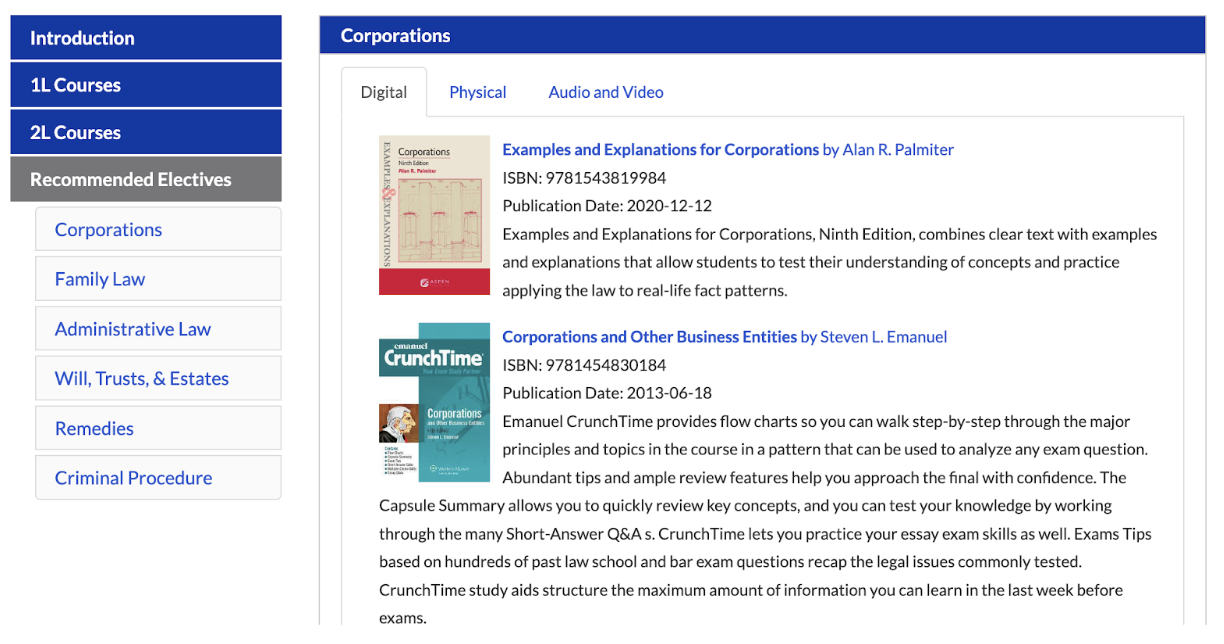
Clicking on “Corporations,” as with the other courses, brings you to a box with “Digital,” “Physical,” and “Audio and Video” tabs. A portion of the “Digital” tab is displayed above. We’ve previously taken a look at the Glannon guide[s] and Examples and Explanations series, so let’s look at something different this time: the Emanuel CrunchTime series.

Clicking the link brings us [again] to the Aspen Learning Library:

Unlike the other resources we’ve investigated in this blog series, there is no “read online/read offline” option – only a “View Inside” option.

Clicking “View Inside” brings us to essentially an e-book within the browser:
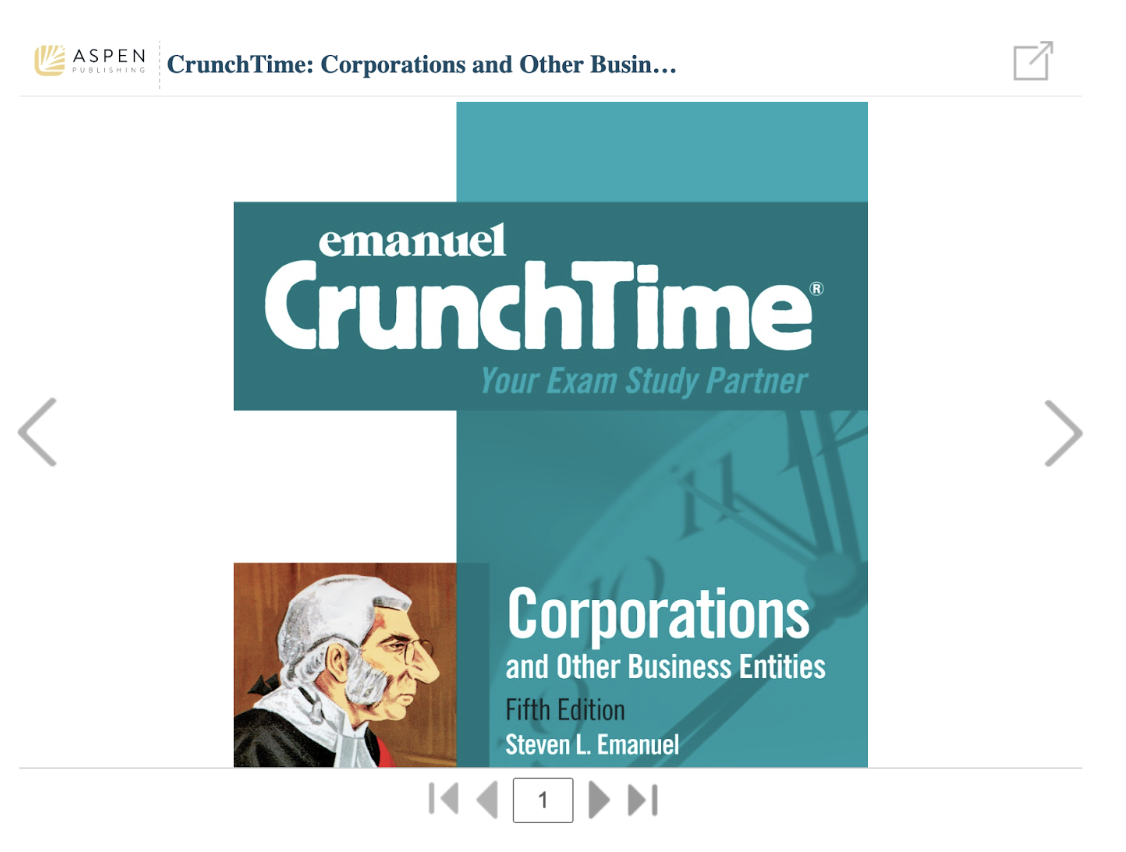
Unlike the other resources we’ve evaluated in this series, the e-book options aren’t as comprehensive. There’s not a search menu button, a table of contents menu button, etc. That does not mean this resource is not valuable though.

With this resource, we are more or less limited to digitally turning the page. That’s not a bad thing though! Looking at the table of contents, this resource has a lot to offer:

As can be seen, there’s around at least 140 pages of exam questions in various formats
(with explanation). This is a great way to test your application of the material, or, alternatively, a great way to learn through experience.

Clicking on the “Physical” tab brings a list of resources that are similar (some are identical) to those in the “digital” tab. These can be accessed physically in the Law Library, or the ISBN is provided and one can Google it and find a vendor-of-choice to obtain the book.

The “Audio and Video” tab has a list of resources that are, well, audio and video! These resources are not as comprehensive oand don’t provide quite the depth that other resources have, but, for those on the go, these resources provide a great opportunity for learning in traffic, in the gym, nursing a child, etc.

The amount of resources available can be overwhelming, but I’d recommend skimming a few, see which resource resonates with you, and going from there. You can’t go wrong. Happy hunting and best of luck on your upcoming exam!
Finding Study Aids for your Professional Responsibility Course

In a previous post we focused on Property Law for the 1Ls, but they are not the only ones who need help!

All of you 2Ls out there likely have your Professional Responsibility final to get past before the summer. The rules of Professional Responsibility are there for a good reason. Unfortunately for us law students though, there’s a little more to them than “don’t touch your client’s money” and “communicate with your client[s].” Thankfully we have the awesome professors at GSU to help us out with these – and the amazing Law Library (and librarians and other staff and students assisting the library) to help us learn them.

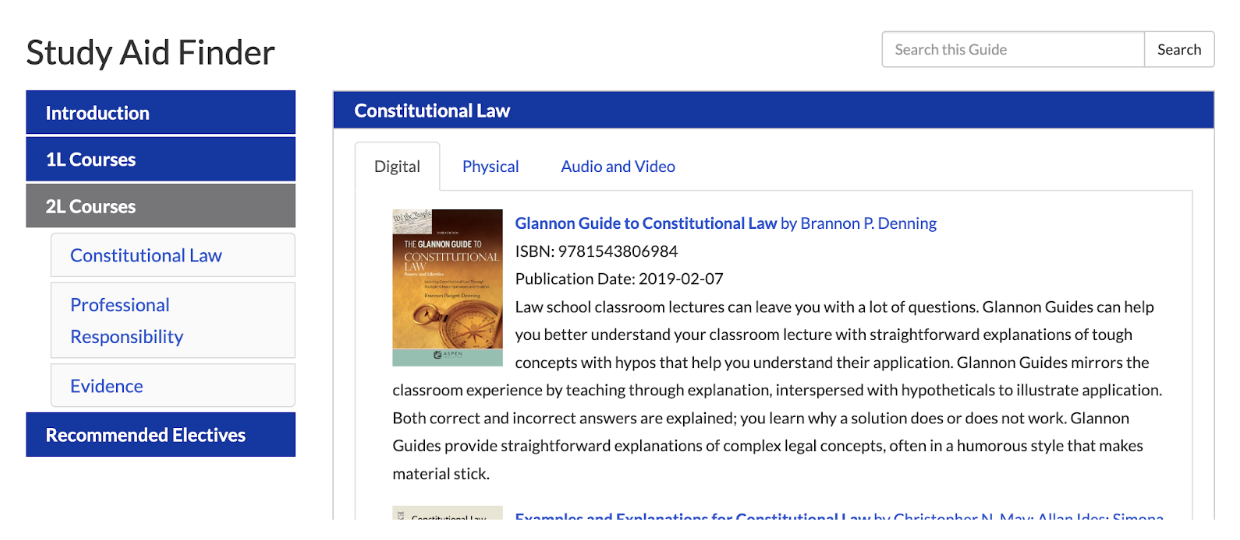
Back to the study guide – to get to Professional Responsibility, we click on the “2L Courses” tab in the left menu. This brings down a drop-down menu of selected 2L courses:

Clicking on “Professional Responsibility” will bring you to a box with digital, physical, and audio/visual resources to aid your study, just like the other courses we’ve reviewed in this blog series:

We previously took a peek at a Glannon guide, so let’s take a look at a different guide this time around.

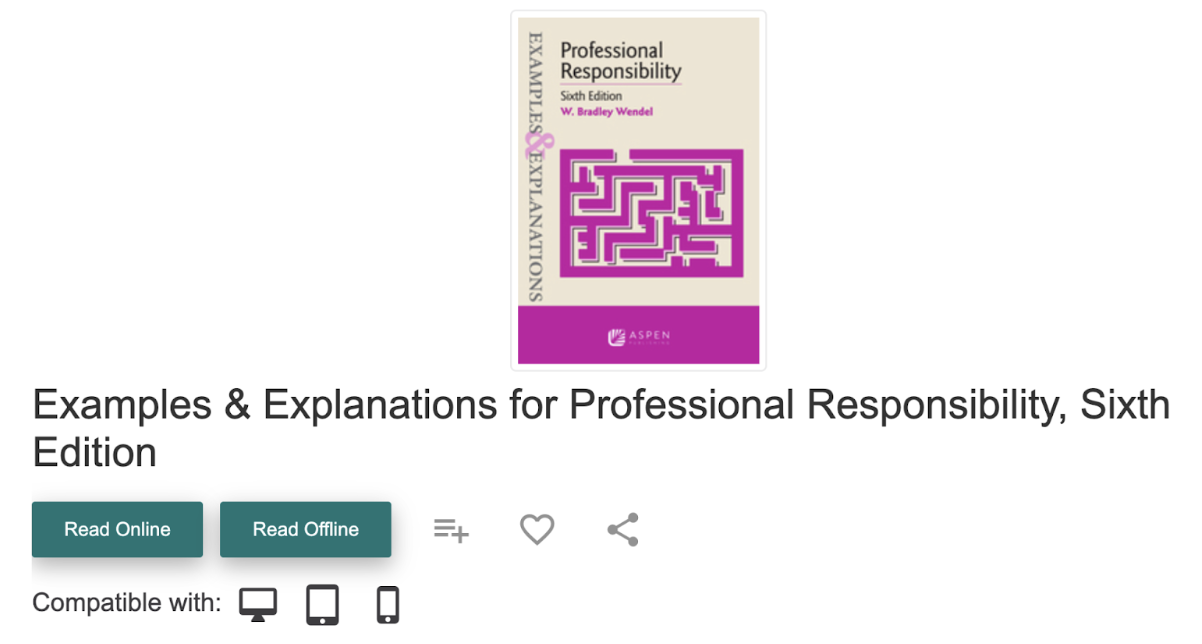
Clicking on the Examples and Explanations for Professional Responsibility (a.k.a., the “E&E” guide) again brings us to the publishers website and the Aspen Learning Library:

As you can see, it’s compatible with a variety of electronic devices (computer, tablet, phone) and can be accessed online or offline (note: offline reading must be done through the Aspen Learning Library App, available for PC/Mac/Android/iOS).

Utilizing the “Read Online” tab, you are brought to the table of contents, and from there, you can search the ToC, scroll through the ToC, etc. Chapters are broken out into the major topics (possession, gifts, title, etc.). The chapters discuss the topics generally, and provide some examples with explanations (hence “E&E”).

As this is another Aspen Learning Library resource, the interface is similar (if not identical) to that of the Glannon guide discussed previously:

Going to the “Duty of Competence” section, for example, is something that none of GSU students should have to worry about, but, you’re going to get tested on it on the final, the MPRE, and the bar. The top left icons bring one to the Aspen Learning Library and Table of Contents, respectively. The five menu buttons on the top right provide a “text to speech” function, a button for supplemental material, a full screen viewer option, a settings option (allows one to change the font size and font), and a search option. The chapter then ends with some examples. Other resources in the “digital” tab include the Glannon series, the Emmanuel crunchtime series, and others. 

Clicking on the “Physical” tab brings a list of resources that are similar (some are identical) to those in the “digital” tab. These can be accessed physically in the Law Library, or the ISBN is provided and one can Google it and find a vendor-of-choice to obtain the book.

The “Audio and Video” tab has a list of resources that are, well, audio and video! These resources are not as comprehensive or have the depth of examples (a.k.a. “Hypos”) that other resources have, but, for those on the go, these resources provide a great opportunity for learning in traffic, in the gym, nursing a child, etc.

The amount of resources available can be overwhelming, but I’d recommend skimming a few, see which resource resonates with you, and go from there. You can’t go wrong. Happy hunting and best of luck on your upcoming exam!
An Easy Way to Find the Best Study Aids for your Course

The GSU Law Library is an absolutely fantastic resource for exam preparation.  A former colleague of mine would tell the tale of when he was in school, after he got the syllabus for a given class, he’d hit the library and look for resources to supplement his in-class experience…and would end up CALI’ing the class.  Anecdotal humble brags aside, we may not be in the beginning of the semester, but it is never too late to look around for resources that can help bolster your understanding of a given subject.

This is especially true with exam season coming up around the corner. Despite the high caliber of GSU’s professors, everyone has a different learning style, and the way material might be presented in class may not “fit” with one’s learning style. Others may just want more practice and to review a different presentation of their course material to help solidify the information in their brain (in neuroscience we call this “memory consolidation”).

Fortunately for you, GSU really goes the extra mile to ensure and promote the success of its students. The Law Library has put together a Study Aid Finder to help students get the most out of what the Library has to offer for us students to knock out those pesky exams with flying colors. This is the kind of resource I really wish someone could have handed me on day 1 of law school…let’s take a look, shall we?

First thing’s first – the Study Aid Finder can be accessed at: https://libguides.law.gsu.edu/studyaidfinder

The landing page has an introduction that one can read if one so pleases, but the interesting stuff can be found on the menu bar on the left-hand side of the page:

Clicking on one of the menu bars will expand the course selections:

Clicking on a given course will then lead you to a collection of study aids for that particular course. You’ll see digital formats that can be accessed with your GSU credentials and can be viewed on laptops, mobile devices, etc. If you’re a luddite like myself and prefer paper, there’s a link for information for the physical printed book. There’s also an audio and video tab with some resources for those of us on the go. It’s not like Atlanta has any traffic or anything, but, if it did, listening to audio while on your way to T-deck is a great use of time.

Happy hunting!

Breyer Retires: some helpful and interesting resources

As you surely know, Justice Breyer recently announced that he would be stepping down at the end of this term, setting another Supreme Court confirmation process in motion. However, you may not know how to further research Breyer’s legacy and SCOTUS confirmations.

Justice Breyer was well-liked by his colleagues and had a reputation for asking colorful hypotheticals from the bench. SCOTUSBlog has great coverage of his overall legacy, including many reminiscences from former clerks. Before his nomination to the federal bench, Breyer taught admin law, and some of the best scholarship on his SCOTUS tenure focuses on this subject, such as this Justice Stephen Breyer’s Contribution to Administrative Law symposium. During his nearly three decades on the Supreme Court, he (of course) wrote important opinions on a wide array of topics, often crafting compromises and creating nuanced balanced tests: the Congressional Research Service (CRS for short—you’ll be seeing a whole lot more of them in this post) recently published a nice overview of his jurisprudence.

To this writer, his most memorable opinion was in dissent, issued in Parents Involved in Community Schools v. Seattle School District No. 1, a case that sharply limited desegregation efforts in public schools. I would encourage anyone who’s ever dismissed Justice Breyer as a bloodless technocrat to listen to him read what Justice Stevens called his “eloquent and unanswerable dissent” from the bench, asking “what happened to stare decisis?”

With Breyer’s imminent retirement, the appointment process for his successor begins. If you’d like to further explore that process, HeinOnline’s History of Supreme Court Nominations collects an impressive array of primary and secondary sources. Those sources include this excellent CRS report on what goes into the President’s selection of a nominee. There are also helpful CRS reports on the rest of the process, including one on the nominee’s consideration by the Senate Judiciary Committee and another discussing the limitations and customs surrounding the questions Senators ask judicial nominees during confirmation hearings.

As you might expect, there is a plethora of scholarship on the appointment process. For a data-based deep-dive into nominations and confirmations from the institutional perspective of SCOTUS, you can’t beat The Supreme Court Compendium‘s chapter on the topic. The legal scholarship on this topic is voluminous, with law review articles exploring the original meaning of ‘advice and consent’ and analyzing SCOTUS confirmations from a historical perspective. Another major strain of scholarship analyzes the role of ideology or politics in the process, as well as the desirability of obscuring that role. Tackling the politics from another perspective, there are also quite a few articles discussing nominations within the context of the Court’s antidemocratic or countermajoritarian characteristics. Other legal scholarship approaches the topic from more oblique angles, with intriguing articles looking at confirmation hearings as “a valuable form of cultural expression” and elaborating on martial metaphors for the confirmation process.

In addition to the legal scholarship discussed above, there is a veritable ton of academic work on SCOTUS appointments taking place in other disciplines, especially political science. Scholars in that field have written interesting articles on topics such as the timing of nominations, the President’s constraints in choosing a nominee, the role of interest groups in nominations, the role of shared identity in public support for a nominee, and how contested nominations contribute to public polarization.

For a deeper dive, there are some great research guides out there that provide a more in-depth treatment of the many, many resources available on these topics. And, of course, if there are any resources on Justice Breyer’s retirement, or on SCOTUS appointments more generally, that you have found to be especially useful or interesting, be sure to let us know in the comments.

Research Smarter Not Harder

By Gilbert Morales, Reference GRA

During my 1L year, researching caselaw triggered instant anxiety. To me, conducting research was an overwhelming experience that was hard to manage. Thankfully, I was wrong. Yes, conducting research is tough, but it is manageable by taking advantage of resources made available by the library. 

An open computer sitting on top of a wooden table

Description automatically generated

One invaluable resource is the library’s collection of research guides (also known as LibGuides). LibGuides essentially serve as a one-stop-shop for beginning your research process. They cover many major law school topics, including Georgia Legal Research, Criminal Law, and Legal Ethics and Professional Responsibility. Students will find links to secondary sources like major journals, treatises, and even articles. 

Students will also see links to primary sources like the Georgia Code, the Federal Code, and local ordinances. What is neat about the guides is that they include tips and tricks to make research easier for you. For example, they provide direct links to secondary sources in Westlaw and LexisNexis so that researchers do not waste time trying to navigate those resources. 

As everyone knows, time is of the essence in law school. Research guides include different approaches to accessing resources, including links to research institutes and links to popular blogs that monitor the trends for any given topic. For example, in the Land Use guide, students are directed to the Wayback Machine to uncover website pages that are no longer available online. These tips and tricks are just the tips of the iceberg. Research guides are full of different ways to make the research experience easier and more productive. 

In addition to research material, LibGuides provide links to study materials. From evidence to tax law, students can access study aids, CALI lessons, and exam archives for each topic. The convenience of finding all the essential study aids in one location is truly a time saver. 

So, the next time you find yourself overwhelmed by the research experience, take a deep breath, and visit the LibGuides on the library website!