Art in the Library : The Library

TheLibrary_1960_JacobLawrence

The Library, 1960 by Jacob Lawrence
Link to the Smithsonian American Art Museum

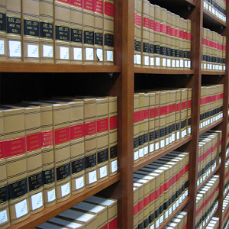
If you’ve ever printed anything at the printers in the alcove, you may have noticed this print. At first glance, it’s a blur of brown blocks with swashes of blue and red and green mixed in. It’s not until you focus on it do you see people bent over books and newspapers, reading and studying. Some even look like they’re napping. It’s actually a common scene when you wander through the library on a Monday afternoon. Most every chair is full, and people are struggling to maintain concentration or furiously write a paper.

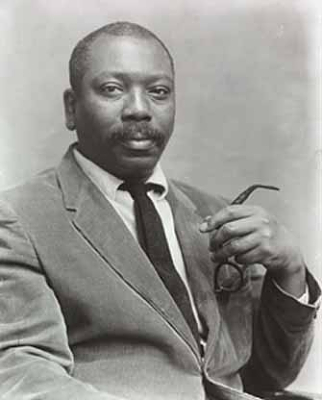
Jacob Lawrence is one of my personal favorite artists. I took an African American Art class as an undergrad and was really captivated by his work. He would create a series of paintings (included 30-40, even 60 pieces) that would tell a story, most about people or events significant to African American history. They included Toussaint L’Ouverture, Frederick Douglass, Harriet Tubman, life in Harlem, the post-World War I migration, and the civil rights movement of the 1960s.

Jacob Lawrence, Originally photographed by Geoffery Clements. Featured on the Smithsonian American Art Museum website.

“I paint the things I know about and the things I have experienced. The things I have experienced extend into my national, racial and class group. So I paint the American scene.” ~Jacob Lawrence

Born in Atlantic City in 1917, he moved with his family to Harlem in 1930. He started taking art classes as a teenager at the 135th Street Branch Library. His skills and talent developed, and he became a key player in the Harlem Renaissance, mingling with other greats like Langston Hughes, August Savage, and Aaron Douglas. He secured a position with the WPA Federal Art Project which helped him through the Depression. He continued to paint, teach, and explore the world until his death in 2000.

Lawrence dubbed his style “dynamic cubism” and he approached his work systematically. When working on a series, he would complete the preliminary drawings for the entire series, lay out the paintings across the studio, and then paint one color at a time on each piece. Doing so would bring consistency and cohesion to the series. I imagine working this way enabled him to maintain the vision of the entire project without getting fixated and lost on one smaller aspect of the entire story he was conveying.

“My work is abstract in the sense of having been designed and composed, but it is not abstract in the sense of having no human content . . . [I] want to communicate. I want the idea to strike right away.” ~Lawrence, 1945 interview, quoted in Wheat, Jacob Lawrence, American Painter, 1986

The Lovers, 1946

The Lovers, 1946

Sources:

Researching From Off Campus

eMac by Flickr user eye-fibre

image by Flickr user eye-fibre

Spring break is almost here! The law library will be open during this time (although with slightly shortened hours), but maybe you’re going to be at the beach, or Disney World, or just on your couch. Just in case you have any grand plans for working during this break, don’t forget that you can access many of the law library’s resources from off campus.

  • A lot of our legal databases (such as HeinOnline, ProQuest Legislative Insight, and Kluwer Arbitration) are accessible with your Campus ID. Just follow the links from the database list to be routed through our proxy server.
  • Our research guides are available from anywhere without a login and cover research for many of your courses.
  • And if you need help from a librarian, don’t forget you can always email us or use the Chat Reference service too.

Have a wonderful break, and we’ll see you again soon!

Meet Deborah Schander

Deborah BigThis marks the third of a series of in-depth, exclusive interviews I am doing with the librarians and staff here at Georgia State University College of Law Library. I hope you enjoy!

Austin: What is your name and what do you do?

Deborah: Deborah Schander, Reference/Student Services Librarian.


A: How long have you been at Georgia State University College of Law Library?

D: I’ve been at GSU since August 2010.

A: That’s crazy. I started in August 2010 as well.

D: Because we started on the same day.

A: Oh yah…


A: So, what books are currently on your night stand?

D: I’m currently reading two books: First, A Homemade Life: Stories and Recipes From My Kitchen Table by Molly Wizenberg, which is a memoir/ode to food, and makes me ravenously hungry during my MARTA commute. And second, Shadow’s Edge, the second book in Brent Week’s Night Angel trilogy, because sometimes, you just need an assassin’s story to pep up life.


A: What is an interesting fact about yourself that you would like to share with our readers?

D: I was in a professional opera despite the fact that I can’t sing.


A: When you are not saving the world here at GSU Law Library, what do you enjoy doing outside of work?

D: I’m pretty boring. I like reading (mysteries, superhero comics, sci fi), going to the theatre, and being crafty (cross-stitch, crochet). I don’t get to travel as much as I would like, but I do love to visit new places.


A: Lastly, what is your favorite vacation spot? The place you go to leave it all behind for a few days.

D: London. I studied in England during part of both college and law school. I traveled throughout the UK, but London just never gets old.

A: Seems pretty old to me…

D: Please don’t make me spit my coffee out.


Now that was fun! The complete, unedited,  behind the scenes interview with Deborah Schander.

ABA Visit

by Nirvi Shah

college of law signsOver 130 years after its inception, the American Bar Association is still the prestigious community that serves its members, profession, and the public by “defending liberty and delivering justice as the national representative of the legal profession.”  The ABA’s goals include improving the legal profession by promoting the highest quality of legal education.  The organization recognized Georgia State University College of Law as an accredited law school in 1984.

Thirty years later, the ABA will visit GSU College of Law again next week, beginning March 3, to evaluate whether the school still complies with ABA standards, and is, thus, accredited.  Typically, a six or seven person team conduct a Site Evaluation Visit.  The team includes: a present or former law school dean, a few academic law school faculty members, a law librarian, a faculty member with an expertise in professional skills instruction, one judge or practitioner, and one university administrator who is not a member of a law faculty.  During the visit, expect the team to visit classes while touring and evaluating the law school.

The Law Library has gathered and organized many of the law professors’ published materials to showcase to the ABA site team during their visit.  If you’re interested in knowing more about our faculty publications too, you can find a full list of them on our website.

Is It Spring Break Yet?

by Ryan Browne

Photo by Flickr user aafromaa.

Photo by Flickr user aafromaa.

If the two snowstorms to hit Atlanta in the past month have made us realize anything, it is that spring break needs to get here as soon as possible. Luckily for us, spring break is right around the corner. Just three short weeks and all you will have to worry about is getting too much sun.

But if you are going on spring break, you have to be prepared. Make sure that you have most or all of these items to ensure that you have the most enjoyable spring break possible.

• Music – While the sounds of the waves crashing on the sand is nice, spring break wouldn’t be complete without your favorite tunes. Make sure that you hit iTunes to fill up your iPhone with your favorite music to play at the beach.
• Portable Speakers – Now that you have your music, you need a way to listen to it while you sit on the beach. Your old 80s boom box isn’t going to cut it anymore. Luckily for you, there are lots of speakers that hook up to your phone/iPod using Bluetooth. They come in a wide range of sizes and prices.
• Sunscreen – The sun is a silent killer, you guys.
• Beach Games – While it’s tempting, you can’t lay on the beach soaking up the sun all day. You have to stay active too. The beach is the perfect place for cornhole, bocce ball, ladder ball, whiffle ball, or to throw around the football or Frisbee.
• Books – Your spring break doesn’t have to be filled with constant activity. Few things are more relaxing than taking in the beautiful weather by the beach while reading a great book. If you need a recommendation for something to read, check out what your professors have suggested in the past.
• Beach chairs and coolers – You can’t enjoy the beach without a place to lounge, so make sure you bring a beach chair. (Probably not this one.) And make sure you have a cooler to wheel onto the sand to keep your, uh, sodas cold.

2014 Georgia General Assembly

 Sunset Skyline From M DeckWe are in the heart of the 2014 Session of the Georgia General Assembly. Beginning the second Monday in January, the assembly will meet for a Georgia Constitution required 40 days. Depending on the number of adjournments, the session usually ends between late March and early May.

Those interested with keeping up with General Assembly can do so by following the status of bills introduced in the assembly, as well as watching live broadcasts of the proceedings from both the House and Senate chambers. You can also locate archived videos and reports on a specific assembly day by using GPB Lawmakers.

Check out the following resources to get more information on the General Assembly:

Meet Pam Brannon

55_555229288940_1029_nThis marks the second of a series of in-depth, exclusive interviews I am doing with the librarians and staff here at Georgia State University College of Law Library. I hope you enjoy!

Austin: What is your name and what do you do?

Pam: Pam Brannon, Faculty Services Librarian


A: How long have you been at Georgia State University College of Law Library?

P: First day here was June 5, 2007.


A: What books are currently on your night stand?

P: I am close to finishing Elantris by Brandon Sanderson, and I am also in the middle of Jingo by Terry Pratchett.


A: What is an interesting fact about yourself that you would like to share with our readers?

P: I co-owned a record label and was a night manager at a liquor store. Maybe that’s two facts. At various times I have played up to six instruments, with varying degrees of proficiency. OK, now that’s three facts. My family has been living in Georgia since the 1700s, at least. Now that’s four facts.


A: When you are not saving the world here at GSU Law Library, what do you enjoy doing outside of work?

P: Reading – a lot, playing trivia, occasionally petting my record collection, assorted geekery.


A: Lastly, what is your favorite vacation spot? The place you go to leave it all behind for a few days.

P: Behind the wheel of a car, driving somewhere. Preferably on a twisty road.


There you have it folks. The complete, unedited,  behind the scenes interview with Pam Brannon.

Art in the Law Library: Cloud and Sea

Photo of Exhibition Poster at the Art Institute of Chicago by Lori L. Stalteri

Photo of Exhibition Poster at the Art Institute of Chicago by Lori L. Stalteri

By Roy Lichtenstein (1923-1997), Cloud and Sea (1964) is a piece you may have seen in the 130s study area/Reading Room. The original is 30×60 inches and is porcelain enamel on steel. Lichtenstein is one of the leading artists in the Pop Art movement of the 1960s. This modern art explores the imagery of everyday, American consumer culture. The artists of this style looked to advertisements, packaging (think Andy Warhol’s famous soup can), celebrity photos, and comic strips. Lichtenstein was inspired by advertisements and comic books, specifically DC Comics’ All-American Men of War, Girls Romances, and Secret Hearts.

[Pop Art] is an involvement with what I think to be the most brazen and threatening characteristics of our culture, things we hate, but which are also powerful in their impingement on us.

– Roy Lichtenstein, quoted in Art News, November 1963

"Drowning Girl" by Roy Lichtenstein

“Drowning Girl” by Roy Lichtenstein

Lichtenstein was born and raised in New York City and upon graduation from the Franklin School for Boys, he attended Ohio State University in Columbus, Ohio. He served in Europe during World War II, and upon his return he completed his Bachelors of Fine Arts and a Masters of Fine Arts from Ohio State. He taught briefly at Ohio State before moving to Cleveland, Ohio where he worked as a window-display designer for a department, an industrial designer, and a commercial-art instructor. All the while, he worked on his art and held exhibitions in Cleveland and New York City. He later became an assistant professor of art at the State University of New York at Oswego and then assistant professor of art at Douglass College, Rutgers, State University of New Jersey. It was during his professorial days that he began experimenting with his style and medium to what we are familiar with today.

Roy Lichtenstein Landscape

Roy Lichtenstein Landscape

Sources:


The Consequences of Snow Days

snowWe’ve gotten through another bout with snow, and K-12 students have missed another several days of school. In Georgia, as in many states, the minimum length of the school year is set by statute at 180 days. Although some wiggle room is built into the school calendars, when snow days start to add up, school districts have to scramble to make up the missed days. In Georgia, there is currently a proposal on the table to allow school districts to not make up some days. Other days may be made up in a variety of ways, from adding days onto the school year to adding hours to the remaining school days. Spring break may even be shortened (or eliminated).

One recent idea is to hold “virtual” school days, where students aren’t required to venture out to school, but instead attend classes online. However, this requires students to have computers and internet access, and so may not be feasible for many students.