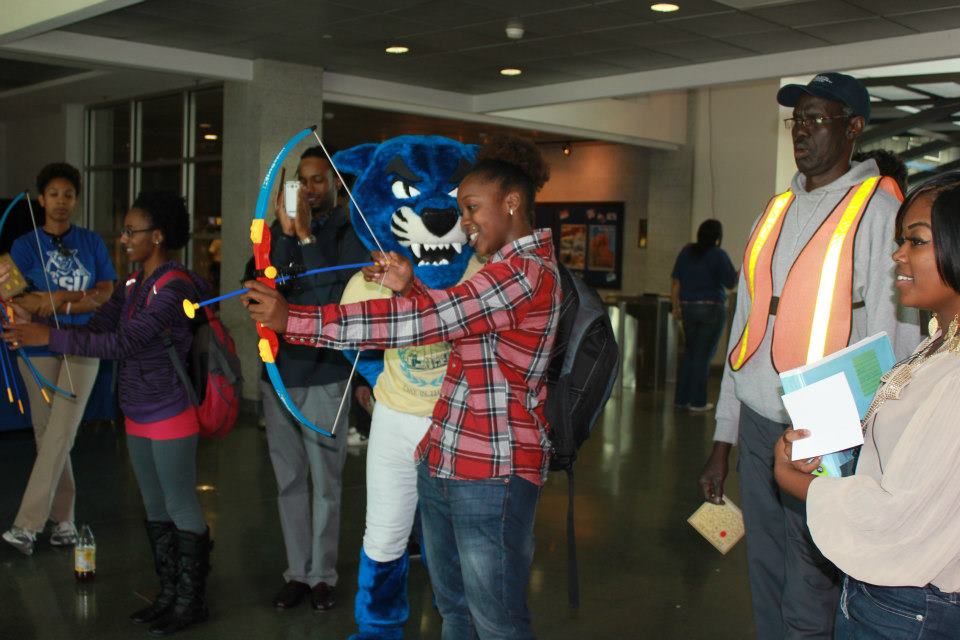
Take a Break: Day at the Rec / October 3

2012_DayNRec_Archery

2012 Day at the Rec, GSU

Who needs a break?!

YOU DO!

This Thursday, wander across the street to the Rec Center between 11-2 for some fun and games. Participate in 3 activities and you get free food; 5 activities and you get free food and a t-shirt!

So grab your study partners, win some prizes, and have some much-needed fun!

Thursday, October 3
11-2
GSU Student Recreation Center

2012_DayNRec_Activities

2012 Day at the Rec, GSU

30 Years of Banned Books Week

Banned Books Week by ALA

Banned Books Week by ALA

September 22-28, 2013 is the 30th anniversary of Banned Books Week. Banned Books Week celebrates the freedom to read by highlighting attempts to suppress books.  In recognition of this anniversary, the American Libraries Association has put together a timeline of books either banned or challenged during the 30 years that Banned Books Week has been celebrated. Among the books on the timeline is that classic of legal literature, To Kill a Mockingbird, which has been repeatedly challenged for language and racial themes.

From the legal side of things, the decision to remove a book from a school library is generally made by the local school board and can be appealed in court. If you want to find cases dealing with the banning of books, we suggest you check out cases assigned the topic and key number Constitutional Law 1983. You may also want to check out Girls Lean Back Everywherea classic book on the law of censorship.

Student Writing Competitions

Flicker photo by jjpacres

Flicker photo by jjpacres

By Meghan Starr

Did you know there were over 60 writing competitions for law students last year?

A listing of current competitions is maintained on the library website under Research Guides, titled Student Writing Competitions.   Papers are currently being accepted in topics as diverse as constitutional interpretation, securities law, civil discovery procedures, human rights, national security, and construction law.  You can also find information about the 13th Annual Law Student Tax Challenge.

Prizes range from $250 to $5,000+ and often include publication in industry journals, travel expenses to meetings, and free membership to the sponsoring organization.  While some contests have a special topic (such as the Center for Alcohol Policy’s “This year marks the 80th anniversary of the 21st Amendment. Has it achieved its intended purpose?”), others allow you to submit papers written for classes.

You will also find a list of resources to help hone your writing skill.  The Guide is updated regularly as new competitions are announced, so check back periodically.

C-SPAN

White House photo 2/24/09 by Joyce N. Boghosian

White House photo 2/24/09 by Joyce N. Boghosian

When you want to see Congress in action, the best place to go is C-SPAN. Created by the cable television industry in 1979, C-SPAN provides the public access to the United States political process.

If you have cable, you have probably stumbled across C-SPAN a few times. C-SPAN and C-SPAN2 offer “gavel-to-gavel” coverage of the House and Senate. Viewers can watch all the of the floor debates and votes. You can also find public committee hearings on C-SPAN as well. Additionally, the networks will provide coverage of key judicial events, and will even rebroadcast oral arguments from major Supreme Court cases.

C-SPAN currently has three television channels and a radio station that provide political coverage. If you don’t have access to a television, not to worry. Viewers can watch all of the channels on the C-SPAN Website for free (links provided below).

To keep up with all the programming C-SPAN has to offer, check out their schedule. If you had your heart set on seeing a particular event, but missed the live showing, you can locate an archived video in the Video Library.

Blueacre

by Mark Stuckey

Urban Life 1With the momentous ground breaking that took place on GSU’s new law building last Thursday, I wanted to take some time to reminisce about my favorite aspects of the current law school. Sure, the new building will be state of the art and sustainable, but I will undoubtedly miss the Urban Life Building, the place that has been much more of a home to me over the last arduous year than my dingy, dark Atlanta apartment. There are too many things to list, but here are some of my personal favorites ULB has to offer:

1. The Lack of Stairs

The designers of the Urban Life Building, like all self respecting Americans, had a robust disdain for aerobic activities. Hence the fact that the law school’s upper floors are only accessible via elevator. This revolutionary feature is exceedingly convenient when exiting a 6th floor lecture hall with 90 of your closest friends. Pro tip: There is a semi-secret staircase connecting the first and second floors by the career services office.

2. Weird Bathrooms

If you have not noticed go check out one of the numerous bathrooms that call the Urban Life Building their domicile. Not only is the decor cold war chic, but also the acoustics are redolent of Atlanta Symphony Hall. Additionally, the bathrooms in the Urban Life Building make it easier to get closer to your classmates (physically at least) when navigating their narrow thoroughfares. Pro tip: I am pretty sure the sixth floor men’s bathroom is haunted by a friendly ghost.

3. Intermittency of Cell Service

Probably the best features of the Urban Life Building are the random black holes that renders that device on which you play Candy Crush useless. This is especially helpful when you need a little extra motivation to pay attention in Civ Pro, or when you’re seeking isolation on the second floor of the library from you non law school friends (who will never understand what you’re going through).

There you have it, a short and rather incomplete list of the parts of the Urban Life Building I will miss the most. Luckily, there is still time to enjoy the idiosyncrasies. Comment below and tell me what you like about the Urban Life Building!

A Key Day for Indigenous Peoples

On September 13, 2007, an event over two decades in the making happened: the United Nations General Assembly adopted the Declaration on the Rights of Indigenous Peoples. 143 countries voted in favor of the Declaration; although the United States voted against it, the U.S. has since voiced its support for the Declaration.

The Declaration addresses issues such as the right to self-determination, preservation of cultural heritage and ethnic identity, and the forcible removal of indigenous peoples from their lands or territory. Work to ensure the implementation of the Declaration continues, particularly by the United Nations’ Permanent Forum on Indigenous Issues, which meets for its thirteenth session in May 2014.

How to Outline

by Joshua Kahn

MacBook writing (Håkan Dahlström) / CC BY 2.0

Today, we have our second installment in the Blackacre Times’ “how do I do this whole law school thing” series—how to write an outline. If you haven’t already read the quick and dirty guide for 1Ls, you should probably start there.

Like almost everything in law school, outlining is one of those things that sounds scarier than it really is.  Basically, an outline is just a scaled down version of your notes that 1) only includes the things that actually matter, and 2) puts those things that matter in an order that shows how they relate to each other.  It is NOT a compilation of every word that has ever fallen out of your professor’s mouth bound in a pretty little binder with tabs.

The real value of outlining is that it forces you to recognize what is important and how it’s important.  That’s why you should always write your own outline, that process is some of your best studying.

So how should an outline look?  Well, everyone has their own method that fits the way they think, but I’m going to use a section of my Corporations outline as an example.  Please take a minute to scroll down and look over it.  It’s discussing situations where an individual or corporation can be liable for the dumb things someone working for them does, even without the employer’s permission.  This is only about 1/3rd of my outline’s agency section, so don’t worry if you don’t understand exactly what it’s talking about.

Ok, finished reading?  Good.  Now I’m going to break down the specific components of the outline.

Easy to Read

First, my outline is formatted to be easy to read.  For some reason I’ll never understand, it’s traditional to write outlines in one font size, without much space between the lines and without a ton of underlining or bold type.  Obviously, I don’t hold by that.  If you want to use your outline on a test, it should be easy to read. I make headings bigger and bold, underline cases, and put citations in parenthesis, etc.

Logical Categories

Next, outlines should be broken down into logical (to you) categories.  A lot of this is optional and more art than science.  I based my contracts outline around the various ways a contract can be formed, for example.  In the example below, I thought that the torts consequences of agency deserved its own section because it’s very easy to spot in a fact pattern.  I could, however, have chosen to include it as a subcategory of the consequences of the formation of an agency relationship and if I had done that, I would have had a completely different organization for the section.

Elements

This is the meat of an outline. Your goal when outlining should be to break anything you possibly can down into clear legal tests with specific elements.  Then, when you see that point on a test, you can just run through those elements.

Take a look at the three numbers listed under “elements” towards the top.  Those are the test to run to see whether an employer is liable for someone else’s actions.  Below, I have a section labeled “notes” with numbers that correspond to each of those elements. You’ll find that most of the content of a law school class boils down to a few main tests, and all the special rules for various exceptions to those main tests. The exceptions are usually exceptions to one of those elements, not all of them, and I put the exceptions into notes corresponding to those elements.

In this case, there are a lot of ways to meet the various elements, so I’ve chosen to organize them under the notes section.  So, to see if you have met element one—an “agency relationship”—you go down to note one and see that you can do that with either “actual authority” or “apparent agency.”

Look more closely at “actual authority” under note 1.  It includes a list of factors that suggest that an employer either has, or does not have, enough control over the employee to create actual authority.  On a test, you’d look at those factors in the fact patter the professor gives to you, and discuss as many as possible.

Citations

Although most professors do not require it, a number like it when you include citations to specific cases or statutes on your final. Don’t try and remember all of that off the top of your head. What I do is include citations to cases and statutes in my outline next to whatever it is those cases show.  For example, under note 1, the sentence “parties cannot disclaim agency” is followed by a citation to the case “Holiday Inns.” That means that the Holiday Inns case shows that parties can’t disclaim agency.  So, when you run into a situation where that applies on the test, just write it down and throw “(see Holiday Inns)” into your answer.  You don’t have to remember the case name, and have all the citations right in front of you to grab quickly.

When to Start Outlining

The traditional answer is about half way through the semester, but that’s not set in stone.  If you can pull it off, you can literally take your notes directly into outline form (don’t try this until your second semester at the earliest).  For your first semester though, you’re better off waiting until you get a feel for how the areas of law you are studying fit together.  Early on, you won’t be able to pick out what’s important and what isn’t.  Later, you can do that much more quickly.  The main thing in 1L is not to wait until the last second to do your outline.

———————-

Agency Tort Liability

Vicarious Liability

-Principals are liable for acts if…

Elements (2nd Rest. §§ 219(1) & 250))

  1. 1.      Agency Relationship (e.g. Master-Servant)
  2. 2.      Act was within Scope of Employment

OR          

3.  Independent Contractor doing Inherently Dangerous Activity

Notes:

1.  Agency Relationship (Master Servant vs. Independent Contractor)

Actual Authority

-Established by sufficient Control (2nd Rest. § 220)

-Parties Cannot Disclaim agency (Case: Holiday Inns)

(Case: Humble control can exist even when contract disclaims, ex of franchise with enough control for master-servant)

(Case: Hoover ex of franchise without enough control for master-servant)

(Case: Holiday Inns ex of franchise without enough control for master-servant)

Factors showing Control: (Case: Conoco factors for scope discussed )

NOTE: Control associated with the harm is stronger evidence

-Controls Time of work

-Controls Method of work

-Controls Manner of work

-Works for one boss or many

-Can complete task however they see fit

-1099 or W-2?  (not definitive)

-Who has the right to hire/fire?

-Do they bring own supplies & tools?

Apparent Agency

(Definition Note:  Apparent Agency establishes agency where none would have existed, Apparent Authority expands authority that already exists)

Elements for Apparent Agency liability (2nd Rest. § 267) (Case: Miller)

  1. Principal Held Out party as an Agent
  2. Plaintiff relied on that holding out

(Case: Miller ex apparent agency establishing apparent agency over franchisor even without enough control for master-servant)

2.  Act was within Scope of Employment

-Scope of Employment if “Employer Benefits from Action”

(2nd Rest. § 228) (Case: Bushey)

Test: Conduct Reasonably Related or Reasonably Foreseeable

Intentional Torts (2nd Rest. § 231 & 228(2))

-Reasonable Related if:

1.  Foreseeable by Master (2nd Rest. § 228(2)

OR            2.  “Manning” Standard (Case: Manning)

A.  In response to P’s conduct

B.  Which was interfering w/ employees ability to perform duties

3. Facilitated by access the position provides (Case: Conoco)

3.  Independent Contractor doing Inherently Dangerous Activity

Principal is liable if…

1.  “Inherently Dangerous Activities” (e.g. a “nuisance per se”)

(2nd Rest. of Torts § 416)

(Case: Majestic ex of inherently dangerous activity)

TEST:  Particular risk of substantial harm

in the absence of special precautions

-factual inquiry

-remember: NOT strict liability/ultra-hazardous

-Harm must come from the basic reason the act was dangerous

-Otherwise, Collateral Negligence and employer not liable

2.  Hiring Incompetent Contractor (Case: Majestic)

3.  Principal Retains Control over manner & means of work (Case: Majestic)

Do This Now, So You Don’t Pay Later. Seriously.

by Nirvi Shah

Study_AidsA few weeks ago my friend, Joshua Kahn, posted “A Quick & Dirty Guide for 1Ls.”  Each of his points are accurate and helpful.  One topic in particular, however, I found most beneficial during my 1L year.  Practicing hypotheticals helps you score better on exams.  The more you practice, the better you do.

Buying study aids can get expensive, and Googling examples may take up too much time.  That is where the Law Library comes in.

The library has study aids.  Many, many, many study aids.  Multiple copies of some books.  While they are all on the shelves right now, they probably will not be around exam times.  That is when you will need them the most.  Why am I pushing you to use the study aids now, before you have even started outlining?

Most law students aren’t really sure about what is going on during their 1L year—especially when it comes to learning class materials and giving professors good answers on the exam.  (If you are one of the few who knows exactly what is going on, that’s awesome—good for you.)  Some professors may claim that students don’t need any study aids or supplements to do well in their class, but honestly, it can’t hurt.

This is why you should get up, walk to the “Law Student Study Aids” section, pick out a book that is written in a way you find easy to read and understand, and start skimming the relevant chapter.  If you don’t start now, you will not have time to search and scan appropriate examples, find the book when exams roll around, or you will have to come to terms with paying more money on books this semester just to use the study aids for a few weeks period, if even that.

Just remember, always put the study aids back in the area, where the sign says, “PUT STUDY AIDS HERE WHEN YOU’RE DONE.”

Good luck with 1L year!

Undocumented Lawyer

The California Supreme Court held oral arguments today in a case that will ultimately decide if Sergio Garcia can become a licensed attorney. While Garcia has already passed the California Bar Exam, he has hit a roadblock in obtaining his law license because of his citizenship status. Garcia, 36, was born in Mexico, but his parents brought him to the United States when he was only 17 months old. Splitting time between Mexico and California, Garcia decided to permanently stay in California at age 17.

For 19 years now, Garcia has waited to receive a green card. During that time he completed college, finished law school, and passed the California Bar Exam on the first try. However, a 1996 federal law passed by Congress prohibits immigrants residing illegally in the United States from receiving “professional licenses.” The Justice Department further determined that the California Supreme Court cannot admit Garcia to the bar because the court is funded by state money. Interestingly enough, the State Bar of California and the California attorney general are both on the side of Garcia.

While no opinion has been rendered yet, the Associated Press stated that the justices “appeared reluctant Wednesday to grant a law license to Sergio Garcia.” (Source: Washington Post).  The court will now have 90 days to rule on the case.

For background on the Garcia case, check out the following sources: