I wish the new library had…

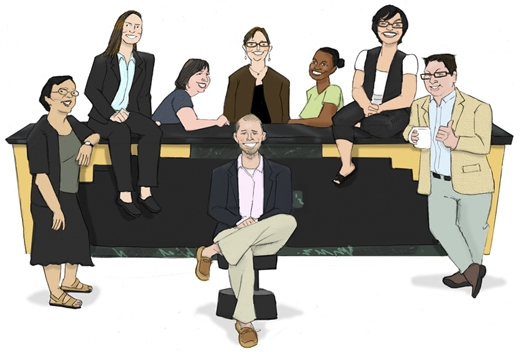
Unless you have been under a rock, or working tirelessly on Legal Bibliography assignments, you know that Georgia State Law is in the process of planning for a new building.  The Law Library will make up a significant portion of that new building.  The chance to design a new building does not happen often, so of course everyone had their “wants” as well as their “needs.”  To signal the end of Law Library week, here are a few items that some of the law librarians thought would be a good addition to the Law Library if they had it their way.  Keep in mind, many of these are over the top and inspired in part by Cornell Law Library’s Squash Court.

Nancy Johnson, Associate Dean for Library and Information Services and Professor of Law

Windows, terraces, and views!  Lucky for us, we will have all of these great features in the new Law Library.

Trina Holloway, Acquisitions/Serials Librarian

Because law school can be stressful, how about a hot tub and Legoland.

Austin Williams, Reference/Student Services Librarian

Who needs a squash court when you can have an indoor soccer field.  Anyone can have a coffee shop in the library, but nothing hits the spot after a long study session like some Bojangles’ Famous Chicken ‘n Biscuits.

Terrance Manion, Director of Information Technology and Librarian

How about a library hawk? Better yet, Supreme Court bobbleheads and  a pair of 300-thousand year old wooly mammoth tusks.
Presidential Libraries

By Lindsay Anglin

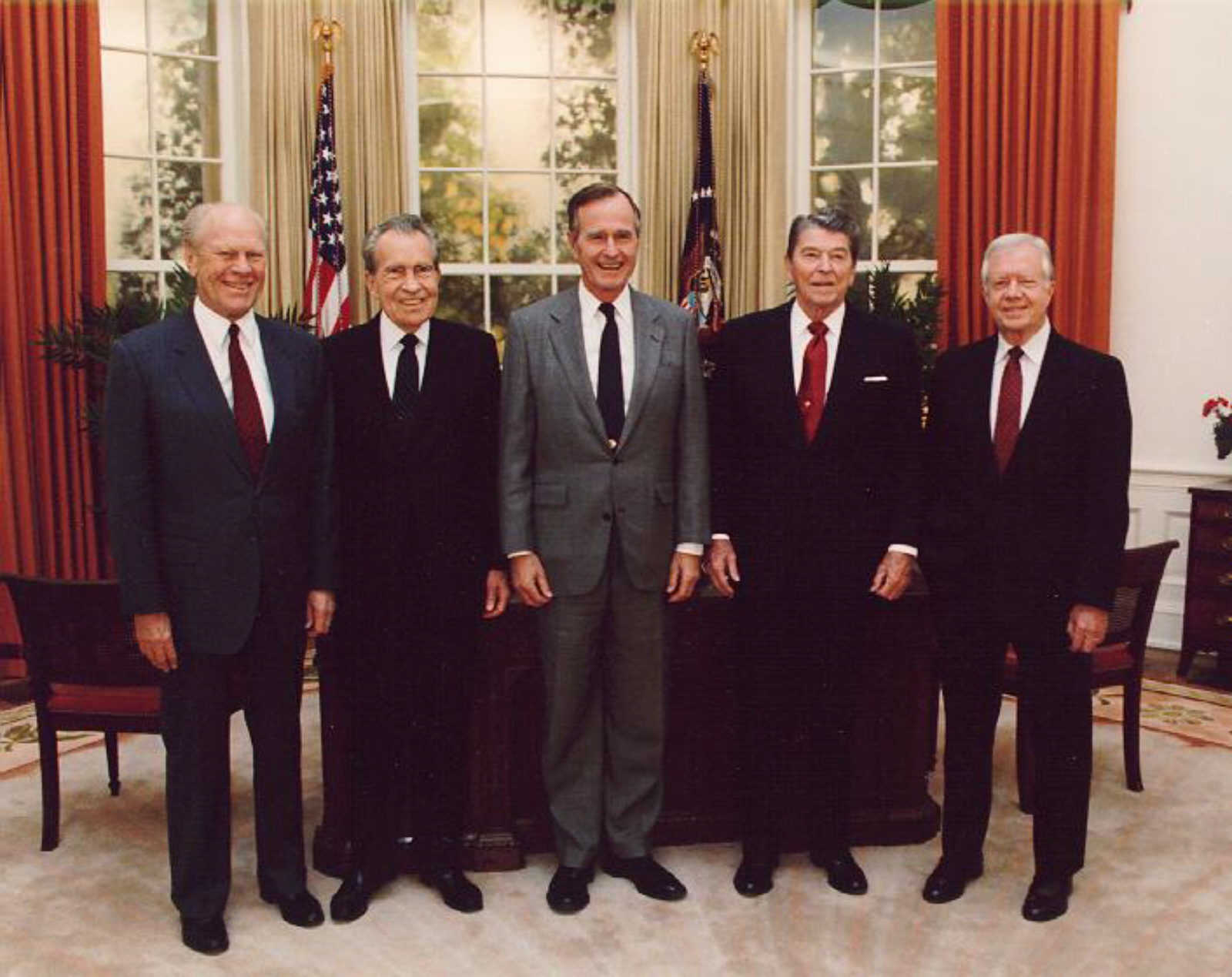
Would you like to see Franklin D. Roosevelt’s New York State Bar Association Application? Or read John F. Kennedy’s national security files from the Cuban Missile Crisis? Or see menus from White House dinners during Bill Clinton’s presidency? Or read about the three-and-a-half tons of Jelly Bellies that were shipped to the White House for Ronald Reagan’s 1981 Inaugural festivities? Or read the condolence mail President George W. Bush received following the September 11, 2001 terrorist attacks? Then explore the Presidential Libraries!

The Office of Presidential Libraries coordinates a nationwide network of thirteen Presidential Libraries, each housing the papers, records, and other historic materials of U.S. Presidents. These libraries are great sources for researchers studying our presidents and our nation’s history. Since President Herbert Hoover, these libraries have been archiving presidential documents, media, and electronic materials to preserve the evidence of the Presidency for future generations.

Presidential libraries are both archives and museums, bringing together documents and artifacts of the President and his administration and displaying them in exhibits to millions of visitors each year. The libraries preserve not only official presidential records and documents, but also personal papers of Presidential family members, associates, and friends and audio and visual collections. If you cannot visit the libraries in person, each Presidential library has an electronic database to make researching more accessible.

Visit the Presidential libraries online:

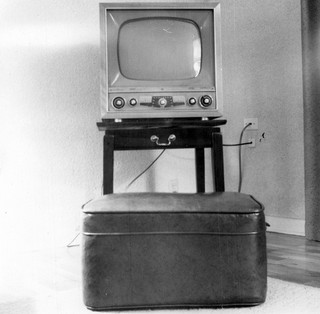
Kick Back, Watch TV (We’re Here to Help)

Image by flickr user gbaku.

It’s fall TV season, and there’s a crop of new shows vying for your attention. There’s even another new show about a lawyer, Made in Jersey, on CBS. But what if the new shows all leave you feeling kind of flat? What do you do then?

Well, we’re here to help you out with that. In addition to the shows you’d expect us to have (Law & Order, Matlock, and Perry Mason, mainly), we also have full-season sets of shows you may not have expected from us – or even heard of. Try one of these out:

  • Drop Dead Diva – A model dies and winds up in the body of a plus-size attorney. And it turns out she’s pretty good – and funny.
  • Harvey Birdman, Attorney at Law – Fred Flintstone on trial for racketeering? Boo Boo Bear accused of being the UnaBooBoo? Harvey Birdman is who cartoon characters turn to when they need legal representation.
  • Arrest & Trial – Before there was Law & Order, there was Arrest & Trial. Same concept, but with a couple of twists: it takes place in L.A., and the “Order” part of the show focuses on the defense attorneys.
  • House – Yes, that House. In case you’re missing now that it’s off the air, we have it.
  • The Guardian – Before he was The Mentalist, Simon Baker was  The Guardian, a corporate attorney who works part time as a child advocate. A rare show that features children and family law issues.
  • Eli Stone – Jonny Lee Miller (now on Elementary as Sherlock Holmes) is Eli Stone, an attorney who has visions – or hallucinations, depending on who you ask.

All of these, and more, are available in our Leisure Collection!

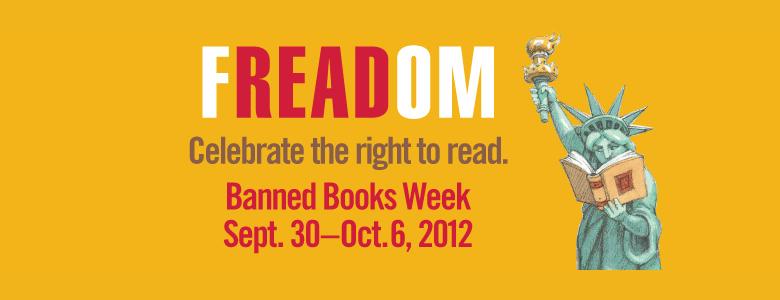
Banned Books Week 2012

By Mark Edwards

Have you ever wanted to do something just because someone told you that it was not allowed?  Well now it is your time to read a book that is currently on the banned book list.  (See below).     Banned Books Week celebrates its 30th anniversary this year.

The purpose of the event is to celebrate the freedom of information and expression of ideas.  Banned Books Week brings together the entire book community – librarians, booksellers, publishers, journalists, teachers, and readers of all types – in shared support of the freedom to seek and to express ideas, even those some consider unorthodox or unpopular.

The movement was started 30 years ago by the American Libraries Association (hereinafter “ALA”) in response to a closely divided Supreme Court in which it was held that the First Amendment limits the power of local school boards to remove library books from junior high schools and high schools. (457 U.S. 853).  The ALA provides a timeline of the movement – Click here.

The Top Ten Most Frequently Challenged Books of 2011 include the following titles; each title is followed by the reasons given for challenging the book: 

1)      ttyl; ttfn; l8r, g8r (series), by Lauren Myracle
Offensive language; religious viewpoint; sexually explicit; unsuited to age group

2)      The Color of Earth (series), by Kim Dong Hwa
Nudity; sex education; sexually explicit; unsuited to age group

3)      The Hunger Games trilogy, by Suzanne Collins
Anti-ethnic; anti-family; insensitivity; offensive language; occult/satanic; violence

4)      My Mom’s Having A Baby! A Kid’s Month-by-Month Guide to Pregnancy, by Dori Hillestad Butler
Nudity; sex education; sexually explicit; unsuited to age group

5)      The Absolutely True Diary of a Part-Time Indian, by Sherman Alexie
Offensive language; racism; religious viewpoint; sexually explicit; unsuited to age group

6)      Alice (series), by Phyllis Reynolds Naylor
Nudity; offensive language; religious viewpoint

7)      Brave New World, by Aldous Huxley
Insensitivity; nudity; racism; religious viewpoint; sexually explicit

8)      What My Mother Doesn’t Know, by Sonya Sones
Nudity; offensive language; sexually explicit

9)      Gossip Girl (series), by Cecily Von Ziegesar
Drugs; offensive language; sexually explicit

10)  To Kill a Mockingbird, by Harper Lee
Offensive language; racism

Law Library Week!

It’s that time of the year again.  No, not the time when McDonald’s brings back the McRib Sandwich, although word on the street is that it will be back by the end of 2012.  It’s Law Library Week!

Law Library Week (Oct. 1st – Oct 5th) is that special time of year when students celebrate the awesomeness that is the Law Library, and the Law Library provides students with all those wonderful things that make them happy:  free coffee, candy, cookies, and last but not least, prizes.

This year, we have several events on tap that should make it a memorable week:

  • Facebook Trivia Contest:  Everyday this week we will post one trivia question on the Facebook page.  The first person to bring their answer to the reference desk will receive some exclusive, never been seen before GSU Law Library swag.  If you want to be apart of the contest, add us on Facebook:  www.facebook.com/georgiastatelawlibrary
  • Movie Viewing Parties: Every afternoon at 3:30 p.m. we will be playing a movie on the projection screen in the Law Library Conference Room.  The order of the movies are as follows:  Monday – The Firm, Tuesday – To Kill a Mockingbird, Wednesday – The Princess Bride, Thursday – Chicago, and Friday – A Few Good Men.
  • Free Coffee and Cookies:  On Wednesday, Oct. 3rd  we will be providing free coffee and cookies throughout the day in the Law Library Conference Room.
  • Free Candy:  Stop by the Reference Desk for your sugar fix throughout the week.
  • Daily Blog Posts:  Check out the Law Library Blog, The Blackacre Times, throughout the week for daily blog posts on library related topics.

Enjoy all the festivities!


Baseball and PEDs

By Kristin Poland

Several years after Congress began investigating the use of performance-enhancing drugs (PEDs) in baseball and the Mitchell Report’s withering condemnation of the culture of Major League Baseball that allowed for their widespread use, some players continue to risk their careers in order to attempt to gain an advantage over their fellow players.  Recent PED scandals have implicated some of the biggest names in the game, including last year’s National League MVP, Ryan Braun, and former Atlanta Brave and 2012 All-Star MVP Melky Cabrera, and former Cy Young Award winner Bartolo Colon.  Braun contested the test results and eventually succeeded in overturning his suspension prior to the beginning of the season based on a chain of custody issue surrounding the urine sample.  Cabrera, on the other hand, quickly admitted to taking a substance that he should not have, and accepted a fifty-game suspension from the league.  Likewise, Colon accepted his suspension and issued an apology statement through the Players’ Association.

The current Major League Baseball Joint Drug Prevention and Treatment Program, agreed to by the league and the MLB Players’ Association, governs testing for prohibited substances among players and also outlines punishments for positive tests.  These guidelines were first adopted in 2006, in response to Congress’ investigation.  A first positive test results in an automatic fifty-game suspension, while a second earns a player a suspension for one hundred games.  A player who has a third positive test will be banned from Major League Baseball for life.

If you are interested in learning more about PEDs and Major League Baseball, the Law Library has a number of resources for you.  A copy of the Mitchell Report can be found through the GPO, or a quick search in GIL Express.  Additionally, a large number of law review and other scholarly articles have been written on the topic, and, among other databases, are available through HeinOnline.

Online Suggestion Box

Got something to say?  Tell us!  If you didn’t know, the Law Library has a online suggestion box where you can leave us comments or suggestions.

You might be asking yourself what sort of comments are appropriate.  We are willing to hear anything you would like to say.   We will also accept any suggestions you have for new resources.  Here are a few sample comments:

  • The chairs in the library are too high.
  • Can we add Ally McBeal to our DVD Collection?
  • You should make a research guide on Roman Law.
  • The people at the Reference Desk are too awesome!

So how can you get to the suggestion box?  The suggestion box is located under the About Us section of the Law Library’s Hompage.  You can also locate it by going to the direct link for the page.

Georgia Archives Closure

As of November 1, 2012, the Georgia State Archives will no longer be open to the general public.  The closure of the archives is a result of a $732,626 budget cut to the Secretary of State’s office budget.  However, this does not mean that the State of Georgia will no longer have a state archives.  Some employees will be retained to take care of critical documents. (Source: Georgia Archives Closing Due to Budget Cuts)

The state archives closure is significant not just for Georgia, but also the United States.  Secretary of State Brian Kemp released a statement on Thursday, September 13, 2012, which acknowledged that “Georgia will be the only state in the country that will not have a central location in which the public can visit to research and review the historical records of their government and state.”   The public will still be able to have some limited access, but that will be by appointment only and will depend on the schedules of the remaining employees.

The archives was used mostly by individuals and state officials looking to conduct genealogy and historical research. (Source: Georgia to Cut Off Public Access to State Archives)

There is a chance that the archives could re-open, but it will depend on funds from future legislative sessions.

Banned Persons

Image of Robben Island by mr_mayer.

September 12 was the 35th anniversary of the death of Steve Biko, an anti-apartheid activist and leader in the South African black consciousness movement, who died in police custody on September 12, 1977. (If you’re a fan of Peter Gabriel, you may know of him through the song “Biko“; if you’re a Denzel Washington fan, you may about Steve Biko from the movie about his life, Cry Freedom.) Biko’s death was a watershed moment in the struggle against apartheid in South Africa.

Biko was also one of over 1,600 people who were “banned” in South Africa. A banning order severely restricted the person’s movements and associations with others. Banning orders could restrict someone to a specific district or city, and sometimes placed the person banned under house arrest. Helen Joseph, a prominent white member of the anti-apartheid movement, was restricted to her home for years. She was not allowed to receive visitors on the weekends or at night, and was also restricted to speaking with one person at a time. Banning orders often prevented people from visiting family and attending events like weddings and funerals.

More information on banning orders is available in books in the Law Library such as Apartheid: A Documentary Study of Modern South Africa and online resources such as South African Apartheid Legislation, available through HeinOnline. A list of many of the persons banned, along with details about the banning orders, is also available from South African History Online.

Bruce Willis, the Rumor Mill, and Digital Ownership

Image by flickr user lorenjavier

Over the weekend, several sites reported that actor Bruce Willis was planning to sue Apple for the right to pass on his digital music collection after his death. Thanks in part to his wife’s Tweet debunking that rumor, everybody has since realized that story was false.

It may not be too surprising that a story like this would spread quickly (Hello. Bruce Willis is awesome.), but perhaps what has caught people off guard was the sudden realization that nobody “owns” their digital music. If you purchase music through iTunes, you are granted a license for it, not ownership.

In law school, you often hear about the reactionary nature of laws. Copyright laws don’t address questions like ownership of digital music or movies because no one knew it was going to be an issue before. Seeing questions like this raised in the public press may mean we see more legal attention given to digital content in future.

In the meantime, makes you think twice about dumping all those CDs you have cluttering up the house, doesn’t it?