Amanda Knox Released

by Katie Ginnane

For those of you keeping up with the well-known trial of Amanda Knox, it all came to a head yesterday. Amanda Knox’s guilty verdict was overturned by an Italian appeals court.

For those of you not keeping up with the Knox case, here is cursory look at the case and its underlying facts and legal issues.

The murder of Meredith Kercher occurred on November 1, 2007. That evening, Amanda Knox, Kercher’s roommate, was with Raffaele Sollecito, another individual convicted in Kercher’s murder trial. Kercher’s body was found by police officers (Post and Communications Police), Knox, Sollecito and Know’s other flatmates.

After Kercher’s body was found, Sollecito and Knox were both interviewed separately by the Italian government.  This resulted in a “confession” from Knox; however, it is unclear how the confession came about.  Knox claimed she was denied food and water and interrogated in Italian.  The Italian government denies such claims.  These allegations would later lead to libel charges against Knox.

Later in the investigation, the Italian Supreme Court would rule that Knox’s human rights were violated because she did not get a lawyer and was not informed of her legal rights; therefore, her signed statement could not be used in the criminal trial.

Police officers found their third suspect through DNA taken from a bloody fingerprint. Rudy Guede was convicted of Kercher’s murder along with Knox and Sollecito; however, Guede’s conviction was not recently overturned. His sentence was reduced because he apologized to the Kercher family.

Some of the evidence used against Knox and its problems are below:

Kercher’s bra clasp and a knife, which surfaced six weeks after the murder, were found with Knox’s, Sollecito’s and possibly Kercher’s DNA on them.  The two sides wanted DNA testing re-done because of possible contamination, but the appeals court refused.

Bloody footprints of both Knox and Sollecito were found at the scene of the murder; however, they were not found in Kercher’s bedroom.  Another expert challenged whether the footprints were really Knox’s and stated that the footprints were those of Guede’s.

Knox’s behavior after arrest also did not help her case.  According to police, Knox was turning cartwheels at the police station and at one point, sat on Sollecito’s lap during questioning.  The two were also seen embracing and kissing after questioning.

Guede testified against both Knox and Sollecito.

Once the written explanation of the appeals court verdict is published, we will have a better understanding of they came to their decision and why.

For more information, you can see the BBC’s news webpage on this issue, or try searching the news archive Westlaw or Lexis for various media sources’ coverage of the trial.

Librarians Go Hollywood

What better way to celebrate the end of Law Library Week than to relax to a movie about the adventures of your average librarian?  Here are a few suggestions to get you started:


BLACK MASK (1996)

Jet Li plays Tsui Chik, a genetically-engineered assassin turned shy librarian after his unit is disbanded.  He becomes a mask-wearing superhero when drug lords start turning up dead.


FOUL PLAY (1978)

Goldie Hawn is a San Francisco librarian who, after being encouraged to try something new, meets a mysterious man who gives her a pack of cigarettes secretly containing a roll of film.  After Hawn is attacked, a detective, Chevy Chase, investigates and together they unravel a mystery and attempt to stop a murder.


THE GUN IN BETTY LOU’S HANDBAG (1992)

Betty Lou Perkins (Penelope Ann Miller) is an introverted librarian largely ignored by everyone including her husband, Alex, a detective.  When she finds the gun to a criminal kingpin’s murder, no one will listen to her, so she confesses to the murder – then she gets attention from the police and the kingpin’s associates.


THE LIBRARIAN

A series of made-for-TV movies featuring Noah Wyle as a brilliant librarian, Flynn Carsen, who holds twenty-two college degrees.  The Metropolitan Public Library where he works houses many rare books as well as historical and magical artifacts in a secret section.


QUEST FOR THE SPEAR (2004):  Someone breaks into the secret section and steals a piece of the Spear of Destiny.  If the thief can unite it with the other two pieces, he will control the destiny of the world and have power over life and death.  Flynn must find the piece of the spear and return it to the library in an Indiana Jones-style adventure.


RETURN TO KING SOLOMON’S MINES (2006):  Flynn receives a map in the mail with the secret location of the mine.  When the scroll is stolen, Flynn must retrieve it before the thief can recover the book hidden in the mine which can give the reader control over space and time.


CURSE OF THE JUDAS CHALICE (2008):  While on vacation, Flynn meets a mysterious woman and they set off in search of the Judas Chalice – a vampire version of the Holy Grail.


THE MUMMY (1999)

Rachel Weisz plays a librarian/Egyptologist, Evelyn Carnahan, in Cairo in the 1920s.  Her brother steals a box with a map from Rick (Brendan Fraser).  When the three team up to follow the map, Evelyn accidentally wakes the mummy of Imhotep.  She and Rick must battle a mummy out for revenge.


MUSIC MAN (1962)

Shirley Jones plays Marian “the librarian” Paroo of the River City, Iowa, Public Library.  Prim and proper, she sets out to prove Professor Harold Hill (Robert Preston) is a fraud, but falls in love with him as she watches him bring the town to life.


THE SHAWSHANK REDEMPTION (1994)

Tim Robbins plays a banker, Andy Dufresne,  convicted of murdering his wife and her lover. While in prison he takes over the library (a former janitor’s closet) and greatly expands the prison library over the next 23 years through an intense writing campaign to government officials.


PLEASANTVILLE (1998)

While not an actual movie about librarians, it is a nice accompaniment to Banned Book Week.  Two modern day teenagers (Toby McGuire and Reese Witherspoon) are transported into a fictional TV show about a 1950s town, Pleasantville, where everything is in black and white, and all the books have blank pages.  As the teenagers tell the plots of the books, the pages of the books fill in.   The library quickly becomes a popular place, and as people start learning new things through books and other experiences, they fill with color.  When town members try to stop the spread of colorization and new ideas, they burn books and forbid access to the library.


If interested, you can find a surprising number of movies about librarians at the following links:

http://emp.byui.edu/raishm/films/introduction.html

http://home.earthlink.net/~movielibrarians/


By Meghan Starr


Surprise! Librarians read too.

In honor of Banned Books Week — and our own Law Library Week — we thought it would be fun to share what we in the library are currently reading. We hope you’ll see something of interest here too.

Rachel Ashe, GRA

I’m currently reading We Wish to Inform You That Tomorrow We Will be Killed With Our Families: Stories from Rwanda by Philip Gourevitch. I’m actually reading it for International Criminal Law, but have wanted to read it for a while.

Pam Brannon, Faculty Services Librarian

I’m reading The Thousand Autumns of Jacob de Zoet by David Mitchell. I’ve read everything else he’s written, loved everything, and this is the latest thing he wrote. And it’s been sitting around my house for months.

Meg Butler, Associate Director for Public Services

I’m reading two books: The Cruel Ever After by Ellen Hart and Fatal Error by J.A.Jance.

Katie Ginnane, GRA/Intern

Although I am currently only reading law school stuff right now, right before school got back I read Animal, Vegetable, Miracle by Barbara Kingslover. The book covers a year of Ms. Kingslover’s family limiting the food they ate to what they could get locally. Ms. Kingslover starts a garden and raises chicken and turkey with her family. This book celebrates the miracle of homegrown food that does not come from a test tube or mass production.

Trina Holloway, Acquisitions/Serials Librarian

I am currently reading Redemption by Jacquelin Thomas. It is my book club selection for the month.

Nancy Johnson, Associate Dean for Library and Information Services and Professor of Law

Try This: Traveling the Globe without Leaving the Table by Danyelle Freeman, 2011 (author is editor of www.restaurantgirl.com). The author covers the most popular world cuisines—how to order and eat them. Her point of departure is the New York City restaurant, where one can find just about any kind of dish as the natives fashioned it, from British to Vietnamese, including information on ingredients, ordering tips, and etiquette. There’s a good bit of research into what’s actually contained in dishes like mincemeat (dried fruit and nuts – no meat), Moros y Cristianos (Cuban beans and rice), and many Asian choices.

Terrance Manion, Director of Information Technology and Librarian

21: The Story of Roberto Clemente, a graphic novel. I’m trying to show my son that the Pittsburgh Pirates were a competitive team and played relevant baseball in September at one time.

Kristin Poland, GRA

I am not currently reading anything but casebooks, but just before the semester started I read Waterland by Graham Swift on the recommendation of my sister, whose opinion I value very highly.

Deborah Schander, Reference/Student Services Librarian

I’m about halfway through Death on the Nile by Agatha Christie. I’ve been working my way through her mysteries because they’re easy reading for the MARTA commute.

Meghan Starr, GRA

I am mostly reading textbooks at the moment, but when I get a chance I’m reading Storm of Swords by George R.R. Martin (the third book of his Song of Fire and Ice saga). My husband strongly recommended the series, then Martin was named one of Time Magazine’s 100 influential people, so I decided to give it a try.

Austin Williams, Reference/Student Services Librarian

Currently I am about 100 pages into Executive Orders by Tom Clancy. I am reading it because the series was on a seven year hiatus until 2010, and I wanted to go through them again to catch up with the newest novels. This is the ninth out of thirteen books set in the Jack Ryan universe.

Emily Williams, Library Technical Assistant

I am currently reading The Other Side of the Bridge by Mary Lawson. I’m reading it because I absolutely loved her first book, Crow Lake.

Betty Wright, Library Reference Specialist

I am currently reading Malcolm X: A Life of Reinvention by Manning Marable. I’m reading this because I am part of a virtual book club created by one of my favorite bloggers. For leisure reading I prefer books with African American women as the main character. Fortunately, this book has been a very interesting read.

Jefferson and the Library of Congress

Picture by Flickr user mkoukoullis

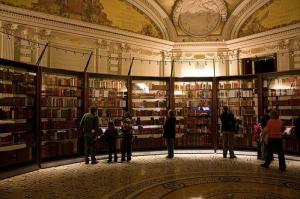
Today, the Library of Congress is the largest library in the world, with over 147 million volumes, but it actually had a little bit of trouble getting off the ground. The Library of Congress was established in 1800, and by 1814 had around 3,000 volumes. Those books, though, went up in smoke when the British burned Washington, D.C. during the War of 1812, leaving Congress without a library – that is, until Thomas Jefferson stepped in.

By 1814, Thomas Jefferson was a little strapped for cash and, coincidentally, also had the largest collection of books in the country. Sensing an opportunity to remedy two issues (his financial situation and the condition of the Library’s collection), Jefferson wrote to Congress offering to sell his personal library to replace the destroyed Library of Congress. After a bit of debate (which, by the way, you can see for yourself in the U.S. Congressional Documents Library and on the Library of Congress’ site), Congress agreed and bought 6,487 volumes from Jefferson for $23, 950, more than doubling the previous size of the Library. Unfortunately, though, there was another fire in 1851 that destroyed two-thirds of Jefferson’s collection; what remains, though, forms the core of the Library of Congress’s current collection.

In 2008, the Library of Congress recreated Jefferson’s library – both physically in the library and online. The interactive portion of the online exhibition also recreates Jefferson’s original organization of the books, starting with the broad categories “Memory,” “Reason,” and “Imagination.”

Famous Librarians!

by Katie Ginnane

In honor of Banned Books Week, the Georgia State Law Library brings you a list of famous librarians, some of whom might surprise you. Before, and sometimes after, these masters of microfiche became famous for their various pursuits, they spent their nine to five in the quiet of a library.  Among this list are a founding father and and former first lady, so librarianship truly leads to great opportunities!

Laura Bush– This former first lady attained her Masters of Library Science from University of Texas at Austin in 1973.  She was employed both in a Houston public library and at Dawson Elementary School.  She has been quoted as saying, “I worked as a teacher and librarian and I learned how important reading is in school and in life.”

Ben Franklin– Not just an inventor, this founding father conceived of the idea of a subscription library, which would pool funds from members to buy books available to all.  He implemented his idea with the Library Company of Philadelphia, which continues today with 500,000 rare books, 160,000 manuscripts and 75,000 graphic items.  Ben Franklin also hired the first American librarian, Louis Timothee.

Mao Zedong–  Prior to his reign over China, this dictator worked as an assistant librarian at Peking University, where he was also a part-time student.  After, Mao became headmaster of school in Changsha.

Lewis Carroll– Before he crafted Through the Looking Glass and inspired Jefferson Airplane, this famous poet and writer worked as a sub-librarian at Christ Church, a college in Oxford.  He would later teach there.  Mr. Carroll, whose real name was Charles Lutwidge Dodson, was also a mathematician.  Lewis Carol’s famous book Alice’s Adventures in Wonderland was banned by one of our other famous librarians, Mao Zedong.

Madeleine L’Engel– Prior to publishing A Wrinkle in Time, this author volunteered at the Cathedral of St. John the Divine as a librarian, where she was later the writer in residence.  Later, she would go on to publish dozens of both fiction and non-fiction books.  “A Wrinkle in Time” is also on several banned books lists.

J. Edgar Hoover– This former head of the F.B.I. worked in the Library of Congress while attending law school at George Washington University.  At the Library of Congress Mr. Hoover worked as a messenger, cataloguer and a clerk during his tenure at the library.  In 1919, he left the library to become a special assistant to the Attorney General.

Philip Larkin– This famous poet also made a career out his librarianship.  Larkin worked as the librarian for many institutions in England, from from the public library in Wellington, Shropshire to the University of Hull library.  Larkin is credited with making the University of Hull library the first library with an automated online circulation system in Europe.

Banned Books Week

Saturday, September 24th marked the first day of Banned Books Week 2011.  Banned Books Week  celebrates the freedom to read and the importance of the First Amendment.   This year Banned Books Week is being held from September 24th until October 1st.  During this time libraries all over the country hold events to highlight free and open access to all information.

The American Library Association (ALA) provides a list of 46 books from the Radcliffe Publishing Course Top 100 novels of the 20th Century that have been the target of ban attempts. Here are a few books on the ALA’s  list you may recognize:

  • The Great Gatsby, by F. Scott Fitzgerald
  • The Catcher in the Rye, by JD Salinger
  • The Grapes of Wrath, by John Steinbeck
  • To Kill a Mockingbird, by Harper Lee
  • The Color Purple, by Alice Walker
  • Animal Farm, by George Orwell
  • Gone with the Wind, by Margaret Mitchell
  • The Lord of the Rings, by J.R.R. Tolkien

There are also hundreds of books that have not been banned but have been challenged.  Challenged means that there was an attempt by a person or a group to remove or restrict the materials.  The Office of Intellectual Freedom cites the following as the top three reasons books are challenged:

  1. the material was considered to be “sexually explicit”
  2. the material contained “offensive language”
  3. the materials was “unsuited to any age group”

For those interested in learning more about banned and/or challenged books, you can consult the ALA’s website devoted to Banned Books Week.

The Law Library also has several books devoted to the First Amendment and book banning.  Here are just a few:

Cal Ripken Wants You to Get a Library Card

September is Library Card Sign-Up Month in the United States. This year’s spokesman and Honorary Chair is baseball Hall of Famer (and author) Cal Ripken, Jr. Ripken joins the American Library Association in urging kids and adults alike to get a library card.

But what exactly can a library card do for you? It allows you to check out books, of course, but there is often more to it. Many public libraries now offer ebooks, computer and Internet access, databases (newspaper archives and geneology research are especially popular), audiobooks, classes and educational programming, conference rooms, free family movie nights and more. Don’t forget the DVDs either. Depending on your library, those movie rentals may even be free or about the same as a Redbox rental (Take that, Netflix Quixster).

As a GSU student, your PantherID is your library card for both the law library and the university library. You can also get cards for local public libraries as well, including the Atlanta-Fulton Public Library, Dekalb County Public Library and Gwinnett County Public Library systems.


NY Times References GSU Law Review Article

by Katie Ginnane

In a story published September 19, 2011, the New York Times mentioned an article published in the Georgia State University Law Review. The story, concerning the recent Supreme Court Decision, Citizen’s United v. Federal Election Commission, discusses the requirement of disclosure outlined in Citizen’s United. It discusses some of the policy implications behind requiring disclosure of campaign contributions by elected officials. By requiring disclosure, voters may be able to make more informed decisions when casting their ballot. The more well known holding in Citizen’s allows unlimited campaign spending by corporations and unions.

The Georgia State Law Review article, written by Professor Torres-Spelliscy of Stetson University College of Law outlines the campaign periods from 2007-2010 and “the dramatic 180-degree turn that the law has taken” after the Supreme Court’s decision.
If you are interested in scholarly works published by Georgia State or other law professors, SSRN is a great site for access to working scholarly papers. You can access SSRN through the law library homepage, under legal indexes and databases.

ALI Members at Georgia State Law

Do you know what the American Law Institute (ALI) is and better yet do you know whom on the Georgia State Law faculty are members?

First things first: as you remember from your first year legal bibliography class, the ALI is made up of 4000 lawyers, judges, and law professors of the highest qualifications.  Through a deliberative process (sometimes taking two decades), they draft and then publish restatements of law and principles of law.  Final versions of these resources can be found in hardcopy in the Law Library general collection (e.g. the Restatement of Law, Torts can be found among tort resources, KF1246-KF1327 and Restatement of Law, Contracts can be found among contract resources, KF801-KF839).  The final restatements can also be found on Westlaw. Their Restatement of Law, Torts database contains the complete text of the 1st, 2nd, and 3rd Restatements of Torts as well as some proposed and tentative drafts, while their Restatement of Law, Torts Archive database provides considerably more historical tentative drafts, proposed drafts, and draft-related documents from the ALI Reporter.

Georgia State Law is well represented in the institute.  The following faculty are members of the American Law Institute:

NFL Lockout and the Law

On the night of Thursday, September 8th, the 2011-2012 NFL season kicked off when the reigning Super Bowl champion Green Bay Packers hosted the New Orleans Saints at Lambeau Field.  However, it was not too long ago that many of us doubted whether this season would start on time, if at all.  The issues involved in the lockout that threatened to derail our fall Sunday traditions remind us how the law intersects with nearly every aspect of our lives, even our diversions.

For those of you who have not spent the last several months closely following every development of the lockout, the following is a brief summary.

After the close of the 2010-2011 season, the final season included in the previous collective bargaining agreement between the league and the NFL Players Association, things looked rather bleak for football fans.  When the CBA expired in early March, the NFLPA was decertified.  On March 11, the players filed a class action antitrust lawsuit in U.S. District Court in Minnesota.  The players listed as plaintiffs are some of the biggest names in the NFL, and include Tom Brady, Peyton Manning, Drew Brees, Osi Unemyiora, Mike Vrabel, Brian Robison, Von Miller, Logan Mankins, Ben Leber, and Vincent Jackson.  The day after the suit was filed, the league imposed a lockout of the players.

One of the first orders of business for the players was to request an injunction against the lockout.  A hearing regarding the players’ request for an injunction was held in April before District Court Judge Susan Richard Nelson.  Judge Nelson declared the lockout was improper, and the owners immediately appealed to the 8th Circuit Court of Appeals.  The Circuit Court granted the NFL’s motion for a stay of Judge Nelson’s order pending appeal, and later, in a 54-page opinion, reversed Judge Nelson’s ruling.  (See opinion here: http://www.ca8.uscourts.gov/opndir/11/07/111898P.pdf )

In the meantime, settlement negotiations took place between the sides outside of the courtroom.  The 136-day ordeal finally came to an end when the players and owners agreed to terms for a settlement in July.  Upon agreement by all parties, Judge Nelson ordered Brady v. NFL dismissed, stating that the parties had “at all times acted with the utmost integrity and in the best interests of football.”

While the veracity of Judge Nelson’s statement is debatable, we can all agree that the end of the lockout is good for fans everywhere.  Now, our minds are free to ponder other things.  Like, why would Aaron Rodgers shave his magnificent preseason mustache?  Just how bad will the Colts be without Peyton Manning?  Did Tom Brady really agree to be the new face of Uggs?  Can the Falcons rebound after that painful Week 1 loss?

So enjoy this football-season-that-almost-wasn’t, and go Bills!!

By Kristin Poland