The Pets of GSU Law, Pt. 1

As you may have noticed, during finals, the library displays feature the pets of GSU Law. That way, although students cannot study in the library with Fido or Whiskers by their sides, they can at least derive some comfort and amusement from these visual representations of their pets. But these pictures are too adorable to keep within the library’s confines! There was no way for us to resist sharing a few of them with the world.

This is 2L Beth Goldstein’s Australian Cattle Dog, Hooch. He loves walks, walking, and going on walks.
This is 1L Jada Clayton Woods’ chocolate lab mix, Monroe. She’s a rescue, she’s very spoiled, and she enjoys dressing up in sweaters, jackets, and Halloween costumes.
From 1L Pricila Barravecchia: Catalina is a 1 L pup who loves walks before Foundations and long naps during Contracts. She hopes to find an internship with colleagues who will give her many pets and treats. Her area of interest is arbitration because she wants to help other pups negotiate for more play time and food.
This is 3L William Lyle’s American Staffordshire Terrier/Boxer mix, Archie. He was adopted from Lifeline Animal Services in Decatur 3 years ago. He is a huge cuddler, loves to run and can chomp down a chicken wing in two bites.

So, please extend your heartfelt gratitude to your furry friends (and your friends’ furry friends) for their absolutely clutch exam assistance. Be on the look out for a sequel to this post featuring more of their adorable brethren. Until then, if you want to see more pets, you’ll have to make it in to the library. While you’re at it, don’t forget to check out some of our amazing exam-related resources, like our study aid collections and the exam archive. Good luck!

Study Aid Spotlight- Select Upper-level Selections

This super-deluxe mega Spotlight is a sequel to our earlier post with guidance on the premier study aids for this semester’s 1L courses. This time, we’re movin’ on up, hitting up some of those current upper-level courses and telling you which study aids are undoubtedly the very best.

As a 2L or 3L, you’ve already endured law school finals, so you basically know what to expect. This increased familiarity may have also given you a better sense of how to prepare. Perhaps you’ve decided to sharpen your outlines into a more exam-ready ‘attack’ format? Maybe you’ve pledged to work more practice exams into your study routine? If you reflect upon your previous exam experiences, you can probably find some ways to ‘level up’ your approach to finals this time around.

But do you know which study aids work well for your upper-level courses? Perhaps you’ve noticed that truly helpful study aids are a bit harder to find for these courses, especially the electives. Fewer students take them, so it’s natural that fewer study aids are published to supplement them. Moreover, quite a few of the upper-level courses are rooted in constitutional jurisprudence, which is less suited to the example-based format of many study aids than the common law courses of your 1L year.

So, if you’ve thoroughly perused the study aid shelves in the back of the library, failed to find Glannon’s trusted name on any of the pertinent spines, and skulked back to your study station empty-handed, this is the post for you. I’m going to help you choose the best study aids for your courses. That is, I’m giving you the inside scoop on which titles are the tip-top, best-in-class study aids to illuminate your courses and position you to triumph over another round of exams. Of course, in the interest of keeping this post of a manageable length, there aren’t selections for every upper-level offering, but most of the required courses (and two important electives) are here.  

Constitutional Law I- Constitutional Law: Principles & Policies (Chemerinsky)

This study aid has a well-deserved reputation for being a game-changer for this challenging course. It’s an absolute classic, and we’ve sung its praises before. It offers tight, lucid descriptions of the key cases that nonetheless manage to capture many of their nuances, while also placing them in the context of SCOTUS’s evolving doctrines. I remember finding it to be a huge help when reworking my outline, but it can also work very well as a general refresher when you have trouble recalling the specifics of those early-semester cases. However, its format is designed to serve as a quick reference, not to help you learn to apply these doctrines. ConLaw exams tend to vary quite a bit from professor to professor, so that may be for the best, but that does mean it’s more important than ever be attentive to your professor’s hypotheticals. You should also see if they have any past exams available, in our archive or elsewhere. Note that this one isn’t available in the library’s online collections, so you’ll need to use it in print.

Evidence- Examples & Explanations for Evidence

In contrast to ConLaw, the rule-based structure of this course is particularly well-suited to the E&E format. The short examples allow you to gain some insight into how the FRE actually work, both in the real world and on your exam. This one also has the virtue of a writing style that makes intimidating topics quite approachable. In particular, I could appreciate how it discusses “hearsay’s appearance of difficulty to ‘outsiders’ and its relative simplicity to initiates” before proceeding to swiftly induct you into the ranks of the latter via two succinct chapters demystifying this topic.

Criminal Procedure: Investigations- Examples & Explanations for Criminal Procedure: The Constitution and the Police

It’s tricky to choose the best approach for this course, which combines ConLaw’s policy orientation with the labyrinthine analytical constructs more often associated with courses like Evidence or CivPro. Fortunately, this E&E does a solid job of addressing both of these aspects. This study aid tries to ‘simulate the Socratic classroom at its best’ and it shows. The examples are shorter than what I’ve seen in other E&Es, but they build upon one another in a way that does a good job of illuminating not just the boundaries of the applicable doctrines, but the justifications behind those boundaries.

Criminal Procedure: AdjudicationPrinciples of Criminal Procedure: Post-Investigation

The Concise Hornbook series is my go-to study aid for if you’re chiefly after a summary of the law. In particular, this one does a great job of tying together the many disparate topics covered in this course. A great example is the early discussion of the CrimPro’s “cornerstone objectives,” which supplies just the type of valuable context that can help make the whole course ‘click.’

Do you like these choices? Do you disagree with them? Which study aids are your top choices? Let us know in the comments!

Study Aid Spotlight- Acing Contracts

By Ross Crowell

In today’s Study Aid Spotlight, Law Library GRA Ross Crowell looks at a concise, popular study aid for your Contracts course. To make sure you’ve got all of your 1L bases covered, check out our recent post with librarian-curated study aid selections for all of them.

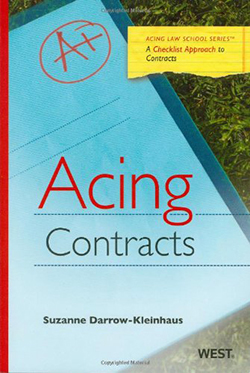
To me, the first semester of Contracts was a complete blur. From the big picture, everything seemed so simple. Offer, acceptance, consideration. Easy enough. However, once we got into the details of cases, things got quite confusing. As a 1L, Acing Contracts helped clear up a lot of these issues as I was cramming for the final exam. 

You can access Acing Contracts very easily: in addition to the library’s print copy, a digital version of the text is available through West Academic’s online study aid collection. Before getting into the nitty gritty details of your Contracts course, check out the Table of Contents for a solid foundation of topics (Offer and Acceptance, Consideration, Statute of Frauds, Defenses, Parol Evidence, etc.), that will help you organize your outline headings. 

Getting into the details, Acing Contracts does a good job of putting the course’s rules and explanations into plain English. As a 1L, so many times I would read some case from the early 1900s and, due to the language and writing style used at the time, it would be tough for me to follow along. Acing Contracts breaks down all of that legal jargon, explaining what you need to know in more modern terms.

It also does a good job of giving relevant examples. There are tons of practice problems that are useful for exam practice, and each comes with an in-depth answer. (Side note – I highly recommend writing out several practice problems for each class. That is probably the biggest thing I realized that I needed to change about my exam preparation after my first semester of law school.) 

Moreover, Acing Contracts provides rule statements from the almighty Restatement Second of Contracts and the UCC. Additionally, it provides checklists for some concepts you might come across (a great example I took advantage of is the in-depth Statute of Frauds checklist).

This study aid will definitely help you write your Contracts outline and study for your final. Most of all, I appreciated the way it put complicated concepts into easy-to-read language. While it is probably best to focus your outlining and studying around your class’s lectures and textbook, Acing Contracts is a great study tool for filling in the gaps and clearing up some of the more complicated concepts.

Study Aid Spotlight- Aman & Mayton’s Administrative Law (Hornbook Series)

In Admin Law, Organization is Everything

By Luke Smith

In this edition of Study Aid Spotlight, Ref GRA Luke Smith takes a closer look at a study aid that’s been a huge help to him in this challenging upper-level course. This one is an excellent example of the most O.G. study aid of them all, a hornbook.

Remember all those things you learned in Con Law about the nondelegation doctrine? Me neither. You’ll have about a week to relearn it all before you move on to the next equally complicated aspect of administrative law. Admin Law is not a required class, so its study aids might not get as much love as someother classes (I’m looking at you Civ Pro study aids), but having a good study aid is absolutely critical for this behemoth of integrated legal concepts. One that I’ve come to love is Aman & Mayton’s Administrative Law hornbook. To me, it stands out for two key reasons.

Reason #1: This aid is well-written and well-organized. It succinctly defines topics to give you an edge when preparing for exams. It’s organized into 5 sections: agency legislative power, agency adjudication, consistency in agency action, control of agency discretion, and access to government information. Within each part, it is broken down further into chapters that each explain an aspect of that overall topic. This might not sound like much if you haven’t taken Admin Law yet, but this easy-to-follow organization is absolutely perfect for the course, making it easy to fill in the gaps you have when it comes time for exams.

Reason #2: One of the worst parts of studying for exams is the limited 3-hour check out time for study aids, which can leave you fighting to make sure you get your preferred study aid. But this hornbook is available online through the library as well as in print. Waiting your turn for a study aid during exam time is a thing of the past. Now you can study all night long from the comfort of your home with a great study aid!!! Additionally, online it features the same great topical organization, with the added benefit of hyperlinks to each section, so you can easily access the exact section you need without having to navigate a table of contents like with those outdated print study aids.

Whether you’re using it to prepare for class or study for exams, this classic hornbook is a must for anyone in Administrative Law.

Study Aid Spotlight- selections for the current 1L courses

Call it Study Aid Spotlight, tripartite edition. We’re going to take a look at not just one, but three study aids, specially chosen for the Fall 2021 1L courses.

As a 1L staring down your first finals, it pays to study up on studying. And while it’s great to have an entire publishing subcategory dedicated to aiding you in this process of studying for law school exams, it can result in a rather paralyzing proliferation of study aid options.

Fortunately, the library’s got your back. We’ve been toiling away to formulate this list of what are unquestionably the very best study aids for your fall courses, as determined by facts & logic.

Civil Procedure- Examples & Explanations

Choices don’t come easier than this. Not only does Professor Glannon (don’t worry: he’ll come up again) communicate the niceties of CivPro with clarity and wit, the example-based format keeps the focus squarely on the all-important skill of applying the law. We have an entire post extolling the virtues of this legendary study aid, so I’m not going to belabor this E&E’s exemplary qualities. Suffice it to say, this one’s a must-have.

Sum and Substance- Contracts (Audio)

More than the other 1L subjects, Contracts is starved for truly great study aids. There are plenty of solid hornbooks, but my usual application-focused standbys—E&Es and Glannon Guides—are a bit underwhelming when it comes to Contracts.

That helps Sum & Substance- Contracts stand out. Audio study aids like this one can improve your studying efficiency, since the format encourages multitasking. Here, Professor Brain does a good job of unpacking the major doctrines in a conversational style.

However, what really sets this apart from other audio study aids is the focus on applying the law. After discussing and summarizing each topic, Professor Brain includes a brief section on answering related questions on a law school exam, going over typical fact pattern and explaining how to analyze them.  

Torts- Examples & Explanations

Another Glannon classic! This one features the same mix of right-to-the-point explication and irreverent humor that made its CivPro counterpart so useful. Standout chapters include “That Odious Character: The Reasonable Person,” whose examples employ Falstaff, Dogberry, and other Shakespearean characters to memorably illustrate concepts like reasonable care and the Hand formula. I can’t recommend this one strongly enough.

Do you like these choices? Do you disagree with them? Which study aids are your top choices? Let us know in the comments!
Dear My 1L Self- this is going to change your life.

This week, we’ve got a very special “Dear My 1L Self.” You know, the classic series where Law Librarians, Upper-class Law Students, and other former 1Ls write actual, time-traveling letters to their 1L selves, giving them that priceless quality of advice that can only result from hindsight. Of course, our one true hope is that some of this advice will also helpful in the here and now, for current 1Ls. In today’s installment, we also get some fond nostalgic insights into everyone’s favorite law school from Leila Lawlor, Director of the Academic Success and LL.M. programs (and GSU J.D. holder)…

Dear 1L Leila, 


I have so much to tell you, but I will try to make this somewhat quick because I know you have a lot going on—fulltime job, family, and LAW SCHOOL AT NIGHT! I know you love it at the College of Law. It may seem kind of uncool to love law school, but it’s okay by me. Here’s a secret for you, 1L Leila. You are going to end up working at the COL someday!! It really is your happy place, isn’t it? 


So, 1L Leila, continue to work as hard as you feasibly can, but remember to keep life balanced! The hard work really will pay off. The COL is going to change your life. After law school graduation, you can quit your current job (the one that is not a great fit for you). You are going to be challenged intellectually in ways you can’t imagine. Here’s something that will blow you away: some of your professors will become LIFELONG friends! You didn’t see that one coming, did you? And here’s another piece of wonderful news: someday, when you work at the COL, some of your students will also become enduring friends, long past their graduation. 

So, 1L self, enjoy the 1L experience. Enjoy the classmates around you. See the picture below? Several of your classmates in that picture from 1993 will still be your best friends in the whole world 28 years later! That photo was taken in the old law school building (the COL will get a new building in 2015). You are in the middle of the photo, standing up, and yep, you are pregnant. I know you think you have a lot going on in your 1L year, but you have no idea how much you will have going on when that baby arrives in your 2L year. Trust me, 1L Leila, you will get through it. You will thrive because of support you have at the College of Law. You have my word. 

Note: There are NO laptop computers in the room! That’ll change soon. And the soft drink in the pink can (Tab) will soon be replaced with something called Diet Coke!


And here you are at your hooding in a couple of years, 1L Leila! See, you are going to make it through this!

Best wishes,

Leila

Study Aid Spotlight- Constitutional Law: Principles and Policies (Chemerinsky)

by Meri Elkin

In this second-ever Study Aid Spotlight, 3LP Meri Elkin takes a look at Erwin Chemerinsky’s celebrated Con Law hornbook.

Hanish Patel boasts that the #1 study aid of all time is CivPro E&E, and it very well may be … if you are a 1L. But tell me 2L’s and 3L’s, how frequently are you picking up CivPro supplements these days? And although Prof. Fowke recently made a case for Getting to Maybe—a study aid focused on exam skills rather than any one subject area—he was too quick to dismiss the the depth and versatility that comes with taking a single-subject focus.

So, I am here to make my case that the all-time best study aid is actually Erwin Chemerinsky’s Constitutional Law: Principles and Policies. Beyond Con Law I and II, there are so many electives that touch on constitutional law. So. Many. Electives.

Don’t let the size of this 1,439-page supplement scare you. With a table of contents and a case index, this study aid is easy to navigate. More than that, it breaks down constitutional law into twelve chapters and easily digestible subsections.

For example, §5.3 tackles the Dormant Commerce Clause in 36 pages, starting with a brief definition, and then covering everything from policy justifications to an in-depth analysis of the modern approach to exceptions. Throughout, the author guides us along with incredibly useful headers, making it easy to get to the relevant sections for your classes.

Professor Chemerinsky’s goal was to write “the most thorough” 1,400-page constitutional law supplement possible. Although it does not cover the entirety of constitutional law, this amazing study aid provides some essential clarity for most of the topics students will encounter in their courses. And it’s these clear explanations that will ultimately keep students coming back, class after class.

For a panoply of study aid-related pro-tips (w/ a side of well-crafted verse), check out this classic post. And if you need to efficiently locate the perfect study aid in the perfect format, the library’s got you covered.

Dear My 1L Self- Shheeeeeesh

Hello, reader. You’ve happened upon “Dear My 1L Self.” Have you heard of this epic library blog series? Wherein law librarians, 2Ls/3Ls, and other intriguing interlocutors engage in anachronistic correspondence w/ their 1L selves? Wherein said correspondence dispenses sage advice that readers would do well to take under advisement? In today’s wise & witty epistle, Reference GRA Colin Daniels addresses his 1L self…

Dear 1L Colin,

I’ve got good news and sad news from the future. First the bad. By your 2L year, law school professors acquire technology that enables them to target a live cold call at any student anywhere on earth—Zoom. On the bright side, I can help you get by as a 1L.

Let’s start with suggestions. The Library’s VIP study rooms have outlets and beautiful marble-white whiteboard walls. Fill a study room with reliable people who keep motivate each other. Take notes and stick to a consistent study plan. There’s a lot of information to track over a semester. It’s a marathon, not a sprint.

Because law school is a marathon, you need to remember you’re a human being with physical limitations. Go through the syllabi at the beginning of the year and stick deadlines into a calendar. Then schedule time well in advance of due dates to work on projects. While you can spend a forty-eight hour period furiously writing a 1L foundations paper, you never want to turn in the first draft of anything you’ve written.

More importantly, you’re going to miss a lot of mistakes if you’re sleep deprived. Just schedule your time instead so you can make slow and steady progress on assignments. Your body and your GPA will thank you.

You’re going to make mistakes. Your biggest is not writing practice exams. Yes, they’re exhausting when many things demand your time. Don’t wait to start writing practice exams until you have a perfect outline (because it’ll never be perfect). Ultimately, 1L Colin, because you don’t take any practice contracts exams, your final exam reads like the next paragraph.

Buy a printer. Take half-days on Friday. Meet other students. It’s not a competition. Watch trashy reality TV occasionally (or frequently). Learn about bird law. Go meet a professor during office hours. Use a watch and a calendar. Get a free lunch (and learn something) at meetings and events. Take a mindfulness seminar. Read the career services emails. Borrow whiteboard markers from the library. Look into GRA positions for experience and a tuition discount. Interviewers care about personality, so don’t forget about the hobbies and interests that make you an interesting person.

Good luck, and don’t worry too much. You can always try for Tik Tok fame.

Shheeeeeesh,

3L Colin

Beetlejuice, Beetlejuice, Bee .. Haunted House Disclosure Law!

For this Halloween season, the Blackacre Times is resurrecting this frightful classic from Professor Parsons…

Patrick Parsons's avatarThe Blackacre Times

Copyright © 2015 Roger H. Goun. Available at http://www.virtualnexus.com/images/beetlejuicegroup2015small.jpg

Imagine this.  You’re a New York City real estate developer.  You just married your second wife, an interior designer, and are looking to get out of the big city and experience some country life.  Your real estate agent finds exactly the perfect house in Wind River, Connecticut (not a real place upon further inspection.) However, the current owners have no interest in selling.  Strangely the day after throwing your agent out of the house, the current owners drove off of a bridge and died.  You immediately swipe in and buy the Connecticut property, and move your daughter, wife, and wife’s interior designer friend Otho into the house.  Your wife immediately starts to remodel the home to give it a more modern esthetic, because, that’s what she does.

However, weird things start happening. One day while eating lunch, everyone present, as if…

View original post 733 more words

Study Aid Spotlight- Getting to Maybe: How to Excel on Law School Exams

Welcome to Study Aid Spotlight! This is a new, semi-regular series that will pop up at the Blackacre Times from time to time, especially as we near exam season. As the name suggests, each installment of Study Aid Spotlight will take an in-depth look at one particular study aid, discussing what it covers and why its useful. Go here if you want some study aid-related tips (alongside some choice iambs), or check out our Study Aid Finder for an easy entryway to the library’s collection. In this first installment of Study Aid Spotlight, Digital Services Librarian Gerard Fowke takes a closer look at Fischl & Paul’s classic Getting to Maybe: How to Excel on Law School Exams.

Here at the Blackacre Times, our ‘all-time’ most popular post is ’14 grad Hanish Patel’s convincing case for Glannon’s CivPro E&E as the ‘all-time’ #1 study aid. And it’s easy to see why the CivPro E&E might warrant such effusive praise: Professor Glannon’s masterful hypos force students to think critically about these storied doctrines, and his witty presentation makes this rather dry material quite memorable.

But I’m here to tell you that Richard Michael Fischl & Jeremy Paul’s Getting to Maybe 1 gives Glannon a run for its money.

Why? Well, it’s right there in the subtitle. ‘Law Schools Exams’ can seem awfully important, and G2M is all about ‘How to Excel ’ on these challenging and mysterious assessments. And unlike Glannon, which will only help in CivPro, G2M’s focus on exam-related skills will help you in all of your classes. Every. Single. One.

Notably, this helpfulness even encompasses those classes without a traditional law school exam. That’s because this study aid’s exam-oriented focus is really just the tip of the iceberg. Although its strategies will undoubtedly prove helpful when untangling an end-of-semester issue-spotter, that’s only because everything about law school revolves around G2M’s true topic: legal analysis.

For example, take Chapter 6, titled “Forks in the Facts.” Here, Fischl & Paul start by telling us they plan to look at a “variety of ways in which laws are structured by category” and explain the challenges of categorizing “a particular set of facts.” Then they proceed to do just that, with subchapters on oft-seen iterations of this analytical concept, such as “Rule vs. Exception,” “Categories as Elements of Legal Rules,” and “Facts on Both Sides.” For each, the authors illustrate their ideas with clear examples drawn from the casebook canon (some even involving everyone’s favorite fictional estate).

But this “categorical” habit of thought will only help you succeed on an exam because it’s an important aspect of legal analysis. And it has rarely (if ever) been given this straightforward of a treatment: the authors have cleared away the jurisprudential rabbit-holes and distilled the essence of “categorical reasoning about the law” into fewer than 20 pages.

In Maybe‘s remainder, they work similar wonders with kindred concepts like “Forks in the Law” and “Patterns of Ambiguity.” Students will walk away wishing they could stop thinking like a lawyer.

Of course, this approach means that Getting to Maybe is less of a reference work than something like the Glannon E&E. It’s not the study aid you’ll grab from the nightstand for that day-before-the-exam Erie refresher.  Instead, most students will want to read G2M once or twice (preferably before the exam ‘crunch’ begins), absorb its analytical framework, and move on. This quality alone probably makes it a perpetual underdog in the study aid “World Series.” Still, few books so effectively capture the essence of what law school seeks to impart and assess. The E&Es and Nutshells of the world would do well to watch out for the weird, scrappy study aid known as Getting to Maybe.

1 I couldn’t help but to completely and utterly geek out when I noticed that Professor Paul’s faculty profile mentions that a new edition of Getting to Maybe is expected for 2021. The first (and only) edition has been out for 22 years. UPDATE: According to Carolina Academic Press (by the way of the Jones School of Law Library’s Gigi Panagotacos) the new edition won’t be out until Fall 2022. Can I even wait that long?