Miller Lectures of the Past

With the 68th installment of the Henry J. Miller Distinguished Lecture Series right around the corner, it’s a great time to revisit some highlights from previous Miller lectures. Recently, the law library has been digitizing programs from the earliest Miller lectures, so these materials are more accessible than ever. This is an ongoing project, so watch this space for additional updates as the archive grows.

Although we have been unable to find a program for Murray L. Schwartz’s inaugural Miller Lecture, we have digitized the program for the second lecture, and it’s a doozy, featuring Justice Antonin Scalia, who had at the time just wrapped up his first year on the Supreme Court.

The Miller series has had the good fortune to feature a few Supreme Court justices. We’ve digitized the program for Justice Sandra Day O’Connor’s 12th Miller Lecture in 1992. In addition to that, the law library’s own Alison Guffey memorably wrote on this very blog about Justice Ruth Bader Ginsburg’s 32nd Miller Lecture, which was delivered in 2003. You can also find a transcription of Justice John Paul Stevens’s 53rd Miller Lecture, from 2014, in the GSU Law Review’s archives.

We’ve also had some other notable jurists from other courts speak, including Judge A. Leon Higgenbotham of the Third Circuit for the 4th Miller Lecture in 1988 and Judge Patricia McGowan Wald of the D.C. Circuit for the 7th Miller Lecture in 1990.

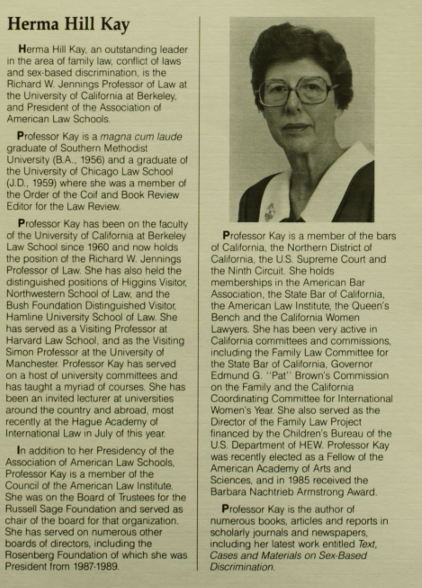
Perhaps unsurprisingly, the Miller Lecture series has also featured many scholars. In the early days, the series did an especially good job of providing feminist legal scholars with a forum. These include Herma Hill Kay, a co-author (along with the aforementioned Justice Ginsburg) of the first casebook on sex-based discrimination, who gave the 6th Miller Lecture in 1989, and Nadine Strossen, the first woman to lead the ACLU, who gave the 15th Miller Lecture in 1994.

Exploring the law library’s Miller archives is a great way to learn more about the history of GSU Law, while also getting to know some of the nation’s most influential scholars and jurists. We will continue this proud tradition at the next Miller Lecture, when Election Law scholar Rick L. Hasen discusses “A Real Right to Vote.” Don’t miss it!

Summer in the Law Library

As always, everyone at the law library is excited to welcome students for a new semester. At the same time, the end of the summer does have a certain bittersweet quality to it.

We always seek to create a calm and comfortable environment, but during summer, the library is often very quiet.[1] At the beginning of the summer, with the busy exam season in the rearview, I can definitely appreciate the chance to take a deep breath and relax in a peaceful environment. Of course, a few weeks in, I really start to miss the hustle and bustle of school year, but the stillness of the summer library is nonetheless worth commemorating.

 As you might imagine, fewer students means fewer patrons at our reference and circulation desks. This gives the reference librarians and our hardworking circulation staff time to work on projects that might otherwise reside on the backburner. It also gives us a nice opportunity to get to know our summer “regulars,” whether they are taking courses, studying for the bar, or researching an important project for their summer job.  This can make summer feel like a productive and fulfilling time, while also making me eager to meet a whole new class of amazing 1Ls, transfers, and LLMs.

Working in the law library, you get accustomed to these seasonal rhythms. The variety keeps things interesting! The quiet times also lead to more overall productivity, with better library services as a result. However, it’s worth remembering that everyone needs downtime, even attorneys and law students.

Here’s to the end of summer and the start of a new year.


[1] Do keep in mind that the 6th floor is always quiet!

Tips for Exam Season

by Ralaya Evans, Law Library GRA

Exam Season can bring anxiety for all law students. There is a lot of pressure and everyone wants to do well. There are a few upkeep actions one can partake in to help ease the nerves surrounding exams.

  1. Sleep is your friend. It can be tempting to wake up super early and stay up late studying and digesting as much information as possible every day. However, this is more harmful than helpful. This can overload your mind and make it hard to retain information. You may find that no matter the ample hours that you are putting into studying, you are not prepared for the exam. Getting the right amount of sleep will make studying more effective and allow you to perform to your best ability on the exams.
  • Take breaks. Studying all day without breaks will also impact your ability to retain information. Mental fatigue will often be the result. Your mind/body will often tell you when you need a break, but during finals we ignore the signs. However, kn­­ow the signs of mental exhaustion so that you can respond appropriately. Pushing yourself too hard will only cause burn out.
  • Set a study schedule and stick to it. Setting a schedule can also help you block out time to study, but to also take a break, eat, do something that you enjoy and more. Sticking to a schedule allows you to accomplish the amount of studying that you want, but also still have a life. A nice balance between the two will be extremely beneficial.

Although taking care of your mental health is key, we must also ensure that we are ready for finals substantively.  To prepare for such information-intensive exams, here are a few tips:

  1. Find your study group. There are many different studying techniques. Some of us share the same techniques for studying and use the same sources such as Quimbee, law library study aids and more. So, it is often a good idea to team up with others and form study groups. Aside from sharing resources and techniques, insight from your fellow classmates can help you see information from a different perspective.
  • Make an attack outline that works for you. It is a good idea to work with your classmates to create a detailed outline of your course to use during the exam. However, it is also extremely helpful to make a more concise “attack outline” that you are more familiar with and comfortable with using during a timed exam. This brevity and familiarity will work to your advantage since it will be so much easier for you to quickly reference during the exam.
  • Go to office hours. Once you reach the point in your studies where you have created your outline, take note on the areas you are still a little fuzzy on and go to that professor’s office hours to see if they can help clear things up for you. The professors are always so willing to help and want you to succeed. So, schedule time with them when needed. Do not choose to suffer in silence or settle for not understanding a topic fully.

Exams are often referred to as the most stressful part of each semester. So, it is important to have the tools to get through the season and feel good about your performance. All of these tips will help to build your confidence for taking the exams.

Introducing the “Bioethics: Inclusive Voices” Video Series

The Center for Law, Health, and Society and the Law Library are excited to bring you Bioethics: Inclusive Voices, a series of short, high-quality videos exploring the diversity of the bioethics field.

Professor Leslie Wolf organized the project, which was funded by the Greenwall Foundation. Like so many of us, she had to adapt to the changing circumstances of Covid-19, turning what had first been conceived as a series of speakers into an innovative series of 6-12 minute videos on important yet under-discussed issues within bioethics.

Professor Leslie Wolf was the principal investigator for the project.

The videos fall into two distinct groups: ‘Career Journeys’ and ‘Diverse Scholars’. The former relay the personal stories of diverse scholars who pursued bioethics from different starting points, such as student activism or the practice of medicine. According to Wolf, the goal here was “to encourage more students form diverse background to consider bioethics as a career.”

In comparison, the “Diverse Scholars’ videos address a wide variety of diversity-related bioethics topics. Some are filled with highly practical insights, such as Fordham Professor Kimini Paul-Emile’s Dealing with Racist Patients, while others focus on vital big-picture issues, such as Professor Anderson’s Health Injustices Caused by Segregation and Housing.

A still from Professor Anderson's Health Injustice Caused by Segregation and Housing video.
A still from Professor Courtney Anderson’s Health Injustices Caused by Segregation and Housing video.

Although many different audiences will find these videos intriguing and useful, they are primarily intended as resources for teachers, at both the graduate and undergraduate level. As such, each features a set of discussion questions, as well as a list of resources for further exploration. Moreover, the high production quality on display here–in the form of the appealing visual aids that accompany each speaker and the professional sound throughout the series–will help ensure that students are fully engaged.

Bioethics: Inclusive Voices is one of the many great resources you’ll find in the Law Library’s “Reading Room,” our home for faculty scholarship, video recordings of important GSU Law events, historical law school materials, and much more. Check it out!

GSU Law Pets- Far Too Adorable or The Perfect Amount of Cute?

With Finals right around the corner, the library has shifted into full-on “Pet Picture” mode. That’s right, instead of informing you about library events and services, the library signs will now beguile you with extremely cute pictures of your own pets! That way, as you pause to to catch your breath before running through the Rule Against Perpetuities one more time, you can look up and see the relaxing, inspiring visage of one of our faithful furry friends. In order to really bring home the sheer cuteness on display, we’ll use this blog post to get to know a few of GSU Law’s pets a little bit better.

Some pets go beyond inspiration and comfort to actually study law right alongside you. That’s the case with the impeccably-named Princess Vanilla Pudding, pictured here helping 2L Nicole Walker Smith get ready for her CivPro exam.

Next up, we have another pet with an amazing name, Kahlua Romeo. She’s also an enthusiastic learner of the law, who likes to jump up and participate during Zoom classes, although 3L Sonny Romeo warns that “Professor Stephens scares her a bit.”

If pets can effectively study law, perhaps they can also execute key governmental functions. As you can see from this picture of 3L Alex Beato’s pup Reagan, our pets have already gotten pretty close to the White House! Alex adopted Reagan from a shelter, and reports that “she has never met a person, squirrel, or really any other living creature she doesn’t love and lives for all the pets and attention she can get.”

Clearly, if the U.S. News & World Report’s rankings included “cuteness of student pets” as a criteria, GSU Law would mount a challenge to Yale and Harvard. Be on the look out for a sequel to this post featuring more of these highly-ranked pets. Until then, if you want to see more of these astoundingly cute animals, you’ll have to make it in to the library. While you’re at it, don’t forget to check out some of our amazing exam-related resources, like our study aid collections and the exam archive. Good luck!

Research Consultations are Really, Really Great and They Will Almost Definitely Improve Your Paper

Researching a paper can be intimidating. In my experience, this emphatically applies to many situations where the paper in question is for a law school course. Most law students have only just recently become familiar with the fundamental sources and strategies of legal research, and applying them to a lengthier treatment of a multidimensional (and often interdisciplinary) topic adds another layer of complexity.

Fortunately, your friendly neighborhood librarian is here to help, in the form of a research consultation. We are available to meet with you one-on-one to give you highly individualized advice on researching your paper. This includes help with many different aspects of the paper-writing process, including refining your thesis, checking for preemption, developing a research plan, identifying relevant resources, finding authorities that support your arguments, and more.

Efficient, high-quality research can make a big difference with any paper. Research can be very path-dependent, and the strategies you choose earlier in the process will lead you to different sources, and those sources will inevitably shape your arguments and ideas in the final product. Impeccable research isn’t just something you do to build an impressive footnote count! (Although a consultation will undoubtedly help you with that as well.)

Research consultations are not only extremely helpful, they are also very easy to schedule. To do so, you can hit us up at lawreference@gsu.edu, email your personal librarian, or simply stop by the reference desk. With that high degree of convenience in mind, I’m going to close out this blog post by stridently demanding that you stop whatever you’re doing and schedule a research consultation right now. I mean, don’t you want to write a better paper?

Resource Highlight: HeinOnline’s Slavery in America and the World: History, Culture, and Law

In case you haven’t read the news, scholarly research into slavery’s influence on our legal system is highly relevant to many ongoing debates. The law library can help with your research in many ways, but today I’m going to highlight HeinOnline’s Slavery in America and the World: History, Culture, and Law. Whether you are doing legal research that relates to slavery, or interdisciplinary research on other aspects of slavery that touches upon the law, this rich collection gathers a wide range of useful primary and secondary sources that might otherwise be cumbersome to identify and locate.

When it comes to primary legal sources, Slavery in America and the World aims to be comprehensive. It includes:

  • Every statute passed by every colony and state on slavery;
  • Every federal statute dealing with slavery; and
  • All reported state and federal cases.

The way the collection organizes these sources by jurisdiction and then presents them chronologically is obviously a great match for a research project focused on historical developments; however, even if the historical timeline itself is not a major focus of your research, this organization still provides some valuable context. It’s quite useful.

This database also cuts a wide swath when it comes to gathering primary historical sources (i.e., contemporary accounts of slavery). HeinOnline says it includes every pre-1920 English-language legal commentary on slavery, including many obscure articles and journals that are otherwise difficult to find. It supplements those legal commentaries with hundreds of newspapers and pamphlets discussing slavery from a variety of perspectives.

A photograph of former slaves in the time period following the Emancipation Proclamation.
Via wikimedia.

Slavery in America and the World also helps to contextualize this impressive range of primary sources with useful secondary materials. It includes a fairly thorough and relatively up-to-date collection of modern legal scholarship on slavery, as well as an extensive bibliography of books on the topic.

Slavery looms large over American history and American law, and there is no shortage of sources on the topic, which can make research feel overwhelming, even for the experienced researcher. Slavery in America and the World helps to make it more manageable by gathering so many of the most important resources in a single place and organizing them in an intuitive and approachable manner. If you are just getting started, the collection has a clear and easy-to-navigate LibGuide to help point you in the right direction. Of course, as with any of the GSU Law Library’s many resources, librarians are also here to help you use them effectively in your research.    

Breyer Retires: some helpful and interesting resources

As you surely know, Justice Breyer recently announced that he would be stepping down at the end of this term, setting another Supreme Court confirmation process in motion. However, you may not know how to further research Breyer’s legacy and SCOTUS confirmations.

Justice Breyer was well-liked by his colleagues and had a reputation for asking colorful hypotheticals from the bench. SCOTUSBlog has great coverage of his overall legacy, including many reminiscences from former clerks. Before his nomination to the federal bench, Breyer taught admin law, and some of the best scholarship on his SCOTUS tenure focuses on this subject, such as this Justice Stephen Breyer’s Contribution to Administrative Law symposium. During his nearly three decades on the Supreme Court, he (of course) wrote important opinions on a wide array of topics, often crafting compromises and creating nuanced balanced tests: the Congressional Research Service (CRS for short—you’ll be seeing a whole lot more of them in this post) recently published a nice overview of his jurisprudence.

To this writer, his most memorable opinion was in dissent, issued in Parents Involved in Community Schools v. Seattle School District No. 1, a case that sharply limited desegregation efforts in public schools. I would encourage anyone who’s ever dismissed Justice Breyer as a bloodless technocrat to listen to him read what Justice Stevens called his “eloquent and unanswerable dissent” from the bench, asking “what happened to stare decisis?”

With Breyer’s imminent retirement, the appointment process for his successor begins. If you’d like to further explore that process, HeinOnline’s History of Supreme Court Nominations collects an impressive array of primary and secondary sources. Those sources include this excellent CRS report on what goes into the President’s selection of a nominee. There are also helpful CRS reports on the rest of the process, including one on the nominee’s consideration by the Senate Judiciary Committee and another discussing the limitations and customs surrounding the questions Senators ask judicial nominees during confirmation hearings.

As you might expect, there is a plethora of scholarship on the appointment process. For a data-based deep-dive into nominations and confirmations from the institutional perspective of SCOTUS, you can’t beat The Supreme Court Compendium‘s chapter on the topic. The legal scholarship on this topic is voluminous, with law review articles exploring the original meaning of ‘advice and consent’ and analyzing SCOTUS confirmations from a historical perspective. Another major strain of scholarship analyzes the role of ideology or politics in the process, as well as the desirability of obscuring that role. Tackling the politics from another perspective, there are also quite a few articles discussing nominations within the context of the Court’s antidemocratic or countermajoritarian characteristics. Other legal scholarship approaches the topic from more oblique angles, with intriguing articles looking at confirmation hearings as “a valuable form of cultural expression” and elaborating on martial metaphors for the confirmation process.

In addition to the legal scholarship discussed above, there is a veritable ton of academic work on SCOTUS appointments taking place in other disciplines, especially political science. Scholars in that field have written interesting articles on topics such as the timing of nominations, the President’s constraints in choosing a nominee, the role of interest groups in nominations, the role of shared identity in public support for a nominee, and how contested nominations contribute to public polarization.

For a deeper dive, there are some great research guides out there that provide a more in-depth treatment of the many, many resources available on these topics. And, of course, if there are any resources on Justice Breyer’s retirement, or on SCOTUS appointments more generally, that you have found to be especially useful or interesting, be sure to let us know in the comments.

Is it February 3rd Yet?

This post from the Research, Instructional & Patron Services Law Librarian blog really struck a chord with this blog’s editor. Perhaps it will resonate with you as well. If you’d like to see more content from other sources, let us know in the comments!

lizmanriquez's avatarRIPS Law Librarian Blog

It’s a new year. A new semester. A new COVID.

But everything feels the same. Actually, not the same, worse? Omicron has made the past few weeks feel like a traumatic retelling of Groundhog Day, minus the quirky smalltown and love story. This timeline is all Ned Ryerson.

2022 has been a real downer so far. COVID cases are surging, highly anticipated events are being cancelled, and we are again being pushed into forced isolation. We’ve been through this before, so why does it feel so much worse this time?

There are a confluence of factors contributing to our collective ennui. The pandemic has dragged on for years. We are at peak time for Seasonal Affective Disorder (SAD). And generally, spring semester is just harder on our psyches than fall semester. It’s even harder on our students: graduation chaos; stress over summer positions; and the honeymoon period of the…

View original post 802 more words

Welcome Back!

That winter break of celebration and relaxation? Hope you were able to take full advantage, because it’s now but a memory, and we find ourselves back for another semester.

But that’s not a bad thing. From personal experience, I can tell you that law school tends to get less stressful as you go along. That initial 1L shock wears off as you get more familiar with its overall format.

That’s good news if you’re hoping to make a triumphant return and improve your grades! This very blog has some materials that will help you achieve that goal, such as this excellent post on effectively managing that most precious commodity, your time. Similarly, it’ll improve your temporal efficiency if you’ve got your course outlines in order from the very start, so you may want to take a look at this post on powering up those outlining skills.

Or maybe you’d rather just sit back and take advantage of the ‘calm before the storm’ by catching up with your friends? That’s cool, but don’t forget to also catch up on some enlightening and entertaining GSU Law Library content that’s not so focused on super-charging your studies? If you’re a history buff or an Atlanta aficionado, you’ll love this highly informative post on the rich history of Georgia’s African-American legal community. Another Blackacre Times ‘greatest hit’ comes in the form of this intriguing rundown of Abe Lincoln’s legal career. And don’t miss this highly amusing post on courts citing talk show hosts, folk singers, Jedi knights, and other unconventional authorities in their opinions.  This recent post on the law of the SEC will even get you ready for the big game!

Of course, as your classes gear up again, you know the library’s got your back. We’re offering the same great services to make your life easier and improve your legal research skills, such as course reserves, online study aids, and the ALERT program (starting up on Tuesday, Jan. 18th and Wednesday, Jan. 19th w/ a can’t-miss session on rocking PowerPoint). If you see one of your favorite librarians, don’t forget to say hello! We’re here to help. Welcome back!