The MLB Lockout: A Look at the Issues

By Ross Crowell, GSU Law Library Sports Law Correspondent

Here in Atlanta, many baseball fans should be looking forward to the upcoming baseball season, as the Braves are fresh off of a World Series victory. The Braves should start off the 2022 season in under two months, as their first game is scheduled at the Miami Marlins on March 31. However, the Braves and the rest of Major League Baseball (“MLB”) likely will not be playing games as scheduled. It appears to be an all-but certainty that the 2022 season will not start on time due to the MLB lockout. And ultimately it might be beneficial to remember that the lockout grew out of something everyone who’s taken 1L Contracts is at least passingly familiar with: protracted negotiations over an extremely complex contract.

We are now over two months into the lockout, which has been caused by the owners and players failing to reach a new collective bargaining agreement (“CBA”). Further, it appears that the two sides have not made much progress in reaching an agreement. The lockout began on December 2, when the Major League Baseball Players Association and the owners could not reach an agreement, resulting in the MLB’s first work stoppage since 1994. 

The players and owners are mainly arguing over financial issues, with players upset that they aren’t paid the high salaries they think they deserve. The players also want to change a long-time rule that forces players to wait six years to reach free agency. As players’ first contracts are usually not for substantial money unless they were a high draft pick, this rule forces players to wait a significant amount of time before they can cash in on a big second contract (potentially worth hundreds of millions of dollars in some cases). 

Further, the players and owners are struggling to reach an agreement on the pre-arbitration bonus pool. The players recently lowered their proposed pre-arbitration bonus pool from $105 million to $100 million, while the owners are sitting at a proposed $10 million. Thus, there is a significant gap in those negotiations. 

Additional issues that the two sides are arguing over are disincentivizing tanking (i.e., stop rewarding teams who intentionally perform poorly), increasing the competitive balance tax threshold, and ending service-time manipulation. The service-time manipulation is an interesting issue that notably occurred with Atlanta’s All Star outfielder Ronald Acuña. With Acuña, the Braves knew that he was ready to be a big contributor during 2018. However, Atlanta waited until three weeks into the season to call Acuña up from the minor leagues, as this would allow the Braves to get an extra year out of Acuña’s contract before hitting free agency. Thus, the players are hoping the new CBA will put an end to this practice. 

Moreover, these negotiations involve several attorneys. Notably, MLB Commissioner Rob Manfred was a labor and employment partner at Morgan Lewis & Bockius LLP prior to his career with the MLB. While Manfred was with Morgan Lewis, he negotiated on behalf of the owners during the 1994-1995 MLB lockout, along with negotiating the league’s first drug-testing program in 2022. Dan Halem, who is the league’s Deputy Commissioner, previously served as a partner at Proskauer Rose LLP, working in labor and employment law, along with sports law. Additionally, Bruce Meyer, the MLB Players Association Senior Director of Collective Bargaining and Legal, is a partner at Weil Gotshal & Manges LLP. Meyer also has experience working on behalf of the NHL, NFL, and NBA during arbitrations, lawsuits, and CBA negotiations. 

These are just a handful of things that are being heavily disputed between the players and owners. With spring training tentatively beginning on February 16, it appears highly unlikely that things will get started on time, likely resulting in the regular season getting pushed back. If you are planning on going to the Braves’ home opener on April 7 against the Mets, now might be the time to start coming to the realization that the game may not occur.  

So, when you’re trying to connect tricky concepts around negotiations, contracts, and labor law to the real world, it might actually be beneficial to think of all of those baseball games that will never be played.

Introducing Aspen Learning Library (formerly known as Wolters Kluwer Online Study Aid Library) & its Companion App

In this post, Law Library GRA Ross Crowell takes a closer look at a resource with a fancy new name but lots of familiar (and very helpful) content.

If you’re a regular user of the law library’s online study aid collection, you’ve probably noticed the recent change in nomenclature: what was formerly known as the Wolters Kluwer Online Study Aid Library is now called Aspen Learning Library. It’s got all of the same study aids, and you can still find it in the same place on the library’s database list, but it now features a new interface and a new app (rather sensibly called the Aspen Learning Library App), which you can find on the App Store, Google Play, and for desktops. I downloaded it on my MacBook and have enjoyed the ease of being able to access all of these great study aids in just a few clicks. Instead of having to log onto the GSU Law Library website and then log in again to access these study aids, they are now accessible simply by opening an app. In addition, unlike the generic IPC Reader app that some students used for these study aids, this one is designed specifically for these resources.

Here is a look at the desktop app’s interface. As of now, there are 211 different study aids that are accessible through the app. 

You’re sure to see some familiar titles. All 1L course study aids are available here, along with study aids for many other courses such as Admin Law, Corporations, Wills Trusts & Estates, and Constitutional Law. One favorite I accessed via the app are the Casenote Legal Briefs, which provide detailed briefs for many cases. Personally, I wish I would have used this study aid for Con Law during my 2L year, as it would have made my life a lot easier by simplifying the long cases that I struggled to understand. These briefs can be great when you are struggling with a case, as they provide condensed and simplified explanations. 

In addition to the Legal Briefs, the app also has Examples & Explanations for many popular electives and core classes. I enjoy using these study aids around finals time, as they can be a good way to do practice problems and then check your answers. There are several other types of study aids available in the app, but these two are the ones that I use the most. 

Feel free to download the app, get logged in, and access all of these great study aids to get you through the semester. To get started, I downloaded the app here. After starting the app, I signed in through “OpenAthens”, searched Georgia State University, then logged in with my GSU credentials. Hopefully, you find that this app will be beneficial to you for the semester and the rest of your time in law school.

Legal Consequences of Oklahoma and Texas Joining the SEC

As we gear up for an SEC-dominated national championship, Law Library Sports Law Correspondent Ross Crowell’s got you covered with this post on the possible legal consequences of new additions to the conference.

On July 29, the Southeastern Conference (“SEC”) unanimously voted to add the University of Oklahoma and the University of Texas, effective July 1, 2025. Oklahoma and Texas, who have been members of the Big 12 Conference (“Big 12”) since the conference’s inception in 1994, potentially could join the SEC even sooner than 2025, as they could be playing in the SEC as early as 2022, as reported by Matt Hayes. 


While this move has some Longhorn and Sooner fans thrilled about the new competition, there are a few legal hurdles the universities face. 


First, the Big 12 said that it expected Texas and Oklahoma to adhere to its bylaws and television contracts that the schools signed, and if the schools failed to do so, each school would owe the Big 12 over $76 million.  Additionally, the Big 12 bylaws provide that a departing member must give the Big 12 at least 18 months’ notice that they are leaving the conference, and also must pay the Big 12 a “commitment buyout fee”, equal to the amount of distributions the schools would have received during the last two years of its membership. The bylaws additionally provide that Texas and Oklahoma would have to give up all distributions the school would have received during the interim period between the schools’ notice and departure. The consequences of the Big 12 bylaws result in Texas and Oklahoma missing out on tens of millions of dollars. 


Further, following the schools’ announcement of departure, the Big 12 sent ESPN a cease and desist letter, demanding that the sports network stop communicating with Big 12 members and other conferences over matters regarding Big 12 schools. Big 12 commissioner claimed that ESPN “actively engaged in discussions with at least one other conference regarding that conference inducing additional members of the Big 12 Conference to leave the Big 12 conference.”
These are just a few of potential legal issues the schools (and ESPN) are facing due to the move. While both Texas and Oklahoma’s football teams alone bring in over a combined $200 million a year in revenue, with that number likely increasing when they join the SEC, the programs will likely have to pay tens of millions of dollars back to the Big 12 due to this move.

As you can see, SEC football is not so different from a Contracts exam. Leave a comment if you spot any additional issues with the teams switching conferences!

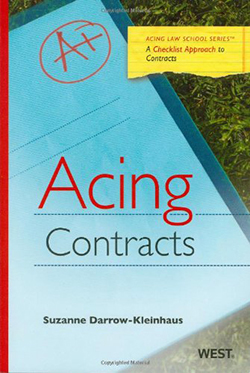
Study Aid Spotlight- Acing Contracts

By Ross Crowell

In today’s Study Aid Spotlight, Law Library GRA Ross Crowell looks at a concise, popular study aid for your Contracts course. To make sure you’ve got all of your 1L bases covered, check out our recent post with librarian-curated study aid selections for all of them.

To me, the first semester of Contracts was a complete blur. From the big picture, everything seemed so simple. Offer, acceptance, consideration. Easy enough. However, once we got into the details of cases, things got quite confusing. As a 1L, Acing Contracts helped clear up a lot of these issues as I was cramming for the final exam. 

You can access Acing Contracts very easily: in addition to the library’s print copy, a digital version of the text is available through West Academic’s online study aid collection. Before getting into the nitty gritty details of your Contracts course, check out the Table of Contents for a solid foundation of topics (Offer and Acceptance, Consideration, Statute of Frauds, Defenses, Parol Evidence, etc.), that will help you organize your outline headings. 

Getting into the details, Acing Contracts does a good job of putting the course’s rules and explanations into plain English. As a 1L, so many times I would read some case from the early 1900s and, due to the language and writing style used at the time, it would be tough for me to follow along. Acing Contracts breaks down all of that legal jargon, explaining what you need to know in more modern terms.

It also does a good job of giving relevant examples. There are tons of practice problems that are useful for exam practice, and each comes with an in-depth answer. (Side note – I highly recommend writing out several practice problems for each class. That is probably the biggest thing I realized that I needed to change about my exam preparation after my first semester of law school.) 

Moreover, Acing Contracts provides rule statements from the almighty Restatement Second of Contracts and the UCC. Additionally, it provides checklists for some concepts you might come across (a great example I took advantage of is the in-depth Statute of Frauds checklist).

This study aid will definitely help you write your Contracts outline and study for your final. Most of all, I appreciated the way it put complicated concepts into easy-to-read language. While it is probably best to focus your outlining and studying around your class’s lectures and textbook, Acing Contracts is a great study tool for filling in the gaps and clearing up some of the more complicated concepts.

Study Aid Spotlight- Aman & Mayton’s Administrative Law (Hornbook Series)

In Admin Law, Organization is Everything

By Luke Smith

In this edition of Study Aid Spotlight, Ref GRA Luke Smith takes a closer look at a study aid that’s been a huge help to him in this challenging upper-level course. This one is an excellent example of the most O.G. study aid of them all, a hornbook.

Remember all those things you learned in Con Law about the nondelegation doctrine? Me neither. You’ll have about a week to relearn it all before you move on to the next equally complicated aspect of administrative law. Admin Law is not a required class, so its study aids might not get as much love as someother classes (I’m looking at you Civ Pro study aids), but having a good study aid is absolutely critical for this behemoth of integrated legal concepts. One that I’ve come to love is Aman & Mayton’s Administrative Law hornbook. To me, it stands out for two key reasons.

Reason #1: This aid is well-written and well-organized. It succinctly defines topics to give you an edge when preparing for exams. It’s organized into 5 sections: agency legislative power, agency adjudication, consistency in agency action, control of agency discretion, and access to government information. Within each part, it is broken down further into chapters that each explain an aspect of that overall topic. This might not sound like much if you haven’t taken Admin Law yet, but this easy-to-follow organization is absolutely perfect for the course, making it easy to fill in the gaps you have when it comes time for exams.

Reason #2: One of the worst parts of studying for exams is the limited 3-hour check out time for study aids, which can leave you fighting to make sure you get your preferred study aid. But this hornbook is available online through the library as well as in print. Waiting your turn for a study aid during exam time is a thing of the past. Now you can study all night long from the comfort of your home with a great study aid!!! Additionally, online it features the same great topical organization, with the added benefit of hyperlinks to each section, so you can easily access the exact section you need without having to navigate a table of contents like with those outdated print study aids.

Whether you’re using it to prepare for class or study for exams, this classic hornbook is a must for anyone in Administrative Law.

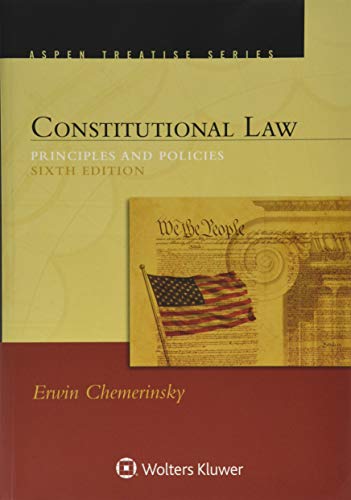
Study Aid Spotlight- Constitutional Law: Principles and Policies (Chemerinsky)

by Meri Elkin

In this second-ever Study Aid Spotlight, 3LP Meri Elkin takes a look at Erwin Chemerinsky’s celebrated Con Law hornbook.

Hanish Patel boasts that the #1 study aid of all time is CivPro E&E, and it very well may be … if you are a 1L. But tell me 2L’s and 3L’s, how frequently are you picking up CivPro supplements these days? And although Prof. Fowke recently made a case for Getting to Maybe—a study aid focused on exam skills rather than any one subject area—he was too quick to dismiss the the depth and versatility that comes with taking a single-subject focus.

So, I am here to make my case that the all-time best study aid is actually Erwin Chemerinsky’s Constitutional Law: Principles and Policies. Beyond Con Law I and II, there are so many electives that touch on constitutional law. So. Many. Electives.

Don’t let the size of this 1,439-page supplement scare you. With a table of contents and a case index, this study aid is easy to navigate. More than that, it breaks down constitutional law into twelve chapters and easily digestible subsections.

For example, §5.3 tackles the Dormant Commerce Clause in 36 pages, starting with a brief definition, and then covering everything from policy justifications to an in-depth analysis of the modern approach to exceptions. Throughout, the author guides us along with incredibly useful headers, making it easy to get to the relevant sections for your classes.

Professor Chemerinsky’s goal was to write “the most thorough” 1,400-page constitutional law supplement possible. Although it does not cover the entirety of constitutional law, this amazing study aid provides some essential clarity for most of the topics students will encounter in their courses. And it’s these clear explanations that will ultimately keep students coming back, class after class.

For a panoply of study aid-related pro-tips (w/ a side of well-crafted verse), check out this classic post. And if you need to efficiently locate the perfect study aid in the perfect format, the library’s got you covered.

Dear My 1L Self- Shheeeeeesh

Hello, reader. You’ve happened upon “Dear My 1L Self.” Have you heard of this epic library blog series? Wherein law librarians, 2Ls/3Ls, and other intriguing interlocutors engage in anachronistic correspondence w/ their 1L selves? Wherein said correspondence dispenses sage advice that readers would do well to take under advisement? In today’s wise & witty epistle, Reference GRA Colin Daniels addresses his 1L self…

Dear 1L Colin,

I’ve got good news and sad news from the future. First the bad. By your 2L year, law school professors acquire technology that enables them to target a live cold call at any student anywhere on earth—Zoom. On the bright side, I can help you get by as a 1L.

Let’s start with suggestions. The Library’s VIP study rooms have outlets and beautiful marble-white whiteboard walls. Fill a study room with reliable people who keep motivate each other. Take notes and stick to a consistent study plan. There’s a lot of information to track over a semester. It’s a marathon, not a sprint.

Because law school is a marathon, you need to remember you’re a human being with physical limitations. Go through the syllabi at the beginning of the year and stick deadlines into a calendar. Then schedule time well in advance of due dates to work on projects. While you can spend a forty-eight hour period furiously writing a 1L foundations paper, you never want to turn in the first draft of anything you’ve written.

More importantly, you’re going to miss a lot of mistakes if you’re sleep deprived. Just schedule your time instead so you can make slow and steady progress on assignments. Your body and your GPA will thank you.

You’re going to make mistakes. Your biggest is not writing practice exams. Yes, they’re exhausting when many things demand your time. Don’t wait to start writing practice exams until you have a perfect outline (because it’ll never be perfect). Ultimately, 1L Colin, because you don’t take any practice contracts exams, your final exam reads like the next paragraph.

Buy a printer. Take half-days on Friday. Meet other students. It’s not a competition. Watch trashy reality TV occasionally (or frequently). Learn about bird law. Go meet a professor during office hours. Use a watch and a calendar. Get a free lunch (and learn something) at meetings and events. Take a mindfulness seminar. Read the career services emails. Borrow whiteboard markers from the library. Look into GRA positions for experience and a tuition discount. Interviewers care about personality, so don’t forget about the hobbies and interests that make you an interesting person.

Good luck, and don’t worry too much. You can always try for Tik Tok fame.

Shheeeeeesh,

3L Colin

Dear My 1L Self- Do Not Believe Them.

The GSU College of Law Library is excited to post another exciting installment of “Dear My 1L Self.” In this series, Librarians, Law Library GRAs, Law Students, and other interesting folks write actual, time-traveling letters to their 1L selves, giving them advice and telling them what to expect from law school and the practice of law. We hope that some of this advice will be helpful for our readers. Today, we’ve got an inspiring message from Class of ’19 Grad (and Seyfarth Shaw Associate) Zain Haq…

Dear 1L Zain:

Don’t believe everything law school tells you. Well…okay, that might be a bit of an exaggeration, but it is still generally pretty good advice. Throughout your three years in law school, a big to-do will be made about the “right” or “proper” path to take in order to end up where you want to be. Your future self is here to remind you about the old cliché: There is no one path to success.

Not that your future self is per se successful yet (sorry to disappoint). BUT, you are striving for it. And, if I may be so bold, you’re well on your way. But you’ll realize throughout your journey that despite what you hear in law school, there are SO MANY ways to get to where you want to go.

Over the next three years, you’ll probably hear that in order to work for certain firms, you’ll have to participate in specific law school activities. Wrong. You’ll also probably hear that, in order to prepare yourself well for your first year of practice, you’ll have to summer at certain places. Also wrong. While the traditional paths law school talks about may work well for some people, it is not the only way to get to where you want to go. And, let’s face it, doing things the old-fashioned way has never really been your style.

Here’s my advice to you, young grasshopper: keep an open mind and listen to the advice law school gives you. It is good advice. But, spoiler alert, there is more than one right way of doing things, and you won’t follow the route law school lays out for you. And that is okay. Try new things, be open minded, and go after new experiences because they sound interesting and will make you happy, not because they promise a certain end result. At the end of the day, do it your way (cue Frank Sinatra).

Zain

Dear My 1L Self- You Earned Your Spot!

The GSU College of Law Library is excited to post another exciting installment of “Dear My 1L Self.” In this series, Librarians, Law Library GRAs, Law Students, and other interesting folks write actual, time-traveling letters to their 1L selves, giving them advice and telling them what to expect from law school and the practice of law. We hope that some of this advice will be helpful for our readers. Today, we’ve got an uplifting missive from 2L (and Urban Fellow) Liliana Esquivel…

Dear 1L Liliana:

First, be confident and don’t overthink things. The more you second guess yourself, the harder this journey will be. You made it in, you earned your spot! So, speak up when you know the answer or don’t understand something. You assume everyone else knows what’s going on, but the opposite is true: no one knows what’s going on. So, breathe and be open to talk more to the people around you; they know what you are going through.

When it comes to those really difficult cases, read them three times. Look for the arguments when you read a case, and always, always, always outline. You will find that what works best for you is handwriting your outline and then typing it up before class, so that it’s fresh in your mind. It’s also important to stick to your schedule and tell people no when you need those days to yourself. It’s ok to need alone time.

Later in your law school career, you’ll discover that the entire GSU Law community is extremely proud of you! But it might help to know now that you really do have a group of people who support you and root for you, so that you don’t feel alone. When you are overwhelmed, take it one task at a time, and little by little, you’ll get through it. I believe in you.

Best wishes,

Liliana Esquivel (2L version)

Dear My 1L Self- Find your Formula for Success

The GSU College of Law Library is excited to post this 5th installment of “Dear My 1L Self.” In this series, Librarians, Law Library GRAs, Law Students, and other interesting folks write actual letters to their 1L selves giving them advice and telling them what to expect from law school and the practice of law. We hope that some of this advice will be transferable to our readers, and show that even the most experienced of us have made a lot of mistakes. Today, we’ve got a dispatch from (and to) 3LP (and Law Library GRA) T.C. Deveau…

Dear My 1L Self,

Work smarter, not harder.

Your 3LP self recently read a twitter feed proffering advice to 1L’s and rising 1L’s that went something along the lines of “you should be working every minute you’re not in class, sleeping, or eating.”  This is terrible advice.

Do not put in work simply for the sake of putting in work.  This is especially true if you are a non-traditional student with other obligations outside of the classroom.  Just like sleeping with a book next to your head won’t help you learn, grinding for the sake of grinding won’t help you in the long run. Law School is a marathon, and you don’t want to burn out by sprinting from the starting line.

Every student is different and there is no “catch all” approach to being successful.  Everyone has their own formula for success.  Don’t forget to take a step back and figure out what is working for you and what isn’t.  Figure out your formula. 

Take those casebooks outdoors!

If you grasp a topic easily, think about why that might be – was it simple, or was there some way you learned or approached the material that aided your understanding?  Was there a teaching style the professor or course material used that helped you out?  When you run up against a weakness, how will you address it?  Should you read an additional 20 cases on the same topic with different fact patterns, or can you apply the approaches you took to subject matter you mastered to your weak spots and get there quicker?  Is there a resource at GSU that may aid your understanding without hitting your head against the wall too many times?

Don’t reinvent the wheel.  Take advantage of the resources GSU has to offer.  Professors and GRAs always make themselves available.  Campus organizations maintain wonderful outline banks for the benefit of younger students to supplement their own notes and outlines.  The Law Library maintains an extensive study aid collection that is freely available to existing GSU students (can be found here: https://libguides.law.gsu.edu/studyaidfinder).  Alumni are plentiful in the Atlanta law community and almost always willing and available to help mentor.  Finally, your peers are always there to help out, and the GSU COL student body is widely supportive of one another.  Study groups are your friend. 

You made it to law school.  You are driven.  You are bright.  You are insightful.  Use that insight and be introspective.  Take note of your strengths.  Take note of your weaknesses and come up with a plan to tackle them.  You will finish law school and pass the bar.  You got this.

-Todd (a.k.a. “T.C.”) Deveau, Ph.D.

GSU COL 3LP