The Art of Persuasion

by Joshua Kahn

logos_flickr_user_x1brett

image by Flickr user x1brett

Spring semester means it’s time to for first years to write persuasive briefs for RWA and second years to craft oral arguments in Litigation.  Both require a heaping cup of persuasive ability, a skill that is totally different from simply knowing the law.  Not only that, but persuasion is one of the cornerstone skills for practicing attorneys.

Clearly, we’ve chosen a profession that demands persuasiveness—but that’s a skill they don’t teach you in Torts, Evidence or CivPro.  RWA shows you some examples of persuasive legal writing, and litigation throws you right into the pool, but neither really breaks down how to make a convincing argument.

So where can you learn how to communicate persuasively?  If you weren’t born with a silver tongue can you pick up the skill?

The GSU library system has a number of helpful tools for learning persuasion.  Even if you don’t have time to read them now, consider at least placing them on your summer reading list:

The Art of Rhetoric by Aristotlethe classic work on persuasion and still deeply relevant today.  The law library has a translation at PA3893 .R3 1991

Thank You for Arguing : What Aristotle, Lincoln, and Homer Simpson Can Teach Us About the Art of Persuasion – an excellent guide to the various tools of persuasion that essentially teaches classic rhetoric in a conversational, modern tone.

How to Win Every Argument : The Use and Abuse of Logic – a good guide to the various smoke and mirrors you often hear in arguments.

John Quincy Adams: Lectures on Rhetoric and Oratory: Delivered to the Classes of Senior and Junior Sophisters in Harvard University (1810) – A series of classes by given by John Quincy Adams a decade before he was elected President of the United States.  They’re considered a classic guide to persuasion and are online for free here.
The State of Presidential Statements

state_of_the_union_flickr_user_barackobamadotcom

Image Creative Commons licensed from Barack Obama’s Flickr account

Last night, President Obama delivered the annual State of the Union address. Today, a transcript of that speech is available in the Congressional Record. Speeches made to a Joint Session of Congress are not the only presidential statements you can find on the Government Printing Office’s website, FDsys. The GPO website also hosts the Compilation of Presidential Documents collection. The Compilation used to be published once a week, but with President Obama’s inauguration in 2009, it became a daily publication. In this collection, you can find all kinds of documents, from the President’s Weekly Address to commemorative statements about historical acts or historical events to proclamations honoring national heroes.

You can access the Compilation of Presidential Documents going back to 1993 on the GPO website — and you may be interested to note that the first item available is actually a statement made by a press secretary, noting the US’s recognition of the new Czech and Slovak republics.

Library Policies- not all that bad

Mentalfloss.com, online purveyors in bizarre, quirky, and nerdy trivia, recently published an interesting library-themed blog list – 9 Very Specific Rules From Real Libraries.

Looking beyond the unimaginative stock photo of a bun-sporting, cardigan-draped,  grandma frames-spectacled, corrective shoes-hobbled,  and eternally shush-ing librarian stereotype that alerts the reader, “this post is about libraries and the author is too lazy to move beyond an outdated and trite sitcom convention”

come on mental_floss, you are better than that

the post makes a good, albeit unintended,  point.

Libraries and particularly smaller, specialized libraries like ours often create policies that at first glance may seem silly or annoying, but are necessary to ensure welcoming and comfortable space as well as reliable resources for group and individual study and research.

I am linking below to a list of policies governing patrons use of the Law Library.  Each of these polices was created with the best of intentions to better support you and your fellow researchers.  As always we welcome your questions and ideas on how better to do so -including sunsetting outdated or irrelevant policies (or heaven forbid, the creation of new ones).

Law Library Policies: http://law.gsu.edu/library/2047.html

A Century of Lawmaking for a New Nation

constitution-signingBy Meghan Starr

If you are researching the legislative history of an early American bill or trying to ascertain original intent, the Library of Congress has a website called A Century of Lawmaking for a New Nation that focuses on U.S. Congressional documents from 1774-1875.

One focus of the website is Debates of Congress.  This section contains four separate journals.  Each can be browsed by volume, by page heading/speech title, or you can run a search for a specific term or phrase.  The site also contains a Citation Guide and a historical timeline.

Annals of Congress

Researching the Louisiana Purchase or the treaties with the Creek and Cherokee?

Formally known as The Debates and Proceedings in the Congress of the United States, the Annals cover the 1st Congress through the first session of the 18th Congress, from 1789 to 1824.  They were actually compiled between 1834 and 1856 using records and newspaper accounts to paraphrase the speeches.  It is considered to be a fuller record than the House and Senate Journals from that period.

The debates over expanding the railroads or renewing the charter for the Bank of the United States can be found in the Register of Debates.  This journal runs from the second session of the 18th Congress through the first session of the 25th Congress (1824-37).

Although published contemporaneously with the proceedings, the journal provides a summary of “leading debates and incidents” of the period rather than a verbatim record.

Each volume has an index, but you can also use the indexes of the House and Senate Journals during the relevant session of Congress to find the date you are looking for, then search by the date in the Register.

Look for speeches to impeach Andrew Johnson and abolition petitions in the Globe which covers congressional speeches from 1833-73 (23rd Congress through 42nd Congress).

The first five volumes overlap with the Register of Debates.  While initially containing an abstract of the debates, by the 32nd Congress (1851) the Globe has more of a verbatim transcription.

The Congressional Record, printed by the Government Printing Office beginning in 1873, is the final publication of debates of Congress.  While this website only provides debates up to 1875, more recent versions can be found on the Library of Congress’ THOMAS website.

Fixing the Beautiful Game

soccer big

Flicker photo by stevendepolo

While a steroid controversy has embroiled two of America’s favorite sports, football and baseball, Europe’s favorite sport soccer has been plagued by a different culprit: match-fixing.

Match-fixing occurs when a match is played to an already pre-determined outcome.  Gambling syndicates and organized crime are often to blame for influencing the outcome of these matches for purposes of sports betting.

Europol, the European Union’s agency that handles criminal intelligence, recently reported that they have deemed suspicious a total of 380 soccer matches played in Europe.  Furthermore, Europol identified 425 corrupt officials, players, and serious criminals involved with match-fixing, spanning across 15 different countries.   Europol even believes some of the matches implicated were World Cup qualifying matches and UEFA Champions League matches, arguably the most prestigious competitions in all of world soccer.  The investigators estimate that the criminals made around €8 million – with the highest bribe coming in at €140,000.

It’s not clear how this will affect fans’ perception of soccer, but it will seriously undermine the integrity of the game, much like steroids have in baseball and football.

For more information on the current match-fixing scandal plaguing European soccer, check out the following articles:

Library Abridged Returns on Monday

Library Abridged LogoYou look like you could use a cookie. Maybe some free coffee. Sound good? Then plan to join us for Library Abridged starting on Monday! Each week between Feb. 4 and Spring Break, you’ll find librarians out in the first floor lobby to offer you free snacks and lots of good information. We’ll be letting you in on several new things this semester, including a Library Rewards program. Look for us during these times:

Mondays: 10-11 a.m.

Wednesdays: 4:30-5:30 p.m.

The full schedule and list of topics is available on our website.

Flashcards

Flicker photo by HeatherMG

Flicker photo by HeatherMG

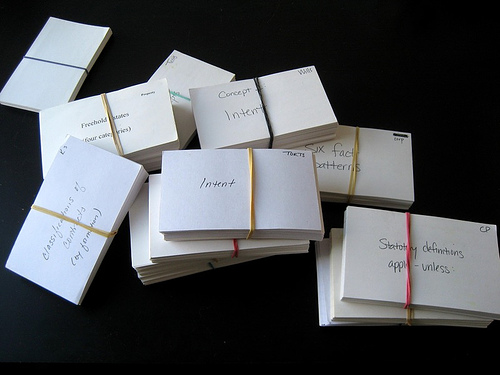
Even though exams are a couple of months away, it is never too early to start studying a little.  When studying, many law students find flashcards useful for memorizing essential definitions, factors, and elements for their courses.  While some people make their own flashcards, others turn to commercial flashcards.  While these can be very helpful, they can also be fairly expensive ($39-$59 per set) if you purchase them for several different subjects.

To help alleviate the burden on your already stretched wallet, the Law Library keeps several sets of Wolters Kluwer’s “Law in a Flash” flashcards on the Law Library Reserve, located behind the Circulation Desk.  As with each of the reserve items, students can check out the flashcards for 3 hours at a time.

Currently, you can check out the following sets from the Law Library:

  • Administrative Law
  • Civil Procedure, Part 1 & 2
  • Contracts
  • Constitutional Law, Part 1 (National and State Powers) & Part 2 (Individual Rights)
  • Corporations & Other Business Entities
  • Criminal Law
  • Criminal Procedure
  • Environmental Law
  • Future Interests
  • Professional Responsibility/MPRE, Part 1 & 2
  • Real Property

Check to see if Flashcards are available on reserve

Law-Related Apps

congressWhether you got a new tablet over the winter break, or if you’ve finally broken free of that cell phone contract to get something new, you may be wondering what mobile apps are available to make your life a little easier as a law student.  From straightforward legal research apps like WestlawNext or Lexis Advance to notetaking software like Evernote, the good news is that there are a lot available. The library has both created an online list of apps that may be of use to you and featured apps in one of last Spring’s Library Abridged sessions. Some favorites around the library include:

  • 30/30 – A timed task manager [iOS]
  • WestlawNext – now available for both iOS and Android systems
  • Google Drive – recently updated with increased functionality [iOS & Android], and
  • Flipboard – an attractive news aggregator [iOS & Android]

If you ever have questions about an app, you can always ask at the Reference Desk.

Fifty-Seventh Presidential Inauguration

barack-obama-inauguration-speechOn Monday, January 21, 2013 the nation will celebrate the Fifty-Seventh Presidential Inauguration.  For over 200 years the United States has celebrated the quadrennial swearing-in of the President and Vice President.  This year is significant because it is only the seventh time that the constitutionally mandated Inauguration date has fallen on a Sunday.

The 20th Amendment changed the inauguration date from March 4th to January 20th.  Generally, on years when January 20th falls on a Sunday, the White House holds a private ceremony on January 20th and then a public ceremony on Monday, January 21st.

Don’t worry if you are not making the trek up to Washington, D.C. this year to see the ceremony in person.   Several of the major networks will be providing live coverage on television and online streaming (Story:  How to watch Obama’s inauguration online).

For more information on the Fifty-Seventh Presidential Inauguration, check out the official Inauguration website.   For more general information, check out the following books located in the University and Law Libraries:

Where Have All the Study Aids Gone?

study aidsWelcome back! We hope you all had a relaxing and enjoyable winter break.

We also wanted to give you a heads up that a few things have moved in the library. The Study Aids collection has swapped places with the Reference collection, so you’ll now find E&Es, Nutshells, and the rest along the wall in the tall shelves rather than in the half-height shelves. By that same token, if you desperately need to look at a volume of the 1992 Encyclopædia Britannica, you’ll find them where the study aids used to be.

One other change is that the Leisure Collection has also moved out to this same area. Now that complete set of The Wire is even more tempting. You’re welcome.