ALERT (Applied Legal Experience, Research, & Technology) is a non-credit program that provides law students additional opportunities outside of the College of Law’s curriculum to learn legal research and technology skills.
By completing the ALERT Program, students can demonstrate to potential employers that they have obtained practice ready skills. Students will have their entire law school term to complete the program.
Levels of Completion:
With Distinction: Complete 6 Topics With High Distinction: Complete 8 Topics With Highest Distinction: Complete 10 Topics
I know, I know. You’re sick of reading. I get it. But, remember when reading wasn’t stressful? Remember reading for fun, when forgetting a key piece of information was only a mild annoyance that interrupted the flow of your book instead of the difference between a B+ and an A-? I do (probably because I haven’t been a law student for a decade) and I think you should too.
In light of our new, lighter approach to reading, the law librarians thought you could use a few fun, interesting, enjoyable books for winter break. No, these won’t be on the exam.
Books held by Georgia State hyperlink to the GilFind Catalog. Books available in online format are indicated.
A struggling novelist travels the world to avoid an awkward wedding in this hilarious Pulitzer Prize-winning novel full of “arresting lyricism and beauty.”
Pulitzer Prize-winning poet Mary Oliver presents a personal selection of her best work in this definitive collection spanning more than five decades of her esteemed literary career.
The Wolf in the Whale by Jordanna Max Brodsky
A sweeping tale of clashing cultures, warring gods, and forbidden love: In 1000 AD, a young Inuit shaman and a Viking warrior become unwilling allies as war breaks out between their peoples and their gods-one that will determine the fate of them all.
In Underland, Robert Macfarlane delivers an epic exploration of the Earth’s underworlds as they exist in myth, literature, memory, and the land itself. Traveling through the dizzying expanse of geologic time—from prehistoric art in Norwegian sea caves, to the blue depths of the Greenland ice cap, to a deep-sunk “hiding place” where nuclear waste will be stored for 100,000 years to come—Underland takes us on an extraordinary journey into our relationship with darkness, burial, and what lies beneath the surface of both place and mind.
Riot Baby by Tochi Onyebuchi
Rooted in foundational loss and the hope that can live in anger, Riot Baby is both a global dystopian narrative an intimate family story with quietly devastating things to say about love, fury, and the black American experience.
The author presents real-life examples and the latest research on how straight talk about racial identities is essential to facilitate communication across racial and ethnic divides. It helps readers to figure out where to start the conversation.
Rediscover the thrills, grandeur, and unabashed fun of the Greek myths—stylishly retold by Stephen Fry. This legendary writer, actor, and comedian breathes new life into beloved tales. From Persephone’s pomegranate seeds to Prometheus’s fire, from devious divine schemes to immortal love affairs, Fry draws out the humor and pathos in each story and reveals its relevance for our own time. Illustrated throughout with classical art inspired by the myths, this gorgeous volume invites you to explore a captivating world, with a brilliant storyteller as your guide.
Springfield Confidential: Jokes, Secrets, and Outright Lies from a Lifetime Writing for The Simpsons by Mike Reiss (Forward by Judd Apatow).
I really don’t feel like this book needs a description.
Patrick Parsons
Levon: From Down in the Delta to the Birth of The Band and Beyond by Sandra B. Tooze
Not available in the library. Email me at pparsons@gsu.edu to borrow my copy. It’s awesome.
He sang the anthems of a generation: “The Weight,” “Up on Cripple Creek,” and “Life Is a Carnival.” Levon Helm’s story––told here through sweeping research and interviews with close friends and fellow musicians––is the rollicking story of American popular music itself.
Get ready for one of America’s great untold stories: the true saga of the Louvin Brothers, a mid-century Southern gothic Cain and Abel and one of the greatest country duos of all time. The Los Angeles Times called them “the most influential harmony team in the history of country music,” but Emmylou Harris may have hit closer to the heart of the matter, saying “there was something scary and washed in the blood about the sound of the Louvin Brothers.” For readers of Johnny Cash’s irresistible autobiography and Merle Haggard’s My House of Memories, no country music library will be complete without this raw and powerful story of the duo that everyone from Dolly Parton to Gram Parsons described as their favorites: the Louvin Brothers.
Meg Butler
Not Buying It: My Year Without Shopping by Judith Levine
Shocked by the commerce in everything from pet cloning to patriotism, frightened by the downward spiral of her finances and that of the trash-strewn earth, Judith Levine enlists her partner, Paul, in a radical experiment: to forgo all but the most necessary purchases for an entire year.
A website eschewing the philosophy “managing your money wisely enables you to pursue unusual aspirations and opens up a world of options for how to live your life.”
The winner will be labeled the GSU Law Library Trivia Master and will be featured on the Law Library’s digital displays.
Pet Pics Display:
Pictures of students, faculty, staff, and their pets are on display via the private link sent to you in the most recent personal librarian email. Please reach out to us if you need access to it. These images are also being displayed on the law library digital signage. You can still get your pet added to the display by emailing Gerard Fowke at gfowke@gsu.edu.
As a reminder, we will be open to the GSU Law community for normal Fall 2020 hours through the end of the exam period, December 16th.
Good luck on finals! Reach out to us if you need assistance, research-based or otherwise.
Congratulations! You have almost made it through your first semester of law school. I remember how overwhelmed I felt at this point in my first semester. Is my outline sufficient? How do I begin studying for finals? Do I even understand the material? I was able to ask these questions to my peers in person, and I cannot imagine the difficulties of a 1L semester that is mostly online. The Law Library is here to help.
Consider study aids a multi-tool in your law school toolkit. They include hypotheticals of all lengths for exam prep, multiple-choice questions to check your knowledge of concepts, and, most importantly, summaries of cases and concepts. Some of your professors may have included suggested study aids in your syllabus. If not, the Law Library has compiled a list of useful sources for you as you enter exam season.
Resources for Comprehension
You may find yourself struggling to understand the legal concepts you learned back in August, or even last week, as you prepare for exams. Many study aids provide clear and concise summaries of the material. Here are a few of the best resources to help comprehend legal concepts:
Having a thorough outline ready for exams is important, but an outline is most useful when used as a reference and not a crutch. Testing your knowledge as you prepare your outline is a helpful way to ensure your exam time is spent creating a thoughtful analysis as opposed to researching rules. The more hypos you practice, the more prepared you will be for the exam. Here are a few of the best resources to test your knowledge:
You may have been thinking about it all semester, but after Halloween, the feeling that something spooky lurks in the future lingers…law school exams. This time coincides with the holiday season, which for many means disrupted routines and extra tasks or responsibilities, not to mention economic stress. This year, we have the added bonus of uncertainty associated with the global pandemic.
In light of all that, perhaps you would like to extend your knowledge about mental health resources available on campus?
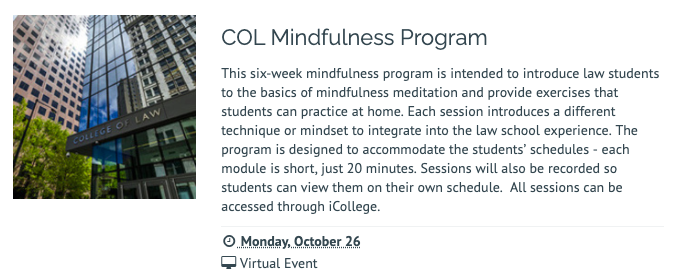
The College of Law Mindfulness Program may be one resource of interest. A six-week program, the sessions provide basics about mindfulness meditation and opportunities to practice. The program is set to be accessed on your own schedule.
Another obvious place to start is with the resources available through the Counseling & Testing Center. The Center is open, and wellness programs are virtual.
But don’t fear! The Law Library has resources to support you too. It may be that you can minimize your exam stress by consulting tools like those found in our online study aids collection.
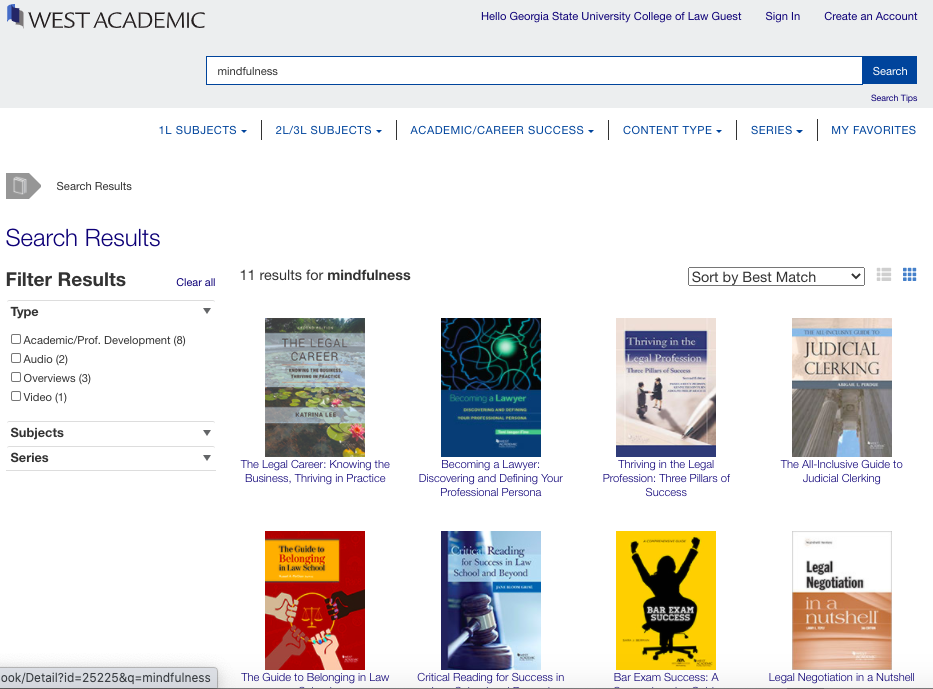
We have online access to some other titles. For example, Stress at Work Management and Prevention is easily available and offers an overview of stress and how it functions as well as coping strategies. There are a bunch of online books about mindfulness, and you can review the results of this library search to pick the book of your choice. If you’d prefer to change the focus and search for lawyer and anxiety or depression, there are also some books you might find of interest.
If you haven’t heard it before, you can remember that you heard it here: taking care of your mental health will only help you as you work your way through law school and your future career path.
Imagine this. You’re a New York City real estate developer. You just married your second wife, an interior designer, and are looking to get out of the big city and experience some country life. Your real estate agent finds exactly the perfect house in Wind River, Connecticut (not a real place upon further inspection.) However, the current owners have no interest in selling. Strangely the day after throwing your agent out of the house, the current owners drove off of a bridge and died. You immediately swipe in and buy the Connecticut property, and move your daughter, wife, and wife’s interior designer friend Otho into the house. Your wife immediately starts to remodel the home to give it a more modern esthetic, because, that’s what she does.
However, weird things start happening. One day while eating lunch, everyone present, as if they could read each other’s minds, starts in on what seems to be a well-rehearsed and well-coordinated version the Harry Belafonte’s Banana Boat Song (Day-O.) While it was really well done, and quite a bit of fun, it seemed strange because no one in your family really likes calypso music or is a particularly good singer. Strange. Then, you hear your daughter, who admittedly has always been a bit eccentric, having conversations with people in the attic. Upon inspection, you find a strange model town and an even stranger book titled Handbook for the Recently Deceased. Interior designer Otho has always been into these types of things, so he tries to have a séance as described in the book. Before you know it, you have a couple of decaying ghosts floating above your kitchen table, your daughter dressed in an old-timey wedding dress, and this guy Beatleguise transforming into a purple and black snake. Even though you always preferred Michael Keaton’s batman to all the others, this situation is less than ideal, and you’d really like to get your money back and return this ridiculous house.
Of course, this is the plot of the cult classic ghost movie Beatlejuice from a different perspective. But, this is a legitimate legal question that has been addressed by state legislatures and courts alike – are there remedies for homebuyers who buy haunted houses? There are causes of actions for purposefully hidden defects like plumbing and electrical issues, so why not ghosts?
Unfortunately, in terms of legal remedies, the Deetz family is probably out of luck. Connecticut has enacted a set of statutes sometimes called the “Ghostbuster Laws[1].” These laws specifically state that the existence of a nonmaterial fact need not be disclosed in a real estate sale and that “no cause of action shall arise for the failure to disclose a nonmaterial fact[2].” Moreover, the law defines “nonmaterial fact” as the fact that a property has been infected with diseases or was at any time suspected to have been the site of a death or felony[3]. Disclosure must only be made if asked for by the purchaser.[4] While the statutes do not specifically mention hauntings, Connecticut law seems to focus much more on whether any nondisclosed acts had any physical effects on the house. So long as the sandworms didn’t smash big holes in the floor (which they ended up doing in the movie), the Deetz family is probably out of luck.
But, what about Georgia? If the Deetz’s house was in, say, Stone Mountain Georgia, they’d probably have a similar result. Unfortunately, Georgia and the rest of the country handle hauntings disclosure in much the same way. Similar to the Connecticut law, the Georgia Stigmatized Property Act states that no cause of action shall arise for failure to disclose if the property was occupied by a person with a disease or the site of a homicide unless specifically asked[5]. If states speak on this type of disclosure, this is the majority approach[6].
Hope is not lost, though, for haunted house owners countrywide. In Stambovsky v. Ackley, the New York Appeals Court did hold that when a house seller failed to disclose her belief that a house was haunted by a poltergeist, the buyer could rescind the contract of sale but not receive money damages[7].
In conclusion, US law seems to favor a more “Casper the Friendly Ghost” than a “suck you into the tv Poltergeist” approach. State statutes typically only require physical defect disclosures and typically don’t require sellers to disclose known hauntings, past murders, or diseases. So, if you’re anywhere but New York state, make sure to specifically ask your seller if the house is haunted. If you’re in the right state, they’ll have to disclose. Otherwise, you had better hope that your ghost is the Casper type, because beyond reselling, you’re probably stuck with your house and all your new paranormal friends.
[1] So characterized in Robinson v. Parillo, 1999 WL 240735 (Conn. Super. Ct. 1999)
Waterskiing Uncle Sam by Jefferson National Expansion Memorial
As we near the end of the US Presidential race, elections have taken center stage in the American consciousness. Headlines about recounts and possible non-concession have brought back memories of the Bush-Gore legal battles over Florida and a general re-interest in election law. But, where exactly does election law come from? While the nuts and bolts of the actual elections are left to the states, the United States Code lays out a very particular, partly unknown, and maybe even esoteric set of steps required to elect the President of the United States. So, come with me on an educational and entertaining journey through Title 3, sections 1-20 of the US code. Make sure to hold on to your hats- things might get weird.
3 U.S.C. § 1 – Time of appointing electors
This is straightforward, mostly. The states appoint their electors, the people who actually elect the president, on the “Tuesday after the next Monday in November” following the presidential election. Yes, you read that right. States don’t even pick their electors until after the election. Contrary to popular belief, the citizens of the US do not actually elect the president, electors do. Each state decides how the vote of their citizens effects the votes of the electors. Typically, the electors select whichever candidate wins the state. However, Nebraska and Maine election laws allow the states to split their electoral votes proportionally according to the popular vote.
3 U.S.C. § 2 – Failure to make a choice on proscribed day
If the state fails to choose electors on the proscribed day, the job then falls to the state legislature.
3 U.S.C. § 3 – Number of electors
This is probably the best known of the US election statutes. The states get a number of electors equal to their number of Senators and Representatives.
3 U.S.C. § 4 (2012) – Vacancies in Electoral College
States can fill any vacancies in their electors when those electors meet to actually vote.
3 U.S.C. § 5 – Determination of controversy as to appointment of electors
This one is strange. If the states choose, they can create procedures for settling any controversy in the picking of electors. However, 3 U.S.C. § 5 requires that these procedures make a determination at least six days before the state electors meet to cast their votes. Don’t want to hold up the entire US Presidential election because of a few people fighting over who gets to be their states proxy vote now, do we?
3 U.S.C. § 6 – Credentials of electors; transmission to Archivist of the United States and to Congress; public inspection
Ok, this one is a bit long, and weird. The executive of each state, typically the Governor, “as soon as practicable” must give “a certificate of ascertainment” , by certified mail, of all the state’s electors to the Archivist of the United States. If the electors are chosen by votes, the governor has to include the number of votes too. The governor must also send six duplicates of this certificate to each of the state’s electors. If there was a controversy, the Governor must also send a certificate stating the outcome of that controversy. The Archivist must keep all of these certificates for at least one year for public inspection, and give copies to both the house and senate of each and every certificate received. I’m pretty sure certificate means letter or document in “Old Timey Government English”, and this whole electoral process stems from a time when electors had more power (ie. they were less likely to listen to the state’s voters.) However, it a nice piece of election tradition as well as a reminder of American history, so, why not? Lets keep going!
3 U.S.C. § 7 (2012) – Meeting and vote of electors
Finally, an easy one. Electors shall meet and give their votes on the first Monday after the second Wednesday in December next following their appointment at such place in each State. That’s right, again. The entirety of the nation is well aware of who is going to be the president well before they are actually elected by the electors.
3 U.S.C. § 8 – Manner of Voting
Another easy one. The electors vote as directed by the constitution. We’ll save the constitution for another day.
3 U.S.C. § 9 – Certificates of votes for the President and Vice President
The electors must make and sign six certificates, with each certificate containing two lists; one for president and the other for the vice president. Yes, for each electoral vote they must provide six signed certificates. They also attach one of the lists of electors given to them by the executive of the state, or Governor, to each certificate.
3 U.S.C. § 10 – Sealing and endorsing certificates
Another easy one- they have to seal and endorse the certificates. That’s all this law says. You’d think they could have just rolled that into § 9.
3 U.S.C. § 11 – Disposition of certificates
What do they do with all these new certificates? § 11 and I are both glad you asked. The electors deliver the certificates as follows: one to the President of the Senate, one to the Secretary of the State, two to the archivist of the US, and one to the judge of the district where the electors assembled. The archivist must keep one of the copies in case the president of the senate requests it, and the other for public inspection.
3 U.S.C. § 12– Failure of certificates of electors to reach President of the Senate or Archivist of the United States; demand on State for certificate
This seems to be another section of the law that was much more important before you could pick up a phone and ask the governor; “hey! Governor! Where are all the certificates?” If the certificates fail to arrive to the President of the Senate or the Archivist by the fourth Wednesday in December, probably a week after the voting, The President of the senate should request the backup certificates from the Secretary of the State. § 12 also says that the Archivist should serve as back up, and do the requesting if the President of the Senate is absent.
3 U.S.C. § 13 – Same; demand on district judge for certificate
The reason for the six certificates, and the preference by the drafters for multiple contingency plans, is becoming more evident. If the President of the Senate or the Archivist strike out with the Governor, they then should ask the District Judge.
3 U.S.C. § 14 – Forfeiture for messenger’s neglect of duty
So you were supposed to deliver the certificates to the President of the Senate, or Archivist, and you forgot? Do not pass go. Forfeit $1000. Seriously. If you mess this up, by law, you must forfeit $1000.
3 U.S.C. § 15 – Counting electoral votes in congress
Where: The sixth day of January succeeding every meeting of the electors, The House of Representatives
Who: Congress, both houses, the whole thing.
When? 1:00 pm
What: Counting the votes. This section lays out, in tedious minutia, the rules for counting the electoral votes. This whole thing is too long to cover here, but some of the highlights are: The President of the Senate opens the envelopes. The state’s votes are counted in alphabetical order, starting with the letter “A.” As they are opened, the envelopes should be immediately handed to two previously appointed tellers. The counts are entered into both the House and Senate Journals. Objections must be made in writing, and be signed by a member of both the House and Senate. After all objections to a vote are received and read, the Senate leaves the House so each can debate independently. But, so long as the electors were correctly certified, there’s not much either body can do.
3 U.S.C.A. § 16 – Same; seats for officers and Members of two Houses in joint meeting
But where is everyone going to sit? Thank goodness, the statutes actually tell us. President of the Senate: Speakers Chair; Speaker – on the Presidents left; Senators – the hall on the Right; Representatives – anywhere the Senators are not sitting; Tellers, Secretary of Senate, Clerk of The House – at the Clerks Desk; Other various officers – in front of the Clerk’s desk and upon each side of the Speaker’s platform. This section also states that they can’t dissolve the meeting until all the votes are counted and the winner declared. They cannot take a recess unless they have some question about the votes. Even then, they cannot declare a recess beyond the next calendar day, Sunday excepted, at 10:00 “in the forenoon.” If they haven’t completed the counting by the fifth calendar day, they cannot take any more recesses.
3 U.S.C.A. § 17- Same; limit of debate in each House
If the two houses separate to decide on an objection, as per § 15, each Senator or Member can only speak for five minutes, and not more than once. The whole debate cannot go on more than two hours. Limited filibustering only.
During my 1L year, researching caselaw triggered instant anxiety. To me, conducting research was an overwhelming experience that was hard to manage. Thankfully, I was wrong. Yes, conducting research is tough, but it is manageable by taking advantage of resources made available by the library.
One invaluable resource is the library’s collection of research guides (also known as LibGuides). LibGuides essentially serve as a one-stop-shop for beginning your research process. They cover many major law school topics, including Georgia Legal Research, Criminal Law, and Legal Ethics and Professional Responsibility. Students will find links to secondary sources like major journals, treatises, and even articles.
Students will also see links to primary sources like the Georgia Code, the Federal Code, and local ordinances. What is neat about the guides is that they include tips and tricks to make research easier for you. For example, they provide direct links to secondary sources in Westlaw and LexisNexis so that researchers do not waste time trying to navigate those resources.
As everyone knows, time is of the essence in law school. Research guides include different approaches to accessing resources, including links to research institutes and links to popular blogs that monitor the trends for any given topic. For example, in the Land Use guide, students are directed to the Wayback Machine to uncover website pages that are no longer available online. These tips and tricks are just the tips of the iceberg. Research guides are full of different ways to make the research experience easier and more productive.
In addition to research material, LibGuides provide links to study materials. From evidence to tax law, students can access study aids, CALI lessons, and exam archives for each topic. The convenience of finding all the essential study aids in one location is truly a time saver.
So, the next time you find yourself overwhelmed by the research experience, take a deep breath, and visit the LibGuides on the library website!
Whether you’re a master at using Westlaw or Lexis, or are just starting your journey into legal research, there will come a time when you feel stuck or don’t even know where to begin. Researching can be difficult and time-consuming, but it doesn’t have to be!
The library has some great online resources that can help you start your research and find what you need faster. As most of our 2L and 3Ls know, whenever you get stuck, you can always come to chat with your Reference Librarian, usually at the reference desk in the library. If you haven’t noticed by the lack of puzzles on the 5th floor, the reference desk is temporarily part of the circulation desk. Now before you start panicking, thinking your librarians have abandoned you, the reference desk has gone virtual for the semester.
During the law library’s usual reference hours, you’ll be able to chat virtually with one of our reference librarians. You read that correctly. It’s not some automated A.I. response, but an actual human waiting to help you! All you need to do is go to the law library website and click on the red tab on the right side of the homepage. Just type in your question, and one of our librarians will give you an answer just like they would at the reference desk.
You may still be thinking, “I’m glad I can still talk to the librarians if I get stuck, but how do I even start my research on my own?” Thankfully, the Law Library has some great Research Guides on several topics that will help you start your research and become the most efficient researcher you can be.
From the library’s homepage, click on the box that says research guides. It will take you to a page where you can pick a topic and get a terrific guide that’ll help you plan your research strategy.
Learn more about our LibGuides in our next blog post!
The Constitution Annotated includes an explanation of the meaning of the Constitution, broken down Article by Article, Section by Section, and Clause by Clause. The explanation is direct and understandable, and it is heavily footnoted to the resources such as United States Supreme Court opinions that have historically interpreted the Constitution.
Hosted by congress.gov and prepared by the American Law Division of the Congressional Research Service, this is a HUGE resource. In print, it is over 3,000 pages! The online version has functionality that makes it even more useful. For example, you can search using simple keywords. You can filter and refine your results to focus on articles, amendments, topics, and resources.
Researchers who prefer to browse are easily able to do so.
For those who wish to review Constitution adjacent information, that is also available. The site includes a number of Tables—every researcher’s favorite! There is a Table of Laws Held Unconstitutional in Whole or in Part, a Table of Supreme Court Justices, and a Table of Supreme Court Decisions Overruled by Subsequent Decisions.
In addition to being a helpful resource to consider in beginning research on a constitutional law research problem, this website has the potential for helping a researcher identify trends in constitutional law over time. The site includes links to additional U.S. Constitutional Resources that are available through the Library of Congress.
Come by the library and visit our print copy—for today it is at the reference desk, regularly it’s located in the Reference Collection—or check it out online!






 The Blackacre Times

You must be logged in to post a comment.