One of the greatest moments of a law student’s life is starting their 3L year. This is the year we all look forward to – schoolwork slows down, applications for graduation are due, many are signing contracts for their post-graduation jobs, and more.
However, 3L is also one of the most vital years pertaining to dates and deadlines. One of the main goals of 3L is to ensure you stay on top of things. Below is a list of important dates and requirements to remember to set yourself up for success during the years and after graduation.
Sign up for and take the MPRE , if you have not already. Doing this as soon as possible allows 3Ls to have one less requirement to worry about.
Ensure you lock in bar prep. There are numerous companies one can choose from for the bar prep, such as Kaplan, Themis, and BarBri. The r/bar exam subreddit has some good discussions of test takers’ experiences with these companies. Do some research and choose the one that seems like the best fit for you.
Apply for the Bar in the state you plan to take practice in. The following information pertains to the July 2024 Bar Exam: The regular Bar Exam Application window for this exam opens on March 1, 2024 and closes on June 1, 2024 at 4:00 PM. Those that apply after June 1, 2024, but before June 15, 2024, are still able to submit. However, the application fee will include a non-refundable $500 late fee.
Complete the Fitness application. If you plan to take the July 2024 bar, you must complete the Fitness Application beforehand.. The regular Fitness Application filing window opens October 25, 2023 and closes on December 6, 2023 at 4:00 PM. You can file after this time, up until March 6, 2024. However, there will be a non-refundable $500 late fee.
Check your credits/connect with the Registrar’s office. Graduation will require that students have completed a certain amount of hours/credits. If you are unsure of where you stand, you can check with the Registrar’s office to ensure that you are on track before applying for graduation. It is best to do this in the Fall semester, just in case you need to register for additional classes in the Spring.
Network. Some will have received an offer for a post-graduation job, while others are keeping their options open. Continuing to network your 3L year, helps take some stress off of trying to find a job while studying for the bar or after taking the bar.
Enjoy yourself. Making it to 3L year is a major accomplishment. Making it to graduation is even more of a celebration. However, for those that plan to take the July 2024, your free time will be limited after graduation, as you prepare for the bar. So enjoy yourself this year, connect with classmates, friends, family, loved ones, etc. You deserve it!
All in all, 3L is exciting, but still requires a lot from students. Set yourself up for a smooth graduation and post-graduation studying!
In this new blog series, real GSU law students tell you about their legal research experiences over the summer.
This past summer, I worked at a local firm. We dealt primarily in white collar criminal law, as well as trademark infringement. The first task I was assigned to was to work on developing a memo for multiple conspiracies. Conspiracies often come in two flavors: multiple conspiracies and multiple-object conspiracies. Multiple-object conspiracies are defined by an interest in multiple objectives that may or may not support each other, but support an overall plan of action whilst multiple conspiracies are not well-related save for a figurehead or ringleader who most of the individual conspiracies are tied to.
Our objective was to illustrate how a potential defendant might be innocent of a conspiracy to commit fraud. We wanted to argue that there were multiple separate conspiracies rather than one. We also wanted to argue that the indictment was duplicitous. As pulled from Wikipedia, “duplicity is the error committed when the charge on an indictment describes two different offenses. An indictment may contain more than one count, but each count must allege only one offense, so that the defendant can know precisely what offenses he or she is accused of.” Because there are multiple conspiracies, it is possible that one of the conspiracies could be duplicitous because it did not account for the difference between the conspiracies.
My first objective was to better understand what conspiracies were. Criminal Law classes can only cover so much! Using cases provided to me by a coworker, I used the cases’ notes of decisions, headnotes, and keycites to further develop my understanding. In addition to that, I also looked at the court websites for all eleven circuits to find their jury instructions to see how they help the jury understand multiple conspiracies. They include helpful cases in their explanation and I used those as well. Unfortunately, the memo was challenging to write because conspiracies commonly exist for drug-related purposes, not for financial abuse. You don’t necessarily want to compare fraud with the distribution and manufacturing of drugs when using cases. Plus, the more similar the case, the better its utility for offensive and defensive purposes. When all was said and done, I had provided some important nuggets of wisdom, but was unable to find exactly what my attorney needed. I read hundreds of cases in pursuit of that illustrative and similar case, but, as far as I could see, it did not exist.
I learned this summer that, while there are MANY cases, sometimes the one you’re looking for just doesn’t exist. It’s totally ok that I wasn’t able to find it. Not only did I find very useful quotes and caselaw, but because I was a first-year intern, a client could have potentially paid less for my services for researching than for that of one of our attorneys. Since I could do the grunt work of sorting, analyzing, and synthesizing cases, I provided a unique benefit that no one else at the firm could, considering no one had a paralegal or another intern. It was a wonderful and insightful summer!
At the library, the beginning of the academic year is always an exciting time. Everyone is eager to meet our amazing new students and welcome back our amazing returning students, so do make sure to come visit.
New students should have met their Personal Librarian during orientation this week. Along with your Research Methods professor, your personal librarian is a great resource when learning how to navigate law school. Don’t hesitate to reach out to them if you need help with anything library-related.
Returning students should come by and let us know about any exciting legal research you did this summer. We are also always trying to provide a better environment for the law school community, so don’t hesitate to let us know how we can help you have a successful year.
Law students are usually pretty busy, so here’s a very short guide to some of our most popular services:
Study aids. Online study aids are increasingly popular, and this year we’ve added Lexis Digital Library to our offerings in this category. If you prefer print, our collection of study aids is on the 5th floor.
ALERT. Get a head start on legal research (and other topics) by attending an ALERT session. The first topic is “Approaching Your Research Problem” on Monday, 8/21 at 5:45pm (Room 345), or Wednesday, 8/23 at 3:15pm (Room 242).
Social media. Did you know that the library is active on social media? Indeed, we just started an Instagram account, and we would love for you to follow us there for all of the latest news from the library.
If you have any questions, let us know. Here’s to an exciting and fulfilling semester! We’re so glad you’re here.
As always, everyone at the law library is excited to welcome students for a new semester. At the same time, the end of the summer does have a certain bittersweet quality to it.
We always seek to create a calm and comfortable environment, but during summer, the library is often very quiet.[1] At the beginning of the summer, with the busy exam season in the rearview, I can definitely appreciate the chance to take a deep breath and relax in a peaceful environment. Of course, a few weeks in, I really start to miss the hustle and bustle of school year, but the stillness of the summer library is nonetheless worth commemorating.
As you might imagine, fewer students means fewer patrons at our reference and circulation desks. This gives the reference librarians and our hardworking circulation staff time to work on projects that might otherwise reside on the backburner. It also gives us a nice opportunity to get to know our summer “regulars,” whether they are taking courses, studying for the bar, or researching an important project for their summer job. This can make summer feel like a productive and fulfilling time, while also making me eager to meet a whole new class of amazing 1Ls, transfers, and LLMs.
Working in the law library, you get accustomed to these seasonal rhythms. The variety keeps things interesting! The quiet times also lead to more overall productivity, with better library services as a result. However, it’s worth remembering that everyone needs downtime, even attorneys and law students.
Here’s to the end of summer and the start of a new year.
[1] Do keep in mind that the 6th floor is always quiet!
We get it. If you’re taking Corporations, you may be thinking “I’ve made it this far in law school, why do I need additional assistance?”
Even if you don’t need it, per se, the Law Library wants to emphasize that these resources are still there for your enjoyment and intellectual enrichment. These resources are still invaluable for those in particular that have “too much on their plate” and need a little help.
The Study Aid Finder has a “Recommended Electives” tab for upper-level students. These courses are courses with subject matter often tested on the bar. You may not even be taking any of these courses, and may not have a course exam to prepare for, but for those 3L’s and 4LP’s, the July bar exam is right around the corner. These resources could be useful for bar prep even if you don’t have a final in these courses.
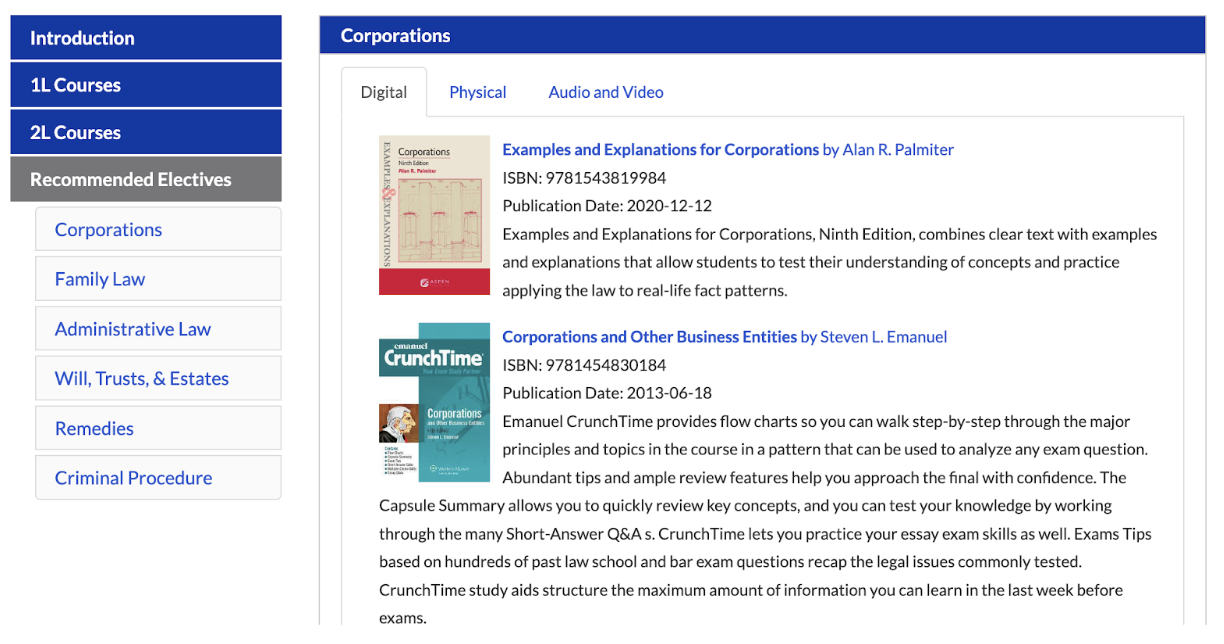
As with the other posts highlighting the Study Aid Finder, going to the menu on the left of the screen and clicking “Recommended Electives” gives a drop-down menu of various courses that are not required for graduation but often tested on the bar exam:
Clicking on “Corporations,” as with the other courses, brings you to a box with “Digital,” “Physical,” and “Audio and Video” tabs. A portion of the “Digital” tab is displayed above. We’ve previously taken a look at the Glannon guide[s] and Examples and Explanations series, so let’s look at something different this time: the Emanuel CrunchTime series.
Clicking the link brings us [again] to the Aspen Learning Library:
Unlike the other resources we’ve investigated in this blog series, there is no “read online/read offline” option – only a “View Inside” option.
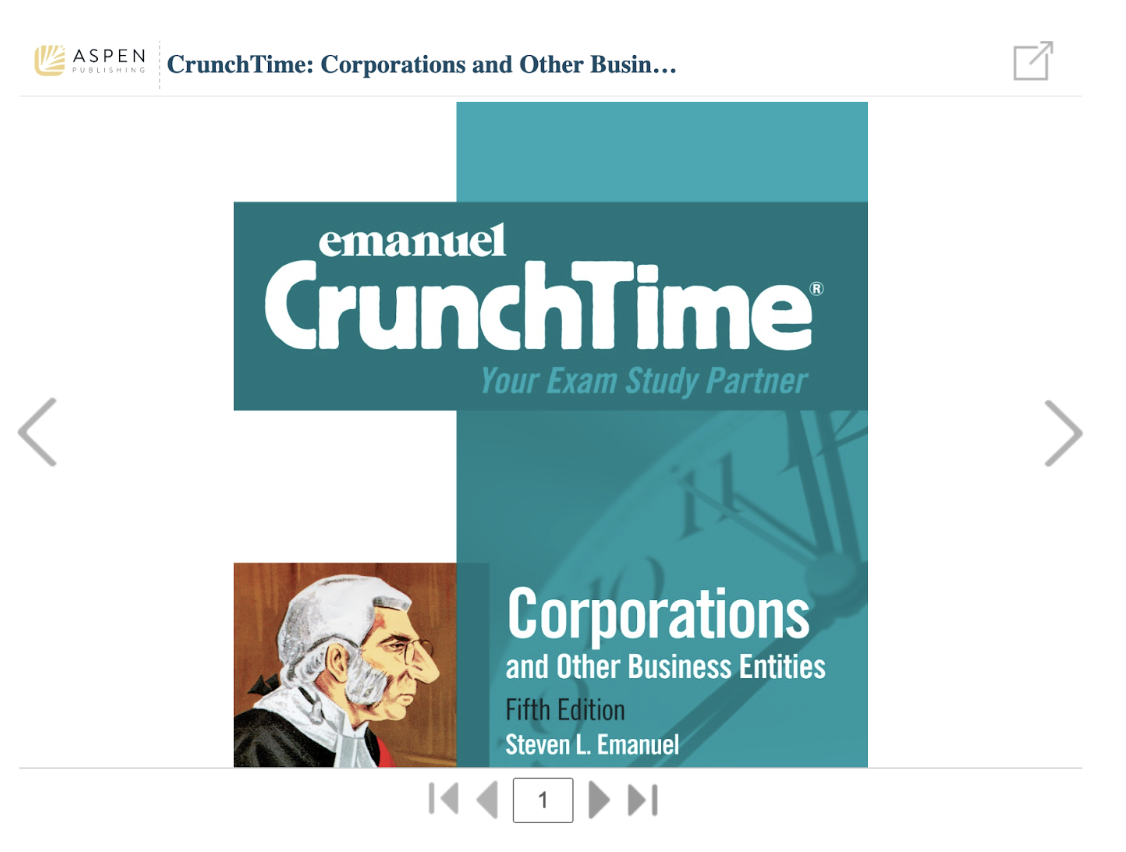
Clicking “View Inside” brings us to essentially an e-book within the browser:
Unlike the other resources we’ve evaluated in this series, the e-book options aren’t as comprehensive. There’s not a search menu button, a table of contents menu button, etc. That does not mean this resource is not valuable though.
With this resource, we are more or less limited to digitally turning the page. That’s not a bad thing though! Looking at the table of contents, this resource has a lot to offer:
As can be seen, there’s around at least 140 pages of exam questions in various formats (with explanation). This is a great way to test your application of the material, or, alternatively, a great way to learn through experience.
Clicking on the “Physical” tab brings a list of resources that are similar (some are identical) to those in the “digital” tab. These can be accessed physically in the Law Library, or the ISBN is provided and one can Google it and find a vendor-of-choice to obtain the book.
The “Audio and Video” tab has a list of resources that are, well, audio and video! These resources are not as comprehensive oand don’t provide quite the depth that other resources have, but, for those on the go, these resources provide a great opportunity for learning in traffic, in the gym, nursing a child, etc.
The amount of resources available can be overwhelming, but I’d recommend skimming a few, see which resource resonates with you, and going from there. You can’t go wrong. Happy hunting and best of luck on your upcoming exam!
In a previous post we focused on Property Law for the 1Ls, but they are not the only ones who need help!
All of you 2Ls out there likely have your Professional Responsibility final to get past before the summer. The rules of Professional Responsibility are there for a good reason. Unfortunately for us law students though, there’s a little more to them than “don’t touch your client’s money” and “communicate with your client[s].” Thankfully we have the awesome professors at GSU to help us out with these – and the amazing Law Library (and librarians and other staff and students assisting the library) to help us learn them.
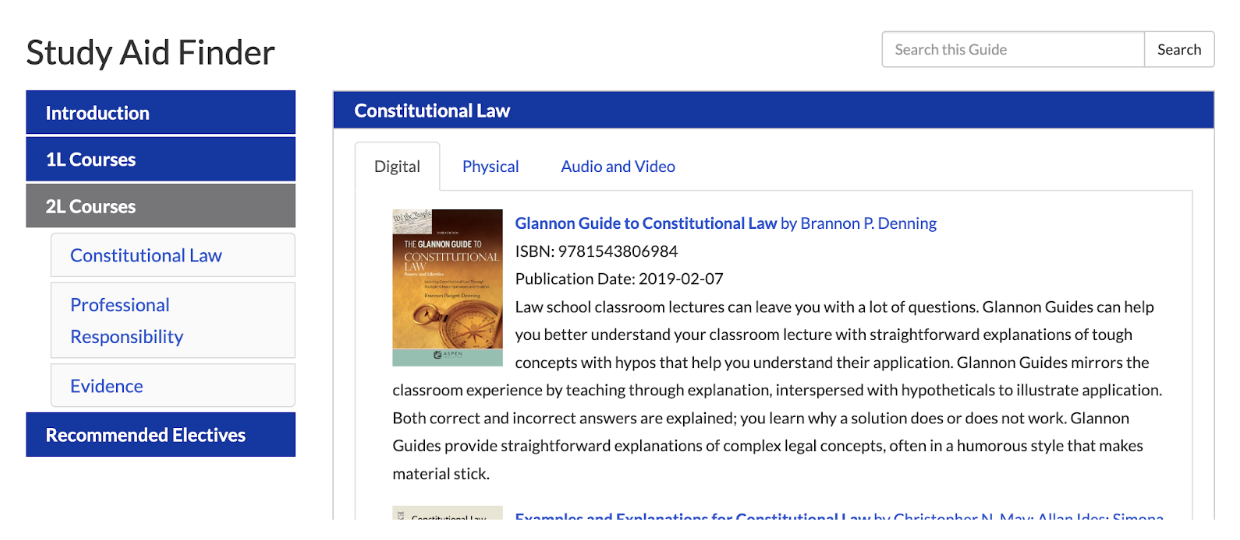
Back to the study guide – to get to Professional Responsibility, we click on the “2L Courses” tab in the left menu. This brings down a drop-down menu of selected 2L courses:
Clicking on “Professional Responsibility” will bring you to a box with digital, physical, and audio/visual resources to aid your study, just like the other courses we’ve reviewed in this blog series:
We previously took a peek at a Glannon guide, so let’s take a look at a different guide this time around.
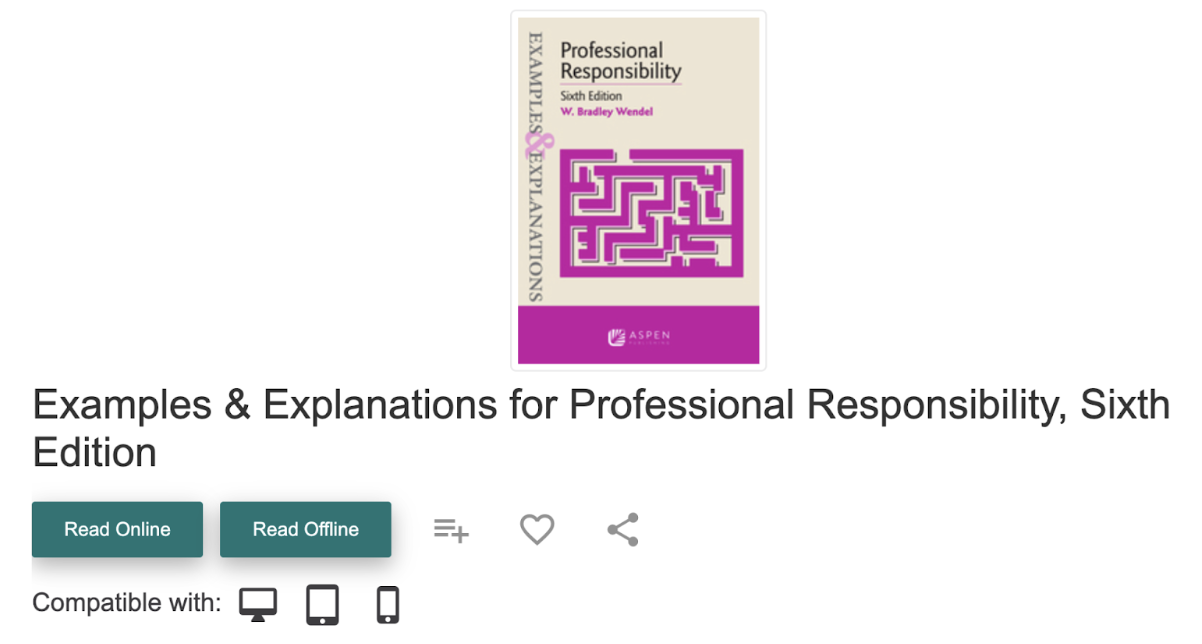
Clicking on the Examples and Explanations for Professional Responsibility (a.k.a., the “E&E” guide) again brings us to the publishers website and the Aspen Learning Library:
As you can see, it’s compatible with a variety of electronic devices (computer, tablet, phone) and can be accessed online or offline (note: offline reading must be done through the Aspen Learning Library App, available for PC/Mac/Android/iOS).
Utilizing the “Read Online” tab, you are brought to the table of contents, and from there, you can search the ToC, scroll through the ToC, etc. Chapters are broken out into the major topics (possession, gifts, title, etc.). The chapters discuss the topics generally, and provide some examples with explanations (hence “E&E”).
As this is another Aspen Learning Library resource, the interface is similar (if not identical) to that of the Glannon guide discussed previously:
Going to the “Duty of Competence” section, for example, is something that none of GSU students should have to worry about, but, you’re going to get tested on it on the final, the MPRE, and the bar. The top left icons bring one to the Aspen Learning Library and Table of Contents, respectively. The five menu buttons on the top right provide a “text to speech” function, a button for supplemental material, a full screen viewer option, a settings option (allows one to change the font size and font), and a search option. The chapter then ends with some examples. Other resources in the “digital” tab include the Glannon series, the Emmanuel crunchtime series, and others.
Clicking on the “Physical” tab brings a list of resources that are similar (some are identical) to those in the “digital” tab. These can be accessed physically in the Law Library, or the ISBN is provided and one can Google it and find a vendor-of-choice to obtain the book.
The “Audio and Video” tab has a list of resources that are, well, audio and video! These resources are not as comprehensive or have the depth of examples (a.k.a. “Hypos”) that other resources have, but, for those on the go, these resources provide a great opportunity for learning in traffic, in the gym, nursing a child, etc.
The amount of resources available can be overwhelming, but I’d recommend skimming a few, see which resource resonates with you, and go from there. You can’t go wrong. Happy hunting and best of luck on your upcoming exam!
In a previous blog post, we provided a 30,000 foot view of the Study Aid Finder that the GSU College of Law Library so kindly put together to aid your studies. The next series of blog posts will highlight certain aspects of the Study Aid Finder with the hope that it helps you take advantage of what it has to offer…and I hope you do, because who doesn’t love saving $$ by not buying resources on Amazon that the Law Library has freely available to you…AND who doesn’t like succeeding in your classes?
The 1L’s out there are only a few weeks away from completing a major milestone: the completion of the first year of law school! Definitely a cause for celebration. There are a few pesky speed bumps in the way of summer, however, one of which likely being the Property law final. Let’s take a look at the Study Aid Finder and see how it can help prepare you for the Property law final…
As noted in a previous blog post, when one goes to the Study Aid Finder, there is a menu bar on the left with 1L courses, 2L courses, and recommended electives. Clicking on the “1L Courses” bar gives a drop down menu, from which “Property” can be selected.
Clicking on the “Property” bar, you’re directed to a box with digital, physical, and audio and video resources that can help prepare you for the exam:
For a given tab, the resources are rank-ordered in an unscientific analysis of comprehensiveness, buts lets go through a few and go through the tabs of the box.
Let’s start with digital. Clicking on the “Digital” tab will display a list of resources. Let’s start with the “Glannon Guide to Property ” for no other reason than it is at the top of the list. Clicking the link may or may not bring you to a landing screen to enter your GSU network credentials (depending on whether or not you are accessing the resources from campus or off campus). After entering credentials (if needed), one is directed to the Aspen Learning Library site for the Glannon Guide:
As you can see, it’s compatible with a variety of electronic devices (computer, tablet, phone) and can be accessed online or offline (note: offline reading must be done through the Aspen Learning Library App, available for PC/Mac/Android/iOS).
Utilizing the “Read Online” tab, you are brought to the table of contents, and from there, you can search the ToC, scroll through the ToC, etc. Chapters are broken out into the major topics (possession, gifts, title, etc.). The chapters discuss the topics generally, and even provide some discussion of case law.
Looking at lost property and treasure trove (because who doesn’t like treasure??), the online viewer has a view like this:
The top left menu buttons bring you to the Aspen Learning Library (the publisher for this particular book) and a link to the table of contents, respectively. The five menu buttons on the top right provide a “text to speech” function, a button for supplemental material, a full screen viewer option, a settings option (allows one to change the font size and font), and a search option. The chapter then ends with some examples. Other resources in the “digital” tab include examples and explanation books, the Emmanuel crunchtime series, and others.
Clicking on the “Physical” tab brings a list of resources that are similar (some are identical) to those in the “digital” tab. These can be accessed physically in the Law Library, or the ISBN is provided and one can Google it and find a vendor-of-choice to obtain the book.
The “Audio and Video” tab has a list of resources that are, well, audio and video! These resources are not as comprehensive or have the depth of examples (a.k.a. “Hypos”) that other resources have, but, for those on the go, these resources provide a great opportunity for learning in traffic, in the gym, nursing a child, etc.
The amount of resources available can be overwhelming, but I’d recommend skimming a few, see which resource resonates with you, and go from there. You can’t go wrong. Happy hunting and best of luck on your upcoming exam!
Exam Season can bring anxiety for all law students. There is a lot of pressure and everyone wants to do well. There are a few upkeep actions one can partake in to help ease the nerves surrounding exams.
Sleep is your friend. It can be tempting to wake up super early and stay up late studying and digesting as much information as possible every day. However, this is more harmful than helpful. This can overload your mind and make it hard to retain information. You may find that no matter the ample hours that you are putting into studying, you are not prepared for the exam. Getting the right amount of sleep will make studying more effective and allow you to perform to your best ability on the exams.
Take breaks. Studying all day without breaks will also impact your ability to retain information. Mental fatigue will often be the result. Your mind/body will often tell you when you need a break, but during finals we ignore the signs. However, know the signs of mental exhaustion so that you can respond appropriately. Pushing yourself too hard will only cause burn out.
Set a study schedule and stick to it. Setting a schedule can also help you block out time to study, but to also take a break, eat, do something that you enjoy and more. Sticking to a schedule allows you to accomplish the amount of studying that you want, but also still have a life. A nice balance between the two will be extremely beneficial.
Although taking care of your mental health is key, we must also ensure that we are ready for finals substantively. To prepare for such information-intensive exams, here are a few tips:
Find your study group. There are many different studying techniques. Some of us share the same techniques for studying and use the same sources such as Quimbee, law library study aids and more. So, it is often a good idea to team up with others and form study groups. Aside from sharing resources and techniques, insight from your fellow classmates can help you see information from a different perspective.
Make an attack outline that works for you. It is a good idea to work with your classmates to create a detailed outline of your course to use during the exam. However, it is also extremely helpful to make a more concise “attack outline” that you are more familiar with and comfortable with using during a timed exam. This brevity and familiarity will work to your advantage since it will be so much easier for you to quickly reference during the exam.
Go to office hours. Once you reach the point in your studies where you have created your outline, take note on the areas you are still a little fuzzy on and go to that professor’s office hours to see if they can help clear things up for you. The professors are always so willing to help and want you to succeed. So, schedule time with them when needed. Do not choose to suffer in silence or settle for not understanding a topic fully.
Exams are often referred to as the most stressful part of each semester. So, it is important to have the tools to get through the season and feel good about your performance. All of these tips will help to build your confidence for taking the exams.
The GSU Law Library is an absolutely fantastic resource for exam preparation. A former colleague of mine would tell the tale of when he was in school, after he got the syllabus for a given class, he’d hit the library and look for resources to supplement his in-class experience…and would end up CALI’ing the class. Anecdotal humble brags aside, we may not be in the beginning of the semester, but it is never too late to look around for resources that can help bolster your understanding of a given subject.
This is especially true with exam season coming up around the corner. Despite the high caliber of GSU’s professors, everyone has a different learning style, and the way material might be presented in class may not “fit” with one’s learning style. Others may just want more practice and to review a different presentation of their course material to help solidify the information in their brain (in neuroscience we call this “memory consolidation”).
Fortunately for you, GSU really goes the extra mile to ensure and promote the success of its students. The Law Library has put together a Study Aid Finder to help students get the most out of what the Library has to offer for us students to knock out those pesky exams with flying colors. This is the kind of resource I really wish someone could have handed me on day 1 of law school…let’s take a look, shall we?
The landing page has an introduction that one can read if one so pleases, but the interesting stuff can be found on the menu bar on the left-hand side of the page:
Clicking on one of the menu bars will expand the course selections:
Clicking on a given course will then lead you to a collection of study aids for that particular course. You’ll see digital formats that can be accessed with your GSU credentials and can be viewed on laptops, mobile devices, etc. If you’re a luddite like myself and prefer paper, there’s a link for information for the physical printed book. There’s also an audio and video tab with some resources for those of us on the go. It’s not like Atlanta has any traffic or anything, but, if it did, listening to audio while on your way to T-deck is a great use of time.
Today’s topic is about an important subject: stress and stress management. Stress is one of those things that doesn’t need a definition or a Wikipedia entry – everyone knows what it is and knows how they feel when they are stressed, especially law school students at the tail end of the semester before finals.
Hobbies can be a wonderful form of escapism if one puts in a little time. Not only that, but undertaking hobbies can activate areas of the brain that may not be stimulated by a casebook or hypos. My two main hobbies are guitar and photography. Some things I like about guitar is it pulls me into a mindset where the only things that matter are the melody, the sound, and the transition to the next note or song. Photography I enjoy as well because of my focus on landscape photography, which is also a great excuse to get outside away from the books and screens and get some sun. There’s always the old faithfuls like movies and video games too. If not into any of those, YouTube and the internet can teach you just about anything you want to know these days. Origami? Crochet? Cooking? The internet’s got you. Cooking is my own personal favorite “hobby du jour”…I’ve finally reached a place where I prefer my own cooking to eating out sometimes, and it’s cheaper! Below is a picture of the Atlanta skyline I took this week with some quick and dirty edits, didn’t have much time to shoot or edit but even 30 mins felt wonderful:
Iconic Jackson Street Bridge view, a panorama of two images taken with a black and white camera in the infrared spectrum. Copyright T.C. Deveau 2023, all rights reserved. Used with permission.
Exercise
Maybe not the most popular or most fun of the stress-managers, exercise definitely should have a place in everyone’s daily routine…or at least weekly routine. It can be physically exhausting but a little sweat and endorphins can be great for one’s mental state. My first “run” at grad school I took up running, which ended up being fantastic. Got me outside and thinking about things that weren’t school….plus it doesn’t cost any money to just go outside and run. Atlanta has lots to offer here if one is so inclined (please excuse the running pun, you’ll learn how “inclined” (or hilly) the city is if you ever start running).. Sure there are gyms and yoga studios all over the place, but there’s so much more around here as well. There’s the Beltline, where one can get out and walk or bike…same with the Silver Comet Trail. The Chattahoochee River National Recreation Area is another great place to get outside and walk, run, bike, kayak, float, etc (parking passes are also only $40/year, one of the best deals around). Cochran Shoals and the bamboo grove off the East Palisades trail are two of my favorite spots. Sope Creek is another great spot. There are plenty of sports leagues around too for adults (some more serious than others) if you’re feeling the itch for team sports. If one feels so inclined to get out of the city a little, there’s also the North Georgia Mountains (and the start of the Appalachian Trail) if one wants to get out and hike and camp.
Food and Drink
Everyone loves food and drink, right? Atlanta is a great food town with great restaurants across the metro area.
Can’t make up your mind? The food court is making a comeback and coming back fast. Krog Street Market, Ponce City Market, Sweet Auburn Market, Chattahoochee Food Works, Ph’East (at the Battery), Politan Row at Colony Square – all of these food courts (er, um, markets) provide a little something for everyone with tastier food and more variety than the mall food courts we all grew up with.
Atlanta is also having its “live-work-play” moment, and one can even combine food and drink with other activities like sports, retail, movie theaters (remember those?) and the like. The Battery, Avalon, Halcyon, Atlantic Station, Streets of Buckhead, Ponce City Market – all of these locations have a little something for everyone.
There’s also no shortage of watering holes around town either. From Decatur to Kirkwood, Dunwoody to Marietta, and southwest Atl as well, there are plenty of bars and breweries one can go to relax as well. Many of these spots offer things like trivia nights as well, which are a great excuse to go and socialize.
Friends and Family
Saving the best for last…last but not least, don’t forget to make time for your friends and family. Yes, making time for friends and family will leave less time to finish that brief that’s due in three days, but the gain in emotional capital often makes the sacrifice of time worth it. Please do lean on your friends and family to help support you when you feel stressed. At the very least, remember that when you apply to take the bar exam, you’ll have to add references to your Character and Fitness application. So if you need an excuse to hang out with your friends one night you think you should be doing work, keeping your friends in your life will make this portion or the bar exam application easy…and it’s good for your mental health.
So there it is. A little bit about stress in a nutshell. For context, we must also keep in mind that law school is certainly a marathon and not a sprint. Stress and stress management are behemoths of topics. Identifying when stress gets in the way of you being you and helping to manage it though will have a tremendous payout, and it’s never too early (or too late) to get working on this if you haven’t already developed your own stress management strategies.
Finally, to minimize stress, try to avoid major life changes during law school…if one can. I get it. We’re all here because we’re overachievers on some level, but a lot of life changes and decisions actually can wait until after school is done. No, no one is getting younger as time goes on and life never really ever gets “simpler” as time goes on, but waiting until school is done to undertake major life decisions is not a bad idea (if it can be managed).
Best of luck to all of you as you undertake your studies. Things will get stressful, but, as always…you got this.
Resources:
GSU Counseling Services – don’t be ashamed to reach out for help if dealing with stress gets too much, the school has a counseling center to help out.
If you’re experiencing an acute emergency resulting from stress, the suicide and crisis management hotline can also be found by dialing 988.







 The Blackacre Times
You must be logged in to post a comment.