Focus Pocus: Study Aids to Cast Away Exam Fright

Exams creeping up on you? Feeling haunted by outlines that refuse to finish themselves? Grab your wand (or your laptop) and let the library’s study aids help you conjure some exam magic.

Summon Your Study Spirits (Online)

COL students have access to three main, spellbinding online study aid collections, all free through the library:

  • West Academic Study Aids – Coverage of almost every law school course. You will find case briefs, outlines, overviews, and exam prep titles, including the Acing series, video lectures, and interactive practice questions (Exam Pro), as well as Sum & Substance Audio lectures if you prefer to listen while you stir the cauldron (or commute).
  • Aspen Learning Library – Home to student favorites like Examples & Explanations, Emanuel CrunchTime, and Glannon Guides. You can read online or download chapters for offline use, perfect for late-night potion-making (aka outlining).
  • CALI Lessons – More than 1,000 short, interactive lessons and tutorials that test your knowledge topic by topic. Think of them as flash spells: small but powerful.

You can find them all on the Law Library’s Study Aid Finder, organized by database so you can search faster than a witch on a Nimbus 2000. Access it here: https://libguides.law.gsu.edu/az.php?q=study%20aids

For Those Who Prefer the Tangible Spellbook

Some of these digital resources also have physical copies right in the library. On the fifth floor, past the circulation desk and to the left, you will find a shelf on the back wall of all of the most recent editions of our most popular study aids. You can also visit the GSU Law Library online catalog and see what we have available in our physical collection.

The display pairs a few favorite print study aids with their online versions, so you can choose whichever format fits your study style—or try both!

A Few Reliable Spells

These are tried-and-true aids worth adding to your spellbook:

  • Examples & Explanations – Deep dives into doctrine with practice hypos.
  • Emanuel CrunchTime – Flow charts and quick review sheets perfect for finals week.
  • Glannon Guides – Engaging multiple-choice questions that walk you through the reasoning.
  • Acing Series – Streamlined and checklist-based for efficient review.
  • Sum & Substance Audio – Great for reviewing concepts while you’re on the move.

Don’t Let Exam Season Spook You

Study aids are meant to supplement, not replace, your class notes and outlines. Mix and match formats, test yourself often, and don’t be afraid to experiment until you find what works best.

Stop by the Focus Pocus display or scan the QR code on the handout to explore every study aid available. The law library has all the tools you need to bewitch your understanding and make this exam season magically… manageable.

Welcome (or welcome back) from the law library

At the library, the beginning of the academic year is always an exciting time.  Everyone is eager to meet our amazing new students and welcome back our amazing returning students, so do make sure to come visit.

New students should have met their Personal Librarian during orientation this week. Along with your Research Methods professor, your personal librarian is a great resource when learning how to navigate law school. Don’t hesitate to reach out to them if you need help with anything library-related.

Returning students should come by and let us know about any exciting legal research you did this summer. We are also always trying to provide a better environment for the law school community, so don’t hesitate to let us know how we can help you have a successful year.

Law students are usually pretty busy, so here’s a very short guide to some of our most popular services:

  • Study rooms. Law students, get your study group together and book one of the library’s study rooms.
  • Study aids. Online study aids are increasingly popular, and this year we’ve added Lexis Digital Library to our offerings in this category. If you prefer print, our collection of study aids is on the 5th floor. 
  • ALERT. Get a head start on legal research (and other topics) by attending an ALERT session. The first topic is “Approaching Your Research Problem” on Monday, 8/21 at 5:45pm (Room 345), or Wednesday, 8/23 at 3:15pm (Room 242).
  • Social media. Did you know that the library is active on social media? Indeed, we just started an Instagram account, and we would love for you to follow us there for all of the latest news from the library.

If you have any questions, let us know. Here’s to an exciting and fulfilling semester! We’re so glad you’re here.

Finding Study Aids for your Corporations Course

We get it. If you’re taking Corporations, you may be thinking “I’ve made it this far in law school, why do I need additional assistance?”

Even if you don’t need it, per se, the Law Library wants to emphasize that these resources are still there for your enjoyment and intellectual enrichment. These resources are still invaluable for those in particular that have “too much on their plate” and need a little help.

The Study Aid Finder has a “Recommended Electives” tab for upper-level students.  These courses are courses with subject matter often tested on the bar.  You may not even be taking any of these courses, and may not have a course exam to prepare for, but for those 3L’s and 4LP’s, the July bar exam is right around the corner. These resources could be useful for bar prep even if you don’t have a final in these courses.

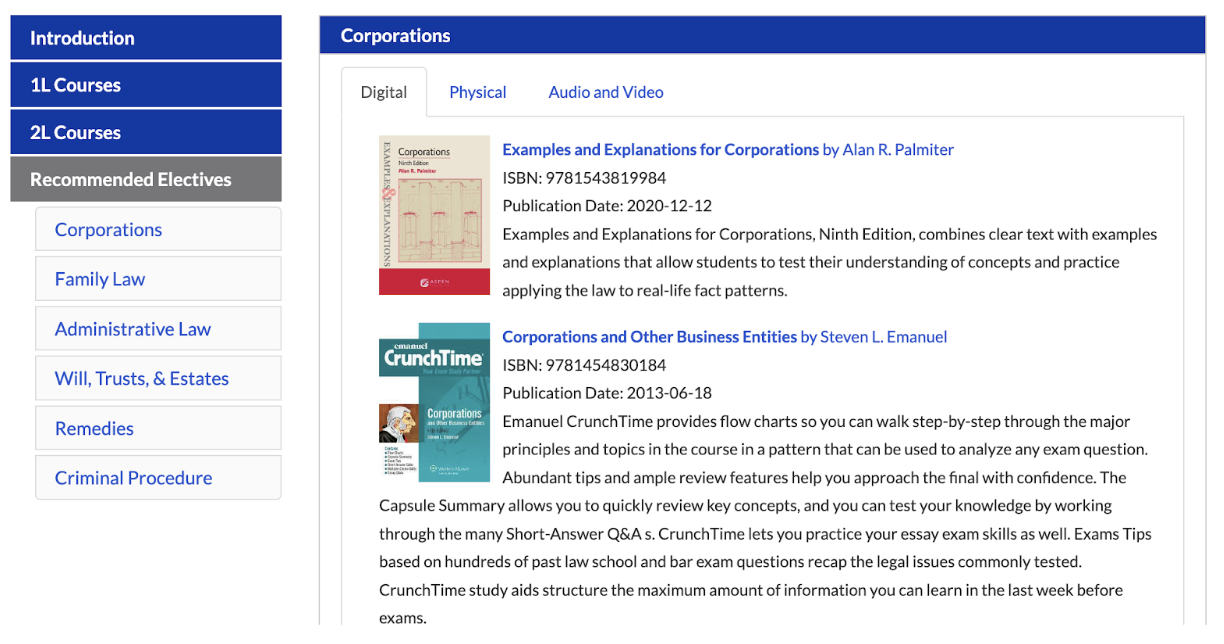
As with the other posts highlighting the Study Aid Finder, going to the menu on the left of the screen and clicking “Recommended Electives” gives a drop-down menu of various courses that are not required for graduation but often tested on the bar exam:

Clicking on “Corporations,” as with the other courses, brings you to a box with “Digital,” “Physical,” and “Audio and Video” tabs. A portion of the “Digital” tab is displayed above. We’ve previously taken a look at the Glannon guide[s] and Examples and Explanations series, so let’s look at something different this time: the Emanuel CrunchTime series.

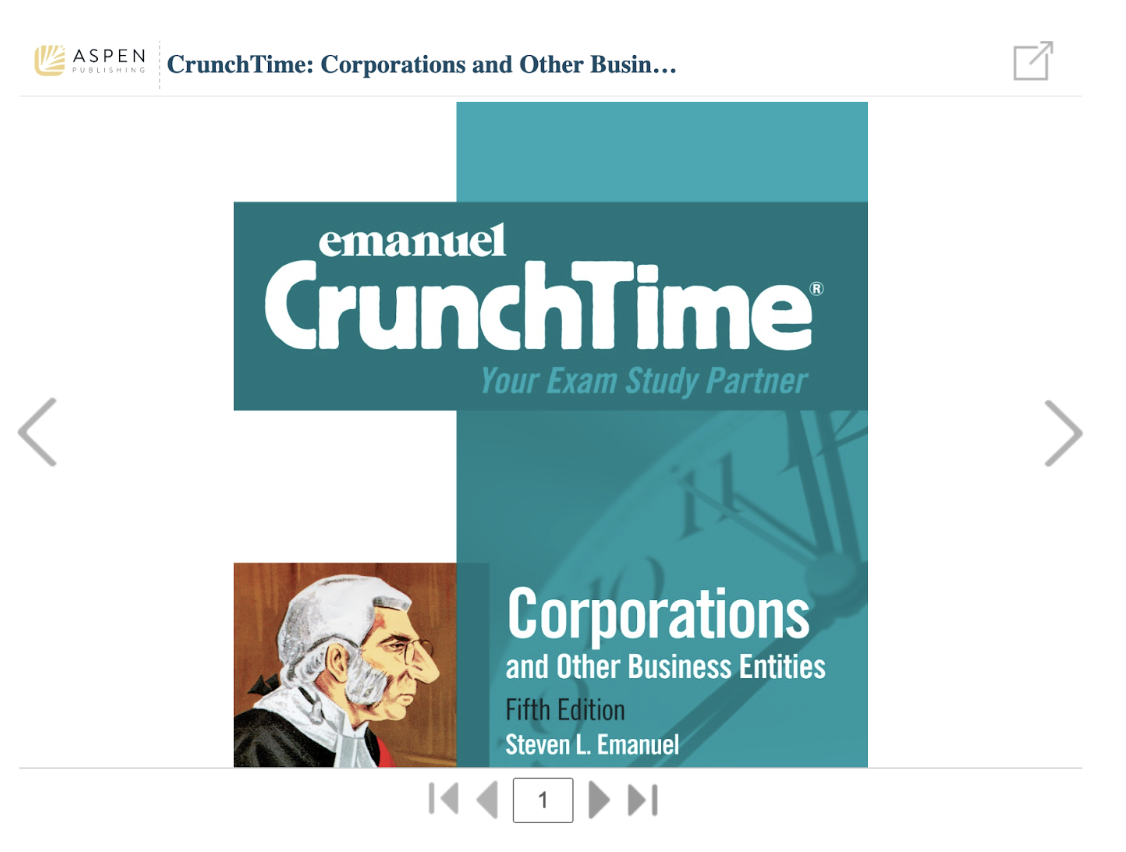
Clicking the link brings us [again] to the Aspen Learning Library:

Unlike the other resources we’ve investigated in this blog series, there is no “read online/read offline” option – only a “View Inside” option.

Clicking “View Inside” brings us to essentially an e-book within the browser:

Unlike the other resources we’ve evaluated in this series, the e-book options aren’t as comprehensive. There’s not a search menu button, a table of contents menu button, etc. That does not mean this resource is not valuable though.

With this resource, we are more or less limited to digitally turning the page. That’s not a bad thing though! Looking at the table of contents, this resource has a lot to offer:

As can be seen, there’s around at least 140 pages of exam questions in various formats
(with explanation). This is a great way to test your application of the material, or, alternatively, a great way to learn through experience.

Clicking on the “Physical” tab brings a list of resources that are similar (some are identical) to those in the “digital” tab. These can be accessed physically in the Law Library, or the ISBN is provided and one can Google it and find a vendor-of-choice to obtain the book.

The “Audio and Video” tab has a list of resources that are, well, audio and video! These resources are not as comprehensive oand don’t provide quite the depth that other resources have, but, for those on the go, these resources provide a great opportunity for learning in traffic, in the gym, nursing a child, etc.

The amount of resources available can be overwhelming, but I’d recommend skimming a few, see which resource resonates with you, and going from there. You can’t go wrong. Happy hunting and best of luck on your upcoming exam!

Finding Study Aids for your Professional Responsibility Course

In a previous post we focused on Property Law for the 1Ls, but they are not the only ones who need help!

All of you 2Ls out there likely have your Professional Responsibility final to get past before the summer. The rules of Professional Responsibility are there for a good reason. Unfortunately for us law students though, there’s a little more to them than “don’t touch your client’s money” and “communicate with your client[s].” Thankfully we have the awesome professors at GSU to help us out with these – and the amazing Law Library (and librarians and other staff and students assisting the library) to help us learn them.

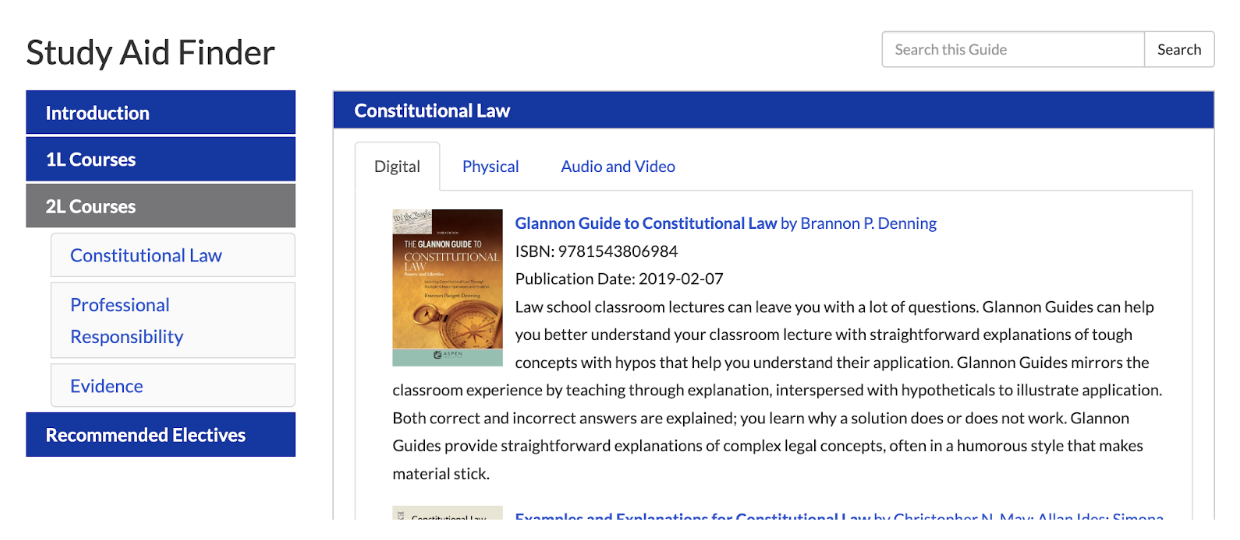
Back to the study guide – to get to Professional Responsibility, we click on the “2L Courses” tab in the left menu. This brings down a drop-down menu of selected 2L courses:

Clicking on “Professional Responsibility” will bring you to a box with digital, physical, and audio/visual resources to aid your study, just like the other courses we’ve reviewed in this blog series:

We previously took a peek at a Glannon guide, so let’s take a look at a different guide this time around.

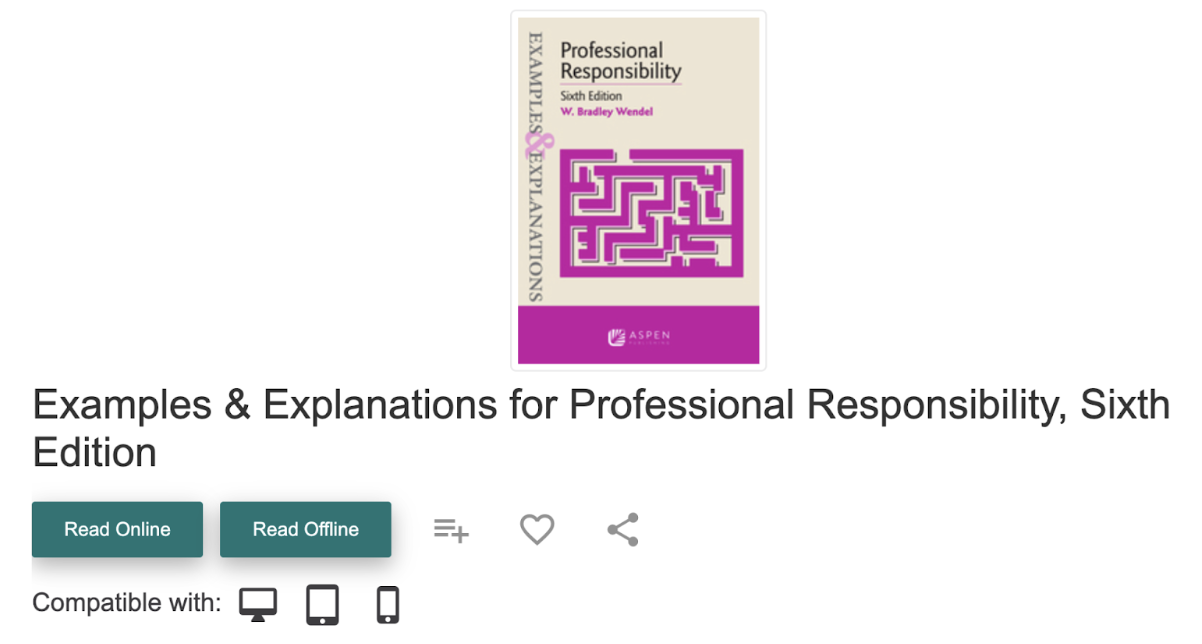
Clicking on the Examples and Explanations for Professional Responsibility (a.k.a., the “E&E” guide) again brings us to the publishers website and the Aspen Learning Library:

As you can see, it’s compatible with a variety of electronic devices (computer, tablet, phone) and can be accessed online or offline (note: offline reading must be done through the Aspen Learning Library App, available for PC/Mac/Android/iOS).

Utilizing the “Read Online” tab, you are brought to the table of contents, and from there, you can search the ToC, scroll through the ToC, etc. Chapters are broken out into the major topics (possession, gifts, title, etc.). The chapters discuss the topics generally, and provide some examples with explanations (hence “E&E”).

As this is another Aspen Learning Library resource, the interface is similar (if not identical) to that of the Glannon guide discussed previously:

Going to the “Duty of Competence” section, for example, is something that none of GSU students should have to worry about, but, you’re going to get tested on it on the final, the MPRE, and the bar. The top left icons bring one to the Aspen Learning Library and Table of Contents, respectively. The five menu buttons on the top right provide a “text to speech” function, a button for supplemental material, a full screen viewer option, a settings option (allows one to change the font size and font), and a search option. The chapter then ends with some examples. Other resources in the “digital” tab include the Glannon series, the Emmanuel crunchtime series, and others. 

Clicking on the “Physical” tab brings a list of resources that are similar (some are identical) to those in the “digital” tab. These can be accessed physically in the Law Library, or the ISBN is provided and one can Google it and find a vendor-of-choice to obtain the book.

The “Audio and Video” tab has a list of resources that are, well, audio and video! These resources are not as comprehensive or have the depth of examples (a.k.a. “Hypos”) that other resources have, but, for those on the go, these resources provide a great opportunity for learning in traffic, in the gym, nursing a child, etc.

The amount of resources available can be overwhelming, but I’d recommend skimming a few, see which resource resonates with you, and go from there. You can’t go wrong. Happy hunting and best of luck on your upcoming exam!

Finding Study Aids for your Property Class

In a previous blog post, we provided a 30,000 foot view of the Study Aid Finder that the GSU College of Law Library so kindly put together to aid your studies. The next series of blog posts will highlight certain aspects of the Study Aid Finder with the hope that it helps you take advantage of what it has to offer…and I hope you do, because who doesn’t love saving $$ by not buying resources on Amazon that the Law Library has freely available to you…AND who doesn’t like succeeding in your classes?

The 1L’s out there are only a few weeks away from completing a major milestone: the completion of the first year of law school! Definitely a cause for celebration. There are a few pesky speed bumps in the way of summer, however, one of which likely being the Property law final. Let’s take a look at the Study Aid Finder and see how it can help prepare you for the Property law final…

As noted in a previous blog post, when one goes to the Study Aid Finder, there is a menu bar on the left with 1L courses, 2L courses, and recommended electives. Clicking on the “1L Courses” bar gives a drop down menu, from which “Property” can be selected.

Clicking on the “Property” bar, you’re directed to a box with digital, physical, and audio and video resources that can help prepare you for the exam:

For a given tab, the resources are rank-ordered in an unscientific analysis of comprehensiveness, buts lets go through a few and go through the tabs of the box.

Let’s start with digital. Clicking on the “Digital” tab will display a list of resources. Let’s start with the “Glannon Guide to Property ” for no other reason than it is at the top of the list.  Clicking the link may or may not bring you to a landing screen to enter your GSU network credentials (depending on whether or not you are accessing the resources from campus or off campus). After entering credentials (if needed), one is directed to the Aspen Learning Library site for the Glannon Guide:

As you can see, it’s compatible with a variety of electronic devices (computer, tablet, phone) and can be accessed online or offline (note: offline reading must be done through the Aspen Learning Library App, available for PC/Mac/Android/iOS).

Utilizing the “Read Online” tab, you are brought to the table of contents, and from there, you can search the ToC, scroll through the ToC, etc. Chapters are broken out into the major topics (possession, gifts, title, etc.). The chapters discuss the topics generally, and even provide some discussion of case law. 

Looking at lost property and treasure trove (because who doesn’t like treasure??), the online viewer has a view like this:

The top left menu buttons bring you to the Aspen Learning Library (the publisher for this particular book) and a link to the table of contents, respectively.  The five menu buttons on the top right provide a “text to speech” function, a button for supplemental material, a full screen viewer option, a settings option (allows one to change the font size and font), and a search option. The chapter then ends with some examples. Other resources in the “digital” tab include examples and explanation books, the Emmanuel crunchtime series, and others. 

Clicking on the “Physical” tab brings a list of resources that are similar (some are identical) to those in the “digital” tab. These can be accessed physically in the Law Library, or the ISBN is provided and one can Google it and find a vendor-of-choice to obtain the book.

The “Audio and Video” tab has a list of resources that are, well, audio and video! These resources are not as comprehensive or have the depth of examples (a.k.a. “Hypos”) that other resources have, but, for those on the go, these resources provide a great opportunity for learning in traffic, in the gym, nursing a child, etc.

The amount of resources available can be overwhelming, but I’d recommend skimming a few, see which resource resonates with you, and go from there. You can’t go wrong. Happy hunting and best of luck on your upcoming exam!

Tips for Exam Season

by Ralaya Evans, Law Library GRA

Exam Season can bring anxiety for all law students. There is a lot of pressure and everyone wants to do well. There are a few upkeep actions one can partake in to help ease the nerves surrounding exams.

  1. Sleep is your friend. It can be tempting to wake up super early and stay up late studying and digesting as much information as possible every day. However, this is more harmful than helpful. This can overload your mind and make it hard to retain information. You may find that no matter the ample hours that you are putting into studying, you are not prepared for the exam. Getting the right amount of sleep will make studying more effective and allow you to perform to your best ability on the exams.
  • Take breaks. Studying all day without breaks will also impact your ability to retain information. Mental fatigue will often be the result. Your mind/body will often tell you when you need a break, but during finals we ignore the signs. However, kn­­ow the signs of mental exhaustion so that you can respond appropriately. Pushing yourself too hard will only cause burn out.
  • Set a study schedule and stick to it. Setting a schedule can also help you block out time to study, but to also take a break, eat, do something that you enjoy and more. Sticking to a schedule allows you to accomplish the amount of studying that you want, but also still have a life. A nice balance between the two will be extremely beneficial.

Although taking care of your mental health is key, we must also ensure that we are ready for finals substantively.  To prepare for such information-intensive exams, here are a few tips:

  1. Find your study group. There are many different studying techniques. Some of us share the same techniques for studying and use the same sources such as Quimbee, law library study aids and more. So, it is often a good idea to team up with others and form study groups. Aside from sharing resources and techniques, insight from your fellow classmates can help you see information from a different perspective.
  • Make an attack outline that works for you. It is a good idea to work with your classmates to create a detailed outline of your course to use during the exam. However, it is also extremely helpful to make a more concise “attack outline” that you are more familiar with and comfortable with using during a timed exam. This brevity and familiarity will work to your advantage since it will be so much easier for you to quickly reference during the exam.
  • Go to office hours. Once you reach the point in your studies where you have created your outline, take note on the areas you are still a little fuzzy on and go to that professor’s office hours to see if they can help clear things up for you. The professors are always so willing to help and want you to succeed. So, schedule time with them when needed. Do not choose to suffer in silence or settle for not understanding a topic fully.

Exams are often referred to as the most stressful part of each semester. So, it is important to have the tools to get through the season and feel good about your performance. All of these tips will help to build your confidence for taking the exams.

An Easy Way to Find the Best Study Aids for your Course

The GSU Law Library is an absolutely fantastic resource for exam preparation.  A former colleague of mine would tell the tale of when he was in school, after he got the syllabus for a given class, he’d hit the library and look for resources to supplement his in-class experience…and would end up CALI’ing the class.  Anecdotal humble brags aside, we may not be in the beginning of the semester, but it is never too late to look around for resources that can help bolster your understanding of a given subject.

This is especially true with exam season coming up around the corner. Despite the high caliber of GSU’s professors, everyone has a different learning style, and the way material might be presented in class may not “fit” with one’s learning style. Others may just want more practice and to review a different presentation of their course material to help solidify the information in their brain (in neuroscience we call this “memory consolidation”).

Fortunately for you, GSU really goes the extra mile to ensure and promote the success of its students. The Law Library has put together a Study Aid Finder to help students get the most out of what the Library has to offer for us students to knock out those pesky exams with flying colors. This is the kind of resource I really wish someone could have handed me on day 1 of law school…let’s take a look, shall we?

First thing’s first – the Study Aid Finder can be accessed at: https://libguides.law.gsu.edu/studyaidfinder

The landing page has an introduction that one can read if one so pleases, but the interesting stuff can be found on the menu bar on the left-hand side of the page:

Clicking on one of the menu bars will expand the course selections:

Clicking on a given course will then lead you to a collection of study aids for that particular course. You’ll see digital formats that can be accessed with your GSU credentials and can be viewed on laptops, mobile devices, etc. If you’re a luddite like myself and prefer paper, there’s a link for information for the physical printed book. There’s also an audio and video tab with some resources for those of us on the go. It’s not like Atlanta has any traffic or anything, but, if it did, listening to audio while on your way to T-deck is a great use of time.

Happy hunting!

5 tips for succeeding on the MPRE

by Ralaya Evans, Law Library GRA

The Multi-State Professional Responsibility Exam (MPRE) is one of the stepping stones that law students must confront at some point on their journey to becoming a licensed attorney. This exam is usually offered three times during each year: March, August, and November.  NCBEX.org will always provide reliable information on any and all things concerning the MPRE, including upcoming important dates.

Often, law students are overwhelmed when it comes to the MPRE. This is understandable, as there are uncertainties that usually lie around this exam, such as how much one should study, what materials to study with, and more.

Here are five tips to ease some of the uncertainty around taking the MPRE:

(1) Take advantage of free resources. Law school is expensive in every way: tuition, books, BAR prep, etc. There are numerous sources of MPRE prep out there that one can pay for. However, many platforms also offer free resources that are extremely useful for preparation of the exam. For example, Barbri offers free practice exams and numerous modules and explanations to practice questions. In addition, the Short & Happy Guide to the MPRE is available to GSU students through the law library’s online study aid collection.

(2) Practice exams are your best friend. Speaking of free practice exams, these exams will be one of the best resources for your preparation for several reasons, including: (a) the practice exams help you become comfortable with the formatting of the exam, (b) you become aware of how different potential topics are tested, and (c) many of the practice exams are timed. Therefore, they will help you gauge whether your pace at answering needs improvement before taking the official exams.

(3) Be aware of your state’s requirements for a passing rate. Every state has a different threshold for what is passing and failing. Be sure to know what your specific state requires and defines as passing, so that you can measure your readiness on practice exams based on that number.

(4) Take your Professional Responsibility class before you sign up for the MPRE. This class is such a great starting place for preparing for the exam. Though it will not fully prepare you for everything on the exam, this class will introduce you to how this specific area is approached by attorneys and make you comfortable with reading the rules.

(5) During the test, be confident in yourself. Confidence plays a major role in test-taking, and the MPRE is no different. There will always be some answers that you are iffy on. However, if you are familiar with the rules, the best answer will jump out at you. On the other hand of that, there will be some questions that seem too easy to be true. Do not get tripped up on these! If the answer seems easy and obvious to you, that doesn’t automatically mean that it isn’t correct.

Hopefully, these five tips will set you on a path to MPRE success. If you have any tips that have helped you along, feel free to share them in the comments!

Study Aid Spotlight: Acing Evidence

by Ralaya Evans, 2L

As 1Ls, we are often guided on which study aids are good to use to help us prepare for some of the hardest exams we will ever have to take. Once we enter into 2L year, we are aware that study aids are helpful, but not always sure where to find them. I talked with a few friends, and we all are of the opinion that Evidence, during 2L year, is one of the courses in a study aid that could be most helpful. Evidence is such a dense and rule-intensive course. During the semester, we review and learn the rules separately, which is not so bad. However, when it is time for the final exam, we quickly realize we will have to be able to identify which rule applies to each problem and this is not always so easy.

Study Aids for Evidence are important for so many reasons. This area of law is important for litigators and transactional attorneys, and studying it gives us all practice for the bar.

Knowing this, I searched for several Evidence study aids and came across Acing Evidence by Aviva Orenstein. I worked with this guide to study for my upcoming final exam and can honestly say that my confidence greatly increased as a result. The “Acing Evidence” study aid has been extremely helpful for a few reasons:

  • Practice Problems: This study aid provides examples and practice at the end of every lesson. For example, the first chapter discusses Relevance, which is a big part of Evidence. At the end, there is a page titled “Illustrative Problems.” Here, you will find questions and answers to practice. The majority, if not all, Evidence professors will tell you that one of the best ways to get great at Evidence and prepare for exams is to practice.
  • Checklists: There are checklists for the majority of the rules. In Evidence, checklists are your absolute best friend. You can virtually get every question correct if you find/develop the correct check list for that rule and apply it to the question. Character is one of the best parts of Evidence to have a checklist for and Chapter 2 of the study aid provides this checklist. Try it out next time you are practicing evidence
  • Reminders: Another great aspect of this study aid is the Points to Remember after each chapter. This provides a quick highlight of the important parts of the chapter and sometimes acronyms to remember points about Evidence during an exam.

As far as study aids go, I give this one two thumbs up. If you need help finding a study aid for another course, don’t forget that the reference librarians are always here to assist. Good luck with exams!

Study Aid Spotlight- Examples & Explanations for Criminal Law

by Ross Crowell, 3L & Law Library GRA

For all of you 1Ls, I am sure you are busy studying for your Criminal Law final. When I took it, the world was turning upside down as COVID-19 had just hit and our classes were going entirely online. Luckily, I had a lot of time on my hands for studying, since there was little else to do in the world. During my Finals prep, I found Examples & Explanations for Criminal Law to be very helpful.

This study aid is immediately useful for its easy-to-understand definitions for key criminal law terms. It does an especially good job of distinguishing the many closely-related terms and concepts studied in the course, such as first-degree murder, second-degree murder, felony murder, and manslaughter. It also explains the often-confusing distinctions between the differing approaches to defining crimes like these, including thorough coverage of the Model Penal Code.

Like others in the E&E series, this study aid also includes a variety of illustrative practice problems, each coupled with a thorough explanation of its answer. This format helps you to become more familiar with applying the law to a variety of hypotheticals. The practice problems in the Criminal Law E&E were also shorter than others I’ve encountered, which makes them easier to incorporate into your study routine. You are able to practice issue-spotting and analysis without being forced to read through a hypo that drags on for multiple pages. While it is important to do full-length practice problems and write out full answers, the shorter hypos in this study aid are a great resource for quick analysis, and a good way to quickly see whether you are on the right track.

Whether you just need to brush up on some key concepts or run through some questions in an exam-like format, Examples & Explanations for Criminal Law is a good choice. You can find the most up-to-date version of this study aid in print. We also have the previous edition available online through the Aspen Learning Library, where it can be used in your browser, or with the associated app.