Art in the Library: Die Fuchse (The Fox)

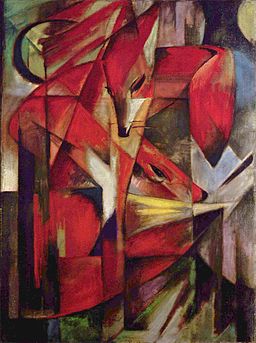
Die Fuchse, 1913 (The Fox)

Die Fuchse, 1913 (The Fox)

Venture up the steps into the “quiet zone” and you’ll find Die Fuchse (The Fox) gracing the wall to your right. This piece was created by painter and printmaker, Franz Marc, in 1913. Marc often used animals as subjects in his expressionistic, almost abstract, style and used a “well-defined symbology of colour” in which red, yellow, and blue represented specific emotions. He was heavily influenced by the work of Paul Gauguin, Vincent van Gogh, the Cubists, Expressionists, Henry Matisse, and later Vasily Kandinsky.
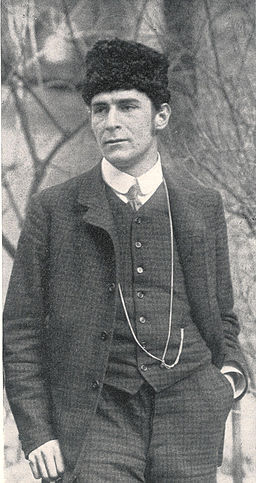
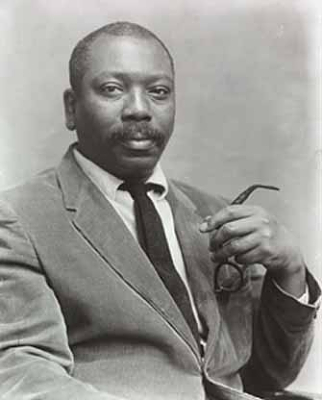
Franz Marc, 1910

Franz Marc, 1910

In 1910, Marc met Kandinsky and became a member of the New Artists’ Association (Neue Künstlervereinigung München). In 1911, this group split and Marc and Kandinsky formed The Blue Rider (Der Blaue Reiter), an association of German Expressionist artists that hosted exhibitions in Munich and edited and published The Blue Rider Almanac in 1912. It was during this time that his work became more abstract, as seen in The Fox. His work evolved from round, impressionistic pieces to paintings with more “faceted space and forms”, in an attempt to “express the brutal power and timorous fragility” of animals.

In 1914, at the outbreak of World War I, Marc immediately enlisted. He died in combat 2 years later near Verdun-sur-Meuse, France.


Sources:

Der Traum, 1912 (The Dream)

Der Traum, 1912 (The Dream)

Law Library Survey

12196410514_1ddd96fd3e_bIt’s that time of the year again. The sun is starting to shine, college basketball is over, and the annual Law Library Spring Survey has just been posted. While it might not seem like the most fun activity ever, taking time to fill out the survey will be very beneficial to you and your classmates.

The survey enables us to determine what we are doing well and what we can improve upon in the law library. It also gives students a chance to voice their concerns and provide suggestions.

Based on past survey responses, we have done the following over the last few years:

  • Added books and DVD’s to our Leisure Collection
  • Bought additional Study Aids
  • Increased awareness of the Quiet Level
  • Improved lighting around the library

For taking time to fill out the survey, you can earn one Library Reward point.

Take the Law Library Spring 2014 Survey

Federal Courts App

Federal Courts

By Meghan Starr

KosInteractive has just released a new app for $2.99 that allows users to access “the full text of all of the federal rules of procedure and the local rules for every federal court in the country – including district, bankruptcy, and appellate courts,” as well as a login portal to PACER.

I am not an “app” kind of person. My phone is mostly used for talking, although I do know how to text, check my email, and play Bubble Shooter. For that reason, I decided to test how user friendly the app is. Since I am taking Advanced Evidence this semester, my goal was to find the Federal Rules of Evidence and see how helpful it would be. The first challenge was to get the app on my phone. I outsourced that to tech support (my husband).

After that, I found the app to be intuitive and simple to navigate. The home screen provides users with 3 options: Rules of Procedure, Local Rules, and Pacer Login. After choosing Rules of Procedure, I had the following choices:

  • Appellate Procedure
  • Bankruptcy Procedure
  • Civil Procedure
  • Criminal Procedure
  • Evidence
  • U.S. Supreme Court
  • FISA Court

Here is where I hit the first problem – only the top half of the letters appeared on the page. Still it was easy enough to find “Evidence” and proceed. The document must be downloaded before viewing, but it didn’t take too long.

Once downloaded, I could view all of the Federal Rules of Evidence – in one big, long document. You can swipe to move between pages or bring up thumbnail images to scroll through quickly; you can “go to” a specific page number; however, you cannot search to find “Rule 801” or “hearsay.” You must know what you are looking for and thumb through all the prior pages to find it.

It should be noted that: The text was of the rules only, no Advisory Committee notes. The font could be enlarged, but the lines of text did not adjust, forcing you to toggle back and forth while reading the text. Finally, a “help” tab exists, but other than contacting KosInteractive with comments, there is little help available.

Overall, I still like having it on my phone. It is a handy reference that I can quickly access on the go. While I not a resource to pull out for a quick objection in court, I do a lot of reading on the move with my kids, and I see it being used to refresh Rules of Procedure when I am preparing for the bar.

Prepping for Finals

by Ryan Browne

image by Flickr user paige-pics

image by Flickr user paige-pics

Spring is fast approaching.  The Masters is right around the corner.  The entire city of Atlanta will turn yellow soon.  We can finally put away the winter coats and jackets and bring out the flip flops and shorts.  And best of all, it means that finals are almost here.

Okay, so maybe the last part isn’t so great.  But it is never too soon to start preparing for your finals.  And there are plenty of ways for law students to prepare.

The library has a wide variety of supplements and study aids to help you with your finals studying.  The Understanding series offers good explanations about many areas of law.  To test your knowledge of the a certain subject, the Examples and Explanations series and the Q and A series offer hypothetical and multiple choice questions on a wide variety of subjects.  Law in a Flash offers flash cards that quiz you on your chosen topic.

You can also check out the law library’s website to for old exams given by your professors.  You can also check with any student organization that you may be a member of and see if they have outlines from prior students that can be used in helping you put together your own outline.  Lastly, check with a Barbri or Kaplan representative about their outlines.  Putting a deposit down for their bar course usually gets you an outline in return.  They have 1L outlines as well as upper level course outlines.

So check out these different ways to prepare for you finals and then enjoy your summer knowing that you aced your finals.

Atlanta in the Spring

by Mark Stuckey

Atlanta image by Flickr user brokentaco

image by Flickr user brokentaco

​Alright, alright, spring break is officially over, and now we are on the all-too-familiar greased slope, slipping ever closer to the dreaded “F” word. Final Exams are only five and half short weeks away, but there is still time to have a (semi) normal life when you’re taking a break from cramming. I don’t know about you, but spring break left quite a bit to be desired; between the Education Law writings and the paucity that it my savings account, I was confined to my plebeian abode. Don’t get me wrong, it wasn’t all a wash. I did get to hang out with my less-than-apathetic dog, catch up on my laundry, and binge on Netflix (Chuck). But, even with all of that excitement, fleeting visions of beaches, beverages, and relaxation lingered in the back of my mind. However, the good news for myself and those similarly situated is, I have scoured the Internet to bring you some ideas for (relatively) “cheap” activities to get you out and about in Atlanta this Spring, and attempt to make up for a lackluster spring break.

Atlantic Station Beer Carnival

On April 5th there will be a beer carnival at Atlantic Station. This event promises good times in the form of carnival games/rides and gourmet food trucks! And, possibly more importantly, the beer carnival offers an opportunity to sample of over 100 great beers. Tickets are a little steep, at around 50 bucks, but might be worth it to get some fresh air and a little sanity. Find all the rest of the relevant details here.

Sweetwater 420 Fest

This year the Sweetwater 420 Fest will be at Centennial Olympic Park, a change of venue from scenic Candler Park where it was held last year. Undesirable change of scenery aside, 420 Fest is always a good time. Whether you’re into running and want to participate in the 5K “beer run“, or you’re like the rest of us lazy Atlantans and just want to drink beer and listen to mediocre live music, there’s something for you. Coming from experience, 420 Fest is a lot of fun and a good way to forget your law school stresses … for a little while at least. For the website and more information click here.

High Museum

The High Museum, located in the Woodruff Arts Center, offers a less bacchanalian and more wallet-friendly option than the prior events, but is nonetheless a great outing. The High Museum is currently exhibiting “Go West“, an incredible collection of photography, painting, and sculpture of the American west. I was personally taken by the mastery of Bierstadt both times I saw this exhibit. Show your Panther ID and receive a generous student discount. Also, for those who live in Fulton County the first Saturday of the month (April 5th) is free for you (restrictions apply). Find out all there is to know about the High Museum here.

So there you have it, a rather incomplete list of activities to get you out of the house and law school off your mind this spring. I hope it helps! Comment below, and tell me what you’re doing in your free time this spring!


We’re Hiring!

Law_Library_LogoDo you want to work for the Law Library? We hope so, because we’re hiring GRAs for this summer!

Positions Available
The following positions will be filled:

Eligibility
Law Library GRA positions are open to all GSU law students who have completed their first two semesters of classes. Part-time students are eligible. Students applying for Summer positions must be enrolled in at least 3 hours of Summer classes. Students may apply for both type of GRA position, but cannot be hired for both positions at the same time.

Submission
Applications are due at 5 p.m. on Thursday, April 10, 2014.

Reference GRA applicants: Email one document which includes a 1) cover letter, 2) current resume, and 3) completed availability form to Austin Williams (austin@gsu.edu). Include your last name in the file name.

Research GRA applicants: Email one document which includes a 1) cover letter and 2) current resume to Pam Brannon (pbrannon@gsu.edu). Include your last name in the file name.

Art in the Library : The Library

TheLibrary_1960_JacobLawrence

The Library, 1960 by Jacob Lawrence
Link to the Smithsonian American Art Museum

If you’ve ever printed anything at the printers in the alcove, you may have noticed this print. At first glance, it’s a blur of brown blocks with swashes of blue and red and green mixed in. It’s not until you focus on it do you see people bent over books and newspapers, reading and studying. Some even look like they’re napping. It’s actually a common scene when you wander through the library on a Monday afternoon. Most every chair is full, and people are struggling to maintain concentration or furiously write a paper.

Jacob Lawrence is one of my personal favorite artists. I took an African American Art class as an undergrad and was really captivated by his work. He would create a series of paintings (included 30-40, even 60 pieces) that would tell a story, most about people or events significant to African American history. They included Toussaint L’Ouverture, Frederick Douglass, Harriet Tubman, life in Harlem, the post-World War I migration, and the civil rights movement of the 1960s.

Jacob Lawrence, Originally photographed by Geoffery Clements. Featured on the Smithsonian American Art Museum website.

“I paint the things I know about and the things I have experienced. The things I have experienced extend into my national, racial and class group. So I paint the American scene.” ~Jacob Lawrence

Born in Atlantic City in 1917, he moved with his family to Harlem in 1930. He started taking art classes as a teenager at the 135th Street Branch Library. His skills and talent developed, and he became a key player in the Harlem Renaissance, mingling with other greats like Langston Hughes, August Savage, and Aaron Douglas. He secured a position with the WPA Federal Art Project which helped him through the Depression. He continued to paint, teach, and explore the world until his death in 2000.

Lawrence dubbed his style “dynamic cubism” and he approached his work systematically. When working on a series, he would complete the preliminary drawings for the entire series, lay out the paintings across the studio, and then paint one color at a time on each piece. Doing so would bring consistency and cohesion to the series. I imagine working this way enabled him to maintain the vision of the entire project without getting fixated and lost on one smaller aspect of the entire story he was conveying.

“My work is abstract in the sense of having been designed and composed, but it is not abstract in the sense of having no human content . . . [I] want to communicate. I want the idea to strike right away.” ~Lawrence, 1945 interview, quoted in Wheat, Jacob Lawrence, American Painter, 1986

The Lovers, 1946

The Lovers, 1946

Sources:

Researching From Off Campus

eMac by Flickr user eye-fibre

image by Flickr user eye-fibre

Spring break is almost here! The law library will be open during this time (although with slightly shortened hours), but maybe you’re going to be at the beach, or Disney World, or just on your couch. Just in case you have any grand plans for working during this break, don’t forget that you can access many of the law library’s resources from off campus.

  • A lot of our legal databases (such as HeinOnline, ProQuest Legislative Insight, and Kluwer Arbitration) are accessible with your Campus ID. Just follow the links from the database list to be routed through our proxy server.
  • Our research guides are available from anywhere without a login and cover research for many of your courses.
  • And if you need help from a librarian, don’t forget you can always email us or use the Chat Reference service too.

Have a wonderful break, and we’ll see you again soon!

Meet Deborah Schander

Deborah BigThis marks the third of a series of in-depth, exclusive interviews I am doing with the librarians and staff here at Georgia State University College of Law Library. I hope you enjoy!

Austin: What is your name and what do you do?

Deborah: Deborah Schander, Reference/Student Services Librarian.


A: How long have you been at Georgia State University College of Law Library?

D: I’ve been at GSU since August 2010.

A: That’s crazy. I started in August 2010 as well.

D: Because we started on the same day.

A: Oh yah…


A: So, what books are currently on your night stand?

D: I’m currently reading two books: First, A Homemade Life: Stories and Recipes From My Kitchen Table by Molly Wizenberg, which is a memoir/ode to food, and makes me ravenously hungry during my MARTA commute. And second, Shadow’s Edge, the second book in Brent Week’s Night Angel trilogy, because sometimes, you just need an assassin’s story to pep up life.


A: What is an interesting fact about yourself that you would like to share with our readers?

D: I was in a professional opera despite the fact that I can’t sing.


A: When you are not saving the world here at GSU Law Library, what do you enjoy doing outside of work?

D: I’m pretty boring. I like reading (mysteries, superhero comics, sci fi), going to the theatre, and being crafty (cross-stitch, crochet). I don’t get to travel as much as I would like, but I do love to visit new places.


A: Lastly, what is your favorite vacation spot? The place you go to leave it all behind for a few days.

D: London. I studied in England during part of both college and law school. I traveled throughout the UK, but London just never gets old.

A: Seems pretty old to me…

D: Please don’t make me spit my coffee out.


Now that was fun! The complete, unedited,  behind the scenes interview with Deborah Schander.