Love at First Cite

Image by slgckgc, taken on February 8, 2010. No changes were made. Licensed under CC by 2.0.

Valentine’s Day is all about love, and this starts with finding the right match.  This can apply in relationships, friendships, or… legal research strategies?

Legal research might not seem like the most romantic subject at first, but like any great relationship, it requires time, patience, communication, and a little bit of effort. This Valentine’s Day, let’s look into skills that may help in love and the law. Who knows—legal research might just be your perfect match!

1. Communication is Key

In a relationship, you’ve got to ask the right questions to understand your partner. The same goes for legal research. Before you start digging through Westlaw or Lexis, ask yourself:

What is the specific legal issue I’m researching?

What jurisdiction is relevant for my search?

Am I looking for case law and precedent or a more general overview?

Being clear about your research goals before you dive in is like having an honest conversation with your research “partner” before things get serious. This will not only save you a lot of time, but will also guide you on where to start your search for the perfect match.

2. Effort and Patience: It’s Not a Fling

You know that instant spark people sometimes talk about? Well, legal research isn’t usually like that—it takes time and patience. You might not fall in love with the first case you find. Just like dating, it may take a few tries to get in right. Maybe you need to sort through citing decisions or follow a trail of precedent. 

If you aren’t feeling any chemistry at first, specialized tools on Westlaw and Lexis can help you find “the one.” Headnotes on Westlaw offer summaries and additional sources for specific legal issues, and Ravel View on Lexis connects all cases from your search to show you how seminal a case is (size of a circle), when it was decided (horizontal timeline), jurisdiction (vertical axis), and a decision’s relevance to your search (circle height).

3. Respect: Recognizing the Value of Secondary Sources

In any healthy relationship, both partners have to respect each other’s strengths. In legal research, secondary sources (like treatises and law review articles) provide valuable context and guidance, giving an overview of a legal topic and explaining things in a more accessible way.

When you’re looking at primary law, treat it as your partner—but, the same way you don’t drop your friends when you get into a relationship, never neglect the role of secondary sources! They can help you get to the root of complex issues, summarize legal points, and provide clarity before you dive into the details.

4. Flexibility: Be Open to Change

Sometimes, your research path will take an unexpected turn, much like any relationship. You might find a piece of case law that completely undermines your argument. You might start researching with one focus and realize halfway through that there’s a better way to approach it.

Being flexible with your research strategy is key. If the case law doesn’t say what you thought it would, don’t try to morph it to fit your argument. Instead, reframe your point so the law is on your side. Don’t be afraid to pivot your search as you gather more information, just like you’d reevaluate your relationship when it needs some growth.

5. The Power of Support

In any successful relationship, support is essential. The same is true for persuasive reasoning. You can’t expect your arguments to hold weight without proper support. In law, that support comes in the form of citations. Every claim you make needs to be backed up by a solid source. Citations are your “support system”—without them, your argument falls flat, just like a relationship without trust.

You wouldn’t want your partner to jump to conclusions, so don’t expect your professor (or a judge) to accept your conclusions without a citation to back them up. Every good argument—and relationship—needs that rock-solid foundation to thrive.

Loving the Law

This Valentine’s Day, give your legal skills a little love by cultivating a deeper connection with research. And remember: like finding the one, great research takes time, effort, and patience.

Miller Lectures of the Past

With the 68th installment of the Henry J. Miller Distinguished Lecture Series right around the corner, it’s a great time to revisit some highlights from previous Miller lectures. Recently, the law library has been digitizing programs from the earliest Miller lectures, so these materials are more accessible than ever. This is an ongoing project, so watch this space for additional updates as the archive grows.

Although we have been unable to find a program for Murray L. Schwartz’s inaugural Miller Lecture, we have digitized the program for the second lecture, and it’s a doozy, featuring Justice Antonin Scalia, who had at the time just wrapped up his first year on the Supreme Court.

The Miller series has had the good fortune to feature a few Supreme Court justices. We’ve digitized the program for Justice Sandra Day O’Connor’s 12th Miller Lecture in 1992. In addition to that, the law library’s own Alison Guffey memorably wrote on this very blog about Justice Ruth Bader Ginsburg’s 32nd Miller Lecture, which was delivered in 2003. You can also find a transcription of Justice John Paul Stevens’s 53rd Miller Lecture, from 2014, in the GSU Law Review’s archives.

We’ve also had some other notable jurists from other courts speak, including Judge A. Leon Higgenbotham of the Third Circuit for the 4th Miller Lecture in 1988 and Judge Patricia McGowan Wald of the D.C. Circuit for the 7th Miller Lecture in 1990.

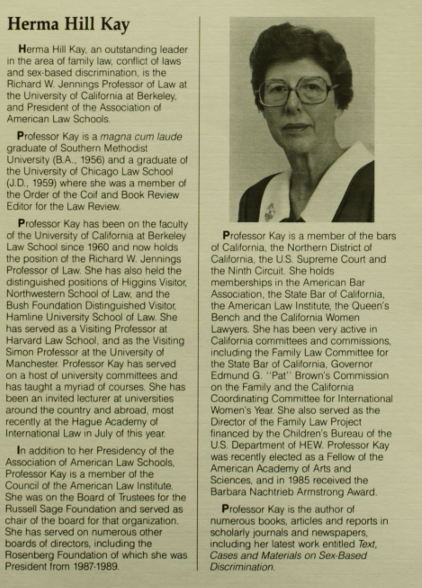
Perhaps unsurprisingly, the Miller Lecture series has also featured many scholars. In the early days, the series did an especially good job of providing feminist legal scholars with a forum. These include Herma Hill Kay, a co-author (along with the aforementioned Justice Ginsburg) of the first casebook on sex-based discrimination, who gave the 6th Miller Lecture in 1989, and Nadine Strossen, the first woman to lead the ACLU, who gave the 15th Miller Lecture in 1994.

Exploring the law library’s Miller archives is a great way to learn more about the history of GSU Law, while also getting to know some of the nation’s most influential scholars and jurists. We will continue this proud tradition at the next Miller Lecture, when Election Law scholar Rick L. Hasen discusses “A Real Right to Vote.” Don’t miss it!

Little Known Offerings of the Law Library

Most law students know they can use the library to ask research questions, reserve study rooms, or check out study aids; but that is just the tip of the iceberg of services that the law library provides. Read on as GSU law library’s wonderful circulation supervisor, Tim Zdencanovic, walks you through some functions of the law library that might be unfamiliar to you.

On any normal day after class, you and a friend can come get a study room and go over your readings and assignments. Oh, hey, while you’re here, don’t forget to pick up your Kenny G album, your Sarah Maas book, and your Mystery science theater box set. To make a long story short, the law library has a lot to offer.

You can check out puzzles, book stands, monitors, flashcards, calculators, chargers and lap desks. You have full access to every GSU library in-person or through online requests. This means you can check out vinyl records from the main university library or request a movie from the Clarkston campus. You can check out a book from GSU’s Dunwoody branch and return it here at the Law Library. Pushing past Georgia State, you can request a book from ANY University System of Georgia library. Simply by searching the USG system, the libraries of every public university in Georgia—from Savannah to Dahlonega—are yours to browse and check out material. And you’re not just limited to Georgia; You can request an interlibrary loan (our library getting a book for you from another library) from anywhere in the world! We send books to Thailand and get books from Germany. The world is your library.

Your GSU student ID allows you access to Kanopy, a free video streaming service that has movies like Everything, Everywhere All at Once and Past Lives, as well as K-Dramas, BBC series, and documentaries. Your student ID will also allow you to get a library card from the Fulton County Library System, which has a convenient location directly across the street from the College of Law: the historic Atlanta Central Library. Being a student at GSU opens you up to the whole world of the public library system; Fulton County can probably get you House of the Dragon faster than we can. 

Atlanta Central Library, ATL” by JJonahJackalope is licensed under CC BY-SA 4.0.

The library is a lot of things: a collection of books; study rooms; and a place to meet people. But more than that, the College of Law Library is one thread in a web of information and resources that stretch from here around the world. Please make use of it!

Happy National Book Lovers Day!

Happy National Book Lovers Day! To celebrate, here is a list of some recent reads, as well as all-time faves, of the GSU law librarians. Click on the title to read through the Goodreads synopsis of each book. Happy reading!

Librarian and Professor Pam Brannon recommends Ella Minnow Pea by Mark Dunn.

Librarian and Professor Patrick Parsons recommends Piranesi by Susanna Clarke.

Librarian and Professor Manion recommends Never Let Me Go by Kazuo Ishiguro and The Wager: A Tale of Shipwreck, Mutiny and Murder by David Grann.

Librarian and Professor Meg Butler recommends:

Librarian and Professor Gerard Fowke recommends Parable of the Sower by Octavia Butler.

Dean Niedringhaus recommends The Book of Joy by the Dalai Lama, Desmond Tutu, and Douglas Carlton Abrams. She specifically recommends the audiobook version.

Librarian and Professor Alison Guffey recommends Good Material by Dolly Alderton.

CELEBRATING BLACK HISTORY MONTH: Thurgood Marshall

For Black History Month, the Law Library will spotlight Black law figures throughout history and their contributions to the legal field. Each week, a different figure will be featured.

by Sydney Hamilton, 1L

Photo taken by Yoichi R. Okamoto on June 13, 1967.

Thurgood Marshall (June 2, 1908 – January 24, 1993)

History often remembers Thoroughgood “Thurgood” Marshall as a focused, articulate man who dedicated his life to the law and the people. However, as a kid growing up in Baltimore, Maryland, his high school teachers knew Marshall better for being a bit of a class clown with a rambunctious nature. Funny enough, his punishment for misbehaving turned out to be a glimpse into his future: sitting on a bench, reading the Constitution.

As a Black boy living in the inner city, Marshall recognized the effects of segregation. However, being uniquely familiar with the Constitution, he realized understanding and reshaping the law would be the key to eliminating this injustice. After high school, Marshall attended Lincoln University in Pennsylvania, where his classmates included the soon-to-be-renowned poet Langston Hughes.  After a hazing incident with his fraternity earned him a two-week suspension, Marshall focused his attention and energy on his academics. His involvement in the debate club furthered his passion to become a lawyer. In 1930, Marshall graduated at the top of his class.

After marrying his wife, Viven, Marshall continued to work towards his goal. However, the ever-looming presence of racial discrimination nearly thwarted his plans. The University of Maryland School of Law rejected Marshall based on his race. Instead, he attended Howard University but still dealt with financial burdens. His mother pawned her wedding rings to pay for his tuition.

During law school, he began to formulate the perspectives and arguments that would later define his career. While there, he studied under Charles Hamilton Houston, the vice dean at the law school and later, the director of NAACP’s Legal Defense and Education Fund. Through Houston, Marshall better understood how the Constitution and the law could be used to extinguish racial discrimination. After graduating from Howard as valedictorian in 1933, Marshall moved back to Baltimore to take his first steps as a lawyer.

Back in Baltimore, Marshall opened his own practice, assisting clients even if they could not pay. Eventually, he dedicated more time to volunteering with the Baltimore chapter of the NAACP. One of Marshall’s first significant strides came in the case of Murray v. Pearson (1936). Just like Marshall, the University of Maryland Law School rejected Donald Murray because of the color of his skin. Marshall sued on Murray’s behalf and, assisting his mentor Houston, won the case.

Following this success, Marshall and Houston strategized how to chip away at the “separate but equal” doctrine from Plessy v. Ferguson (1896) that fueled segregation. In Missouri ex rel Gaines v. Canada (1938), the two men argued that the University of Missouri had violated Lloyd Gaines’s equal protection rights by rejecting him due to his race and thereby denying him legal education equivalent to what white students received. Winning this case set the stage for Marshall’s most memorable victory.

After Houston retired, Marshall took over Houston’s position at the NAACP. He continued to win several more cases before finally landing on the one that would forever impact history: Brown v. Board of Education (1954). In this case, which was five separate cases consolidated into one, Marshall argued that segregating the school system was unequal and unconstitutional. During the second hearing, Marshall stated that segregation evolved from a desire to keep “the people who were formerly in slavery as near to that stage as possible.” After much indecision and deliberation, the Supreme Court finally ruled that the “separate but equal” doctrine should not take precedence in the public education system.

In the years following that decision, Marshall was appointed as a federal judge and then Solicitor General before eventually being appointed as the first Black justice on the U.S. Supreme Court in 1967.  As a Justice, Marshall was known for his progressive views and strong moral compass, opposing the death penalty and ensuring the civil rights of all people. Marshall served 25 terms before retiring in 1991 as one of the greatest voices on the Supreme Court.


Sources:

Justice Thurgood Marshall profile – Brown v. Board of Education Re-enactment. United States Courts. (n.d.). https://www.uscourts.gov/educational-resources/educational-activities/justice-thurgood-marshall-profile-brown-v-board

Brown v. Board of Education: The case that changed America. Legal Defense Fund. (2023, December 15). https://www.naacpldf.org/brown-vs-board/

History – Brown v. Board of Education Re-enactment. United States Courts. (n.d.). https://www.uscourts.gov/educational-resources/educational-activities/history-brown-v-board-education-re-enactment

Thurgood Marshall. Oyez. (n.d.). https://www.oyez.org/justices/thurgood_marshall

Movies that Every Law Student Should Watch (pt. 1)

Maybe you are a law student looking for a morale-boosting movie set in the legal profession or perhaps you cannot seem to escape thoughts about law school even in your free time. Either way, this new series, Movies that Every Law Student Should Watch, can act as your guide in navigating the world of movies related to the legal field. 

Note: All of the movies in this series can be borrowed from the Law Library (find them in person near the study aids or online here). 

Legally Blonde (2001) - IMDb
  1. Legally Blonde (2001)

Run-time: 96 min

Subjects: Criminal Law; Evidence; Lawyering: Advocacy

While it is likely that most of you have already watched this cult classic, I will not let that stop me from recommending it to you again. Elle Woods, played by Reese Witherspoon, breaks all of the stereotypes held against her when she makes it into Harvard Law School. Though it may look like your typical early-00s romantic comedy, the film intermixes humor with invaluable lessons on friendship, female empowerment, and conquering impostor syndrome.

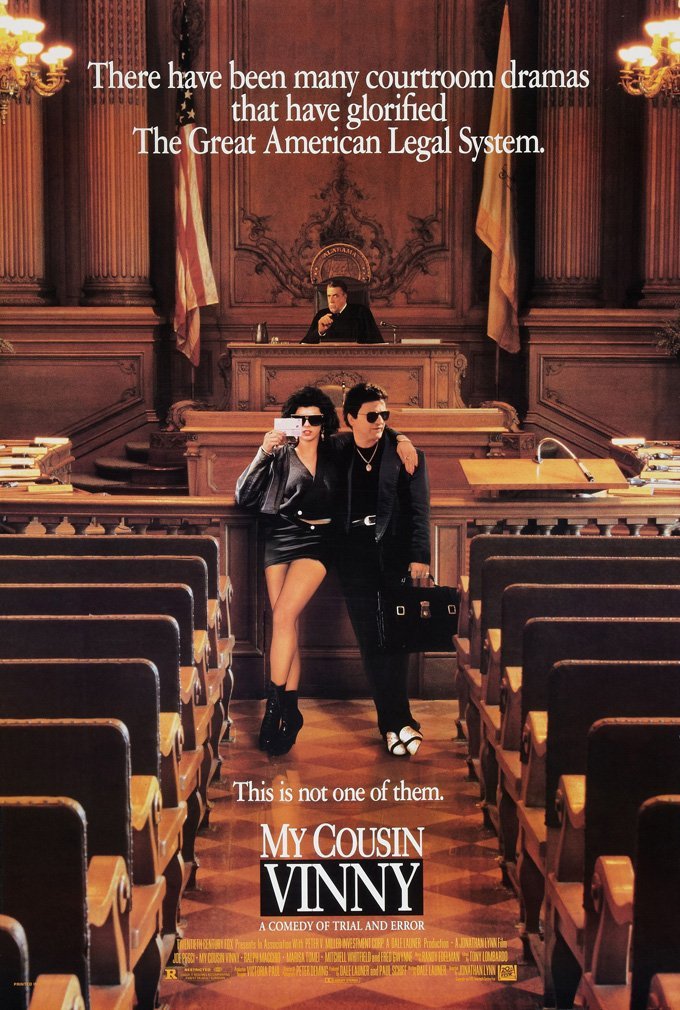
My Cousin Vinny (1992) - IMDb
  1. My Cousin Vinny (1992)

Run-time: 119 min

Subjects: Criminal Procedure; Evidence; Lawyering: Advocacy

For a light-hearted take on legal proceedings, this movie is a must-watch. It follows the misadventures of a novice lawyer, Vinny Gambini, as he tries to defend his cousin against murder charges. While the film humorously portrays courtroom antics, lawyers have commended My Cousin Vinny for its accurate depiction of trial strategy and criminal procedure. 

The Paper Chase (film) - Wikipedia

  1. The Paper Chase (1973)

Run-time: 111 min

Subjects: Contracts, General 1L Curriculum

Though the movie is now over fifty years old, The Paper Chase portrayal of law school life is ever relevant and painfully realistic. You cannot help but root for the main character, Hart, as he tries to find his way through his first year at Harvard Law.

  1. 12 Angry Men (1957)

Run-time: 96 min

Subjects: Criminal Law; Lawyering: Advocacy; Evidence

12 Angry Men (1957) - IMDb

12 Angry Men is a riveting courtroom drama that focuses on the dynamics of a jury room. The film follows twelve jurors as they deliberate the guilt or innocence of a young man accused of murder. It provides valuable insights into the art of persuasion, reasonable doubt, and the importance of careful deliberation—essential skills for any law student.

I hope this list provides you with a good head-start as you begin your legal movie journey. Keep an eye out for the next installment in this series (Movies that Every Law Student Should Watch).

We would to hear from you. What is your favorite legal movie?

Dear My 1L Self: Be Kind to Yourself

By Ralaya Evans, 3L

Congratulations! You are nearing the finish line and starting your 3L year. Knowing what I know now, there are a few things I wish I could have told you back when you were a 1L.

First, just as choosing to start anything, making the choice to start law school is a big decision and can bring about numerous uncertainties and challenges. One thing you should know is that you were brave to start this journey. You are now a 3L, and can honestly say that the legal language and community are different from anything you have ever experienced. By now, you have talked with many attorneys and several have stated that if they were given the chance to go back and choose law school again, they are not sure they would do it. So, I want you to know that this was a courageous choice. You graduate in less than a year and can now see the light at the end of the tunnel!

Second, do not ever be afraid or hesitant to reach out to professors for guidance. They are all so willing to lend a hand and give you some encouraging words. Every single professor you have had has been a mentor in some sense and are so genuinely in your corner. As you venture into classes of your choice, you will meet one professor in particular: Anjali Deshmukh. She is wise, honest, supportive, and never too busy to listen. She is a mentor that you will admire and appreciate forever.

Professor Anjali Deshmukh

Third, try to remain positive. When it is time for your exams, approach them with a positive mindset and do not speak negative words to yourself. For example, do not tell yourself “I am not prepared,” or “I should have studied more.” This will only put you in a more anxious mindset for the exam and could set you up for failure. It is normal to be “stressed,” but do not let it overtake you. You are prepared…..and even if not….it is too late to worry about that once the exam starts.

Fourth, speaking of exams……your best preparation will be completing practice exams. This applies to all exams you will take during law school (including the MPRE). Practice exams will ease most anxiety you have around taking the exams. They will also help be able to have an idea of how many questions you are able to complete in the normal exam period (3-4 hours). This is the best way to get quicker at issue spotting and completing exams in the usual timeframe provided. I promise you will be happy that you did this – three/four hours go by quicker than you would think when you are taking an exam.

All in all, take this advice but also know that you did not do bad at all. You made it this far. You have a community behind you: your family, friends, classmates, and professors. You just have to remember to be kind to yourself, do not worry too much, and study in a smart way.

Busting Some Common Law School Myths

by Ralaya Evans, 3L

Not many incoming students know what to expect when they start law school, and only have common perceptions to cling on to. I believe that debunking a few myths can bring some clarity to 1Ls. So, what are some of the common myths about law school?

  • Law school is not a good place to look for long-life friends because it is so competitive. This is false for many individuals who choose this career path. There is a competitive aspect to law school, however, many students also want to build lasting relationships. Law school is where many individuals build a community and bond with others from similar or different walks of life. Further, law school can bring several different stressors and exhaustion that only other law students will understand. The fact that the individuals around you can relate to your experience, alone, often brings a sense of comfort and belonging.  On a more positive note, law school is also where you begin to start networking and building relationships for post-graduation.
  • It is nearly impossible to maintain a social life during law school. In all honesty, law school is time-consuming. However, many students, professors, and lawyers would note maintaining a social life as one of the most important things to do during your law journey.  With a little organization and preplanning, it can become easy to maintain a social life. An easy way to work social time in is to make a schedule carving out time blocks for studying/reading and free time(etc). You can spend the free time however you choose, but it is good to plan a stopping point for work. Use this time to step away from school work and do something that makes you happy.
  • Being a person who is good at debating, automatically means that you will excel in law school. Legal disputes and arguments are art and require many skills. Being good at making a logical point, does not translate to being a great lawyer. There are several other qualities that make someone a good attorney (good listener, great researcher, detail-oriented, etc). Further, law school is more than arguments, oral or written. There are different forms of law that require a lawyer to be good at different things.
  • The smartest students are those with the best grades. If you have made it to law school, it is basically understood that you are smart and competent. There will be students who appear smarter than everyone else. However, there is a difference between being smart and knowing what to look for/pay attention to. Being smart does not equate to having the patience to (1) study or learn how to take exams and (2) learning your best study techniques. Law school is also about self-awareness. What will help with success in law school is the combination of all these things.

Law school is a learning curve for all. But, the perception of law school is often scarier than the reality.

Law School and Life Lessons

by Ralaya Evans, 3L

In starting my 3L year, I began asking myself how I would describe my growth, what I have learned and my law school journey thus far. I can honestly say that these past two years have taught me so much. I have matured in many ways that I believed myself to already be mature.

So, what have I learned so far?

Confidence. Law school taught me how to be more sure of myself. Even when I was not completely certain that I would be great in an interview, present in class, take an exam or more, I learned that second-guessing myself only encouraged a negative perspective. Building confidence in myself and knowing where I needed to improve were the keys to my success. There were times I would have to fake it. However, once I became aware of where I was lacking and what subjects were not my strong suit, I was able to plan a course of attack to get better at those things. Further, knowing where you may be falling short allows you not to be insecure in those things; you just view them as a chance for growth. It is best to own that you need the help and then do something about it.

Stress Management. Law school really taught me how to deal with stress, pressure, and difficult times. When I started law school, I had been out of school and in the workforce for about 3 years. I do believe that working before going to school prepared me for law school in numerous ways. However, law school taught me the most about stress and time management. I have continued to work throughout law school, as I have bills that need to be paid (of course). So, working, transitioning back into the mode of school, and going from having no responsibilities after work to having to complete assignments after was very stressful. However, I learned that even when I feel that I do not have any free time, I always do. I always have a few minutes to spare that I can take to myself and call my mom, grab dinner with my brother/friends, watch a show, etc. The goal is always to do something that I enjoy and will take my mind off of all of my responsibilities for a second. We are not all robots and “me” time is a must to prevent burnout.

Understanding, Patience, and Letting Go of the Need to Know. Law school can test your patience like no other. Everything seems to take forever. For example, we take exams and often have to wait several weeks until we know out grades. This was one of the hardest things about my 1L year: not knowing quick enough. So, I learned the art of waiting. Yes, I still want to know my grades immediately, but I also know I will not receive them quickly. That is just how law school works. Therefore, I take the exam and remind myself once I turn it in, nothing else is within my control. This ties back into the confidence aspect mentioned earlier. I know that I put the work in for the exams and that I did just fine. So, that helps me to wait comfortably and enjoy my Winter Break after fall semester or the beginning of summer after the spring semester.

To Have Realistic Expectations and to be Real With Myself. Before law school, I always made straight A’s. I have always cared so much about my grades and have always wanted to do exceptionally well at everything. However, school never required much effort on my part.  In law school, everyone is smart. Law school takes the top students of many schools and brings them together. Although your school will tell you school is not a competition, many things are viewed as a competition. Everyone wants to CALI. Everyone wants to be in the top percent. Everyone wants to be a member of groups, and maybe even President. It is not hard being surrounded by this; it is just very different from what we are most used to. I am now in an environment where everyone cares. It is a good thing but can cause disappointment at times. I have learned that not doing AMAZING on something does not mean failure. I have also learned that having to spend a little extra time on something to learn it doesn’t mean anything negative. I appreciate this lesson because it helped me learned that the only way to really prepare for challenges and spare myself unnecessary disappointed is to always be realistic with my expectations.

Since it is only September of 3L year, I know that I will learn more. And I welcome all of the lessons that law school will teach me.

How I Prepared for My Summer Firm Job

by Ralaya Evans, 3L

As I started my 1L year, I remember the one aspect of law school that caused me the most anxiety was obtaining and working a summer job with a firm. I was unsure of myself and if I would be prepared to do the work. I thought that I had to be perfect. However, this ended up being one of my favorite parts of law school. It reinforced my desire to be an attorney and I learned so much each summer.

Obtaining a summer job is a process within itself. However, once you lock in a job, the preparation to be an asset starts. In preparation for the summer jobs, I found it important to research the firm and the type of work they do. The majority of firms have a website that details the type of law practiced there, the attorneys, and more. This was always my starting point.

Next, after researching, I would look at courses that align with their work. For example, if you are working at a Corporate firm, or planning to work at a Corporate firm, it would be a good idea to take Corporations. This way you are aware of the language, you have a foundation for the work, and everything you see and work on that summer is not completely new/foreign to you. Choosing to take courses that coincide with your chosen summer job is much more advice for 2Ls, as law students get to start choosing electives in the second year of law school.

Further, externships helped me prepare for my summer jobs. This is so helpful to those who are not sure what they want to practice yet. If you are stuck between a couple of practices, choose one and focus your externship on that. This will help you get some real practice in, work in the field and give you a better idea of what works for you and what does not work for you. In all honesty, this is also helpful to those who are certain about what they want to practice. Choosing an externship that aligns with your desired practice will either reinforce your choice of practice or let you know that you are open to other practices.

One of the biggest aspects of my preparation process that helped me get over the anxiety of summering was talking to professors and my mentor. Professors/Mentors have already gone through this process before and know what to expect. They also offer wise words and advice. In the end, you learn that summering is not something to be too anxious about. The firms know that you are still learning, and they are guiding and helping you learn while you work for them. Mistakes are expected and there will always be a learning curve. This is a mutually beneficial relationship and both the firm and you are important pieces to the puzzle.

Lastly, to prepare for a summer job, it is important to take a break. Some summer jobs start the very next week after finals and some give you a couple weeks off. No matter the length of time between the end of finals and the first day of your summer job, take a mental break after finals and let yourself breathe for as long as possible.

Summering is such a surreal experience. It provides irreplaceable practice and builds your confidence. It is not the end all be all, and it is not required to be successful as an attorney. However, if you are interested in doing it, I would say go for it!